CPT Code 51705: Change of cystostomy tube, simple
CPT Code 51705 at a glance CPT Code 51705 reports a simple change of a cystostom...

Last Updated: Oct 16, 2026
E0141 is the HCPCS Level II code for walker, rigid, wheeled, adjustable or fixed height. It covers a standard-capacity rolling walker with two, three or four wheels and a frame that doesn't fold.
E0141 sits between E0130, the rigid pickup walker, and E0143, the folding wheeled walker. Medicare covers it when the patient meets the three mobility criteria in the Walkers LCD, L33791.
Let Pabau's smart automation suggest the right codes, reduce claim denials, and keep your practice compliant—effortlessly.
Automate repetitive tasks and focus on what matters most—your patients.
Reduce coding errors and ensure compliance with the latest regulations.
Clean claims, fewer denials, and faster reimbursements.
Powerful insights and reporting to help your practice thrive.
HIPAA compliant SOC 2 certified GDPR-compliant Trusted by 4,000+ clinics worldwide

HCPCS Code E0141 covers a rigid wheeled walker, fixed or adjustable height, at standard weight capacity.
A folding wheeled walker is E0143, and a heavy duty wheeled walker labeled for patients over 300 lb is E0149.
Medicare Part B covers E0141 when the patient meets the three mobility criteria in the Walkers LCD, L33791.
E0141 takes no KX modifier, because the walker policy reserves KX for heavy duty walkers and E0150.
Pabau’s claims tools scrub each E0141 claim for missing details and track it from submission to payment.
HCPCS Code E0141 is the Level II durable medical equipment (DME) code for a walker, rigid, wheeled, adjustable or fixed height. Billing teams use it for a standard-capacity rolling walker with two, three or four wheels and a frame that doesn’t fold.
According to the Centers for Medicare & Medicaid Services (CMS), HCPCS Level II codes are maintained and updated quarterly to reflect coverage policy changes. E0141 sits in the walker series that runs from E0130 to E0149, alongside the pickup, folding and heavy duty codes.
The official descriptor for E0141 is “Walker, rigid, wheeled, adjustable or fixed height.” Before choosing it over a neighboring code, the supplier confirms these physical traits:
Rollators trip coders up most often. A rollator usually has four wheels, a seat and hand brakes, and its frame usually folds. A folding frame already rules out E0141, so check the frame before you pick a code.
The descriptor draws the line between E0141 and its neighbors, so the exclusions follow directly from it.
Medicare Part B covers E0141 under the DME benefit when the patient meets all three criteria in the Walkers LCD, L33791. Missing any one of them is enough for the claim to be denied.
The LCD also requires a standard written order (SWO) to reach the supplier before the claim is submitted. Proof of delivery has to be available when the contractor asks for it. E0141 isn’t on CMS’s list of items that need a face-to-face encounter and a written order before delivery. CMS updates that list, so check it periodically.
Claims go to the DME MAC that covers the beneficiary’s address. Only two contractors hold DME MAC jurisdictions today: Noridian (Jurisdictions A and D) and CGS (Jurisdictions B and C). Both apply the same Walkers LCD and policy article.
Every E0141 claim carries at least one ICD-10-CM diagnosis code, but the Walkers policy article publishes no list of covered diagnoses. Coverage turns on the three functional criteria above. The diagnosis has to explain why the patient can’t walk safely without support, and the codes below are common examples rather than a payer list.
ICD-10-CM codes change every October 1. The FY2026 update made G35 a header code, so multiple sclerosis now needs a subtype such as G35.A. A yearly medical billing compliance review should recheck the diagnosis codes your team uses most.
A claim that passes the DME MAC’s automated edits can still be recouped on post-payment review. That happens when the medical record doesn’t support it, so build these five elements into every E0141 file:
A clean claim submission checklist for E0141 covers all five before the walker leaves the supplier. It’s the cheapest protection against a post-payment audit.
Run a pre-delivery documentation check on every E0141 order. Confirm the standard written order is on file and the notes describe the MRADL limitation. Then have the proof-of-delivery paperwork ready for the patient to sign at handoff. A delivery signature is far harder to obtain once the walker is already in the patient’s home.
Medicare prior authorization (PA) applies only to the DMEPOS codes on CMS’s Required Prior Authorization List, which changes periodically. Check the current list and your DME MAC’s guidance before you dispense E0141.
Walker HCPCS codes cover a narrow range of devices, and three physical traits separate them. The table gives each code’s descriptor, and the diagram below puts the questions in the order a coder asks them.
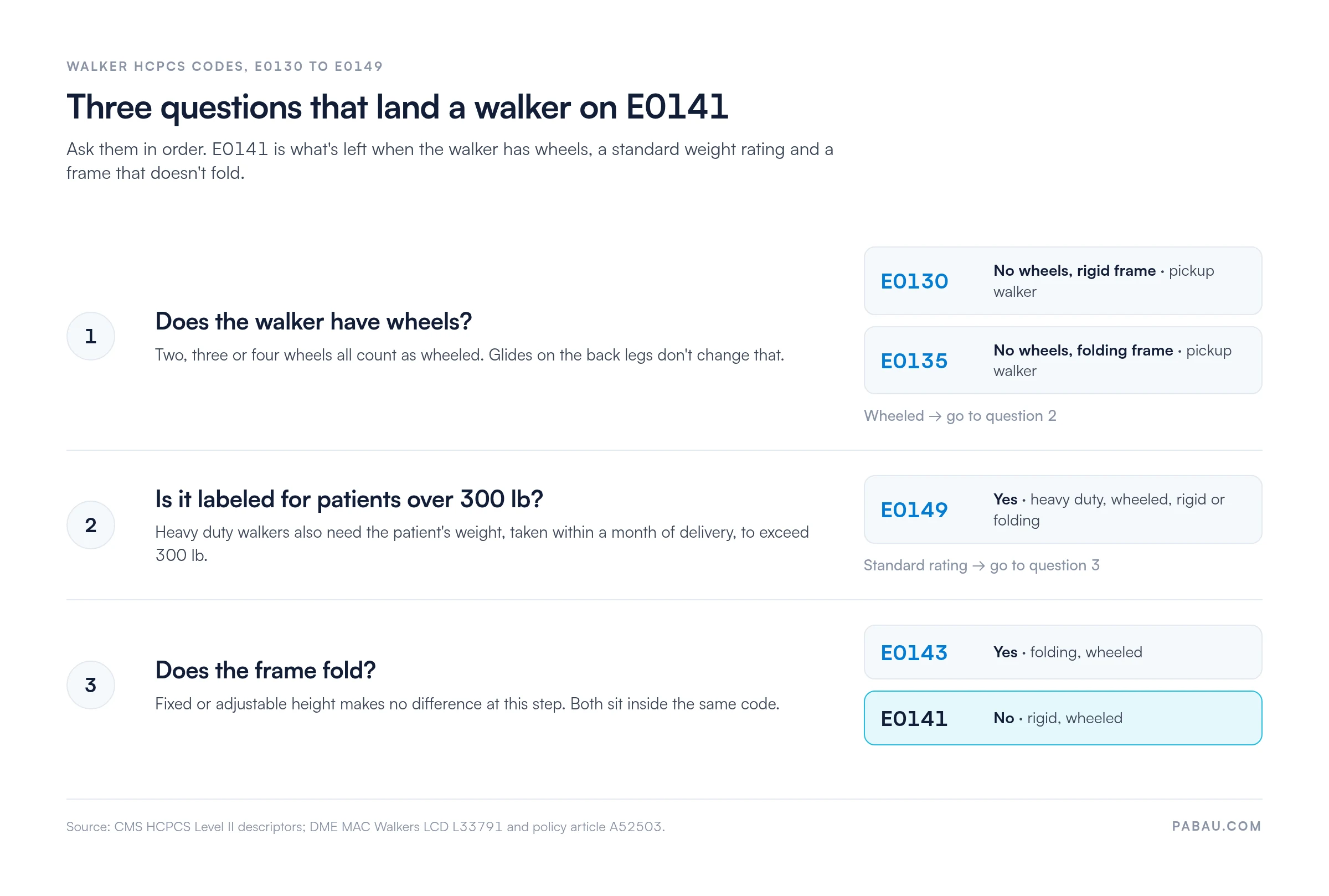
Once a walker has wheels, the weight label decides between E0149 and the standard codes. After that, the frame decides. A frame that folds is E0143, and a rigid frame is E0141.
E0141 doesn’t take the KX modifier. The Walkers policy article reserves KX for heavy duty walkers (E0148, E0149) and, from October 1, 2026, for the walker and transport chair combination, E0150.
Most E0141 claims need only NU, UE or RR, matched to how the walker reaches the patient. Add GA or GZ only when you expect Medicare to deny the walker as not medically necessary.
E0141 denials follow the same few patterns in both DME MAC jurisdictions. Each one has a clear fix once you know the cause.
Proactive denial management in healthcare catches these patterns at the billing stage. Suppliers who audit a sample of E0141 claims each month correct repeat errors before they become audit targets.
Each denial comes back with an adjustment reason code that names the problem. A reference of common denial codes helps your team read the remittance and pick the right fix.
Medicare’s DMEPOS fee schedule sets E0141 allowables by state, and CMS updates them each year. A single dollar figure here would be wrong for most readers, so look up your own rate.
For current rates, open the CMS DMEPOS fee schedule and find E0141 for your state. The file lists the purchase allowable and the monthly rental allowable. Medicare typically pays 80% of the lesser of the billed amount or the fee schedule allowable. The beneficiary owes the remaining 20% coinsurance after the Part B deductible.
E0141 is inexpensive or routinely purchased (IRP) DME, not capped rental equipment. Medicare pays either a one-time purchase or a month-to-month rental. There’s no 36-month cap and no forced transfer of ownership after a set rental period.
Medicaid and commercial insurers use HCPCS Code E0141 but apply their own coverage rules. Don’t assume a claim that meets Medicare’s LCD will satisfy a Medicaid or commercial plan.
Run insurance eligibility verification for DME benefits before you dispense the device. If the plan excludes wheeled walkers, or PA was required and never obtained, the supplier may not get paid at all.
For non-Medicare payers, call to verify DME benefits before every E0141 order. Confirm whether the plan covers wheeled walkers under HCPCS E0141, whether prior authorization is required, and what documentation the payer needs. Document the verification call: payer name, representative name, reference number, and confirmed coverage details.
Most billing teams track walker orders, delivery slips and claim status in separate places. A spreadsheet holds the order, the payer portal holds the claim, and the delivery receipt sits in a shared drive.
Pabau, the practice management platform we build, keeps those records on the patient file and runs cleaner claims management from there. It scrubs every claim for missing or invalid details before submission, and it checks insurance eligibility through Claim.MD in the US. Prior authorization codes are stored against the patient, too.
Once the claim is out, the claims dashboard tracks it from Pending to Paid, and ERA files reconcile the payment to the invoice. Your team spends less time chasing returned walker claims and more time on patients.


Pabau scrubs each claim for missing details, verifies insurance eligibility and tracks every E0141 claim from submission to payment.

E0141 is one of the easier HCPCS codes to get right, because the descriptor does most of the work. Wheels, a standard weight rating and a rigid frame point to E0141. A frame that folds points to E0143.
The claims that fail usually fail on paperwork. Notes that skip the MRADL limitation, a missing written order or an unsigned delivery slip will each cost you the payment.
Check the frame and the file before the walker ships, and most appeals never happen. Book a demo to see how Pabau tracks each walker claim from order to payment.

Adding a seat to a walker? HCPCS Code E0156 explains how a walker seat attachment is billed on its own line.
Need the pickup walker code instead? HCPCS Code E0130 covers the rigid walker with no wheels.
Want to understand how DME billing fits into the revenue cycle? What is revenue cycle management explains the end-to-end process from patient encounter to collected payment.
HCPCS Code E0141 covers a rigid wheeled walker, fixed or adjustable height, with two, three or four wheels at standard weight capacity. Folding wheeled walkers bill as E0143, and heavy duty wheeled walkers bill as E0149. Medicare Part B, Medicaid and most commercial plans recognize the code.
Yes. Medicare Part B covers E0141 when the patient meets the three criteria in the Walkers LCD, L33791. The patient has a mobility limitation that impairs daily activities at home, can use the walker safely, and the walker resolves the deficit. The supplier also needs a standard written order before submitting the claim.
The frame. E0141 is a rigid wheeled walker, while E0143 is a wheeled walker with a folding frame. Both are standard-capacity codes with two, three or four wheels, at fixed or adjustable height.
Medicare prior authorization applies only to the DMEPOS codes on CMS’s Required Prior Authorization List, which changes periodically. Check the current list and your DME MAC’s guidance before dispensing. Medicaid and commercial plans set their own prior authorization rules.
The Walkers policy article publishes no covered diagnosis list, so coverage rests on the functional criteria in LCD L33791. Common supporting codes include gait disorder codes (R26.0, R26.1, R26.89), multiple sclerosis (G35.A to G35.D), Parkinson’s disease (G20.A1 to G20.C), and knee or hip osteoarthritis.
The leading reason is notes that don’t document the mobility criteria. Close behind are a folding or heavy duty walker billed as E0141, a missing standard written order, and absent proof of delivery. Each one is preventable with a pre-submission documentation checklist.