

CCSD code G5100: Bypass of duodenum billing guide
CCSD code G5100 bills a bypass that leaves the duodenum in place CCSD code G5100...

Last Updated: Oct 16, 2026
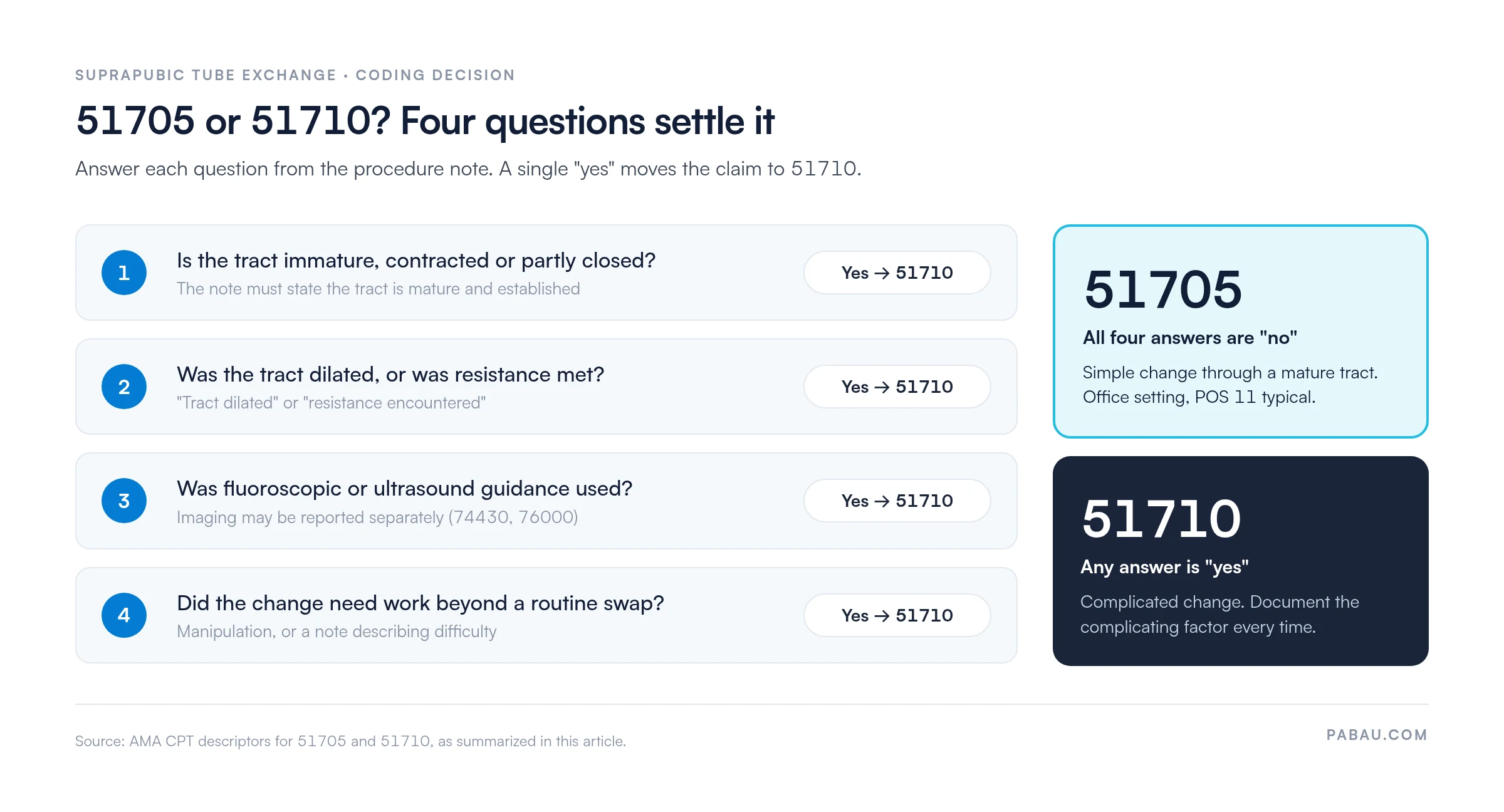
51705 is the CPT code for change of cystostomy tube; simple. It reports removing a suprapubic catheter and inserting a new one through a mature, established tract, with no dilation, imaging guidance or extra procedural work.
The code sits in the bladder introduction procedures of the CPT surgery section. Assignment turns on tract maturity, because an immature tract, dilation or imaging moves the claim to 51710.
Let Pabau's smart automation suggest the right codes, reduce claim denials, and keep your practice compliant—effortlessly.
Automate repetitive tasks and focus on what matters most—your patients.
Reduce coding errors and ensure compliance with the latest regulations.
Clean claims, fewer denials, and faster reimbursements.
Powerful insights and reporting to help your practice thrive.
HIPAA compliant SOC 2 certified GDPR-compliant Trusted by 4,000+ clinics worldwide

CPT Code 51705 reports a simple change of a cystostomy tube through a mature, established suprapubic tract.
Bill 51710 instead when the tract is immature, needs dilation or imaging guidance, or the change takes work beyond a routine exchange.
The note must confirm tract maturity and record the tube type, size and indication, because auditors look for those details first.
Pair a routine exchange with Z46.6, and match the T83.098 7th character to the encounter when a complication drives the change.
Claims software such as Pabau checks each 51705 claim for missing details before submission and tracks it through to payment.
CPT Code 51705 reports a simple change of a cystostomy tube. The provider removes a suprapubic catheter and inserts a new one through a mature, established tract, with no dilation or imaging. The table below sets out the billing facts for the code, which the American Medical Association (AMA) maintains.
A cystostomy tube, also called a suprapubic catheter or suprapubic tube (SPC), drains urine from the bladder through the abdominal wall. CPT Code 51705 applies when a practitioner removes the existing tube and inserts a replacement through a fully mature tract.
“Simple” in the descriptor means the tract is well established. The change needs no dilation, meets no resistance, uses no imaging guidance and involves no new surgical work.
The procedure is common in urology practices and home health settings. Patients with neurogenic bladder or bladder outlet obstruction often need scheduled suprapubic tube changes every four to 12 weeks. So do patients who tolerate an indwelling urethral catheter poorly.
Each routine exchange is a candidate for 51705, provided the tract has been in place long enough to be fully epithelialized.
The simple-versus-complicated call is the main coding decision for this procedure, and a wrong call creates audit risk in both directions. Billing 51705 when 51710 applies undercodes the work. Billing 51710 for routine exchanges inflates payment and draws upcoding scrutiny.
The decision rule is short. If the practitioner removes the old tube and inserts the new one with no additional work, 51705 is correct. Dilation, manipulation, imaging or a note describing difficulty all support 51710 instead. The four questions below put that rule in the order a coder reads the note.
CPT 51705 sits in the 517xx bladder introduction series, next to several codes that coders often confuse with it. Knowing where each code starts and stops, along with medical billing fundamentals, prevents the most common same-day bundling errors.
51702 and 51705 on the same date: The National Correct Coding Initiative (NCCI) generally treats this pair as mutually exclusive at the same encounter. 51702 covers a urethral catheter insertion, while 51705 covers a suprapubic tube change. These are two anatomically distinct routes, and routine practice rarely calls for both at one visit.
Check the current NCCI edit table on CMS.gov before billing 51702 and 51705 on the same date. NCCI edits are updated quarterly, and a modifier that permitted separate billing in a prior quarter may no longer apply. Document distinct clinical indications for each procedure clearly in the record.
Missing documentation is the most common audit finding for CPT Code 51705. Payers deny the claim when the record does not confirm the conditions that justify the code. Good medical billing software flags missing fields before submission, and consistent charting habits stop the problem at the source.
For practices billing regularly, a superbill template that prompts for each of these fields keeps charts complete without adding charting time. Ask for free-text confirmation of tract maturity rather than a checkbox. Auditors are skeptical of checkbox-only documentation for code-level distinctions.
Diagnosis code selection decides whether the claim clears medical necessity review. Each ICD-10-CM code below is a common pairing, but the code you choose must match the condition documented in the chart. A code that doesn’t match the chart is a compliance issue.
Z46.6 is the standard pairing for routine exchanges. T83.098A (initial encounter) applies when a mechanical catheter complication is the reason for the change.
T83.098D (subsequent encounter) applies to follow-up visits for the same complication. Match the 7th character to the encounter type, because auditors flag “A” on every visit.
Medicare reimbursement for CPT Code 51705 varies by locality and by facility or non-facility setting. The national figures below use 2026 Medicare Physician Fee Schedule RVUs and the $33.40 conversion factor.
Confirm locality-adjusted amounts in the CMS MPFS online lookup tool before quoting patients or setting fee schedules. Private payer contracts typically pay a percentage of the Medicare allowable.
Place of service matters. Billing POS 11 (office) for a procedure performed in a hospital outpatient department (POS 22) is one of the most common 51705 billing errors. The non-facility rate is more than double the facility rate, because the fee schedule assumes the practice pays the overhead in its own office.
When the service happens in a hospital, the hospital bills its facility fee separately, so CMS reduces the physician’s payment. Billing POS 11 in that scenario misrepresents the service to the payer.
To benchmark your fee schedule against Medicare, the FastRVU 2026 RVU lookup breaks out the work, practice expense and malpractice components for 51705.
Two billing issues cause most preventable 51705 denials: modifier 25 misuse on a same-day evaluation and management (E/M) service, and thin documentation. Building billing compliance requirements into your workflow catches both before submission. That takes far less time than working denials afterward.
Modifier 25 goes on an E/M code billed on the same day as 51705 only when the E/M is a significant, separately identifiable service. That means a new complaint, a condition unrelated to the tube change, or an assessment that goes well beyond the decision to perform the exchange.
Most of these denials never happen when the claim goes out clean. Clean claim submission means verifying eligibility, confirming POS before the patient arrives and finishing documentation at the point of care.
Practices that lean on denial management workflows after the fact spend far more staff time than those that fix the problem upstream.
Payers explain each 51705 denial with a claim adjustment reason code (CARC). The medical billing denial codes reference lists what each one means and how to respond.
A tube-change claim usually passes through three hands: the clinician’s note, a coder’s code choice and a clearinghouse portal. Each handoff is a chance for a wrong POS, a missing tract-maturity line or an unmatched diagnosis to slip through.
Pabau, the practice management platform we build, keeps those steps in one place. Its claim validation scrubs each claim for missing or invalid details before it leaves Pabau. In the US, eligibility checks run through Claim.MD before the visit, so coverage problems surface while the appointment is still on the calendar.
After submission, each claim’s status is tracked from Pending to Paid, and insurer payments reconcile against the invoice. A rejected claim is flagged with a link to the field that needs fixing, so your team knows exactly what to correct before resubmitting.

Pabau scrubs each 51705 claim before submission, checks eligibility ahead of the visit and tracks every claim to payment. See how urology practices cut claim rework with it.

CPT Code 51705 rewards precise charting more than coding skill. If the note says the tract is mature and the tube changed without difficulty, the code is settled.
The trade-off sits at the 51710 boundary. Billing 51710 for every exchange invites an upcoding review, while defaulting to 51705 gives away payment on complicated changes. Write the tract status into every note, and let the note decide the code.
Want 51705 claims scrubbed and tracked without a second system? Book a demo to see how Pabau handles claims for urology and primary care practices.

Want to stop coverage denials before the visit? Insurance eligibility verification sets out the checks to run before a scheduled tube change.
Want to understand how electronic remittance works after submission? Electronic remittance advice explains how 835 ERA files confirm payment and flag adjustment reasons.
Looking to reduce the administrative burden of revenue cycle management? Revenue cycle management fundamentals covers the end-to-end process from eligibility to payment posting.
Checking bladder emptying in the same patient population? CPT Code 51798 covers billing for post-voiding residual urine measurement by ultrasound.
CPT Code 51705 reports a simple change of a cystostomy tube. The provider removes a suprapubic catheter and inserts a new one through a mature, established tract. No dilation, imaging guidance or extra surgical work is involved. Urology and primary care offices use it most for routine scheduled exchanges.
CPT 51705 covers a simple tube change through a mature tract with no complications. CPT 51710 applies when the tract is immature or contracted, needs dilation, meets significant resistance or needs imaging guidance. Use 51710 whenever the procedure goes beyond a routine exchange, and document the complicating factor in the record.
Yes. A suprapubic catheter, also called a suprapubic tube or SPC, is the same device as a cystostomy tube. It drains the bladder through a surgically created opening in the abdominal wall called a cystostomy. The terms are interchangeable in billing and clinical documentation, and CPT 51705 covers exchanges of either.
Yes, but only when the same-day E/M is a significant, separately identifiable service, such as evaluating a new complaint unrelated to the tube change. An assessment of the tube before changing it is bundled into 51705. Per AUA coding guidance, billing that check as an E/M with modifier 25 is a leading audit trigger for this procedure.
For a routine scheduled exchange with no acute complication, Z46.6 (encounter for fitting and adjustment of urinary device) is the standard pairing. Use T83.098A for an initial encounter prompted by a mechanical catheter complication. Use N31.9 for neurogenic bladder patients on chronic suprapubic drainage, or N39.0 when a catheter-associated UTI drives the change. The diagnosis must match the documented reason for the visit.
The most common reasons are missing documentation of medical necessity or tract maturity, and NCCI conflicts when 51702 is billed on the same date. An incorrect place of service also triggers denials, such as POS 11 billed for a hospital outpatient service. So does a same-day E/M billed without modifier 25. Payer frequency limits can also deny routine exchanges that exceed the covered interval without a letter of medical necessity.



