CPT Code 88291: Cytogenetics consultation and report
CPT Code 88291: Definition and clinical description CPT Code 88291 is defined by...

Last Updated: Oct 16, 2026
V2110 is the HCPCS Level II code for spherocylinder, single vision, plus or minus 4.25 to 7.00d sphere, over 6.00d cylinder, per lens.
V2110 trips up more optometry billing staff than almost any other V-series code. Its closest neighbors, V2109 and V2111, describe lenses that look almost identical on a prescription. V2109 shares the same sphere band but caps the cylinder at 6.00 diopters, and V2111 begins where the V2110 sphere range ends. Read the cylinder wrong, bill a sphere-only lens as V2110, or submit without the right ICD-10 diagnosis pairing, and the claim comes back denied.
Let Pabau's smart automation suggest the right codes, reduce claim denials, and keep your practice compliant—effortlessly.
Automate repetitive tasks and focus on what matters most—your patients.
Reduce coding errors and ensure compliance with the latest regulations.
Clean claims, fewer denials, and faster reimbursements.
Powerful insights and reporting to help your practice thrive.
HIPAA compliant SOC 2 certified GDPR-compliant Trusted by 4,000+ clinics worldwide

HCPCS code V2110 covers a single vision spherocylinder lens: Sphere of plus or minus 4.25 to 7.00 diopters, cylinder over 6.00 diopters, per lens.
Medicare Part B covers V2110 only for post-cataract surgery patients with an intraocular lens (IOL) implant; routine vision correction is excluded.
Bill V2110 per lens using RT (right eye) and LT (left eye) modifiers; most payers require separate line items for each lens.
Pabau’s claims management software supports HCPCS code assignment, modifier tracking, and 837P claim submission to reduce V2110 denials.
HCPCS code V2110 is defined by CMS as: Spherocylinder, single vision, plus or minus 4.25 to 7.00d sphere, over 6.00d cylinder, per lens. That descriptor sets two conditions, and the lens has to meet both. The sphere power must fall between plus or minus 4.25 and plus or minus 7.00 diopters. The cylinder power must be greater than 6.00 diopters.
A lens with no cylinder component is a sphere-only lens and belongs in V2100, V2101, or V2102, not V2110. A lens in the same sphere band with 6.00 diopters of cylinder or less belongs in V2107, V2108, or V2109.
According to the CMS HCPCS Level II code system, V2110 is an active, billable code for fiscal year 2026 with no revisions pending.
V2110 applies exclusively to single-vision lenses that combine a sphere and a cylinder component. The sphere must sit between plus or minus 4.25 and 7.00 diopters, and the cylinder must exceed 6.00 diopters.
Single vision means one focal point only; bifocal, trifocal, lenticular, and progressive addition lenses are categorically excluded from this code. Both power conditions are checked against the dispensed prescription before the claim is built.
The V2100 series covers spectacle lenses, so a spectacle-mounted low vision aid falls outside it. Those aids are billed under V2610, a separate code for devices prescribed when standard lenses do not correct the vision loss.
The most expensive documentation mistake is reading the sphere power and ignoring the cylinder. A prescription of -5.00 DS with -3.00 DC sits inside the V2110 sphere band, but its cylinder is well under 6.00 diopters. That lens is V2109, not V2110.
V2110 is reserved for the uncommon lens that carries more than 6.00 diopters of cylinder within that same sphere range. A lens with that same high cylinder but a sphere of plano to plus or minus 4.00 diopters belongs on V2106 instead.
The selector below sets out which code each cylinder reading points to once the sphere is confirmed.
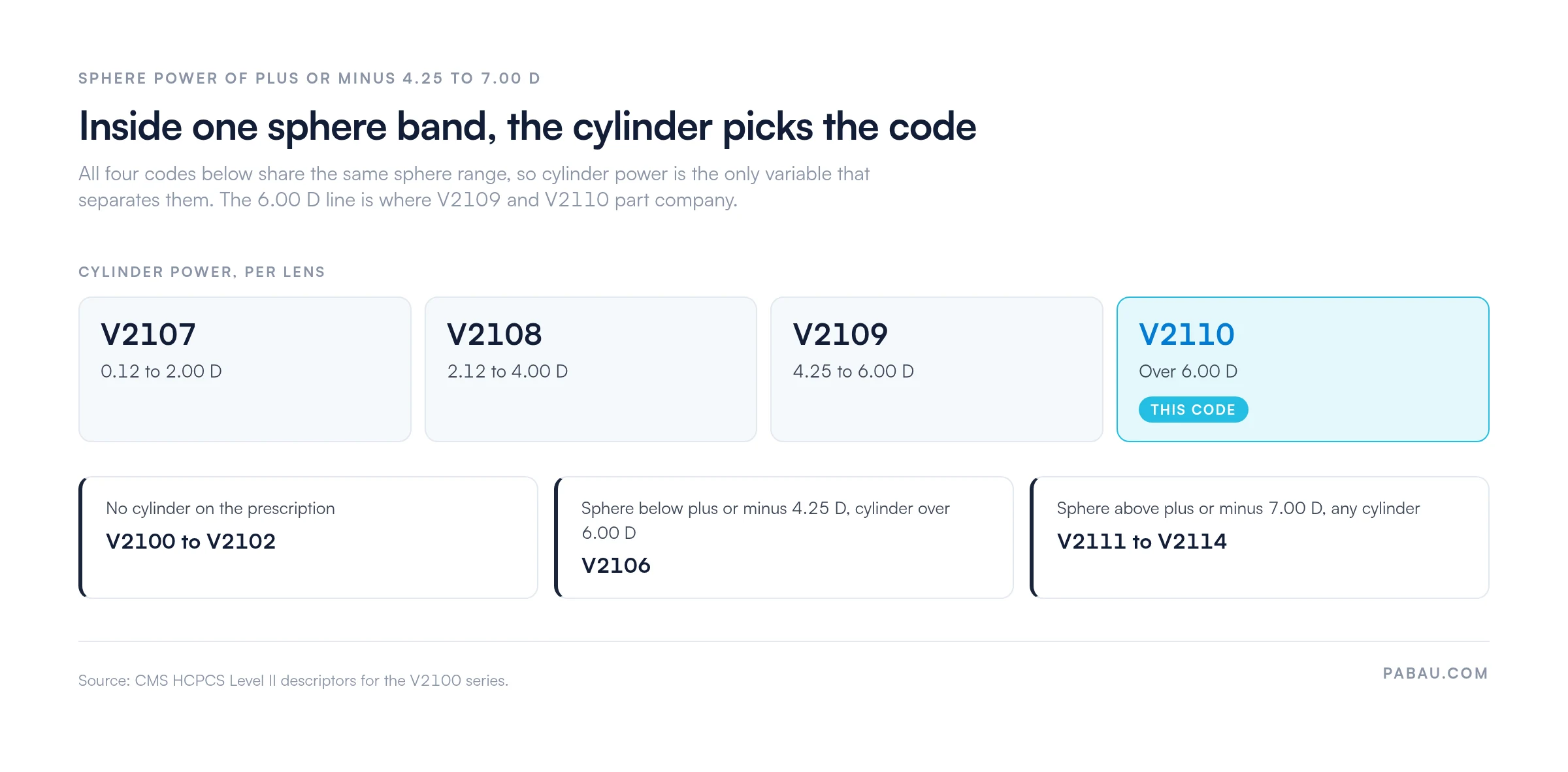
The V2100 through V2115 series covers single-vision spectacle lenses, sorted first by sphere power and then by cylinder power. Selecting the wrong code within this series is the single most common denial reason for V2110 claims. The table below shows the codes coders confuse with V2110 most often.
Two mix-ups account for the majority of V2110 coding errors. First, coders treat V2109 and V2110 as interchangeable, because the two codes share an identical sphere band. Only the cylinder separates them, at the 6.00-diopter line.
Second, coders reach for V2110 when the sphere is above plus or minus 7.00 diopters, which moves the claim into V2111 through V2113. Auditing the dispensed prescription rather than the refraction catches both errors before submission. The AAPC HCPCS code lookup provides descriptor comparisons across the V2100 series for rapid verification.
Medicare Part B covers V2110 under a narrow, specific indication: The beneficiary has undergone cataract surgery with insertion of an intraocular lens (IOL) implant. That is the primary and practically only covered indication under the Medicare Benefit Policy Manual.
Routine vision correction is not a Medicare Part B benefit. A patient presenting for standard glasses due to myopia or astigmatism does not generate a covered V2110 claim, regardless of the prescription power. Verify IOL status from surgical records before billing Medicare.
Practices managing post-cataract optical claims benefit from eligibility checks that confirm IOL status and Medicare enrollment before the order is placed. That check stops a claim reaching the payer without its supporting surgical context. The CMS Physician Fee Schedule lookup shows the current payment amount for V2110 under Medicare by locality.
Medicaid coverage for V2110 varies by state. Some states cover routine vision as an optional benefit and reimburse V2110 for any eligible beneficiary whose prescription meets the power criteria.
Others limit coverage to medically necessary optical supplies only, mirroring Medicare’s post-surgical restriction. Reimbursement rates differ substantially across state Medicaid programs and should be verified against the current state fee schedule before billing. Never assume the federal Medicare rate applies to Medicaid.
Commercial vision plans including VSP, EyeMed, and Spectera all use V2110 in their code sets, each with their own contracted allowances and prior authorization thresholds.
Prior authorization requirements are common among commercial payers when the lens sits at the high end of the power range. The practice’s revenue cycle process should include a payer-specific PA check for any V2110 claim before the lens is ordered. Key payer considerations:
A V2110 claim that reaches a payer without complete documentation is effectively pre-denied. The prescription must confirm that the dispensed lens meets the V2110 power ranges. The billing record must connect the dispensed item to the patient’s clinical need. Sound billing compliance means holding the documentation in the file before submission, rather than chasing it after a denial.
The diagnosis code paired with V2110 determines whether the claim is covered or rejected for medical necessity. The ICD-10-CM code library lists the diagnosis families that turn up on optical supply claims. Pairing V2110 with a diagnosis that does not support the lens supply is a compliance risk. Accurate diagnosis coding starts with the supporting clinical documentation, not code-book selection.
For Medicare claims, the aphakia codes (H27.00-H27.03) and Z96.1 are the diagnoses that establish post-cataract medical necessity. Using only H52.1x (myopia) on a Medicare claim for V2110 will result in a medical necessity denial.
That holds even if the lens was prescribed following cataract surgery, because the myopia code does not, by itself, signal the surgical context. Include both the condition code and the aphakia or IOL presence code where applicable. Practices looking to reduce diagnosis coding errors benefit from claims management software that flags incomplete diagnosis pairings before submission.

Check the dispensed lens order against the original prescription every time, not just the refraction. Prescriptions change between the exam and the order. Dispensing a lens at a power that no longer matches the written Rx creates a documentation mismatch that auditors flag on post-payment review.
Denials on V2110 claims cluster around four root causes: Wrong code selection, incomplete prescription documentation, payer enrollment problems, and billing unit errors. Each is preventable with a structured pre-submission checklist.
Catching them at the verification stage, before the claim leaves the practice, is what holds the denial rate down. The AAPC coding forums consistently highlight power-range misreads and unit-of-service errors as the most frequent V2110 denial triggers among optical billing staff.
Reviewing denied claims for the specific reason code (CARC) is the fastest way to identify which of these patterns is recurring in a given practice. Tracking those reason codes across a quarter shows whether denials concentrate in documentation, enrollment, or coding errors.
That tells the practice where to target the fix. The NLM HCPCS Level II API is useful for verifying current code descriptors programmatically before claim generation.
Accurate billing for V2110 follows a consistent sequence from prescription verification through claim submission. Skipping steps in this workflow is where errors accumulate.
Practices that build this into a standard operating procedure, rather than relying on individual coder memory, consistently see lower denial rates on optical claims. Each step below assumes the prescription, the diagnosis, and the supplier record are already in the patient file.
Always confirm modifier requirements with the specific payer. Medicare DME MACs may have regional guidance on KX attestation that differs from commercial payer requirements. Modifier omission on Medicare V2110 claims is a common clean-claim failure that delays payment without generating a meaningful denial explanation.
A clean-claim standard for optical billing makes modifier verification part of every pre-submission review. Pabau’s claims tools support modifier assignment and flag missing fields before the 837P is generated.
In most optical practices, the three pieces of a V2110 claim sit in three different places. The sphere and cylinder powers are in the exam record. The lens order is with the dispensing optician, and the code is picked from memory at billing. No system ties the three together, so a cylinder misread surfaces weeks later on a remittance advice.
Practice management software like Pabau keeps all three in one patient record. The prescription captured at the exam stays attached to the chart, and the dispensed lens order references it. The HCPCS code and the RT or LT modifier are then assigned against that same record. Nobody is coding from recall at the end of the day.
The result is fewer V2110 claims that fail on power ranges, modifiers, or missing diagnosis pairings. Billing staff catch the mismatch before the 837P file is generated. That is considerably cheaper than appealing a denial after payment has already been recouped.

Pabau’s practice management platform helps optometry and ophthalmology practices manage HCPCS code assignment, modifier tracking, diagnosis pairing, and electronic claim submission in one place. See how it works for your practice.

V2110 denials almost always trace back to one of three preventable errors. The first is choosing the wrong adjacent code because the cylinder was never checked against the 6.00-diopter line.
The second is submitting a Medicare claim without the aphakia or IOL diagnosis code. The third is billing two lenses as a single unit instead of separate RT and LT line items.
None of those errors require a system overhaul to fix. They require a consistent pre-submission checklist and documentation standards that are enforced at the point of dispensing, not discovered during post-payment audit.
Pabau’s claims management software supports the full HCPCS billing workflow, from code selection through 837P submission and remittance matching. Optical billing teams get a structured way to catch these errors before they become denials. To see how it fits your practice’s billing process, book a demo.

Want to understand how clean claims are built before submission? Clean claim best practices covers the pre-submission checks that prevent optical billing denials.
Need to track and resolve denied HCPCS claims efficiently? Denial management in healthcare explains how to categorize, appeal, and prevent recurring claim rejections.
Looking for guidance on superbill structure for optical visits? Superbill documentation guide walks through how to build a compliant superbill that supports V-series code billing.
HCPCS code V2110 covers a spherocylinder single vision lens: Sphere of plus or minus 4.25 to 7.00 diopters, cylinder over 6.00 diopters, per lens. It applies to single-focal-point lenses only; bifocal, trifocal, and progressive lenses are excluded and require separate V-series codes.
A spherocylinder single vision lens combines a sphere component (correcting myopia or hypermetropia) with a cylinder component (correcting astigmatism). Both corrections sit within a single focal point. Unlike bifocal or progressive lenses, there is only one optical power zone across the entire lens.
Yes, Medicare Part B covers V2110, but only for beneficiaries who have had cataract surgery with an intraocular lens (IOL) implant. Routine vision correction for myopia, hypermetropia, or astigmatism is not a covered Medicare Part B benefit. V2110 submitted for routine glasses will be denied for lack of medical necessity.
V2110 and V2111 differ on both powers. V2110 covers a sphere of plus or minus 4.25 to 7.00 diopters with cylinder over 6.00 diopters. V2111 covers a sphere of plus or minus 7.25 to 12.00 diopters with cylinder of 0.25 to 2.25 diopters. Both cover single vision lenses only.
Required documentation includes a signed, legible written prescription showing sphere and cylinder powers that meet the V2110 ranges. You also need the patient’s identifying information, the dispensing supplier’s NPI, a supporting ICD-10 diagnosis code, and proof of delivery. Medicare claims additionally require documentation of cataract surgery with an IOL implant to establish medical necessity.
V2110 is billed per lens. A patient receiving two lenses requires two claim lines. Use modifier RT for the right eye and modifier LT for the left eye, each at a quantity of one. Billing two lenses on a single line at quantity two is a unit-of-service error that typically results in a denial or overpayment recoupment.