CPT code 28825: Amputation, toe; interphalangeal joint
CPT code 28825: official descriptor and anatomical scope CPT code 28825 is descr...

Last Updated: Oct 6, 2026
V2104 is the HCPCS Level II code for spherocylinder, single vision, plano to plus or minus 4.00d sphere, 2.12 to 4.00d cylinder, per lens.
It is the second of four codes that share the low sphere band and step up by cylinder power. A lens with 2.00D of cylinder or less belongs on V2103, and one with 4.25 to 6.00D belongs on V2105. A sphere stronger than plus or minus 4.00D moves the lens to V2107 and above, so billers should check both powers on the prescription.
Let Pabau's smart automation suggest the right codes, reduce claim denials, and keep your practice compliant—effortlessly.
Automate repetitive tasks and focus on what matters most—your patients.
Reduce coding errors and ensure compliance with the latest regulations.
Clean claims, fewer denials, and faster reimbursements.
Powerful insights and reporting to help your practice thrive.
HIPAA compliant SOC 2 certified GDPR-compliant Trusted by 4,000+ clinics worldwide

V2104 covers a single-vision spherocylinder lens with sphere from plano to plus or minus 4.00D and cylinder from 2.12 to 4.00D, billed per lens.
Cylinder power picks the code inside that sphere band: up to 2.00D is V2103, 2.12 to 4.00D is V2104, and 4.25 to 6.00D is V2105.
Medicare Part B covers V2104 only for aphakia or for one pair after each cataract surgery with an IOL. Routine vision correction is excluded.
RT and LT modifiers are required on every V2104 claim line. A bilateral prescription needs two separate line items, each with the correct side modifier.
Pabau’s claims management software helps optical practices submit V2104 claims with accurate code selection, modifiers, and supporting ICD-10 diagnosis codes.
HCPCS code V2104 belongs to HCPCS Level II, maintained by the Centers for Medicare and Medicaid Services (CMS).
Its official descriptor reads: Spherocylinder, single vision, plano to plus or minus 4.00d sphere, 2.12 to 4.00d cylinder, per lens. Each element of that descriptor narrows the lens that qualifies. Breaking them down prevents the most common selection errors.
V2104 sits in the V2100 to V2199 range for single-vision lenses. V2100 to V2102 cover sphere-only lenses, and V2103 to V2114 cover spherocylinder lenses.
The spherocylinder codes are grouped by sphere band, then stepped up by cylinder power inside each band. V2104 is the second cylinder step in the lowest sphere band. You can look up the neighboring lens codes in our HCPCS code directory.
Pabau, the practice management platform we build, keeps the lens prescription next to the claim in its claims software for optometrists. Billing teams can check the cylinder value against the code before the claim reaches the payer.

V2104 covers a prescription spherocylinder spectacle lens for a patient whose sphere power sits between plano and plus or minus 4.00D. The cylinder must fall between 2.12 and 4.00D. The typical patient has low-to-moderate myopia or hyperopia combined with moderate astigmatism. A prescription such as -2.50 DS -3.00 DC × 180 is a textbook V2104 lens.
Several neighboring prescriptions look similar but belong on another code:
Cylinder power is the only difference between V2103, V2104 and V2105. All three share the same sphere band of plano to plus or minus 4.00D.
A prescription reading -2.00 DS -1.75 DC belongs to V2103, while -2.00 DS -2.25 DC belongs to V2104. A reading of -2.00 DS -4.50 DC belongs to V2105. The table below maps the neighboring spherocylinder codes so billers can cross-check both powers at a glance.
The most frequent confusion sits at the cylinder boundaries: 2.00D/2.12D between V2103 and V2104, and 4.00D/4.25D between V2104 and V2105. The second risk is the sphere boundary at 4.00D/4.25D, where V2104 hands over to V2108.
Read both powers directly from the written prescription, cylinder first, before selecting the code. The grid below plots both powers together, so each neighbor sits one step from V2104.
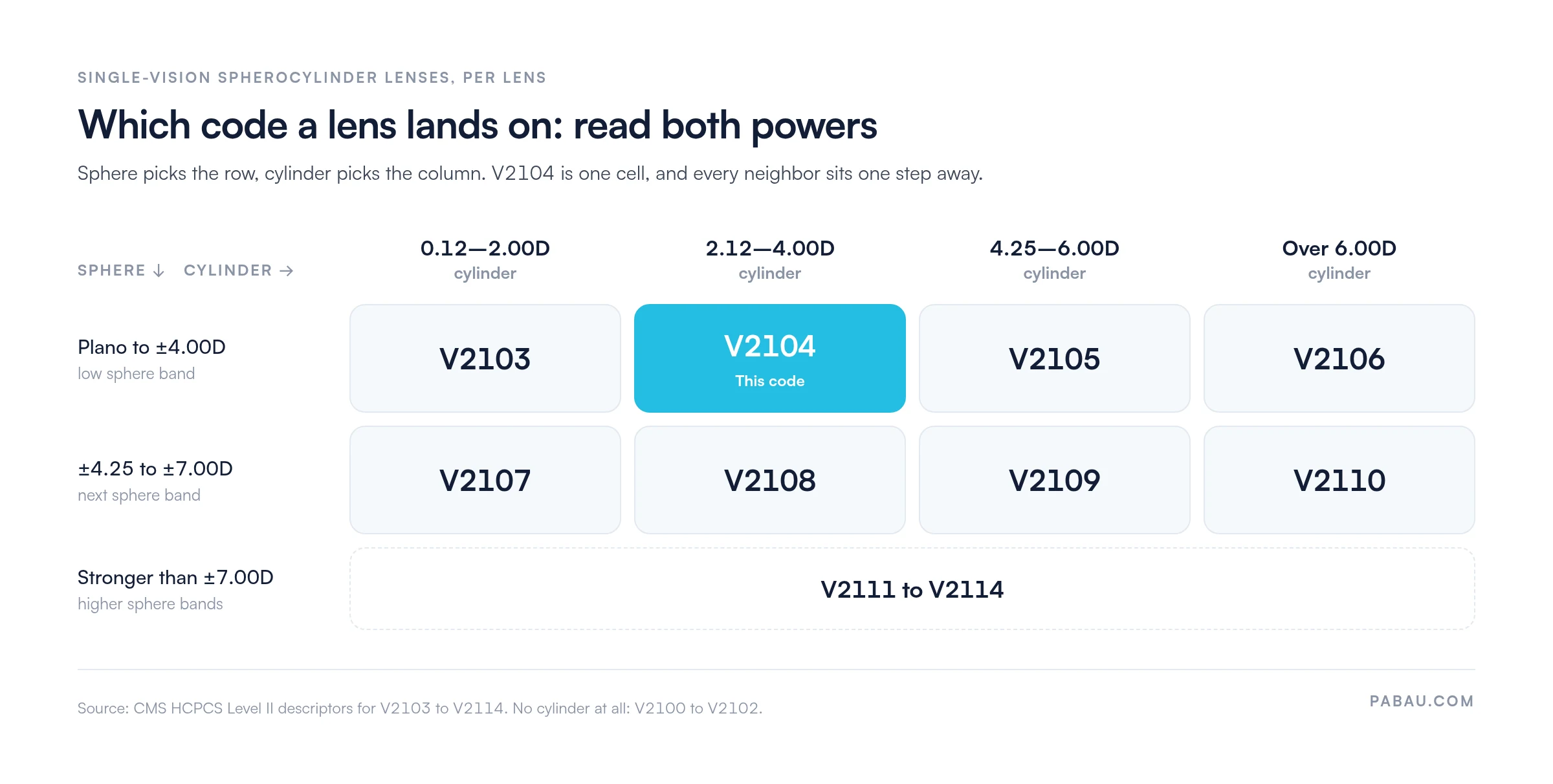
Medicare Part B excludes routine vision services. HCPCS code V2104 is covered by Medicare only when the lens corrects vision after cataract surgery or for aphakia. That means aphakia (no natural lens), congenital aphakia, or pseudophakia after an intraocular lens (IOL) is implanted.
The DME MAC Refractive Lenses LCD (L33793) and its policy article (A52499) set these conditions. For pseudophakia, Medicare covers one pair of eyeglasses or contact lenses after each cataract surgery with IOL insertion.
Run insurance eligibility verification before dispensing, because commercial payers and Medicaid programs treat V2104 differently. Some commercial plans cover routine eyeglass lenses through a vision benefit rider, in which case V2104 may be billable outside the post-cataract context.
State Medicaid programs vary. Some cover V2104 for all beneficiaries under a vision benefit, while others limit coverage to medically necessary lenses.
For Medicare claims, the billing entity must be a DMEPOS (durable medical equipment, prosthetics, orthotics, and supplies) supplier enrolled with CMS. A DMEPOS supplier number is required on the claim form. An optometry office that has not completed DMEPOS enrollment cannot submit V2104 to Medicare directly.
Medicare pays V2104 per lens from the DMEPOS fee schedule, which CMS updates every January. The allowed amount varies by state, so there is no single national figure to bill against.
For 2026, CMS applied a net 2.0% update to DMEPOS fees. Check the current V2104 rate for your state in the CMS DMEPOS fee schedule before you set your fee table.
Key points on V2104 reimbursement:
Run a fee schedule check for V2104 each October or November using the CMS DMEPOS fee schedule tool at cms.gov. CMS publishes the following year’s rates before January 1, giving your billing team time to update fee tables before the new rate period begins.
HCPCS code V2104 requires a laterality modifier on every claim line. Because V2104 is billed per lens, each lens needs its own line item with the modifier identifying which eye it belongs to:
A bilateral prescription generates two V2104 lines, one with RT and one with LT, each billed as one unit. Submitting a single V2104 line with two units and no laterality modifier is a common denial trigger.
The KX, GA and GZ modifiers in the Refractive Lenses policy apply to add-ons such as anti-reflective coating (V2750), not to the base lens. Confirm any further requirements with the DME MAC for your jurisdiction.
A V2104 claim must be supported by an ICD-10-CM diagnosis code that establishes medical necessity. For Medicare claims, the supporting diagnosis must be aphakia, congenital aphakia, or pseudophakia after cataract surgery.
For commercial payers with a routine vision benefit, refractive error codes are generally acceptable. The table below lists the most commonly used diagnosis codes for V2104 claims.
For Medicare, the aphakia codes (H27.00-H27.03), congenital aphakia (Q12.3) and pseudophakia (Z96.1) are the accepted diagnoses. A refractive error code such as H52.10 on a Medicare claim for V2104 brings a medical-necessity denial.
Medicare treats refractive error as routine vision, which is excluded. The record must show that the lens follows cataract surgery or treats aphakia.
Supporting documentation determines whether a V2104 claim survives audit. Optical suppliers and ordering providers each have responsibilities.
Documenting this correctly from the start supports good medical billing compliance and protects the practice in a retrospective audit. Keeping the prescription, order, dispensing record, and proof of delivery together in a single patient file makes it straightforward to respond to a records request.
Medicare does not require prior authorization for V2104 spectacle lenses following cataract surgery. Many commercial plans and some state Medicaid programs do require prior authorization before a V-code lens claim will be reimbursed.
The safest practice is to verify prior authorization requirements with the specific payer before dispensing the lenses, using the plan’s provider portal or eligibility line.
Some Medicare Advantage plans add prior authorization requirements beyond original Medicare rules. Treat a Medicare Advantage plan as a separate payer when you check prior authorization.
V2104 denials follow a predictable pattern. Most arise from one of six root causes:
Each of these denial reasons has an appeal path. For modifier and code selection errors, a corrected claim with the right modifier or code is typically sufficient. For medical-necessity denials, the appeal requires supporting clinical documentation from the ordering physician.
Good denial management workflows should track V2104 denial reason codes and route appeals appropriately. The AAPC’s HCPCS code reference is a useful cross-check when confirming code selection during the appeal process.
The National Correct Coding Initiative (NCCI) publishes quarterly edits that stop two codes from being billed together when one is bundled within the other. For V2104, the main bundling risk sits within the V2100 series itself.
Billing V2104 alongside another V2100 to V2114 code for the same eye on the same date is likely to trigger an edit. A single lens can only fall within one sphere-and-cylinder range.
NCCI edits for V-series lens codes are less extensive than those for physician procedure codes, but they do exist. The key rules to check:
NCCI edits change quarterly. Before submitting a claim with several V-series codes, check the current edit status for each V2104 code pair in the CMS NCCI edit tool. CGS, one of the DME MACs, also offers a coding verification lookup tool. It shows whether a HCPCS code needs a product classification review before you bill it.
A clean V2104 claim follows a defined sequence. A step skipped at the front end comes back as a denial at the back end. Correcting that denial takes longer than completing the step would have.
Billing software that links the prescription to the claim can automate several of these steps, including eligibility checks and modifier validation. That cuts the manual review work for billing staff.
Many optical practices still copy a lens prescription from the exam record into a separate billing tool. That retyping step is where a 2.25D cylinder gets billed as V2103, or a pair of lenses lands on one claim line.
Pabau keeps the prescription, the dispensing notes and the claim in the same patient record. Its claims management runs validation checks before submission, so an incomplete claim is held back rather than sent to the payer.
In the US, Pabau connects to the Claim.MD clearinghouse for real-time eligibility checks and electronic remittance posting. Each V2104 claim’s status sits on one dashboard, so your billing team can correct a rejected line the day it comes back.

Pabau’s claims management software helps optical suppliers and eye care practices submit V-code claims with the right code, modifiers and diagnosis. Fewer denials mean faster reimbursement.

Read the cylinder before you pick the code, then check the sphere. That one habit prevents the wrong-step error behind most V2104 rejections. Bill each eye on its own line with RT or LT, and pair Medicare lines with an aphakia or pseudophakia diagnosis.
The step that takes longest to fix is DMEPOS enrollment. Without a supplier number, a post-cataract patient’s lenses can’t be billed to Medicare, however clean the claim is. Settle enrollment before you dispense, not after the first denial.
Pabau runs validation checks before submission, so a V2104 line goes out as a clean claim rather than coming back as a denial. Book a demo to see how Pabau keeps optical claims accurate from prescription to payment.

Need a full overview of medical billing fundamentals? What is medical billing covers the end-to-end process from claim creation through payment posting.
Struggling with denied claims across multiple code types? Denial management in healthcare explains how to build a denial tracking and appeal workflow that reduces write-offs.
Want to understand how clearinghouses handle V-code submissions? Medical claims clearinghouse guide walks through how electronic claims are validated and routed to payers.
HCPCS code V2104 covers a spherocylinder, single-vision spectacle lens, billed per lens. The sphere must sit between plano and plus or minus 4.00 diopters, and the cylinder between 2.12 and 4.00 diopters. It does not cover bifocal or trifocal lenses, contact lenses, or prescriptions outside those ranges.
Yes, but only after cataract surgery or for aphakia. Medicare Part B covers V2104 for aphakia, congenital aphakia, or one pair of lenses after each cataract surgery with an intraocular lens. Routine vision correction is excluded, and the claim needs a supporting diagnosis such as H27.00-H27.03 or Z96.1.
RT (right side) and LT (left side) modifiers are required on every V2104 line item. A bilateral prescription needs two separate claim lines, one with RT and one with LT, each billed as one unit. The KX, GA and GZ modifiers in Medicare’s Refractive Lenses policy apply to add-ons such as anti-reflective coating, not to the base lens.
V2103, V2104 and V2105 share the same sphere band of plano to plus or minus 4.00D and differ only by cylinder. V2103 covers 0.12 to 2.00D cylinder, V2104 covers 2.12 to 4.00D, and V2105 covers 4.25 to 6.00D. V2104 and V2103 are most often confused at the 2.00D/2.12D boundary, so read the cylinder power first.
The two most common denial reasons are a missing RT or LT modifier and a cylinder power outside 2.12 to 4.00D. Others include a refractive error diagnosis on a Medicare claim, a non-enrolled DMEPOS supplier, and a missing order or proof of delivery.
Original Medicare does not require prior authorization for post-cataract V2104 lenses, but many commercial plans, Medicare Advantage plans, and state Medicaid programs do. Always verify prior authorization requirements with the specific payer before dispensing lenses to avoid a retroactive denial.