CPT code 63081: Vertebral corpectomy, cervical spine
CPT code 63081: official descriptor and procedure overview CPT code 63081 descri...

Last Updated: Oct 6, 2026
V2105 is the HCPCS Level II code for spherocylinder, single vision, plano to plus or minus 4.00d sphere, 4.25 to 6.00d cylinder, per lens. It covers one finished eyeglass lens that pairs a low sphere power with a strong cylinder correction for astigmatism.
V2105 is the third cylinder step in the plano to ±4.00D sphere bracket. It sits between V2104 (2.12 to 4.00D cylinder) and V2106 (over 6.00D cylinder), and each lens is billed on its own line.
Let Pabau's smart automation suggest the right codes, reduce claim denials, and keep your practice compliant—effortlessly.
Automate repetitive tasks and focus on what matters most—your patients.
Reduce coding errors and ensure compliance with the latest regulations.
Clean claims, fewer denials, and faster reimbursements.
Powerful insights and reporting to help your practice thrive.
HIPAA compliant SOC 2 certified GDPR-compliant Trusted by 4,000+ clinics worldwide

HCPCS Code V2105 covers one single vision spherocylindrical lens with a plano to ±4.00 D sphere and a 4.25 to 6.00 D cylinder.
It is the third cylinder step in its sphere bracket, after V2103 and V2104 and before V2106.
Medicare Part B pays for V2105 only as part of the eyeglasses covered after cataract surgery with an intraocular lens, under CMS Policy Article A52499.
A cylinder value matched to the wrong code is an avoidable denial, so check sphere and cylinder against the written prescription before coding.
Pabau’s claims management software checks each claim for required details, such as membership numbers and authorization codes, before it goes to the payer.
HCPCS Code V2105 is a Level II HCPCS code for one single vision spherocylindrical lens, billed per lens. The sphere power runs from plano (0.00 D) to plus or minus 4.00 diopters, and the cylinder power from 4.25 to 6.00 diopters.
The code belongs to the HCPCS Level II code set maintained by CMS, which covers supplies, equipment and drugs that CPT does not.
Optometrists, ophthalmologists, optical dispensaries and outpatient facilities use V codes to bill corrective eyewear as separate supply items. V2105 sits in the V2100-V2199 range of single vision lenses, alongside the other codes in our HCPCS codes library.
The code applies only to a finished single vision lens, with one focal power and no bifocal or progressive segment. Each lens is billed separately. A pair of glasses with two qualifying lenses means two V2105 claim lines.
The official CMS descriptor for V2105 is: Spherocylinder, single vision, plano to plus or minus 4.00d sphere, 4.25 to 6.00d cylinder, per lens. Sphere power and cylinder power set the code boundary, and both must fall within range for V2105 to apply.
The single vision lens series runs from V2100 to V2115, and it holds two kinds of code. V2100, V2101 and V2102 are sphere-only lenses with no cylinder. V2103 through V2114 are spherocylinder lenses, coded first by a sphere bracket and then by a cylinder step.
Within the plano to ±4.00 D sphere bracket, the cylinder rises from V2103 to V2106, and V2105 is the third of those four steps. The same cylinder ladder repeats from V2107 to V2110 in the ±4.25 to ±7.00 D bracket.
It runs once more from V2111 to V2113 for sphere powers of ±7.25 to ±12.00 diopters. The grid below lays the whole series out by sphere row and cylinder column.
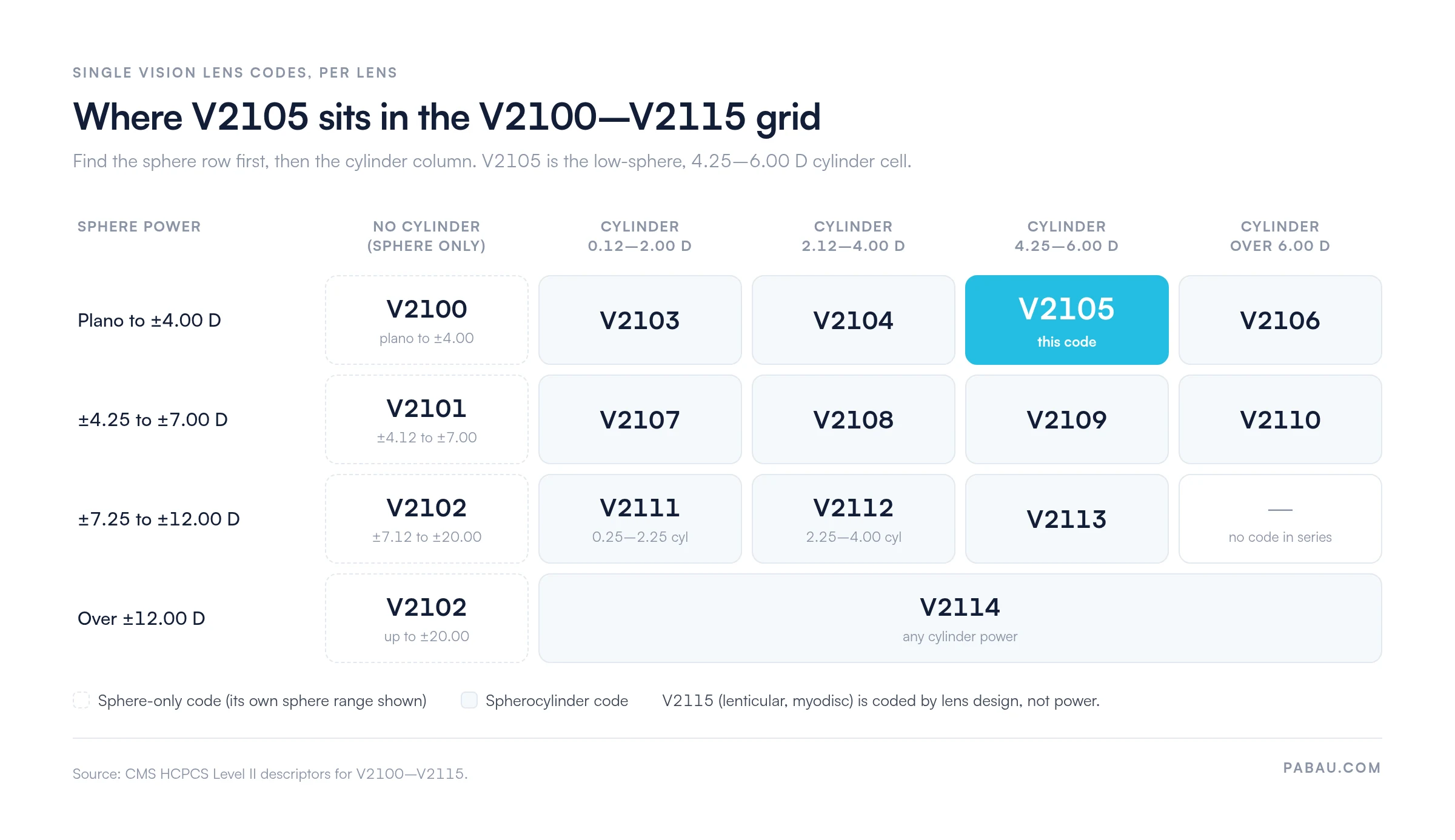
Both boundary values belong in V2105, so a cylinder of exactly 4.25 or 6.00 diopters stays here. A 4.00 diopter cylinder drops the lens to V2104, and a cylinder above 6.00 diopters moves it to V2106. A cylinder of 2.00 D or less makes it V2103, and a lens with no cylinder at all is V2100.
Work from the prescriber’s written values. Transposing a prescription between minus and plus cylinder notation changes the sphere value, which can move the lens into a different sphere bracket.
V2105 covers the supply of a single vision spherocylindrical lens within the stated power range, furnished as a vision benefit item to an eligible patient.
Standard Medicare Part B does not cover routine eyeglasses or contact lenses. V2105 is billable to Medicare only under the narrow post-cataract surgery exception set out in CMS Policy Article A52499 (Refractive Lenses).
Under that exception, Medicare covers one pair of conventional eyeglasses or one set of contact lenses after each cataract surgery with an intraocular lens. If V2105 is part of that covered pair, the claim is payable. For routine refractive correction, glaucoma management or diabetic eye exams, Part B does not pay for the lens.
Medicare Advantage plans may extend vision coverage beyond Part B’s narrow exception. Check each plan’s benefit structure before submitting, since coverage rules vary by carrier and plan year.
State Medicaid programs publish their own fee schedules for HCPCS V codes, and coverage rules differ significantly across states. Virginia DMAS includes V2105 in its vision services HCPCS fee schedule.
Texas TMHP covers V codes for Medicaid-eligible patients under its vision services provider manual, and Louisiana sets maximum allowable fees through its administrative code.
Never apply one state’s reimbursement rate to another. Rates are set annually and vary by geography.
Solid documentation is the first defense against a V2105 denial. Understanding how medical billing works from encounter to claim helps billing staff catch errors before submission. Together, the patient record and the claim must show three facts. The lens was prescribed, it falls within V2105’s power range, and the patient was eligible for it.
Strong medical billing compliance means keeping the written prescription on file and linking it to the claim date. Auditors routinely request the prescription to confirm the power range matches the V code billed.
A V2105 claim submitted without a supported diagnosis code is one of the most predictable denial triggers. The ICD-10-CM codes below are commonly paired with V2105. Payer acceptance varies, so confirm with each plan’s coverage policy before submitting.
For Medicare post-cataract claims, include Z96.1 as a secondary diagnosis alongside the primary refractive diagnosis. Leaving out the IOL status code is a common denial trigger for that exception.
The National Correct Coding Initiative publishes code-pair edits that control which codes may appear together on the same claim. CMS updates NCCI edits for vision HCPCS codes quarterly, so the specific pair tables change. The general bundling principles that apply to V2105 stay stable across quarters.
For specific edit pairs and modifier override rules in the current quarter, check the AAPC Codify HCPCS lookup or the CMS NCCI policy manual. When a modifier override is permitted, document the clinical reason clearly in the record.
Check NCCI edit pairs quarterly. CMS updates the tables four times per year, and a new edit may now bundle a code pair your practice has been billing separately. Set a calendar reminder for the start of each CMS quarter (January, April, July, October) to review vision V-code pairs against your standard claim templates.
Most V2105 denials trace back to a small set of predictable errors, and each one has a corrective action. Systematic denial management in healthcare starts with tracking denial codes by category to find patterns.
Most V2105 errors start before the claim exists, with a cylinder value read against the wrong row or a prior authorization number never entered. The coding decision stays with your team. Software can still stop an incomplete claim from leaving the practice and show you where every claim stands.
Pabau, the practice management platform we build, includes claims management software that runs validation checks every time you send a claim. It confirms that membership numbers, authorization codes and other required details are present. A missing field gets caught at your desk instead of by the payer.
A clean claim for V2105 still depends on matching the prescription to the code and the code to the diagnosis. Pabau handles the checks and follow-up around that decision, so your billing staff spend less time chasing claims and more time on the coding itself.

Pabau checks every claim for required details, like membership numbers and authorization codes, before submission and tracks it through to payment. See how that fits your optical billing workflow.

V2105 is one of the easier lens codes to get right, because the descriptor gives you two numbers to match. Read the sphere first, then the cylinder, and then confirm the patient’s plan pays for lenses at all.
If your practice dispenses glasses regularly, build that check into dispensing rather than leaving it for the billing queue. Spotting a 4.00 D cylinder at the counter costs nothing. Spotting it on a denial costs a resubmission and a delayed payment.
Book a demo to see how Pabau checks and tracks lens claims for optometry practices.

Working with a high-power prescription? HCPCS Code V2111 covers spherocylinder lenses in the ±7.25 to ±12.00 D sphere bracket.
HCPCS Code V2105 is the Level II code for one single vision spherocylindrical eyeglass lens, billed per lens. It applies when the sphere is plano to plus or minus 4.00 diopters and the cylinder is 4.25 to 6.00 diopters. Optometrists, ophthalmologists and optical dispensaries use it to bill the lens as a separate vision supply item.
V2105 applies to lenses with sphere power from plano (0.00 D) to plus or minus 4.00 diopters and cylinder power from 4.25 to 6.00 diopters. Both parameters must fall within these ranges at the same time. A prescription with a cylinder of 6.25 D belongs in V2106, not V2105.
No, not for routine vision correction. Medicare Part B covers V2105 only under the post-cataract surgery exception in CMS Policy Article A52499. That exception allows one pair of eyeglasses or contact lenses after cataract surgery with an intraocular lens. For other prescriptions, Medicare does not pay for eyeglass lenses, and an ABN must be issued before dispensing.
V2104, V2105 and V2106 share the same plano to ±4.00 D sphere bracket and differ only by cylinder. V2104 covers 2.12 to 4.00 diopters of cylinder and V2105 covers 4.25 to 6.00 diopters. V2106 takes any cylinder above 6.00 diopters. Reading the cylinder value precisely is what separates the three codes.
The most common reason is a cylinder outside 4.25 to 6.00 D, which means the wrong V code was selected. Other causes include a missing or mismatched ICD-10 code, no prior authorization, a non-covered benefit, duplicate lens lines or an NCCI edit conflict. Verify the prescription values, diagnosis pairing and payer benefit rules before resubmitting.
You need a signed prescription showing sphere and cylinder values within the V2105 range and a supporting ICD-10 code, typically from H52.2. The claim also needs the prescriber’s NPI, the dispensing date, a place of service code and prior authorization where the payer requires it. For Medicare post-cataract claims, add Z96.1 as a secondary diagnosis.