

HCPCS code E0198: Water pressure pad billing guide
HCPCS code E0198 is a water pad for a standard mattress HCPCS code E0198 is the ...

Last Updated: Oct 13, 2026
T4542 is the HCPCS Level II code for incontinence product, disposable underpad, small size, each. It covers a single-use pad placed on a bed or a chair, not a garment the patient wears.
Most T4542 claims go to Medicaid rather than Medicare, because traditional Medicare Part B excludes T-codes. Submitting the code to a Medicare fee-for-service plan triggers an automatic denial. Medicaid and Medicaid managed care plans pay it when the documentation is in place.
Let Pabau's smart automation suggest the right codes, reduce claim denials, and keep your practice compliant—effortlessly.
Automate repetitive tasks and focus on what matters most—your patients.
Reduce coding errors and ensure compliance with the latest regulations.
Clean claims, fewer denials, and faster reimbursements.
Powerful insights and reporting to help your practice thrive.
HIPAA compliant SOC 2 certified GDPR-compliant Trusted by 4,000+ clinics worldwide

HCPCS Code T4542 covers a disposable incontinence underpad in the small size. It is a flat pad for a bed or a chair, not a worn garment.
T4539 through T4545 are not a size ladder. Each code names a different product, so read the full descriptor before you choose one.
T-codes are Medicaid-specific. Traditional Medicare Part B does not reimburse T4542 under any circumstance.
Documentation must include a written physician order, a qualifying ICD-10 diagnosis, and proof of medical necessity. Missing any one of the three triggers a denial.
Claims management software like Pabau flags missing documentation before a T4542 claim leaves the practice.
HCPCS Code T4542 covers a disposable incontinence underpad in the small size, billed per item. It sits inside the T4521-T4545 incontinence supplies range maintained by AAPC. An underpad is a flat absorbent pad laid on a bed, a chair, or a wheelchair to protect the surface beneath the patient.
The pad is never worn on the body. Briefs, diapers, and pull-on protective underwear all sit under different codes in the same T-code family, which is where most miscoding on this range starts.
Payers check supply claims against the product invoice, so the item shipped decides the code. If the delivered product does not match the code billed, the claim is denied for incorrect product type.
That holds even when the patient’s documented need is beyond question. Coders working with DME suppliers should confirm the supplier’s product catalog codes before submitting.
The following table shows key reference data for HCPCS Code T4542 as published in the CMS HCPCS Level II code set.
The code is specific to a single-use underpad in the small size. Picking the wrong product characteristic, even within the same T-code family, is one of the most common causes of denial on incontinence supply claims. A washable pad is excluded whatever surface it covers, so a reusable bed-size underpad is billed as T4537.
T-codes exist for Medicaid billing, and traditional Medicare Part B does not recognize them. CMS classifies the T4521-T4545 range as Medicaid-only codes, so no amount of extra documentation makes a T4542 claim payable under original Medicare. Submitting to Medicare fee-for-service wastes a billing cycle and generates a denial that still takes staff time to clear.
For patients on Medicare Advantage plans, coverage depends on the individual plan’s benefit design. Some Medicare Advantage plans do cover incontinence supplies, but they may use their own preferred codes or require prior authorization. Verify the plan’s incontinence supply benefit before billing T4542 to an MA plan.
State Medicaid programs are the correct destination for most T4542 claims. Coverage rules, quantity limits, and fee schedule rates vary widely by state. Treat each state plan as its own payer with its own claim edits, rather than assuming national uniformity.
State Medicaid programs set their own reimbursement rates for T4542 and update them on their own schedules. Some publish annually, some mid-year. No single national rate exists.
To find the current rate for a specific claim, go straight to the state’s Medicaid fee schedule. The state agency portal or the managed care organization’s provider manual is the place to look. The CMS Physician Fee Schedule lookup does not include T-codes, as these are Medicaid-only.
Third-party aggregators publish estimated rates, but those figures may lag state updates by months. Treat an external rate reference as a starting point for comparison, not as a billing-ready figure. States such as Minnesota and Oregon publish their incontinence supply fee schedules through their state department of health services websites.
Pull your state’s current Medicaid fee schedule each January and each July. Many states implement mid-year rate adjustments without wide notification. A mismatch between your billed amount and the current fee schedule is an easy audit trigger to avoid. One calendar reminder keeps you ahead of it.
Billing T4542 accurately means completing several steps in order before the claim is submitted. Missing any step usually results in a denial that takes longer to resolve than the original submission. Document first, bill second.
Payers audit incontinence supply claims at higher rates than many other HCPCS categories. The Office of Inspector General has historically included DME and incontinence supply billing in its Work Plan as an area of active review. The defense is a complete, dated file for every patient receiving supplies.
Every T4542 claim must be supported by the following documents, retained by the supplier for the applicable state audit period (typically five to seven years):
Prior authorization for T4542 is not universal. It depends on the specific state Medicaid program and, within managed care states, on the individual MCO contract. Some state fee-for-service Medicaid programs cover incontinence supplies without PA for the first authorization period, then require renewal PA. Others require PA from the first unit billed.
When a PA is required, the request typically needs the physician order and the qualifying ICD-10 diagnosis. It also needs a clinical summary supporting medical necessity, plus the requested quantity and duration. MCOs often layer extra requirements on top of state minimums. Call the plan’s provider line before submitting to confirm the current PA form and clinical criteria.
Most state Medicaid programs cap the number of T4542 units billable per calendar month. These limits match what is clinically reasonable for a patient with incontinence and control program spend. Billing above the allowed quantity results in denial of the excess units.
Units for T4542 are typically billed per item, so each individual underpad counts as one unit. If a state plan allows 120 units per month, a supplier can bill up to 120 individual underpads per month per patient.
The specific limit varies by state, and sometimes by the patient’s underlying diagnosis or care setting. Verify the applicable monthly limit in the state’s Medicaid billing manual before submitting.
The T4521-T4545 range is not one continuous size ladder. Consecutive codes switch between worn garments and underpads, between disposable and reusable products, and between adult and pediatric sizing. Three questions settle which code applies, and the flow below runs through them in order.
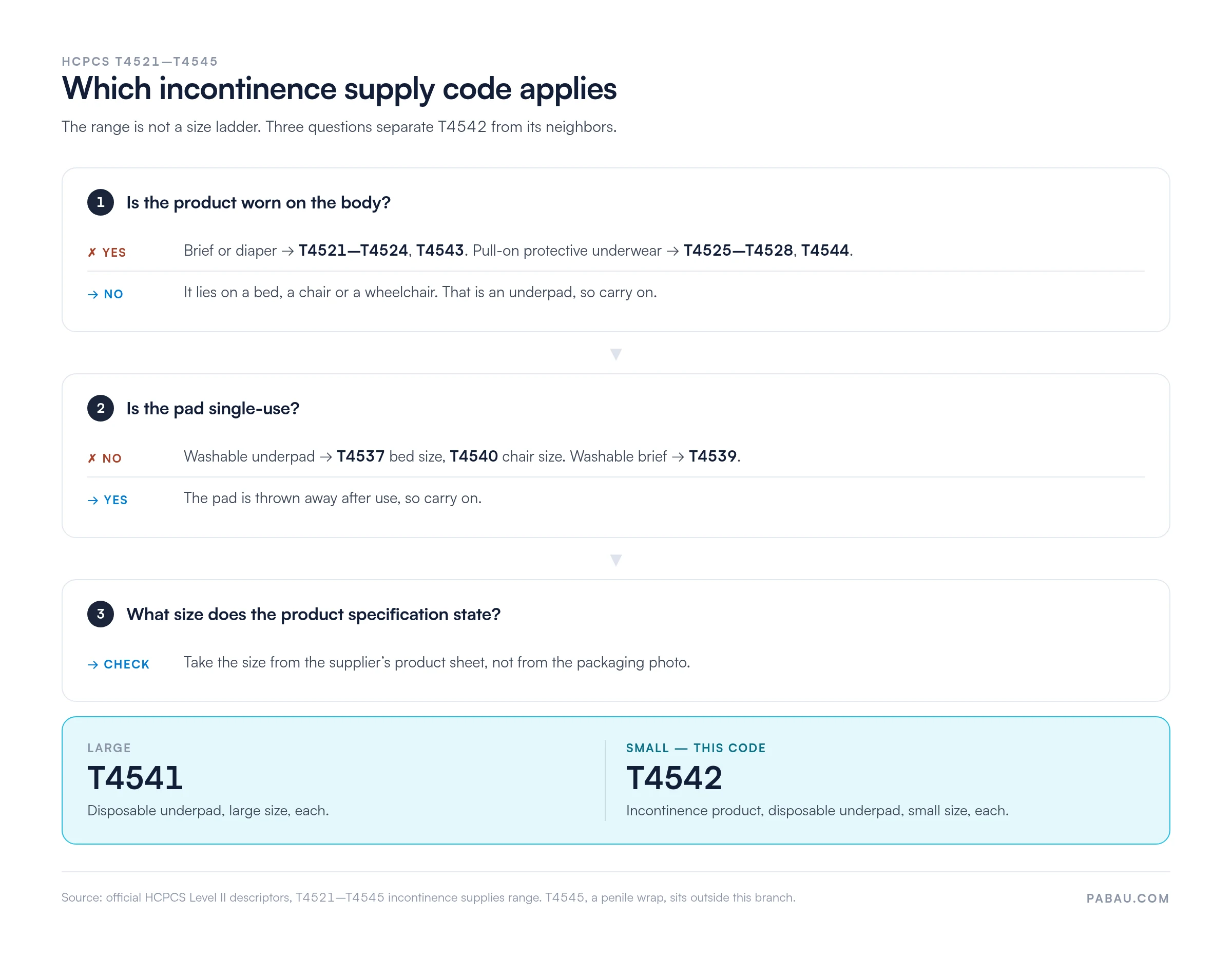
Reading the full descriptor is the only reliable way to choose. The table below covers T4542 and its closest neighbors.
One confusion is worth naming on its own. The adult disposable pull-on series is a different code family altogether: T4525 (small), T4526 (medium), T4527 (large), and T4528 (extra large). If the patient wears the product, T4542 is the wrong code whatever size it is. A small adult brief, for instance, belongs under T4521.
The near-miss that catches most coders is T4541, the same underpad in the large size. Map the delivered pad against the product specification before the claim goes out.
Payers require at least one qualifying ICD-10-CM diagnosis code on a T4542 claim to establish medical necessity. The diagnosis must be documented in the patient’s medical record, not simply listed on the claim form without clinical support.
Most state Medicaid programs maintain an approved diagnosis code list for incontinence supplies. A code that is not on that list generates a denial even where the clinical need is obvious.
Using the most specific applicable code improves claim acceptance. R32 (unspecified) is acceptable when the clinical record cannot support a more specific code. Payers may still request extra documentation when an unspecified code is paired with high-volume supply claims.
Incontinence supply billing carries above-average audit risk, and the most common denials follow predictable patterns. The table below maps each denial type to its cause and the corrective action needed.
Reading the remittance one claim at a time hides the pattern. Group a month of T4542 rejections by reason code and the failing step in the workflow shows up. Our guide to denial codes explains what each code is telling you.
When the same denial code recurs across several patients, the workflow is at fault rather than the coder. That is the argument for checking claims before they go out. Cleaner claims management software flags incomplete documentation first, so preventable T4542 denials never reach the payer.
Run a quarterly audit of your T4542 denial patterns. Group denials by reason code and look for any single reason accounting for more than 20% of rejections. A recurring wrong-code denial usually points to a product catalog mismatch. A recurring PA denial usually means the pre-delivery authorization check is being skipped.
Supply documentation tends to live in several places at once. The physician order sits in a scanned folder, the delivery receipt in the supplier’s system, and the eligibility check in a browser tab nobody saved. When a payer asks for proof nine months later, someone rebuilds the file by hand.
Practice management software like Pabau keeps those records on the patient file instead. The order, the diagnosis, the eligibility result, and the delivery confirmation all attach to the record the claim is built from. Staff stop hunting for paperwork that was filed somewhere else.
Pabau’s claims tools then check the claim before it goes out. A missing order or an unapproved diagnosis is flagged on screen, so the fix takes seconds instead of a denial cycle. For a supplier billing hundreds of underpad units a month, that turns a rework queue into a clean remittance.

Pabau’s claims management software helps DME suppliers and practices track documentation, flag missing orders, and submit clean claims for incontinence supply codes. That means fewer denials and less rework.

Get the product right and the rest of a T4542 claim follows. The pad lies on a bed or a chair, it is thrown away after use, and the specification says small. If any of those three is untrue, a different code applies, whatever the packaging photo suggests.
The rest is payer discipline. Confirm the plan covers T-codes before a unit ships, hold the order and the diagnosis on file, and stay inside the state’s monthly limit. Suppliers who check those three before delivery spend far less time appealing afterward.
Building those checks into the billing workflow costs less than the rework one denial creates. Book a demo to see how Pabau keeps supply documentation attached to the claim it supports.

Need to understand how billing errors affect your revenue? Medical billing fundamentals covers the end-to-end billing process and where claims most commonly go wrong.
Want a deeper look at managing claim rejections systematically? Denial management in healthcare outlines strategies for identifying patterns and reducing your overall denial rate.
Checking coverage before a supply delivery? Insurance eligibility verification walks through the checks that catch a lapsed plan before the claim is submitted.
Unsure what belongs on the billing document itself? What a superbill includes breaks down each required field and who is responsible for filling it in.
Want fewer claims coming back at all? Clean claim submission sets out what a payer accepts first time and how to hit that standard consistently.
HCPCS Code T4542 covers a disposable incontinence underpad in the small size, billed per item. An underpad is a flat absorbent pad placed on a bed or a chair, not a garment worn by the patient. Worn briefs and pull-on protective underwear are coded elsewhere in the T4521-T4545 range.
T4542 is covered by Medicaid, not traditional Medicare Part B. T-codes are Medicaid-only codes and are automatically denied by Medicare fee-for-service. Some Medicare Advantage plans may cover incontinence supplies under a supplemental benefit. Verify with the specific plan before billing.
Required documentation includes a signed written physician order, a qualifying ICD-10-CM incontinence diagnosis in the patient’s record, and proof of medical necessity. You also need eligibility verification, a signed delivery receipt, and prior authorization approval where the plan requires it.
Monthly quantity limits for T4542 vary by state Medicaid program and managed care organization. Units are typically billed per item, with most state plans imposing a monthly cap. Check the state Medicaid billing manual or the MCO’s provider handbook for the applicable limit before submitting claims.
Both codes cover a disposable incontinence underpad, and the difference between them is size. T4542 is the small size and T4541 is the large size, each billed per item. T4543 is not a third size of the same product. It covers an adult protective brief or diaper above extra large, which the patient wears.
Prior authorization requirements for T4542 depend on the state Medicaid program and, in managed care states, on the individual MCO. Some plans require PA from the first claim, others require renewal PA annually. Verify the PA requirement for the specific plan before delivering supplies, or the claim may be non-payable.
A T4542 claim is most often denied for a product mismatch, a missing or expired physician order, or a quantity limit overage. A missing prior authorization, an unsupported ICD-10 diagnosis, and non-enrolled supplier status account for most of the rest. A product mismatch usually means the item delivered was a large underpad or a worn garment. Billing T4542 to traditional Medicare is also a guaranteed denial.
No single national rate exists for T4542 because it is a Medicaid-only code and each state sets its own reimbursement rate. To find the current applicable rate, consult your state Medicaid agency’s published fee schedule directly. Third-party rate aggregators give a starting reference point, but cross-check them against the official state source before billing.



