HCPCS Code L0472: Hyperextension TLSO billing guide
HCPCS code L0472: Official descriptor and device definition HCPCS code L0472 des...

Last Updated: Nov 5, 2026
Q4110 is the HCPCS Level II code for PriMatrix, per square centimeter, an add-on listed in addition to the primary procedure. It reports the graft supply only, a dermal matrix processed from fetal bovine dermis and billed by the square centimeter applied.
The application goes on the same claim under a CPT code such as 15271, sized by the wound's surface area. Since January 1, 2026, Medicare pays Q4110 as an incident-to supply at a flat $127.14 per sq cm.
Let Pabau's smart automation suggest the right codes, reduce claim denials, and keep your practice compliant—effortlessly.
Automate repetitive tasks and focus on what matters most—your patients.
Reduce coding errors and ensure compliance with the latest regulations.
Clean claims, fewer denials, and faster reimbursements.
Powerful insights and reporting to help your practice thrive.
HIPAA compliant SOC 2 certified GDPR-compliant Trusted by 4,000+ clinics worldwide

HCPCS Code Q4110 reports PriMatrix, a dermal matrix processed from fetal bovine dermis, billed per square centimeter of product applied.
Q4110 units come from the graft applied, while the wound’s surface area selects the application CPT, such as 15271.
Since January 1, 2026, Medicare pays Q4110 at a flat $127.14 per sq cm, but coverage still depends on your MAC’s skin substitute LCD.
A missing wound measurement, product invoice or lot number leaves a Q4110 claim without the evidence a payer checks first.
Pabau, the practice management platform we build, keeps wound measurements, lot numbers and the claim in one patient record.
HCPCS Code Q4110 is the Level II code for PriMatrix, per square centimeter. PriMatrix is a dermal matrix processed from fetal bovine dermis. The code reports the graft material only, one unit per square centimeter applied, listed in addition to the application procedure.
Q4110 sits in the Q4100 series of skin substitute codes within HCPCS Level II. The Centers for Medicare & Medicaid Services (CMS) maintains that code set for products and supplies CPT doesn’t describe. Each code in the series names one cellular and tissue-based product (CTP).
Check Q4110 against the CMS HCPCS Level II code set at the start of each year. CMS adds and retires skin substitute codes in its annual updates, and a retired code is denied whatever the intent.
Q4110 reports the supply of PriMatrix applied to a wound. It covers the graft material, not the surgical application. The application is reported separately with a CPT code from the 15271–15278 range.
Wound types typically covered: The most common indications on Q4110 claims are diabetic foot ulcers (DFUs), venous leg ulcers (VLUs), pressure injuries and post-surgical wounds. Each must have failed conservative therapy first.
Q4110 is a supply code, not a procedure code, so the claim always needs a paired application CPT. Submitting Q4110 on its own is a common technical denial.
Q4110 is billed by the product, not the wound. Report one unit for each square centimeter of PriMatrix applied, taken from the sheet size and the product invoice.
The wound’s surface area is a separate number, measured at each application and recorded in that day’s procedure note. It selects the application code.
15271 covers the first 25 sq cm on the trunk, arms or legs, and 15272 adds each further 25 sq cm. Wounds on the feet use 15275 and 15276 instead. The diagram below shows how the two measurements split across one claim.
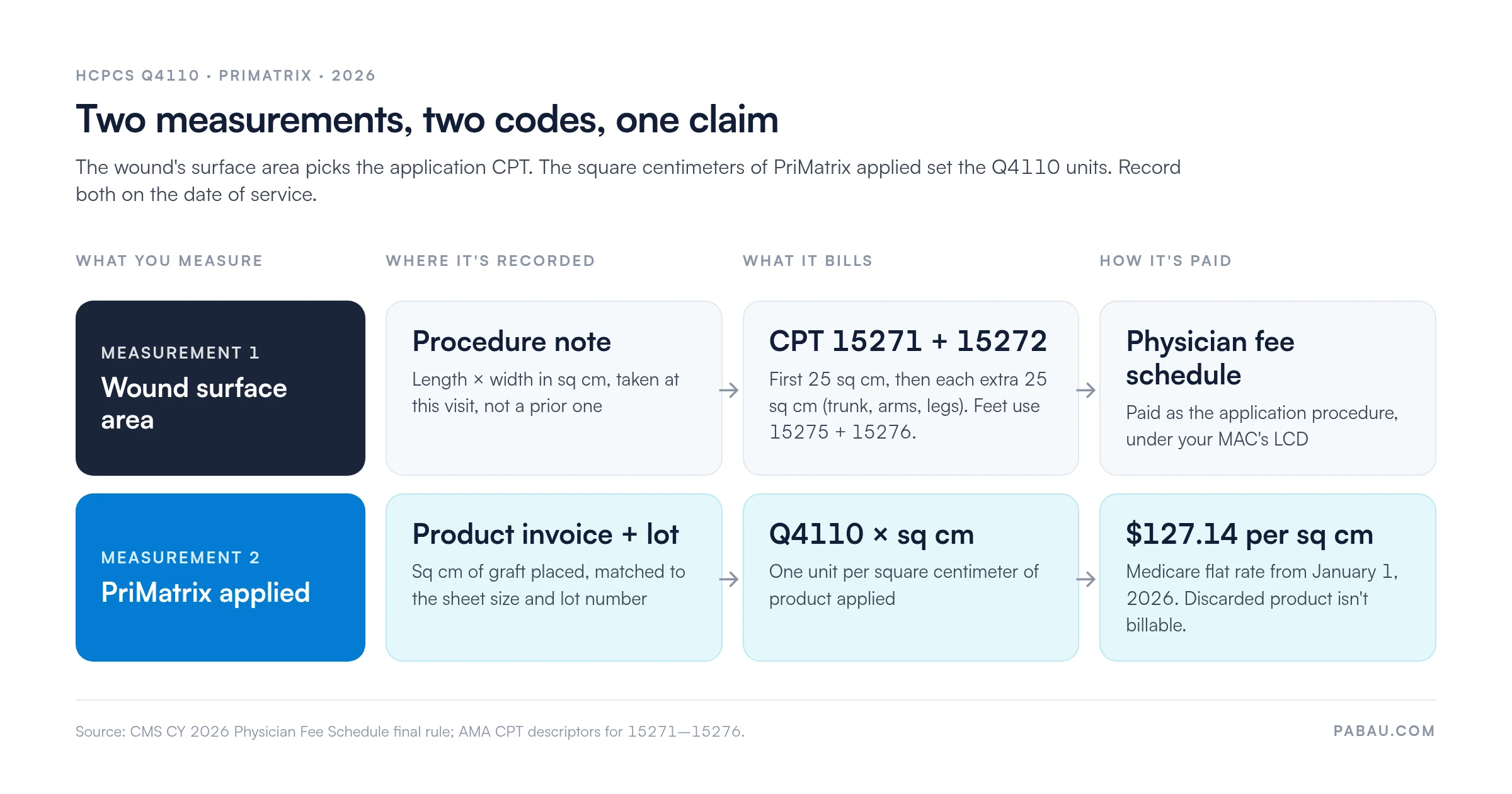
Since January 1, 2026, Medicare pays non-BLA skin substitutes such as PriMatrix as incident-to supplies at a flat $127.14 per sq cm. Payment covers only the product applied, so discarded graft isn’t billable and the JW and JZ waste modifiers don’t apply.
In an ambulatory surgery center (ASC), confirm Q4110’s payment indicator in the current CMS OPPS addendum, as packaging rules can apply with the concurrent procedure. For office claims, the CMS Physician Fee Schedule search tool shows the current rate. Check it each calendar year rather than reusing last year’s figure.
Record two numbers at every application: the wound’s surface area and the square centimeters of PriMatrix placed. Auditors check the first against the application CPT and the second against the invoice. Logging both in the patient record during the visit means neither has to be reconstructed at billing.
Each code in the Q4100 series names one product. Q4107 is Graftjacket and Q4123 is AlloSkin RT, both processed from human tissue, while PriMatrix is bovine-derived. Payers match the Q code against the product invoice, so a code that doesn’t match the graft applied gets denied.
The AAPC’s HCPCS code lookup and the CMS quarterly HCPCS file confirm which product each Q code names. Check both every January, and again whenever a manufacturer rebrands or reformulates a product.
Medicare covers Q4110 only when the wound meets the criteria in your Medicare Administrative Contractor’s (MAC’s) Local Coverage Determination (LCD) for skin substitutes.
Each contractor sets its own criteria, so look up your MAC’s current published LCD in the Medicare Coverage Database. If that LCD doesn’t list Q4110 as covered, expect a denial however well the claim is documented.
Q4110 claims need more documentation than most supply codes, because LCDs require proof of medical necessity at the wound level, not just the patient level. A complete Q4110 claim file holds these six items.
A structured wound assessment form captures these items at the chair rather than at billing. It prompts for the measurement, the product, the lot number and the therapy history at every application.

Q4110 claims need at least one ICD-10-CM diagnosis code that establishes the wound type and clinical context. The code must be specific to the wound’s location and type. “Unspecified” codes rarely meet LCD medical necessity requirements and raise denial risk.
When coding a diabetic foot ulcer, sequence E11.621 first, then add the L97 code for the ulcer’s site and severity. Many MAC LCDs list covered diagnoses, so check your codes appear there before you submit.
Most Q4110 denials trace back to a handful of causes, because the claim depends on supply billing, clinical documentation and LCD compliance at once. The table maps each cause to the claim adjustment reason code (CARC) it usually returns.
Practices running wound care claims software can flag missing documentation fields before a claim reaches the clearinghouse. Prompts for the wound measurement, lot number, paired CPT and diagnosis specificity work better inside the clinical workflow than in a billing review afterward.
Review your workflow against your MAC’s LCD at least once a year. Coverage criteria change, and an annual check catches the change before it produces a run of denials.
Run a quarterly denial audit for Q4110. Pull every claim denied with CO-16, CO-50 or CO-197 in the past 90 days and trace each one back to the source record. Fixing a recurring root cause at the workflow level stops the same denial from repeating.
In many wound care practices, the measurement sits in the procedure note and the lot number on a paper invoice. The claim lives in a separate billing tool. Answering an LCD review then means chasing three sources for one application.
Pabau, the practice management platform we build, keeps them in one patient record. Digital forms capture the wound size, product and lot number at each application, and measurement tracking charts the wound across visits.
Because the claim is raised from that same record, your biller sees the measurement, the paired application code and the invoice before submitting. Fewer claims go out missing the evidence a payer asks for.

Pabau connects clinical notes, wound measurements and procedure codes in one record. The documentation your MAC requires is already in place when you submit the claim.

Q4110 billing turns on two numbers recorded at the same visit: the wound’s surface area and the square centimeters of PriMatrix applied. Put both in the note and the invoice, and the claim carries what an LCD review looks for.
The 2026 flat rate makes each application easier to forecast, but it hasn’t loosened coverage. Check your MAC’s LCD and each payer’s authorization rules every January, before the first application of the year.
If your measurements, lot numbers and claims still live in three places, that is where most of your denials start. Book a demo to see how Pabau ties each Q4110 claim to the wound measurement and lot number behind it.

Need to understand clean claim standards for HCPCS submissions? Clean claim requirements in medical billing covers the technical elements every HCPCS claim must include to avoid preventable rejections.
Looking for guidance on managing denied claims across your practice? Denial codes in medical billing explains the most common CARC and RARC codes your team will meet on Q code claims.
Want to track Q4110 denials from your remittance files? Electronic remittance advice explains how ERA files surface denial reason codes so you can fix root causes faster.
Billing Medicare Part B for wound care supplies? Medicare billing walks through how Part B claims are built, submitted and paid.
HCPCS Code Q4110 is the Level II supply code for PriMatrix, a skin substitute processed from fetal bovine dermis. It’s billed per square centimeter of product applied. It sits in the CMS Q4100 series, where each code names one product.
Report one unit of Q4110 for each square centimeter of PriMatrix applied, taken from the sheet size and the invoice. The wound’s surface area is measured separately at each visit to select the application CPT, such as 15271. Since 2026, Medicare pays only for product applied, so discarded graft isn’t billed.
Q4110 reports PriMatrix, a bovine-derived dermal matrix, while Q4107 reports Graftjacket, a human acellular dermal matrix. Payers match the Q code against the product invoice, so billing one for the other gets the claim denied or recouped. Confirm each product’s code in the CMS HCPCS file every January.
Medicare Part B generally doesn’t require prior authorization for Q4110 under most MAC LCDs, but many commercial plans and Medicare Advantage contracts do. Verify with each insurer before the date of service. A missing authorization usually comes back as CARC 197 and is hard to overturn afterward.
The most common pairing is E11.621 for type 2 diabetes with foot ulcer, used with an L97 site code. L97.x codes cover non-pressure chronic lower limb ulcers, and I87.311/I87.312 cover chronic venous hypertension with ulcer. L89.x codes cover stage 3 or 4 pressure injuries. Always match the code to your MAC’s covered diagnosis list.
Yes. Q4110 can be billed in an ambulatory surgery center (ASC) under the CMS OPPS/ASC payment system. Check the current OPPS addendum for its ASC payment indicator, as packaging rules may apply with the concurrent procedure on the same encounter.