CPT code 87510: Gardnerella vaginalis nucleic acid probe billing
CPT code 87510: Official descriptor and clinical definition CPT code 87510 is th...

Last Updated: Nov 25, 2026
Q4139 is the HCPCS Level II code for AmnioMatrix or BioDmatrix, injectable, 1 cc. It reports an injectable amniotic product by volume, so one unit equals 1 cc administered.
Q4139 sits in the skin substitute range, but CMS classes it as a non-sheet product. Wound area does not set its unit count, and CPT 15271-15278 do not describe its application. In a physician office in 2026, Medicare contractors set its price.
Let Pabau's smart automation suggest the right codes, reduce claim denials, and keep your practice compliant—effortlessly.
Automate repetitive tasks and focus on what matters most—your patients.
Reduce coding errors and ensure compliance with the latest regulations.
Clean claims, fewer denials, and faster reimbursements.
Powerful insights and reporting to help your practice thrive.
HIPAA compliant SOC 2 certified GDPR-compliant Trusted by 4,000+ clinics worldwide

HCPCS code Q4139 reports AmnioMatrix or BioDmatrix injectable, and one unit equals 1 cc of product, not 1 square centimeter of wound.
CMS classes Q4139 as a non-sheet skin substitute, so from April 1, 2026, its application is reported with G0681-G0684 rather than CPT 15271-15278.
In a physician office, Medicare contractors price Q4139 in 2026. The CY 2027 rule moves non-sheet products to a national rate of $127.14 per square centimeter.
Most denials start in the chart: no record of the volume injected, no lot number, or no proof that standard wound care failed first.
Pabau, a practice management platform with claims management, records the product lot against the visit and tracks prior authorization on the case.
HCPCS code Q4139 is the Level II code for AmnioMatrix or BioDmatrix, injectable, 1 cc.
The CMS quarterly HCPCS file lists it as active, with no termination date in the October 2026 release. It reports an injectable amniotic product by volume, so each unit is 1 cc of product.
Q4139 sits among the sheet-form amniotic codes in the HCPCS code set, yet it does not bill like them. The neighboring codes report square centimeters of graft, while Q4139 reports volume. That one difference changes the unit count, the application code, and the 2026 payment method.
Q4139 covers AmnioMatrix and BioDmatrix, injectable amniotic tissue products supplied by volume. CMS lists Q4139 among its non-sheet form skin substitutes, in the HCT/P regulatory category. Report Q4139 only when the invoice names one of those two products.
In wound care, the product is applied into or across a chronic wound as part of a covered application procedure. Medicare’s skin substitute payment rules apply only in that setting. Injection for other uses, such as joint pain or plantar fasciitis, falls outside them.
Commercial payers can be stricter. Premera’s amniotic membrane policy 7.01.583 lists Q4139 as investigational and not eligible for coverage. Check each payer’s policy before the first application, not after the denial arrives.
Medicare contractors that cover skin substitutes generally limit them to chronic wounds like the ones below. Confirm the indications against your MAC’s current LCD and billing article.
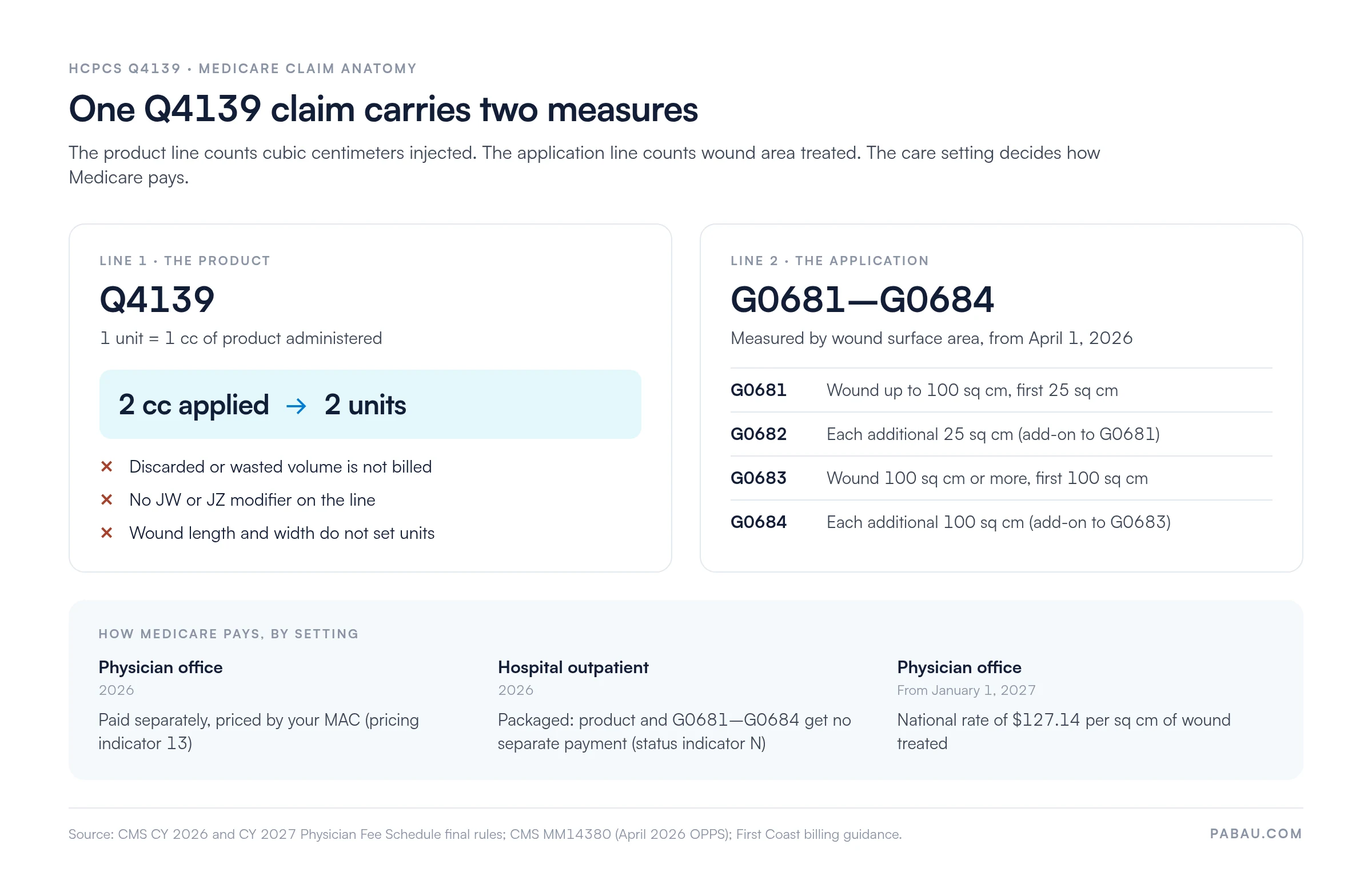
Q4139 units equal the volume of product administered, counted in cubic centimeters. One unit is 1 cc, so 2 cc applied to the wound is reported as 2 units. Wound length and width do not set the unit count for Q4139.
The CY 2026 Physician Fee Schedule final rule states that skin substitutes paid as incident-to supplies are not subject to the Medicare discarded drug policy. Medicare MACs such as First Coast do not pay for or accept discarded or wasted skin substitute units. Bill only the cc administered on Q4139, with no JW or JZ modifier. Commercial payers set their own waste rules, so check the plan.
Measure the wound at every application as well. The application codes for non-sheet products are built on wound surface area, so the note needs both the area treated and the volume used.
Photograph the product label before you open the vial. The label shows the lot number and the volume, and the photo ties the cc billed on Q4139 to a specific product in the chart.
Q4139 is a supply code, so the application service goes on its own claim line. For an injectable like Q4139, that line is not CPT 15271-15278. CMS noted in its CY 2026 rule that the CPT manual excludes powders and injectables from those codes.
Since April 1, 2026, HCPCS codes G0681-G0684 describe the application of a non-sheet form skin substitute. Each one is measured by the wound surface area treated, not by the volume of product.
A Q4139 claim therefore carries two measures. The product line counts cc, and the application line counts wound area. Confirm the pairing with your MAC before the first claim, because its billing articles set the local rules.
NCCI edits decide which codes can share a date of service. Debridement codes such as 97597 can sometimes be billed alongside an application code, but edit pairs change quarterly. Check the current NCCI table before combining them.
Since January 1, 2026, Medicare has paid for skin substitutes as incident-to supplies when they are used in a covered application procedure. Sheet products get one national rate of $127.14 per square centimeter, before geographic adjustment.
Q4139 does not get that rate in 2026. CMS counts non-sheet products as skin substitutes, but it left their pricing to the MACs. The CMS HCPCS file shows this with pricing indicator 13, meaning the contractor sets the price.
That MAC-priced, separately paid model applies in the physician office. In the hospital outpatient department, non-sheet products and their application stay packaged for 2026. CMS’s April 2026 OPPS update gave G0681-G0684 status indicator N, so they get no separate payment there.
The CY 2027 Physician Fee Schedule final rule prices non-sheet products nationally on a per square centimeter basis. For these products, CMS says a square centimeter reflects the wound surface area treated, not the product’s size.
The Q4139 descriptor stays at 1 cc, because CMS kept the existing descriptors. Watch for your MAC’s 2027 billing instructions on how Q4139 units line up with the area treated.
Every Q4139 claim needs a diagnosis that meets the medical necessity criteria in the payer’s policy. The table lists the code families MACs most often accept for chronic wounds. Check your MAC’s current LCD and billing article for the exact list.
An unspecified code invites a CO-50 denial. Type 2 diabetes with a foot ulcer takes E11.621, which supports a wound claim. E11.9, type 2 diabetes without complications, does not. Search LCDs and billing articles in the Medicare Coverage Database.
The codes around Q4139 describe related amniotic products, but they bill differently. Q4137, Q4138, and Q4140 are sheet products billed per square centimeter. Q4139 is the injectable, billed per cc.
Match the product invoice to the descriptor, never to the code number. A sheet product billed under Q4139 reports the wrong unit and the wrong application code. Q4100 is wrong whenever AmnioMatrix or BioDmatrix was used, because Q4139 names them. Verify the mapping in the CMS HCPCS code files.
Medicare Part B coverage for skin substitutes runs through each MAC’s LCDs and billing articles, with no single national coverage policy. In December 2025, CMS announced that the MACs would withdraw the new LCDs for diabetic foot and venous leg ulcers. Check which policy your MAC applies before the first application.
These rules appear across most MAC policies and payer plans.
A denial for undocumented standard care is hard to appeal, because the chart lacks the evidence. Build the documentation checklist into the workflow before the product is ordered. A structured billing workflow ties each requirement to an ordering step.
Read the Physician Fee Schedule final rule each November, as well as your MAC’s LCD each January. CMS changed the payment basis for non-sheet products two years running, and both changes reached Q4139.
Payers check Q4139 claims against a documentation list drawn from the applicable policy. A missing element is enough for a denial, even when the application was clinically appropriate.
Structured templates that map each element to a chart field cut rework on high-volume wound care. The guide to medical billing compliance covers documentation that holds up under payer audit. CrossCoder lets coders check LCD and billing article policies by MAC jurisdiction.
Most Q4139 denials trace back to the chart or the payer policy, not to the code itself. The table maps the most frequent claim adjustment reason codes to their cause and fix.
Medicare has a five-level appeals process. Most successful Q4139 appeals end at Level 1 or Level 2, when the missing documentation was in the chart but not sent with the claim.
Keep a standard appeal packet with the care log, photographs, product invoice, administration note, and a one-page policy summary. Denial management workflows help practices categorize and prioritize Q41xx appeals by denial type. The Medicare Informatics HCPCS tables add a quick lookup for code details.
Q4139 claims fail when the cc on the claim, the lot in the stock record, and the volume in the note disagree. Many practices keep those in three places: a billing tool, an inventory sheet, and the chart.
Pabau, a practice management platform with built-in claims management, keeps them on one patient record. The product lot is recorded against the patient and the appointment. US claims go out as CMS-1500/837P through Claim.MD, with eligibility checks and ERA remittances.
Prior authorization is tracked on the case, with the auth code, dates, and sessions. Pabau shows a warning when an authorization is missing, so the team can catch it before the claim goes out.
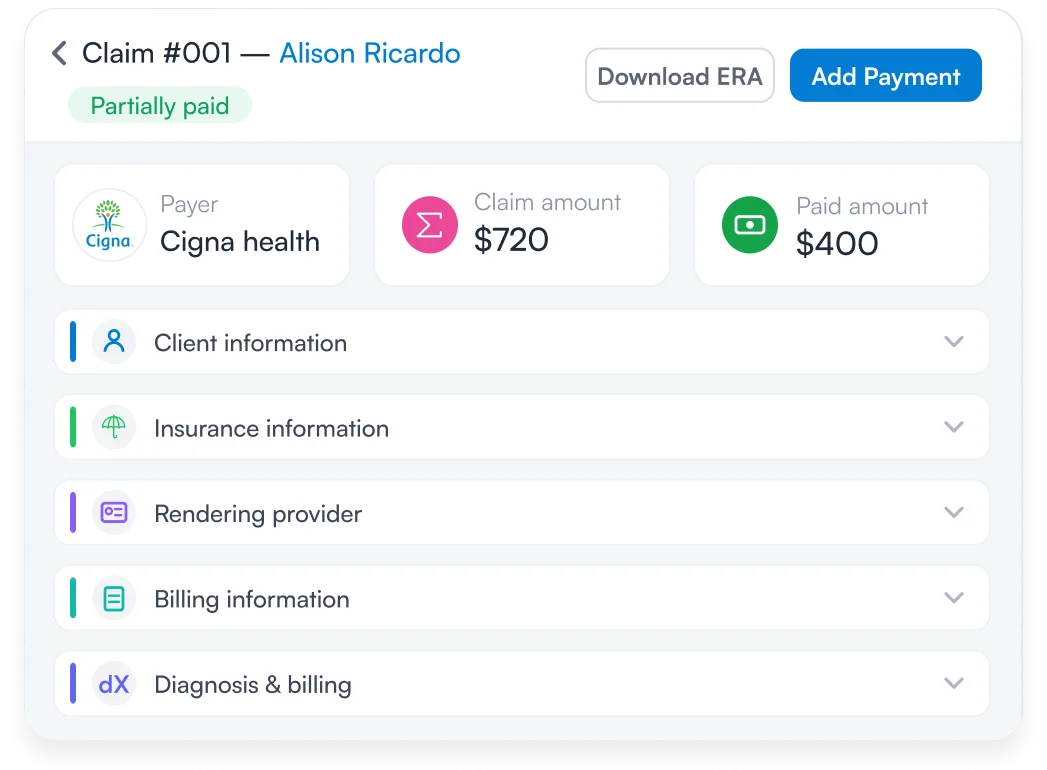

Pabau records the product lot against the visit and tracks prior authorization on the case. US claims go out through Claim.MD from the same patient record.

Q4139 rewards practices that bill it as what it is: an injectable measured in cc. Treat it like the sheet products around it, and the units, the application code, and the payment method go wrong together.
The work happens before the claim. Record the volume administered, the lot, and the wound area in the same note, and bill only the cc that went into the wound. Confirm payer coverage first, since some commercial plans treat injectable amniotic products as investigational. Then plan for January 2027, when Medicare’s payment basis for non-sheet products changes.
Book a demo to see how Pabau keeps product lots, authorizations, and wound care claims on one patient record.

Need a full wound care billing workflow? Revenue cycle management for healthcare practices explains how to structure billing, documentation, and denial tracking across the full claim lifecycle.
Struggling with claim denials across your practice? Denial codes in medical billing provides a reference guide to CARC and RARC codes, their meanings, and the corrective actions that resolve each denial type.
Want to submit cleaner claims first time? What is a clean claim in medical billing outlines the elements every claim needs before submission to avoid preventable rejections and denials.
HCPCS code Q4139 covers AmnioMatrix or BioDmatrix, injectable, billed per 1 cc of product. CMS classes it as a non-sheet skin substitute in the HCT/P category. Its application is reported on a separate line, with G0681-G0684 from April 1, 2026.
Report one unit for each cc of product administered, so 3 cc equals 3 units. Wound length and width do not set the unit count. Medicare MACs such as First Coast do not pay for discarded product, so leave waste off the claim and add no JW or JZ modifier. Commercial plans set their own rules, so check the plan.
Use the non-sheet application codes G0681-G0684, in effect since April 1, 2026, which are measured by the wound surface area treated. CPT 15271-15278 exclude injectables, as CMS noted in its CY 2026 rule. Confirm the pairing with your MAC.
Original Medicare has no single national prior authorization rule for Q4139. In the six WISeR model states, skin and tissue substitutes go through prior authorization review. Medicare Advantage plans often set their own requirements, so check the plan before the first application.
In a physician office in 2026, your MAC sets the price, because CMS left non-sheet skin substitutes to contractor pricing. In the hospital outpatient department, Q4139 and its application are packaged for 2026. From January 1, 2027, the physician fee schedule pays non-sheet products $127.14 per square centimeter of wound treated, before geographic adjustment.
Q4139 names one product pair, AmnioMatrix or BioDmatrix injectable, billed per cc. Q4100 is the not-otherwise-specified skin substitute code, for products without a code of their own. Billing Q4100 for AmnioMatrix or BioDmatrix misreports the product.
The most common causes are CO-50 for medical necessity and CO-197 for missing prior authorization. A mismatch between the units billed and the cc documented draws a CO-16 denial. Some commercial payers deny Q4139 outright as investigational.