CPT Code 64680: Neurolytic celiac plexus block
CPT Code 64680: Official descriptor and code category CPT Code 64680 reports des...

Last Updated: Nov 18, 2026
19361 is the CPT code for breast reconstruction with a latissimus dorsi flap. The surgeon harvests the latissimus dorsi muscle from the back and tunnels it to the chest wall with its blood supply intact. An implant placed with the flap is not part of 19361 and is reported separately with 19340 or 19342.
The code sits in the Breast subsection (19000–19499) of the integumentary system. An operative note that never names the flap harvest is a common reason 19361 claims get denied or audited.
Let Pabau's smart automation suggest the right codes, reduce claim denials, and keep your practice compliant—effortlessly.
Automate repetitive tasks and focus on what matters most—your patients.
Reduce coding errors and ensure compliance with the latest regulations.
Clean claims, fewer denials, and faster reimbursements.
Powerful insights and reporting to help your practice thrive.
HIPAA compliant SOC 2 certified GDPR-compliant Trusted by 4,000+ clinics worldwide

CPT code 19361 reports breast reconstruction with a latissimus dorsi flap, and the operative note must document the flap harvest for the code to hold.
An implant placed with the flap is not part of 19361, so report it separately with 19340 or 19342.
The code carries a 90-day global period, so routine follow-up inside that window is bundled into the surgical payment.
Z42.1 goes first on reconstruction-only claims, while an active breast malignancy treated at the same session is sequenced ahead of it.
Commercial payers and Medicare Advantage plans usually require prior authorization, so confirm it is valid on the date of service.
CPT code 19361 is the Category I CPT code for breast reconstruction with a latissimus dorsi flap. It belongs to the CPT code set, which the AMA’s CPT Editorial Panel maintains and updates. Since CPT 2021, the descriptor reads “Breast reconstruction; with latissimus dorsi flap.” The older “without prosthetic implant” wording is gone. The code still covers the flap only.
An implant placed with the flap is reported on its own line. Use 19340 when it goes in on the same day as the mastectomy, and 19342 when it goes in on a separate day. The code sits in the Breast subsection (19000-19499) of the Surgery/Integumentary System section of the CPT codebook.
CMS publishes Medicare Physician Fee Schedule values for 19361 every calendar year. Check the current RVUs and national rate in the CMS Physician Fee Schedule Look-Up Tool before you bill, because the figures change each January. The table below sums up how the code is structured.
Important: Take the national Medicare rate from the current CMS fee schedule files, not from a third-party fee schedule site. Commercial rates follow each payer contract.
The latissimus dorsi (LD) flap is a pedicled autologous flap. The surgeon harvests the latissimus dorsi muscle from the patient’s back, along with its overlying skin and fat. The thoracodorsal vessels stay attached, so the flap keeps its own blood supply. It is then tunneled under the skin to the chest wall and inset to rebuild the breast mound.
An implant may be placed at the same session for volume, and it gets its own code. For 19361 to hold up, the operative note must reflect each step of the flap work. A missing element gives the payer grounds to downcode or deny. Coders should look for these phrases in the note.
The global package for 19361 decides what you can bill on top of it. Knowing where it ends prevents unbundling errors and duplicate-claim denials.
Several breast reconstruction codes in the 19340-19369 range get mixed up. The technique decides the code in almost every case. Was a flap harvested, which flap was it, and was a microvascular anastomosis performed? Aetna’s breast reconstruction policy lists the current descriptor for each code below.
The diagram below runs the same decision in the order a coder reads the operative note.
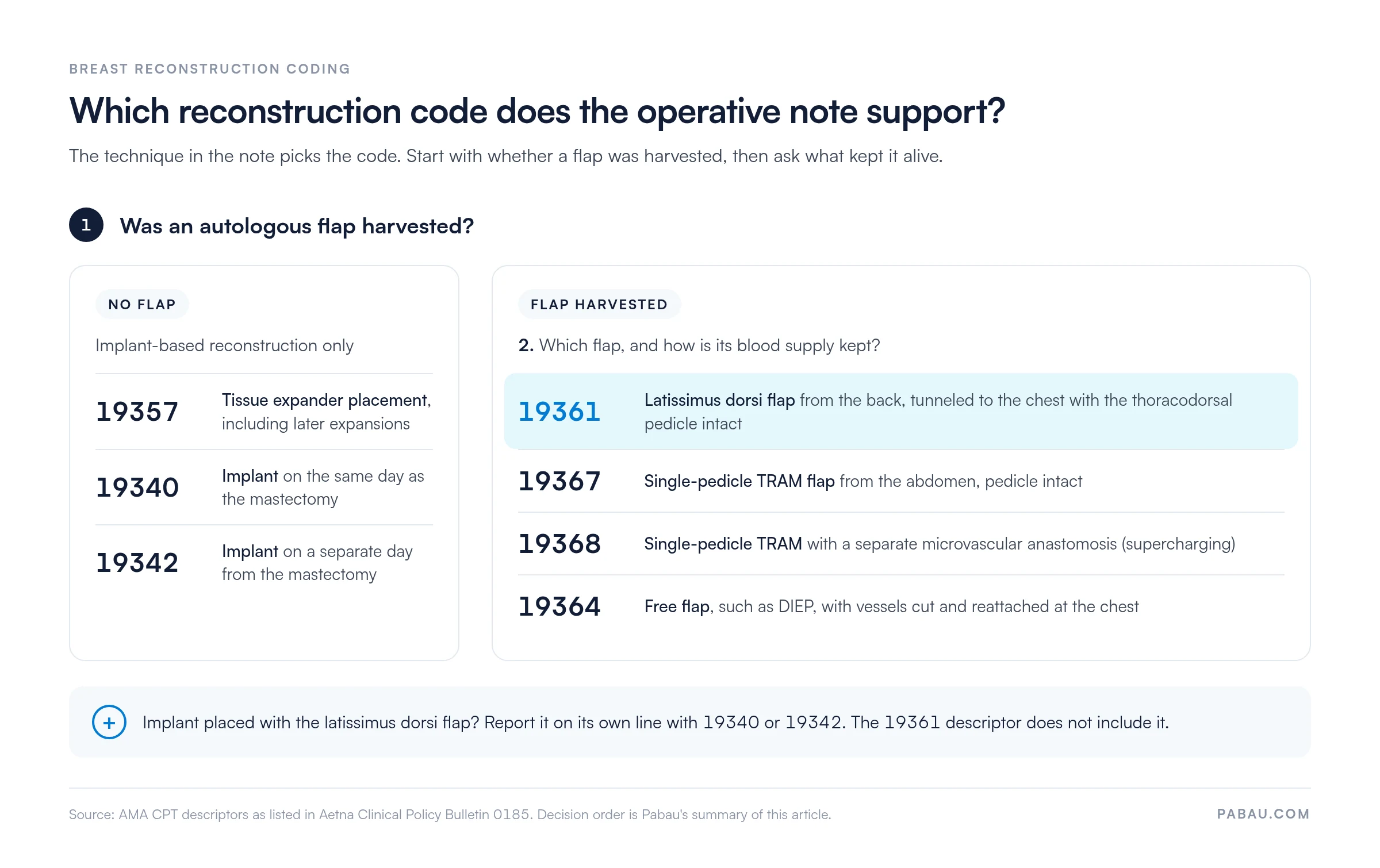
CPT code 19357 reports tissue expander placement in breast reconstruction, including the expansions that follow. It involves no flap harvest. A permanent implant placed without a flap is coded 19342, or 19340 when it goes in on the day of the mastectomy. If the operative note does not describe harvesting and tunneling the latissimus dorsi muscle, 19361 is the wrong code. No flap harvest, no 19361.
CPT code 19364 covers free-flap breast reconstruction. The flap’s blood supply is cut and reattached at the chest through a microvascular anastomosis. CPT 19361 is a pedicled LD flap, and the thoracodorsal vessels stay intact throughout. If the note describes a free flap reattached this way, 19364 is the correct code. DIEP and free TRAM reconstruction also use 19364, not 19361.
Incorrect modifier use is a common reason 19361 claims are paid at reduced rates or rejected outright. The table below summarizes the modifiers most relevant to 19361 billing, per guidance from the AAPC CPT code reference.
Before you append Modifier 50 to a 19361 claim, confirm the payer accepts bilateral reconstruction on a single line item. Some payers want two lines with RT and LT instead. Getting this wrong means a denial rather than a reduced payment, plus an appeal you could have avoided.
Every 19361 claim links to an ICD-10-CM diagnosis code that tells the payer why the reconstruction is medically necessary. Z42.1 is the principal diagnosis for most post-mastectomy reconstruction encounters, as listed in the CDC/NCHS ICD-10-CM coding tool.
Sequencing rule: Z42.1 is the principal diagnosis when breast reconstruction is the only reason for the encounter. When an active malignancy (C50.x) is treated at the same session, sequence the malignancy code first and add Z42.1 after it. Wrong sequencing is a denial trigger reviewers flag.
Most commercial payers and Medicare Advantage plans require prior authorization before 19361 is performed. Missing authorization, or authorization obtained on the wrong code, is a leading denial cause for breast reconstruction claims. A tight medical billing compliance routine catches both before surgery is scheduled.
Original Medicare (Parts A and B) generally does not require prior authorization for surgical breast reconstruction. Still, check with the Medicare Administrative Contractor (MAC) that covers your region.
Medicare Part B covers CPT 19361 as a physician professional fee billed on a CMS-1500 claim form. The hospital or ambulatory surgery center bills the facility fee for the same procedure under its own payment rules. That fee never goes on the physician’s claim.
The WHCRA mandate means most group health plan denials on coverage grounds can be appealed. Cite the mandate in the appeal letter.
Check these points before you submit:
CPT code 19361 carries a 90-day global surgical period, shown as “090” in the CMS fee schedule. What sits inside that period decides how follow-up services are billed. For a grounding in how global periods fit the wider revenue cycle, see the medical billing fundamentals guide.
What the global package includes: The pre-operative visit on the day before or day of surgery, plus the intraoperative service itself. It also covers routine post-operative follow-up within 90 days of the procedure date. None of these can be billed separately.
When separate billing is allowed inside the global period:
Most 19361 denials are preventable. The patterns below follow coding guidance from the AAPC and reflect commonly reported denial reasons in reconstructive surgery billing. A structured denial management workflow catches most of them before the claim leaves the practice.
When a claim is denied, the claim adjustment reason code (CARC) and remittance advice remark code (RARC) on the ERA identify the reason. See the reference guide to denial codes in medical billing for a full CARC/RARC lookup.
Run this checklist before submitting any 19361 claim. Every item maps to a common audit finding or denial trigger. Submitting a clean claim means confirming each point against the operative note before the claim leaves the practice.
Most 19361 denials start well before the claim is built. An authorization lapses, a diagnosis goes in the wrong order, or the implant line never gets added. Those are workflow problems, so they get fixed where the case is managed.
Pabau, the practice management and billing platform we build, tracks the authorization code, dates and sessions on the patient’s case. It warns your team when an authorization is missing, so the problem surfaces before the surgery date. US claims go out through Claim.MD as CMS-1500/837P claims, with eligibility checks before the date of service.
Pabau’s claims management software also records the remittance and any secondary claim against the same patient. Your billing team can trace each 19361 payment back to the case behind it, which helps when a payer audits the flap documentation.
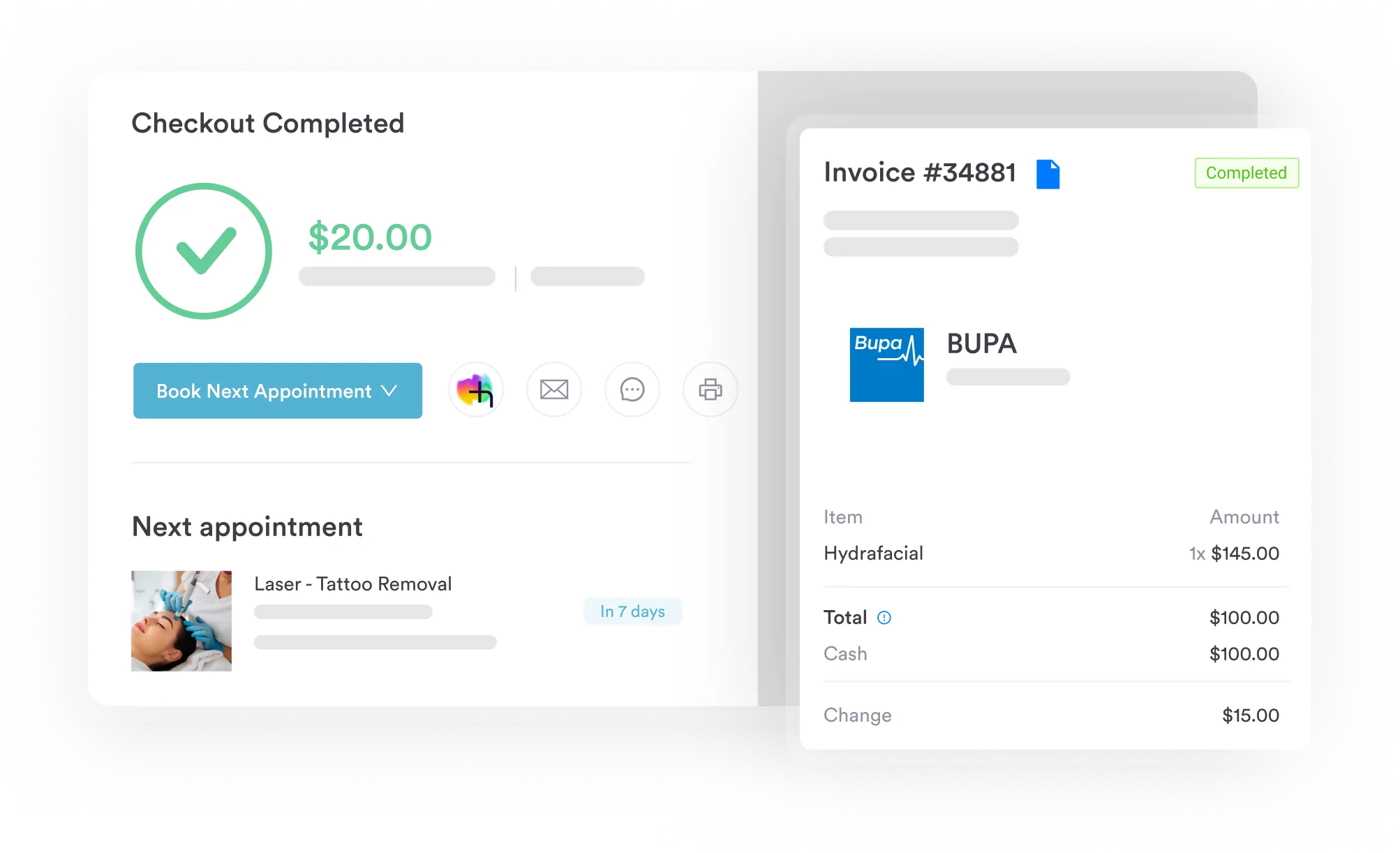

Pabau tracks authorization codes, dates and sessions on the case and warns when one is missing. Claims go to US payers through Claim.MD, with eligibility checks before the date of service.

CPT 19361 pays for the flap and nothing else. The claim holds up when the operative note names the latissimus dorsi harvest and the intact pedicle. Any implant goes on its own 19340 or 19342 line.
Before the claim leaves, confirm two things. The prior authorization must cover the date of service. Any E&M visit inside the 90-day global needs the right modifier, or it will deny as bundled.
Pabau tracks those authorizations on the case and warns your team when one is missing. Book a demo to see how it supports reconstructive surgery billing in your practice.

Coding a TRAM flap instead? CPT code 19367 covers single-pedicle TRAM reconstruction from the abdomen and how it differs from the LD flap.
Struggling with remittance advice interpretation? Electronic remittance advice explained breaks down ERA file formats and 835 transaction sets for billing teams.
Want to reduce 837 file rejections before they hit the payer? Understanding the 837 file format covers the transaction set structure that determines whether a claim is accepted or rejected at the clearinghouse.
CPT code 19361 covers breast reconstruction with a latissimus dorsi flap. It does not include an implant, which is reported separately with 19340 or 19342. The operative note must document the harvest and tunneling of the latissimus dorsi muscle. Without that, 19361 cannot be supported.
CPT code 19367 describes breast reconstruction with a single-pedicle TRAM (transverse rectus abdominis myocutaneous) flap, harvested from the abdomen. CPT code 19361 uses the latissimus dorsi muscle from the back. The donor site and the muscle used set them apart. Both are pedicled flaps with an intact blood supply, but they have separate code descriptors.
CPT code 19361 carries a 90-day global surgical period. Routine pre-operative and post-operative care within that window is bundled into the procedure payment. Use Modifier 24 for an unrelated E&M visit, 57 for the visit that results in the decision to operate, and 79 for an unrelated procedure. Modifier 78 covers an unplanned return to the operating room for a complication, and no new global period starts.
The most common reasons are missing or expired prior authorization and Z42.1 sequenced wrongly for the encounter. An operative note that never describes the latissimus dorsi harvest is another. Others include an implant left off the claim instead of billed with 19340 or 19342, and a bilateral modifier error. A place-of-service mismatch between the professional and facility claims also causes denials.