CPT Code 19361: Latissimus dorsi flap breast reconstruction
CPT code 19361: Official descriptor and payment basics CPT code 19361 is the Cat...

Last Updated: Nov 18, 2026
64680 is the CPT code for destruction by neurolytic agent, with or without radiologic monitoring; celiac plexus.
Pain management physicians, interventional radiologists, and anesthesiologists report it when they permanently ablate the celiac nerve network with alcohol or phenol. The usual goal is control of severe visceral pain from pancreatic cancer or intractable chronic pancreatitis. Imaging guidance is included in the code, and payers audit neurolytic procedures, so the operative note must name the agent and the indication.
Let Pabau's smart automation suggest the right codes, reduce claim denials, and keep your practice compliant—effortlessly.
Automate repetitive tasks and focus on what matters most—your patients.
Reduce coding errors and ensure compliance with the latest regulations.
Clean claims, fewer denials, and faster reimbursements.
Powerful insights and reporting to help your practice thrive.
HIPAA compliant SOC 2 certified GDPR-compliant Trusted by 4,000+ clinics worldwide

CPT 64680 describes permanent chemical ablation of the celiac plexus, distinct from the temporary anesthetic block reported with CPT 64530.
Radiologic monitoring is included in 64680, so CT, fluoroscopic or ultrasound guidance is never reported as a separate code.
Modifier 50 (bilateral) almost never applies, because the celiac plexus is a midline structure, not a paired nerve.
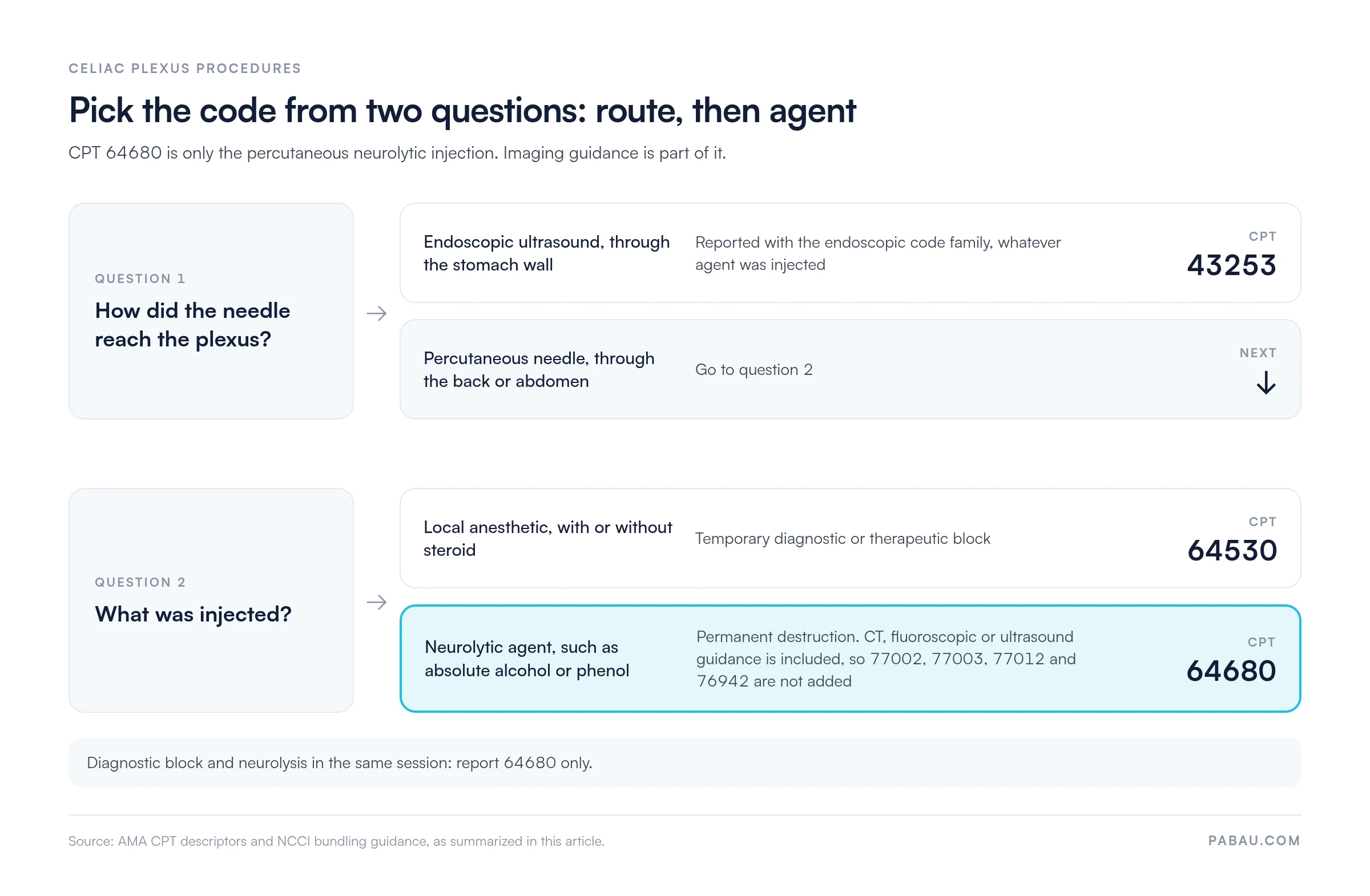
EUS-guided celiac neurolysis is an endoscopic procedure reported with CPT 43253, not 64680.
Pabau’s claims management software tracks prior authorization on the case and submits 64680 claims through Claim.MD, with eligibility checks and ERA remittances alongside.
CPT Code 64680 reports destruction of the celiac plexus with a neurolytic agent, such as absolute alcohol or phenol, with or without radiologic monitoring. The code belongs to the AMA’s CPT code set, in the Surgery section’s Nervous System range 64600-64681. That range covers destruction by neurolytic agent and chemodenervation, and the AMA publishes the full descriptor as follows.
Official descriptor: “Destruction by neurolytic agent, with or without radiologic monitoring; celiac plexus.”
The key phrase here is “destruction by neurolytic agent.” This wording sets 64680 apart from anesthetic or steroid blocks, because those only last a short time. A neurolytic agent, usually absolute alcohol or phenol, chemically ablates the nerve tissue. As a result, pain signals stop reaching the brain for the long term.
CPT 64680 covers celiac plexus neurolysis, the injection of a neurolytic agent into or around the celiac plexus. In practice, the agent ablates the nerve network that carries visceral pain from the upper abdominal organs. Also, the celiac plexus lies behind the abdominal lining at the T12-L1 vertebrae, in front of the aorta.
The code also reports the percutaneous approach, the injection of the neurolytic agent, and any imaging guidance used to place the needle. Endoscopic ultrasound (EUS)-guided celiac neurolysis is a different procedure, reported with the endoscopic code 43253 rather than 64680. Primary clinical indications include:
However, radiologic monitoring is always bundled into CPT 64680. The descriptor reads “with or without radiologic monitoring”, so CT, fluoroscopic or ultrasound guidance used to place the needle is part of the code.
For that reason, do not add a guidance code such as 77002, 77003, 77012 or 76942 to a 64680 claim. Medicare’s NCCI edits treat that guidance as part of the procedure. Reporting it separately is therefore an unbundling error that draws post-payment audits.
CPT 64530 covers injection of an anesthetic or steroid agent into the celiac plexus for a diagnostic or temporary therapeutic purpose. By contrast, CPT 64680 covers permanent chemical destruction of that same structure. The clinical difference is permanent vs. temporary effect. Reporting both on the same date of service is an unbundling error under NCCI editing logic. That is because the neurolytic procedure (64680) subsumes any diagnostic injection.
A physician may perform a diagnostic celiac block to confirm pain response, then proceed straight to neurolysis in the same session. As a result, only CPT 64680 is reported. Likewise, National Correct Coding Initiative (NCCI) guidance does not let you bill the diagnostic part on its own at that visit.
The route matters as much as the agent, so the decision flow below asks about both before it lands on a code.
Several codes often appear with, or get confused with, CPT Code 64680 in pain management and interventional radiology billing.
Transforaminal epidural injections such as 64483 treat radicular spine pain, so they never stand in for a plexus code. Also, the 64681 superior hypogastric code is the usual mix-up for pelvic cancer pain.
Payers require a diagnosis code that justifies neurolytic (not merely anesthetic) intervention, because the effect is permanent. The ICD-10-CM codes most often accepted with CPT 64680 reflect malignant disease, intractable pancreatitis, or severe chronic pain that has not responded to conservative care. For example, using a vague diagnosis code, such as unspecified abdominal pain without prior treatment documentation, is a common medical necessity denial trigger.
Always list the most specific diagnosis code available as the primary code. If R10.9 or G89.29 is the standalone primary diagnosis, it will likely trigger a medical necessity review or denial.
Medicare pays CPT 64680 at the code’s total Relative Value Units (RVUs) times the annual conversion factor set by CMS. Facility and non-facility payment differ because the practice expense (PE) RVU is lower in a hospital or ASC. Instead, the facility bills for overhead on its own in those settings.
Use the FastRVU lookup tool to find the current work, practice expense, and malpractice RVU parts for 64680, since they vary by region. Payment amounts change each January when CMS updates the conversion factor and geographic practice cost index (GPCI) values. Verify current figures rather than relying on prior-year rates.
Workers’ compensation carriers usually pay at or above the Medicare fee schedule rate, although state fee schedule rules apply. Commercial payers negotiate their own rates, which often exceed Medicare but vary widely by plan. Always verify the contracted rate in your payer agreement before estimating reimbursement.
Applying the wrong modifier to CPT Code 64680 often causes claim rejection, so use the table below. The table below covers the modifiers most applicable to celiac plexus neurolysis, including one that is often misapplied.
The modifier 50 trap: Some celiac plexus neurolysis claims carry modifier 50 because the physician placed two needles. A bilateral paravertebral technique still ablates one structure, since the celiac plexus is a single midline network of ganglia.
As a result, payers often deny or question modifier 50 on this code. Report 64680 once, without the modifier, and the rejection never happens.
Payers audit neurolytic procedures, so incomplete documentation is a common reason CPT Code 64680 claims are denied on post-payment review. The operative report and supporting chart notes must contain each of the following elements before submission.
Most commercial payers and many Medicare Advantage plans require prior authorization for CPT 64680 before the procedure is performed. Standard criteria include:
Understanding medical billing fundamentals for high-cost procedures is the starting point, but prior auth status tracking needs to happen at the practice level before scheduling. Failing to obtain authorization when a payer requires it is a denial that cannot be fixed with an appeal afterward in most cases.
CPT 64680 has a fairly narrow denial pattern. If your practice bills this code often, you will meet one of the following denial triggers. Denial management workflows that catch these before submission cut the cost of appeals. Our guide to medical billing denial codes also explains the CARC and RARC codes each trigger returns.
When you bill CPT Code 64680, a clean workflow moves through six steps. A clean claim that pays on the first pass skips the rework cycle of denials, corrections and appeals.
Run a three-point check before submitting a CPT 64680 claim. Confirm the operative report names a neurolytic agent rather than an anesthetic. Verify the prior auth on file covers neurolysis specifically, and confirm modifier 50 is not on the claim. These three steps catch the majority of avoidable 64680 denials before they reach the payer.
Many 64680 denials start before the procedure, with an authorization nobody recorded or a claim built from an incomplete operative note. Pabau, the practice management platform we build, keeps the authorization and the claim on the same patient case.
Its claims management software tracks the prior authorization code, dates and approved sessions on the case. It warns you when an authorization is missing before the appointment is booked. Claims go out through Claim.MD, and then eligibility checks and ERA remittances come back to the same record.
However, Pabau does not choose or pair diagnosis codes for you. Your coders still own code selection, while the system keeps the authorization, the submission and the payment trail in one place.

Pabau’s claims management software tracks prior authorization on the patient case and submits claims through Claim.MD. Eligibility checks and ERA remittances land on the same record, so your team can follow each 64680 claim from approval to payment.

CPT 64680 pays for a single procedure, the percutaneous neurolytic injection of the celiac plexus, with guidance included. Code the route and the agent from the operative note, and then the choice between 64680, 64530 and 43253 settles itself.
The denials that remain are mostly avoidable before the patient arrives. Therefore, secure an authorization that names neurolysis, document failed conservative therapy, and keep modifier 50 and separate imaging codes off the claim. A practice that builds those checks into scheduling spends its billing hours posting payments instead of writing appeals.
Book a demo to see how Pabau tracks 64680 authorizations and claims for pain management practices.

Need to understand how clearinghouse submission works? Pabau’s Claim.MD clearinghouse guide explains how EDI claims are validated and submitted to over 4,000 US payers.
Confused by denial codes on your 835 remittance? Denial codes in medical billing breaks down CARC reason codes and what each one means for your 64680 appeals.
Billing the electronic claim format? The 837 file explained covers how CPT codes, ICD-10 pairings, and modifiers are structured in an 837P professional claim.
CPT Code 64680 is the billing code for destruction by neurolytic agent of the celiac plexus, with or without radiologic monitoring. A physician uses it when permanently ablating the celiac nerve network with a chemical agent such as absolute alcohol or phenol. The goal is control of severe visceral pain, most often from pancreatic cancer or intractable chronic pancreatitis.
No. CPT 64680 and CPT 64530 should not be billed together on the same date of service. Per NCCI editing logic, 64680 (neurolytic destruction) subsumes any diagnostic or anesthetic injection component, so only 64680 is reported when neurolysis is performed. Billing both codes together is an unbundling error that will trigger payer denial or recoupment.
Radiologic monitoring is included in CPT 64680. The descriptor covers the procedure with or without radiologic monitoring, so CT, fluoroscopic or ultrasound guidance is not reported separately. Adding 77002, 77003, 77012 or 76942 to the claim is an unbundling error under NCCI edits.
The ICD-10-CM codes most often paired with CPT 64680 are C25.0 or C25.9 (pancreatic malignancy) and K86.1 (other chronic pancreatitis). G89.29 (other chronic pain) works as a secondary code, and C22.0 (hepatocellular carcinoma) covers another upper abdominal cancer. The diagnosis must justify permanent neurolytic intervention. R10.9 (unspecified abdominal pain) used as a standalone primary diagnosis carries a high denial risk.