HCPCS code P9058: Red blood cells, leukocytes reduced, CMV-negative, irradiated
HCPCS code P9058: Official descriptor and key attributes HCPCS code P9058 report...

Last Updated: Oct 26, 2026
L1499 is the HCPCS Level II code for spinal orthosis, not otherwise specified. It is the miscellaneous code Medicare contractors accept for a complete spinal brace that no specific L-code describes.
L1499 has no fixed fee schedule amount, so the DME MAC prices each claim individually. It works from the claim narrative and fee schedule amounts for comparable equipment. The code also applies when a spinal brace whose only code requires custom fitting is delivered off the shelf.
Let Pabau's smart automation suggest the right codes, reduce claim denials, and keep your practice compliant—effortlessly.
Automate repetitive tasks and focus on what matters most—your patients.
Reduce coding errors and ensure compliance with the latest regulations.
Clean claims, fewer denials, and faster reimbursements.
Powerful insights and reporting to help your practice thrive.
HIPAA compliant SOC 2 certified GDPR-compliant Trusted by 4,000+ clinics worldwide

HCPCS code L1499 is the miscellaneous code for a complete spinal orthosis that no specific L-code describes.
L0999 covers an addition to a spinal orthosis, and L2999 is the lower extremity NOC code, so neither one replaces L1499.
CMS article A52500 sends a prefabricated spinal brace to L1499 when its only code requires custom fitting but it was delivered off the shelf.
Every L1499 claim needs a narrative naming the item, manufacturer, model and Supplier Price List amount, or it comes back unprocessable.
L1499 is not on the CMS Required Prior Authorization List, so billing a listed LSO or TLSO under it to avoid review is incorrect coding.
HCPCS code L1499 is the Level II code CMS lists as “spinal orthosis, not otherwise specified.” It is the not otherwise classified (NOC) code for a complete spinal brace. It closes the spinal orthosis range that runs from L0112 to L1499.
A joint DME MAC and PDAC billing reminder defines the purpose of a NOC L-code. It is “intended to describe a unique product which is not described by a specific L-code.” L1499 is therefore a last resort. You reach it only after the specific cervical, TLSO, LSO and scoliosis codes have been ruled out.
CMS policy article A52500 names L1499 as “the miscellaneous HCPCS code for billing of spinal orthoses.” The same article sends one specific delivery scenario to L1499, covered in the decision guidance below.
L1499 covers a complete spinal orthosis that no specific L-code fully describes. Under Medicare rules, the device must be rigid or semi-rigid. It must support a weak or deformed body part, or restrict motion in a diseased or injured one.
The code does not cover features that other L-codes already describe. The joint DME MAC reminder also rules out billing equipment or supplier time used in fabrication, modification or delivery. Payers treat NOC misuse as incorrect coding, whatever the intent, which makes it a medical billing compliance issue.
Work through four checks before you assign L1499. Stop at the first check that gives you a specific code.
Minor custom changes to a brace with a specific code do not move it to L1499. The CMS HCPCS Level II code set and the AAPC Codify HCPCS lookup help you run the search.
A52500 sends one common delivery scenario to L1499. Some prefabricated spinal codes end in “prefabricated, includes fitting and adjustment” and have no off-the-shelf twin.
L0458, a modular TLSO with two rigid plastic shells, is one example. If a qualified fitter customizes it at delivery, bill L0458. If the patient receives it with only minimal self-adjustment, A52500 says to bill the miscellaneous code, L1499.
Where a twin pair exists, such as L0631 and L0648, an off-the-shelf delivery goes to the off-the-shelf twin instead. A custom-fitted code billed after an off-the-shelf delivery is denied as incorrect coding.
The chart below puts the brace definition, the code search and the off-the-shelf rule into one sequence.
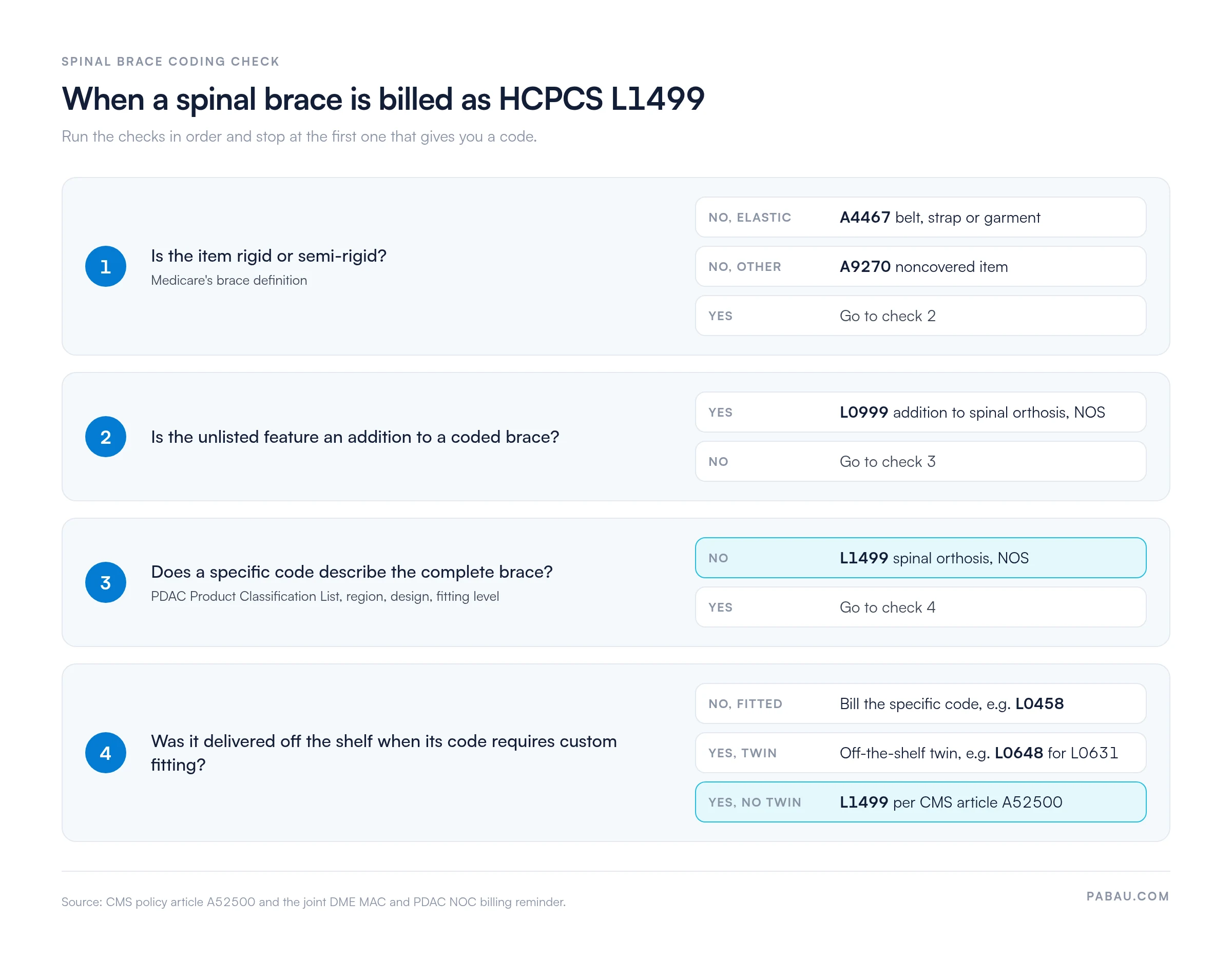
Before you default to L1499, search the PDAC Product Classification List for the exact product. A brace with a verified code assignment must be billed under that code. The PDAC Contact Center can advise on products that have not been reviewed.
Medicare covers spinal orthoses under the braces benefit in Social Security Act §1861(s)(9). LCD L33790 covers a spinal orthosis ordered for one of four indications:
L1499 carries pricing indicator 46, so the DME MAC prices each claim individually. Noridian sets the price from fee schedule amounts for comparable equipment and from other DME MACs’ fee schedules. Expect slower adjudication than on a fee-scheduled code.
An L1499 file has to prove two points: the brace is medically necessary, and no specific code describes it. Keep these records before the claim goes out.
Noridian requires a narrative on every NOC claim, in the NTE 2400 or NTE 2300 segment or Item 19 of the CMS-1500. The NTE 2400 field holds 80 characters, so use standard abbreviations. The narrative must state:
For a custom-fabricated brace, add what makes it unique and a breakdown of materials and labor charges. A claim without the narrative is denied as unprocessable, with no appeal rights, so you correct it and rebill.
L1499 is not on the CMS Required Prior Authorization List, updated July 29, 2026. Several spinal codes are, including L0631, L0637, L0639, L0648, L0650 and L0651. L0456, L0457 and L0486 join the list nationwide from October 28, 2026.
That turns the code choice into a compliance question. Billing a listed LSO or TLSO under L1499 to avoid review is incorrect coding, and the claim is denied once reviewed. Commercial and Medicaid plans set their own authorization rules for NOC codes, so check each payer before you dispense.
Most L1499 denials trace back to the code choice or the narrative rather than to coverage. Denial management in healthcare starts with reading the reason code correctly.
Our guide to medical billing denial codes defines each remittance code in full.
The spinal orthosis policy’s CG modifier applies only to listed specific codes, not to L1499. RT and LT do not apply to a spinal brace.
On the CMS-1500, report L1499 in Box 24D and the ordering practitioner’s NPI in Box 17b. Put the narrative in Item 19, or in the NTE segment of the 837P. The medical billing fundamentals overview covers the claim form fields most often completed incorrectly.
A52500 publishes no ICD-10-CM list for spinal orthoses, so no single diagnosis unlocks coverage. The diagnosis must support one of the four LCD indications and match the treating practitioner’s notes. These codes often appear on spinal brace claims.
A diagnosis that doesn’t fit the stated indication invites a medical necessity challenge. A brace ordered after fusion surgery but coded only as low back pain is a typical example.
Keep a one-page code-search checklist for every L1499 claim. List the TLSO, LSO and scoliosis codes you checked, the PDAC search result, and the fitting performed at delivery. That page answers the first questions an auditor asks.
Many suppliers track NOC claims across spreadsheets, scanned orders and a clearinghouse portal. The narrative gets typed at the last minute, and the code-search record is easy to lose.
Pabau, the practice management platform we build, keeps that work in one place, so claims management gets faster. Each claim is raised from the patient’s invoice and validated before it leaves Pabau. In the US, claims go to payers through Claim.MD, with eligibility checks before the visit.
Prior authorizations are stored as cases that follow the appointment through to the claim. A rejected claim is flagged Needs action, with a link to the field to fix. You send fewer unprocessable NOC claims and rebill faster when one comes back.
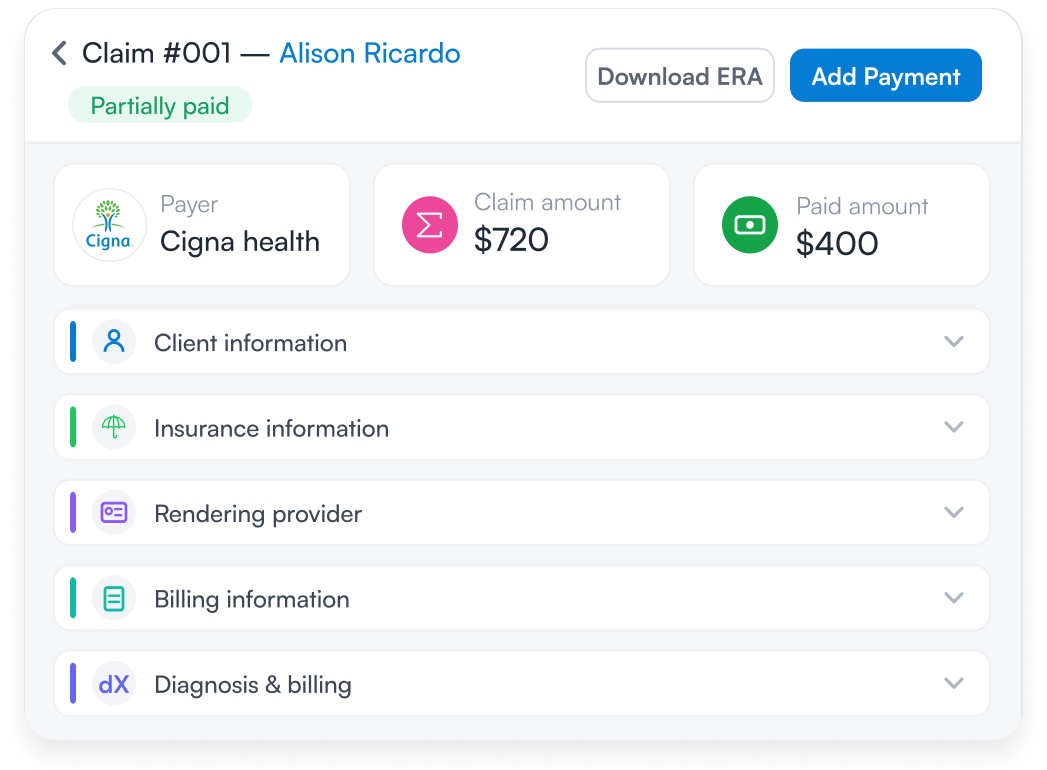

Pabau validates each claim before it reaches the clearinghouse and carries prior authorization codes from booking to billing, so your L1499 claims go out complete.

Treat L1499 as the answer you reach after the code search, never the starting point. When a specific TLSO, LSO or scoliosis code fits, bill it. When none fits, or a custom-fitted-only brace goes out off the shelf, L1499 is the correct code.
The trade-off is paperwork. A narrative, a code-search record and a fitting note take minutes before submission and can save weeks of rebilling. Book a demo to see how Pabau helps you send complete spinal orthosis claims the first time.

Looking for guidance on insurance eligibility checks before treatment? Insurance eligibility verification outlines how pre-claim checks prevent downstream payment issues.
Billing a custom-fitted LSO instead? HCPCS code L0631 covers the sagittal-control LSO that sits on the prior authorization list.
Coding an unlisted leg or knee brace? HCPCS code L2999 explains the lower extremity NOC code and when to use it.
HCPCS code L1499 is the Level II code for “spinal orthosis, not otherwise specified.” It is the miscellaneous code for a complete spinal brace that no specific L-code describes. It closes the spinal orthosis range, L0112 to L1499.
No. L1499 is the spinal orthosis NOC code. The lower extremity NOC code is L2999, and the upper limb NOC code is L3999. Billing a leg or knee brace under L1499 is incorrect coding.
L1499 describes a complete spinal orthosis that no specific code covers. L0999 describes an unlisted addition to a spinal orthosis. The joint DME MAC and PDAC guidance draws that line explicitly.
CMS article A52500 applies this rule when a prefabricated spinal brace’s only code requires custom fitting and has no off-the-shelf twin. If the brace was delivered with minimal self-adjustment, bill L1499 instead of the custom-fitted code.
Noridian requires a description of the item, the manufacturer, the product and model name and number, and the Supplier Price List amount. Add a related HCPCS code where one applies. Without the narrative, the claim is unprocessable and must be rebilled.
L1499 is not on the CMS Required Prior Authorization List, updated July 29, 2026. Several LSO and TLSO codes are on it. Commercial and Medicaid plans set their own rules, so check each payer before you dispense.
CO-189 means a NOC code was billed where a specific code exists. CO-16 with remark N350 means the NOC narrative is missing or incomplete. CO-50 is a medical necessity denial, and CO-197 means a required authorization was absent.