HCPCS code L0174: Cervical collar billing, PDAC and coverage rules
HCPCS code L0174 is a two-piece foam collar with a thoracic extension HCPCS code...

Last Updated: Nov 18, 2026
L0190 is the HCPCS Level II code for a cervical multiple post collar with occipital and mandibular supports and adjustable cervical bars. It covers the SOMI, Guilford and Taylor types, rigid braces that hold the neck still, often after a stable cervical fracture or neck surgery.
Medicare's DME MACs class L0190 as a prefabricated, custom-fitted orthosis with no off-the-shelf version. A trained fitter must adjust it in person at delivery and record how. A soft foam collar is never L0190, because it belongs under L0120.
Let Pabau's smart automation suggest the right codes, reduce claim denials, and keep your practice compliant—effortlessly.
Automate repetitive tasks and focus on what matters most—your patients.
Reduce coding errors and ensure compliance with the latest regulations.
Clean claims, fewer denials, and faster reimbursements.
Powerful insights and reporting to help your practice thrive.
HIPAA compliant SOC 2 certified GDPR-compliant Trusted by 4,000+ clinics worldwide

HCPCS code L0190 is a rigid multiple post collar with occipital and mandibular supports and adjustable cervical bars, the SOMI, Guilford and Taylor types.
A soft foam collar is L0120, and a two-piece semi-rigid thermoplastic collar falls under L0172 or L0174, never L0190.
The DME MACs class L0190 as custom fitted, so a trained fitter must adjust it at delivery and record how it was fitted.
No DME MAC LCD covers cervical orthoses, so Medicare coverage rests on the brace benefit and the treating practitioner’s records.
A second identical collar billed within its reasonable useful lifetime is denied by an automated CMS review unless the file justifies replacement.
HCPCS code L0190 reports a cervical multiple post collar with occipital and mandibular supports and adjustable cervical bars. The descriptor names the SOMI, Guilford and Taylor types. A joint DME MAC and PDAC coding article lists L0190 as a prefabricated, custom-fitted orthosis with no off-the-shelf equivalent.
In plain terms, this is the brace with a chest plate, a chin support and a back-of-head support joined by posts. It holds the neck far more firmly than any foam collar. That difference drives every coding decision below.
Most L0190 errors start with the device on the shelf, not the claim form. Check the brace against this list before you code it.
L0190 fits when the collar has:
Code it elsewhere when the device is:
The cervical codes read alike, so compare the device’s build with each descriptor. Ask the six questions below in order, and the first match gives you the code.
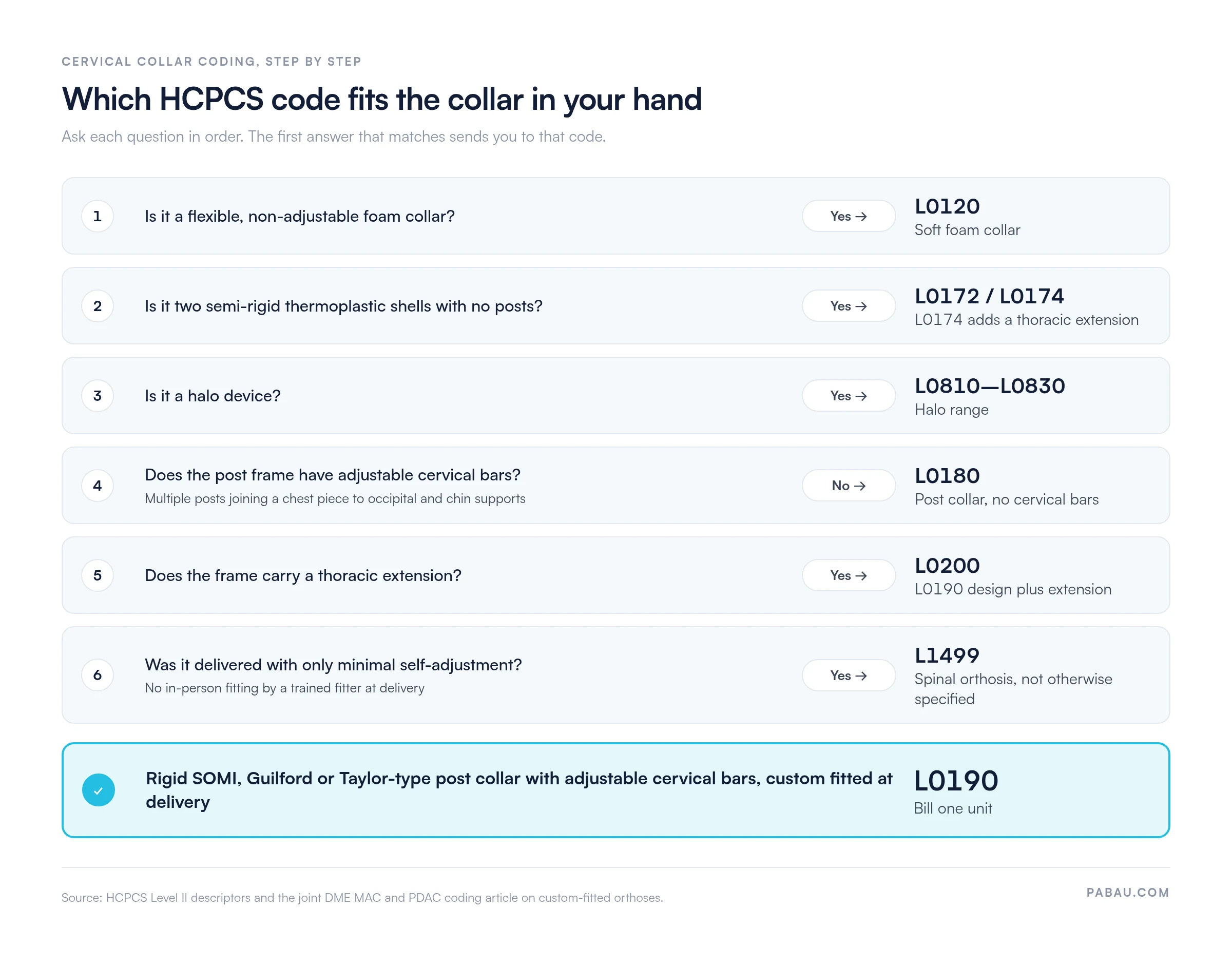
The table then sets the closest neighbors side by side, descriptor against descriptor.
L0180 is the sibling that causes most second-guessing. When the order just says “SOMI brace,” check the product itself. The manufacturer’s PDAC coding verification, where one exists, settles which of the two codes the model belongs to.
Because L0190 is custom fitted, the brace can’t simply be handed over or mailed. The joint DME MAC article sets three expectations for any custom-fitted orthosis.
What if the collar only needed minimal self-adjustment by the patient, caregiver or supplier? Then it was delivered off the shelf, and L0190 no longer applies. The same article directs suppliers to a not-otherwise-specified code instead, and for a spinal orthosis that is L1499.
Medicare pays for L0190 under the Part B braces benefit. The Medicare Benefit Policy Manual, Chapter 15, section 130 defines a brace as a rigid or semi-rigid device. It must support a weak or deformed body part, or restrict motion in a diseased or injured one.
Here’s what that means in practice:
With no LCD, Medicare publishes no covered-diagnosis list for cervical orthoses. These codes commonly appear on orders for rigid cervical bracing, but the notes must still explain why this brace was needed.
A Medicare reviewer reads the file, not the claim. Follow medical billing compliance habits and tick off each item before the claim leaves.
Does L0190 need the KX modifier? Not for traditional Medicare. KX attests that an LCD’s coverage criteria are met, and no LCD covers cervical orthoses. A commercial or Medicaid payer may still have its own rule.
What if you expect Medicare to deny it? Append GA when the patient signed an Advance Beneficiary Notice of Noncoverage (ABN). Use GZ when you expect a denial and have no ABN.
Is the collar a replacement? Add RA when you replace the whole orthosis. Use RB for a replacement part furnished as part of a repair.
Do you need RT or LT? No. A cervical collar has no side, so leave laterality modifiers off.
Here’s an illustrative case. A patient leaves the emergency department in a temporary collar after a stable cervical fracture. At follow-up, the spine surgeon orders a SOMI brace and signs a standard written order.
The orthotist checks the product’s PDAC coding, which confirms L0190. They fit the brace in the office, adjust the chin and occipital supports, and write a short fitting note. The patient signs the delivery receipt before leaving.
The claim carries one unit of L0190 with the S12 fracture code from the surgeon’s note and no KX. The file already holds the order, notes, fitting record and proof of delivery. If the DME MAC asks for records, the supplier can answer in a day.
On paper, the order, fitting note and delivery receipt often live in three places. When a records request arrives, someone has to find all three.
Pabau, the practice management platform we build, keeps them on one patient record. Your orthotist completes the fitting note as a digital form, and the patient signs the delivery receipt on a tablet. Both save to the record straight away.
For US practices, Pabau’s claims management software sends CMS-1500 and 837P claims through Claim.MD. It pre-fills the claim from the record and checks required fields before sending. Remittances post back, so your team sees a denied line next to the paperwork that answers it.

Pabau stores the order, fitting note and signed delivery receipt on the patient record, then sends the claim through Claim.MD. A records request no longer means a hunt through folders.

L0190 rewards suppliers who code the device in front of them. A rigid post collar with adjustable cervical bars is L0190, and a foam or two-piece collar never is.
The bigger risk sits in the fitting. Make the fitting note as routine as the delivery signature, and check claim history before any replacement. Those two habits protect the claim far better than any modifier.
Book a demo to see how Pabau keeps orders, fitting notes and claims together for orthotic practices.

Need a broader overview of the billing workflow? Understanding the medical billing process walks through each stage from encounter to remittance.
Seeing recurring denials you can’t explain? Denial management in healthcare covers how to find root causes and cut denial rates across claim types.
Want claims that pass on the first try? What is a clean claim sets out the definition, the rate to aim for and a checklist.
Dispensing soft collars too? HCPCS code L0120 explains billing for the flexible foam collar.
SOMI stands for sterno-occipital-mandibular immobilizer. The name maps the brace’s three contact points: the breastbone, the back of the head and the jaw.
No. A Philadelphia collar is a two-piece, semi-rigid thermoplastic foam collar with no posts. It is usually billed as L0172, or L0174 when it has a thoracic extension.
Halo devices have their own codes, L0810 to L0830, chosen by the jacket or vest the halo attaches to. A SOMI brace stays on L0190.
No. Orthoses go to the DME MAC, not the A/B MAC. A physician who dispenses the collar in-office must be enrolled as a DMEPOS supplier to bill it.
It can, when the collar is lost, irreparably damaged or no longer fits a changed condition. Document the reason and add the RA modifier. Without that record, an identical collar within its useful lifetime is denied.