HCPCS code L0174: Cervical collar billing, PDAC and coverage rules
HCPCS code L0174 is a two-piece foam collar with a thoracic extension HCPCS code...

Last Updated: Nov 18, 2026
L0160 is the HCPCS Level II code for cervical, semi-rigid, wire frame occipital/mandibular support, prefabricated, off-the-shelf.
It sits in the HCPCS Level II L-code series, which the Centers for Medicare & Medicaid Services uses to identify orthotics, prosthetics and durable medical equipment. The wire frame that supports the jaw and the back of the head is what sets L0160 apart from its neighbors. A two-piece thermoplastic foam collar bills as L0172, and a collar molded to a patient model bills as L0170. Multiple post collars with adjustable supports fall under L0180 and L0190. Matching the device in hand to the descriptor, and documenting that match, is what keeps the claim clean.
Let Pabau's smart automation suggest the right codes, reduce claim denials, and keep your practice compliant—effortlessly.
Automate repetitive tasks and focus on what matters most—your patients.
Reduce coding errors and ensure compliance with the latest regulations.
Clean claims, fewer denials, and faster reimbursements.
Powerful insights and reporting to help your practice thrive.
HIPAA compliant SOC 2 certified GDPR-compliant Trusted by 4,000+ clinics worldwide

L0160 is a semi-rigid cervical support built on a wire frame that holds the jaw and the back of the head, sold prefabricated and off-the-shelf.
A two-piece foam collar bills as L0172, or L0174 with a thoracic extension. A collar molded to a patient model bills as L0170.
Multiple post collars with adjustable occipital and mandibular supports bill as L0180, or L0190 with adjustable cervical bars.
The DME MAC spinal orthoses LCD covers back braces, not neck collars, so the medical record carries the case for L0160.
Most denials trace back to an incomplete order, an unsigned proof of delivery, or a code that doesn’t match the device in the box.
HCPCS code L0160 describes a cervical, semi-rigid, wire frame occipital/mandibular support, prefabricated, off-the-shelf.
That wording comes from CMS’s HCPCS Level II code set, which CMS maintains for orthotics and other DMEPOS items. In plain terms, it is a neck brace whose structure is a shaped wire frame. That frame supports the lower jaw at the front and the back of the skull behind.
It sits in the L0112 to L0174 cervical orthotics range, inside the orthotic procedures and devices section of HCPCS. L-codes bill through the DMEPOS benefit, not the physician fee schedule.
Each word of the descriptor narrows which device qualifies.
If any one of those elements fails, L0160 is the wrong code. The next section shows where that device most likely belongs instead.
Cervical collars look alike in a supply room, and the codes around L0160 are close in number. Sort them by construction first, then by whether the device extends onto the chest or upper back.
Notice where the thoracic-extension question lives. It splits L0172 from L0174, not L0160 from L0170. HCPCS code L0174 is the two-piece foam collar with that thoracic extension added. L0170 is the custom collar molded to a patient model, so the line between L0160 and L0170 is off-the-shelf versus custom. Swap the wire frame for a molded plastic chin cup and occipital piece, and the device becomes an L0150 chin cup collar.
At the bench, run six questions in order and stop at the first yes. Only a ready-made wire frame that holds the chin and the back of the head reaches L0160.
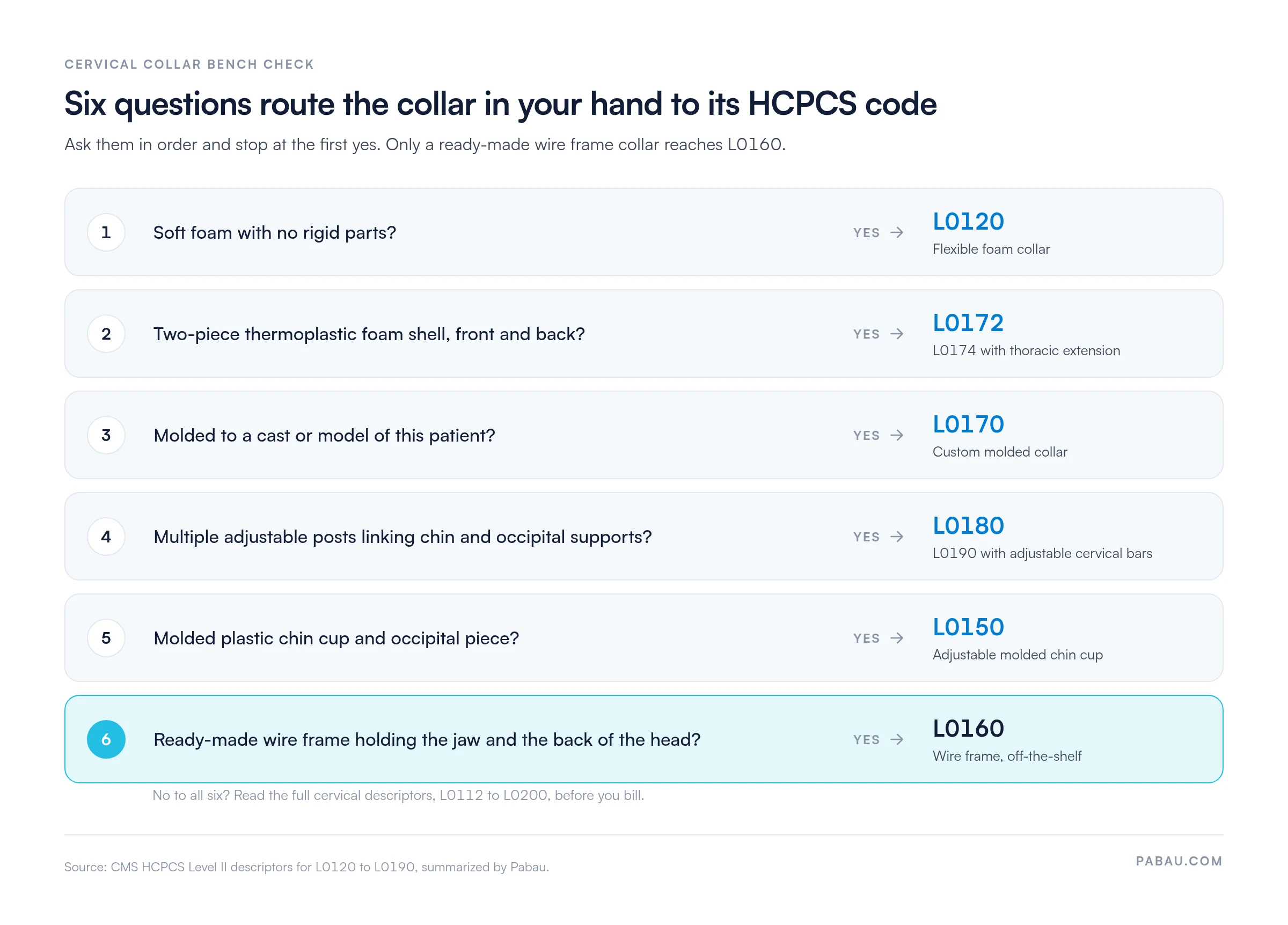
When the packaging and the device disagree, code the device. Manufacturers sometimes print a suggested code, but the supplier owns the code on the claim.
Medicare covers neck braces under the braces benefit of Part B. The DME MACs publish a spinal orthoses LCD, L33790. Its policy article lists only lumbar-sacral and thoracic-lumbar-sacral codes. Cervical collars such as L0160 are not on it.
That changes how you build the file. No LCD hands you a checklist of covered diagnoses. The treating practitioner’s notes have to explain why the patient needs this level of neck support. Typical diagnoses in physical therapy, orthopedic and urgent care settings include:
These are examples, not a payer list. A diagnosis code alone won’t carry the claim. The note should describe the exam findings, the reason for a semi-rigid device over a soft collar, and how long the patient should wear it.
Once the device matches the code, the paperwork takes over. The steps below follow one collar for a Medicare patient, and each is a point where a claim can stall.
Use one unit per collar. Report the place of service where the patient lives, usually 12 for home, rather than the office where the collar was fitted.
If an auditor asks for the file, it has to stand on its own. Build it before the claim goes out, not after the records request lands.
No certificate of medical necessity (CMN) applies to cervical orthoses. CMS keeps CMNs for a short list of items such as oxygen. Keep the order and proof of delivery for at least seven years.
Pull the proof of delivery and the order up side by side before you submit. The item description and quantity should match on both, and the delivery date should not come before the order date.
Orthoses are paid as purchases, so the rental modifiers that dominate other DME claims rarely come up. With no LCD criteria to attest to, there is no basis for adding KX to L0160 out of habit.
Commercial payers write their own rules. Some ask for NU on purchased items, so check the plan’s billing guide before the first claim.
Original Medicare’s orthoses prior authorization program targets specific spinal and knee codes, such as L0648 and L0650. L0160 is not one of them. Medicare Advantage and commercial plans are a different story, since many set their own authorization rules for orthotics.
When a plan does require it, run the request in this order:
Medicare pays L0160 from the DMEPOS fee schedule, which CMS updates at least once a year. Amounts vary by state, so look up the current file rather than relying on a figure from last year. The patient owes the Part B deductible and 20% coinsurance.
Two details shift what you collect. Suppliers who accept assignment take the allowed amount as payment in full. A competitive bidding contract, where one covers the item and the patient’s area, replaces the fee schedule amount.
Run this list on every collar claim before it leaves the building. Each line maps to a denial reason in the next section.
Denials tend to trace back to a short list of upstream slips. The denial codes on the remittance advice tell you which one you hit.
Here is a typical case. A supplier bills L0160 for a two-piece foam collar because the stock bin was labeled wrong. On review the device matches L0172, and the payment is taken back. A bench check at dispensing would have caught it before the claim went out.
A Medicare denial is not final. Fix a minor clerical error through a reopening, which is faster than a formal appeal. Otherwise, the path runs like this:
At every level, send new evidence rather than the same file twice. A short letter from the practitioner and a side-by-side of the device against the descriptor do most of the work. A denial management workflow that logs each reason shows you which upstream step keeps failing.
Many L0160 denials start with a missing signature or a blank field rather than a coding puzzle. Pabau, the practice management and billing platform we build, keeps the order, the visit note and the delivery record in one patient file.
Pabau’s claims management software pre-fills the claim from the record. Required claim fields must be complete before the claim can be sent. In the US, claims route through Claim.MD with eligibility checks, status tracking and electronic remittance posting.
When a Medicare Advantage plan wants prior authorization, the auth code, dates and sessions sit on the patient’s case. Pabau warns you when one is missing, so the collar doesn’t leave the shelf without it.
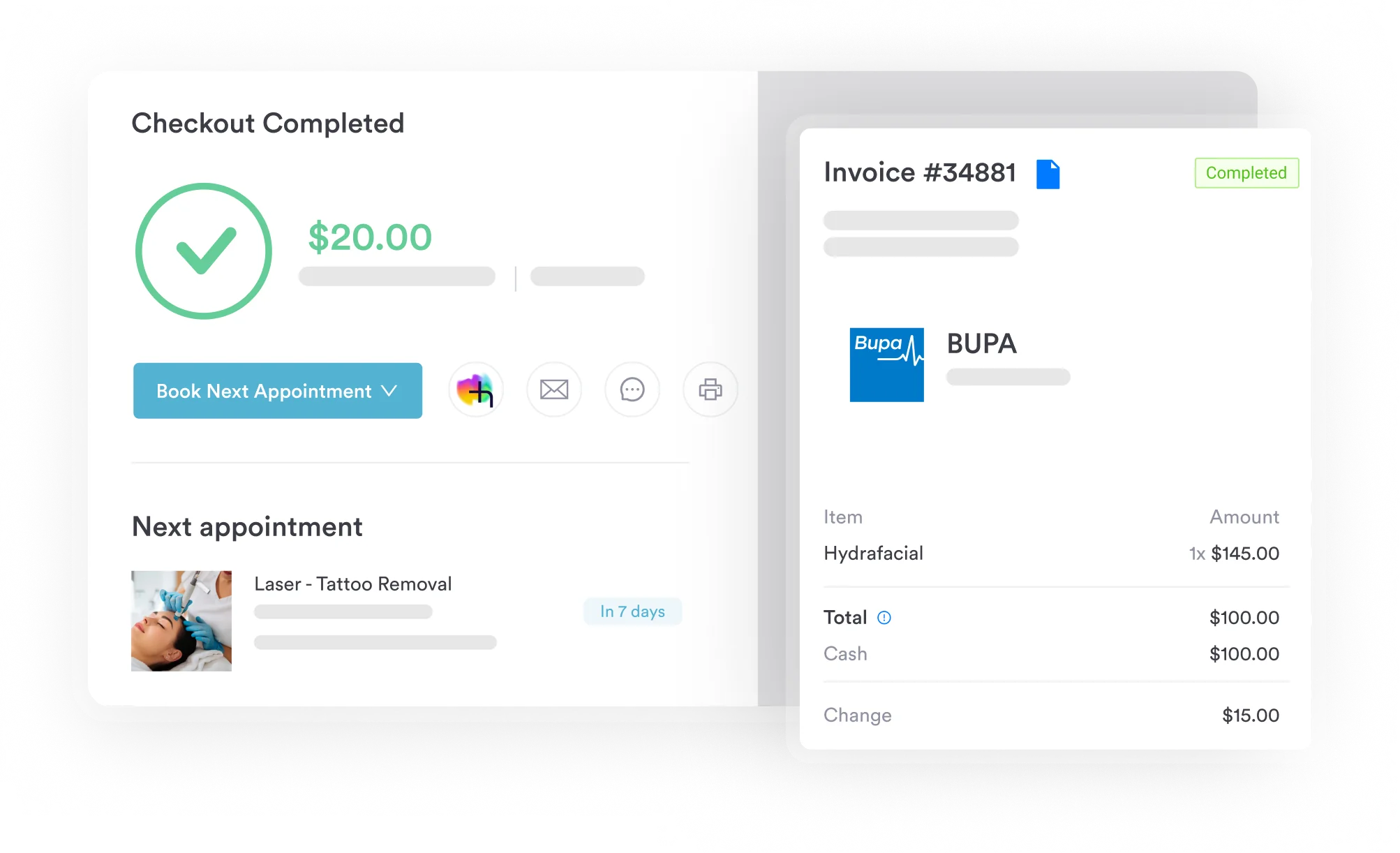

Pabau pre-fills claims from the patient record, checks required fields before submission, and tracks each claim through to payment.

L0160 is a narrow code. It fits one kind of device, a ready-made wire frame collar that holds the jaw and the back of the head. Get that match right and the biggest risk is gone.
The rest is file discipline. With no LCD to lean on, the practitioner’s note, a complete order and a signed delivery record decide whether the claim pays. Check them before you submit, not after a denial.
Book a demo to see how Pabau keeps orders, delivery records and claims in one place.

Billing a two-piece foam collar instead? HCPCS code L0172 covers the prefabricated thermoplastic foam collar that L0160 is most often confused with.
Need a denial management framework? Denial management in healthcare covers root-cause tracking and appeal timelines.
Looking for clean-claim habits? Clean claim best practices outlines the data elements that drive first-pass payment.
New to the billing cycle? What is revenue cycle management explains the process from intake to payment posting.
Usually not. A Philadelphia-style collar is a two-piece semi-rigid foam collar, which matches L0172. A version with a thoracic extension matches L0174. Always code from the device itself, not the brand name.
No. Off-the-shelf means the collar needs only minimal self-adjustment by the patient, a caregiver or the supplier. If an orthotist has to modify it, a different code may apply.
Whiplash is usually coded as S13.4XXA, sprain of ligaments of cervical spine, initial encounter. Follow-up visits take the D seventh character. The note still needs to explain why a semi-rigid collar is required.
No. Medicare accepts DMEPOS orders from physicians, nurse practitioners, physician assistants and clinical nurse specialists. A physical therapist can fit the collar and document the fitting, but one of those practitioners signs the order.
Only if the practice is enrolled with Medicare as a DMEPOS supplier. It then bills the DME MAC under that supplier number, not on its regular Part B claim. Otherwise, an enrolled supplier dispenses and bills the collar.