CPT Code 19361: Latissimus dorsi flap breast reconstruction
CPT code 19361: Official descriptor and payment basics CPT code 19361 is the Cat...

Last Updated: Nov 18, 2026
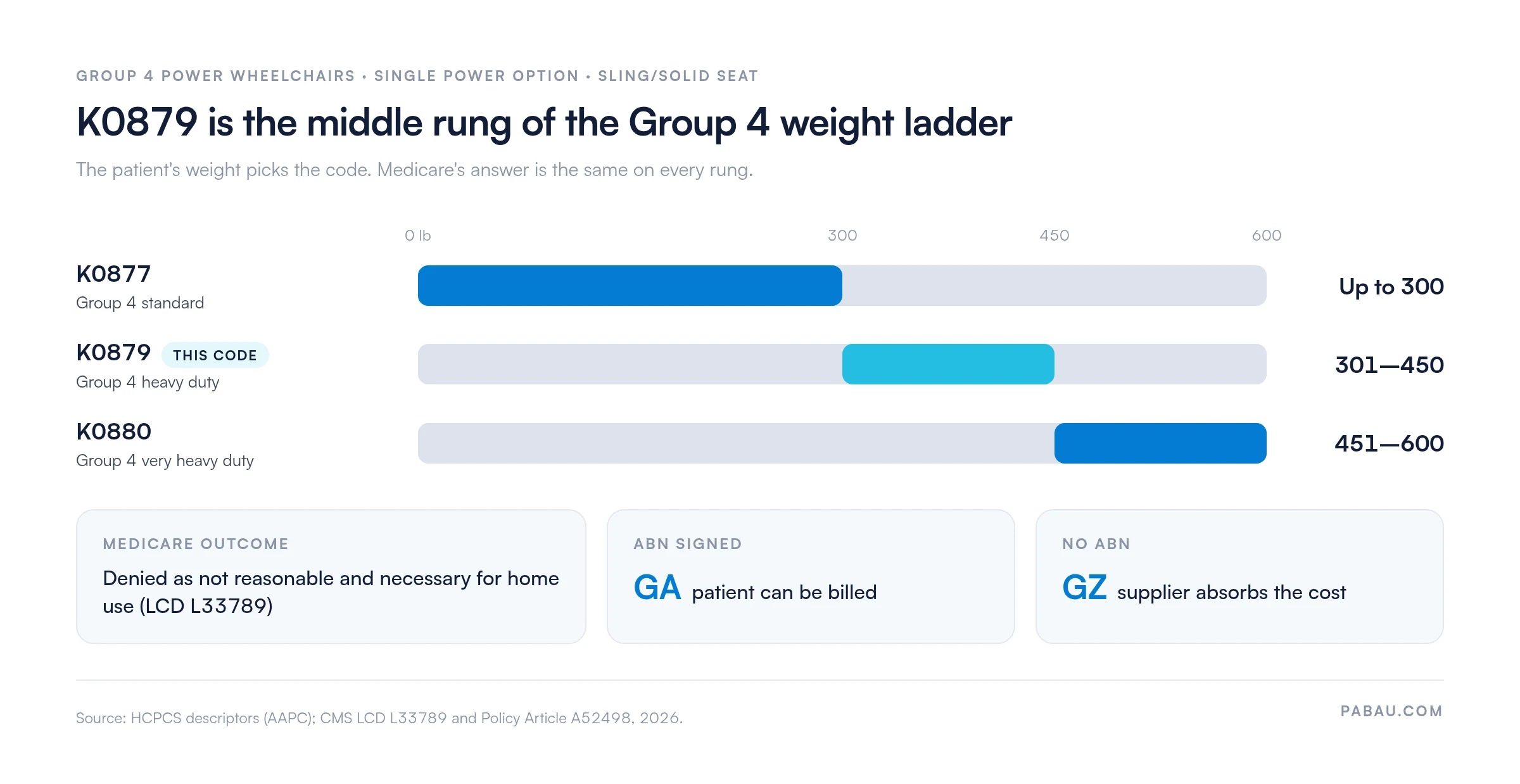
K0879 is the HCPCS Level II code for a Group 4 heavy duty power wheelchair, rated for patients weighing 301 to 450 pounds. It has a single power option and a sling/solid seat and back. The code covers the base chair, and accessories are billed separately under their own E-codes.
Group 4 chairs are built for more speed, range and obstacle climbing than home use requires. Medicare's power mobility devices policy denies them as not reasonable and necessary. Most K0879 claims therefore go out with a signed ABN and modifier GA, or with GZ when there is no ABN.
Let Pabau's smart automation suggest the right codes, reduce claim denials, and keep your practice compliant—effortlessly.
Automate repetitive tasks and focus on what matters most—your patients.
Reduce coding errors and ensure compliance with the latest regulations.
Clean claims, fewer denials, and faster reimbursements.
Powerful insights and reporting to help your practice thrive.
HIPAA compliant SOC 2 certified GDPR-compliant Trusted by 4,000+ clinics worldwide

HCPCS code K0879 bills a Group 4 heavy duty power wheelchair base for patients weighing 301 to 450 pounds. It has a single power option and a sling/solid seat and back.
Medicare’s Power Mobility Devices LCD (L33789) denies every Group 4 power wheelchair as not reasonable and necessary for home use.
With a signed ABN, bill K0879 with modifier GA so the patient can be charged. Without one, use GZ, and the supplier carries the cost.
Power wheelchairs no longer use a CMN. The file needs a face-to-face encounter within six months before the written order, and the order before delivery.
Pabau supports insurance billing through claims management, so the practice that documents the encounter can also track the claims it sends.
HCPCS code K0879 bills the power wheelchair itself, a Group 4 heavy duty chair for patients weighing 301 to 450 pounds. Medicare treats every Group 4 chair as not medically necessary. The Power Mobility Devices LCD says these chairs “will be denied as not reasonable and necessary.” The billing work is mostly about who pays.
The official descriptor reads: “Power wheelchair, group 4 heavy duty, single power option, sling/solid seat/back, patient weight capacity 301 to 450 pounds.” The CMS HCPCS program maintains it as a Level II K-code, a national code CMS created for durable medical equipment.
Check the descriptor against the current CMS HCPCS release before billing. CMS publishes the annual alpha-numeric file ahead of each calendar year and issues quarterly updates in between.
Read the descriptor as four filters. A chair has to pass all of them before K0879 is the right code.
K0879 covers the base only. Seating, cushions, power seating systems and other add-ons are wheelchair accessories, coded separately with E-codes such as those in the E2310-E2399 range. Each accessory goes on its own claim line.
Medicare Part B will not pay for a K0879 chair used in the home. The Power Mobility Devices LCD (L33789) says Group 4 chairs “have added capabilities that are not needed for use in the home.” As a result, they are denied as not reasonable and necessary. Policy Article A52498 holds the coding rules.
That denial is a medical necessity denial, not a statutory exclusion. The distinction matters, because it lets the supplier use an Advance Beneficiary Notice (ABN) and bill the patient. Run insurance eligibility verification first, so you know whether a secondary or commercial plan might pick up the cost.
The four DME Medicare Administrative Contractors (DME MACs) all apply the same LCD. Jurisdictions A and D are run by Noridian, and Jurisdictions B and C by CGS. Palmetto GBA is the Pricing, Data Analysis and Coding (PDAC) contractor, not a DME MAC.
The general power mobility requirements still shape the file, even when you expect a denial:
If the patient also qualifies for a chair Medicare does cover, the supplier can treat K0879 as an upgrade. The covered chair is what Medicare assesses, and the ABN covers the difference the patient pays.
Medicare’s DMEPOS prior authorization program covers power mobility codes from the Group 1 to Group 3 ranges, such as K0813-K0829 and K0848-K0864. K0879 isn’t among them, which fits a code Medicare denies outright. Confirm against the current Required Prior Authorization List on the CMS DMEPOS prior authorization page, because CMS updates it.
For codes that are on the list, CMS gives standard decisions within 7 calendar days and expedited decisions within 2 business days. Commercial plans and state Medicaid programs run their own prior authorization rules, so a K0879 request often needs approval from those payers instead.
An expected denial still needs a complete file. The secondary payer reviews it, and an auditor can still check whether the ABN was valid. Good medical billing compliance means building this package before the chair leaves the warehouse.
Retain the file for at least seven years. Post-payment reviews can reach back several claim periods, and missing records mean repayment.
Have the ABN signed at the same visit where the patient chooses the chair, not on delivery day. A patient who signs under pressure at the door is more likely to dispute the bill later. An ABN signed after delivery doesn’t protect the supplier either.
A K0879 claim is built to be denied by Medicare cleanly, so the patient or a secondary payer can be billed. Claims management software helps you track each line from submission to remittance. A clean claim still needs every field on the CMS-1500 or 837P filled in correctly.
Claim form fields: On the CMS-1500, the HCPCS code and modifiers go in Box 24D and the place of service in Box 24B. Use place of service 12 for the patient’s home. Electronic claims use the 837P transaction, and units equal the number of chairs supplied, which is one.
Supplier accreditation: Under 42 CFR 424.57, DMEPOS suppliers need active accreditation from a CMS-approved organization to bill Medicare. Claims for a lapsed period cannot be paid.
CMS publishes DMEPOS fee schedule amounts by state and updates them quarterly. Check the current figure on the CMS DMEPOS fee schedule page rather than relying on a number in any article.
Because Medicare denies K0879, the usual 80/20 split doesn’t apply to the chair. With a GA claim, the patient pays the supplier’s charge after the denial. Some commercial plans and Medicaid programs benchmark DME rates against the Medicare fee schedule. That makes the figure worth knowing when you quote a secondary payer.
Most coding errors on K0879 come from a neighbor in the Group 4 range, or from treating an accessory as part of the base. The table shows what separates each one. The closest neighbor is HCPCS code K0870, the same heavy-duty sling-seat chair without a power option. Above 450 pounds, that sling chair without a power option moves to K0871.
Weight is the usual tiebreaker. A patient at 290 pounds belongs on K0877, and one at 470 pounds on K0880. Record the weight in the encounter note, so the code choice can be traced.
Use the AAPC HCPCS code lookup or the PGM Billing HCPCS lookup tool to compare current descriptors side by side. Never pick a code from memory of a prior year’s file.
Medicare denying K0879 is expected. The problem is a denial that leaves the supplier unable to bill anyone else. Each remittance denial code on the ERA points to a root cause, and good denial management starts before the claim goes out.
Outside Medicare, coverage for K0879 depends entirely on the payer. A Medicare denial doesn’t mean the other payer will deny it too.
Medicaid: State Medicaid programs don’t have to follow Medicare’s DME policy, and some use their own codes for DME. Before billing K0879, get the state’s DME coverage policy and confirm the code is on its covered list.
Commercial payers: Commercial plans may cover a Group 4 chair under their DME benefit, but prior authorization, documentation and rates vary by plan. Check the plan’s DME policy, or call provider services, before ordering.
Workers’ compensation: State programs set their own rules. Some use Medicare’s DME fee schedule as a reference, while others negotiate rates. Confirm with the insurer before billing K0879.
For the practice that orders a K0879 chair, the risk sits in the paperwork. An encounter note in one system and an order in another is how dates drift outside the six-month window.
Pabau, the practice management platform we build, keeps the encounter note and the patient’s insurance details on one record. It supports insurance billing through claims management, with US claims sent as CMS-1500 or 837P through Claim.MD.
Remittances come back to the same place, so your team can see which claims were paid, denied or passed to a secondary payer. That leaves fewer claims stuck between payers.

Pabau supports insurance billing through claims management, with encounter notes and remittances on the same patient record. Your team sees each claim’s status without switching systems.

K0879 is rarely a coding puzzle. The hard part is accepting early that Medicare won’t pay for it, and building the claim around that fact. A signed ABN, a clean GA line and a complete file turn a denial into a bill the patient or a secondary payer can settle.
If you change one habit, move the ABN conversation to the day the patient chooses the chair. Everyone then knows who pays before the chair arrives.
Book a demo to see how Pabau keeps encounter notes and insurance claims together, so your team can follow each one to remittance.

Need a denial prevention framework? Denial management in healthcare covers the core workflows for tracking, appealing, and preventing claim denials across payer types.
Unclear on what goes into a clean HCPCS claim? What is a clean claim explains the data elements, modifier rules, and submission standards that determine whether a claim adjudicates on the first pass.
Want to understand the broader billing compliance picture? Medical billing compliance covers HIPAA transaction standards, documentation retention, and audit readiness for DME and other claim types.
Billing a heavier patient? HCPCS code K0880 covers the Group 4 very heavy duty chair for patients weighing 451 to 600 pounds.
It depends on the plan. Medicare Advantage plans must cover what Original Medicare covers and can add more. Check the plan’s DME policy, and ask whether it needs prior authorization before you order.
Yes. On the ABN, the patient can choose the option to pay without a claim going to Medicare. The trade-off is that there is then no Medicare denial to send to a secondary payer.
Group 4 chairs are built for more speed, range and obstacle climbing, including a 6 mph top speed and a 16-mile range. Medicare’s LCD finds that performance unnecessary in the home. A Group 3 chair can qualify when the patient meets its specific coverage criteria.
A delivered K0879 stays coded as K0879. If the patient later weighs more than 450 pounds, the practitioner documents it at a new encounter. A replacement Group 4 chair with the same features would then be K0880.