HCPCS code L0174: Cervical collar billing, PDAC and coverage rules
HCPCS code L0174 is a two-piece foam collar with a thoracic extension HCPCS code...

Last Updated: Nov 18, 2026
K0870 is the HCPCS Level II code for a group 4 heavy-duty power wheelchair with a sling/solid seat/back. It covers patients weighing 301 to 450 pounds. Group 4 chairs are built for outdoor use, with a 6 mph top speed and a 16-mile range.
Medicare's power mobility LCD (L33789) denies Group 4 chairs as not reasonable and necessary for home use. Bill K0870 to Medicare with a signed ABN and the GA modifier, usually as an upgrade beside a covered Group 3 base code. Weight and seat type separate it from K0868, K0869 and K0871.
Let Pabau's smart automation suggest the right codes, reduce claim denials, and keep your practice compliant—effortlessly.
Automate repetitive tasks and focus on what matters most—your patients.
Reduce coding errors and ensure compliance with the latest regulations.
Clean claims, fewer denials, and faster reimbursements.
Powerful insights and reporting to help your practice thrive.
HIPAA compliant SOC 2 certified GDPR-compliant Trusted by 4,000+ clinics worldwide

HCPCS code K0870 is a Group 4 heavy-duty power wheelchair with a sling or solid seat/back, rated for patients from 301 to 450 pounds.
Medicare’s power mobility LCD (L33789) denies Group 4 chairs as not reasonable and necessary, because their extra capability isn’t needed in the home.
Bill K0870 to Medicare with a signed ABN and the GA modifier, usually on an upgrade claim beside a covered Group 3 base code.
K0870 isn’t on the CMS required prior authorization list, and power wheelchairs don’t use a CMN. Build the file around the order and face-to-face notes.
Weight and seat pick the code: K0868 and K0869 cover up to 300 pounds, and K0871 covers 451 to 600 pounds.
HCPCS code K0870 describes a power wheelchair, group 4 heavy duty, sling/solid seat/back, with a patient weight capacity of 301 to 450 pounds. It’s a capped rental item. The catch sits in the Power Mobility Devices LCD (L33789), which denies Group 4 chairs as not reasonable and necessary for home use.
That one rule shapes the whole claim. You’re rarely billing K0870 for straightforward payment. You’re billing it with an ABN, usually as an upgrade from a Group 3 chair the patient does qualify for.
Coding verification matters as much as coverage. The PMD policy article (A52498) requires a PDAC coding verification review for every power wheelchair base. A chair without one is billed as K0899. A model billed under a code it isn’t listed for is denied as incorrect coding.
The four Group 4 codes without power options split on two things: the patient’s weight and the seat the chair ships with.
Weigh the patient and record it, because the weight on file is what a reviewer checks first. A 300-pound patient belongs on K0868 or K0869, and a 460-pound patient on K0871. An automotive-style back on a solid seat pan still counts as sling/solid, not as a captain’s chair.
Keep K0870 apart from the Group 3 family too. The heavy-duty Group 3 bases are K0850 (sling/solid) and K0851 (captain’s chair). K0861 to K0864 are Group 3 chairs with multiple power options. None of them is a K0870 look-alike, but K0850 is often the covered base on a K0870 upgrade claim.
Medicare’s DME benefit pays for equipment used in the home. LCD L33789 says Group 4 chairs “have added capabilities that are not needed for use in the home.” If one is supplied, it will be “denied as not reasonable and necessary.”
The wording matters for billing. Since June 2011, Group 4 denials have been medical-necessity denials rather than statutory exclusions. That’s what makes an ABN valid, and a signed ABN moves financial liability to the patient.
Other payers write their own wheelchair policies. Some Medicaid and commercial plans weigh community mobility differently, so read the plan’s policy before you quote the patient.
The usual Medicare route is the DME MACs’ upgrade process. The patient qualifies for a Group 3 chair, chooses the Group 4 model and pays the difference under an ABN.
Never put KX on the same line as GA, GZ or GY. The MACs return that combination as unprocessable, and you’ll have to correct it and rebill.
Take an illustrative patient with multiple sclerosis who weighs 380 pounds. A PT completes the specialty evaluation, and the face-to-face notes show they can’t safely use a cane, walker or manual chair at home. They qualify for a heavy-duty Group 3 chair, K0850.
They want more range for trips beyond the house, so they choose a Group 4 sling-seat model that PDAC lists under K0870. You explain what they’ll owe above the K0850 allowance and get the ABN signed before delivery.
The first rental claim carries K0870-GA-RR on line one and K0850-GK-KX-RR on line two. Medicare pays line two at the K0850 rental allowance, less coinsurance. Line one denies as patient responsibility, and you collect the difference the ABN set out.
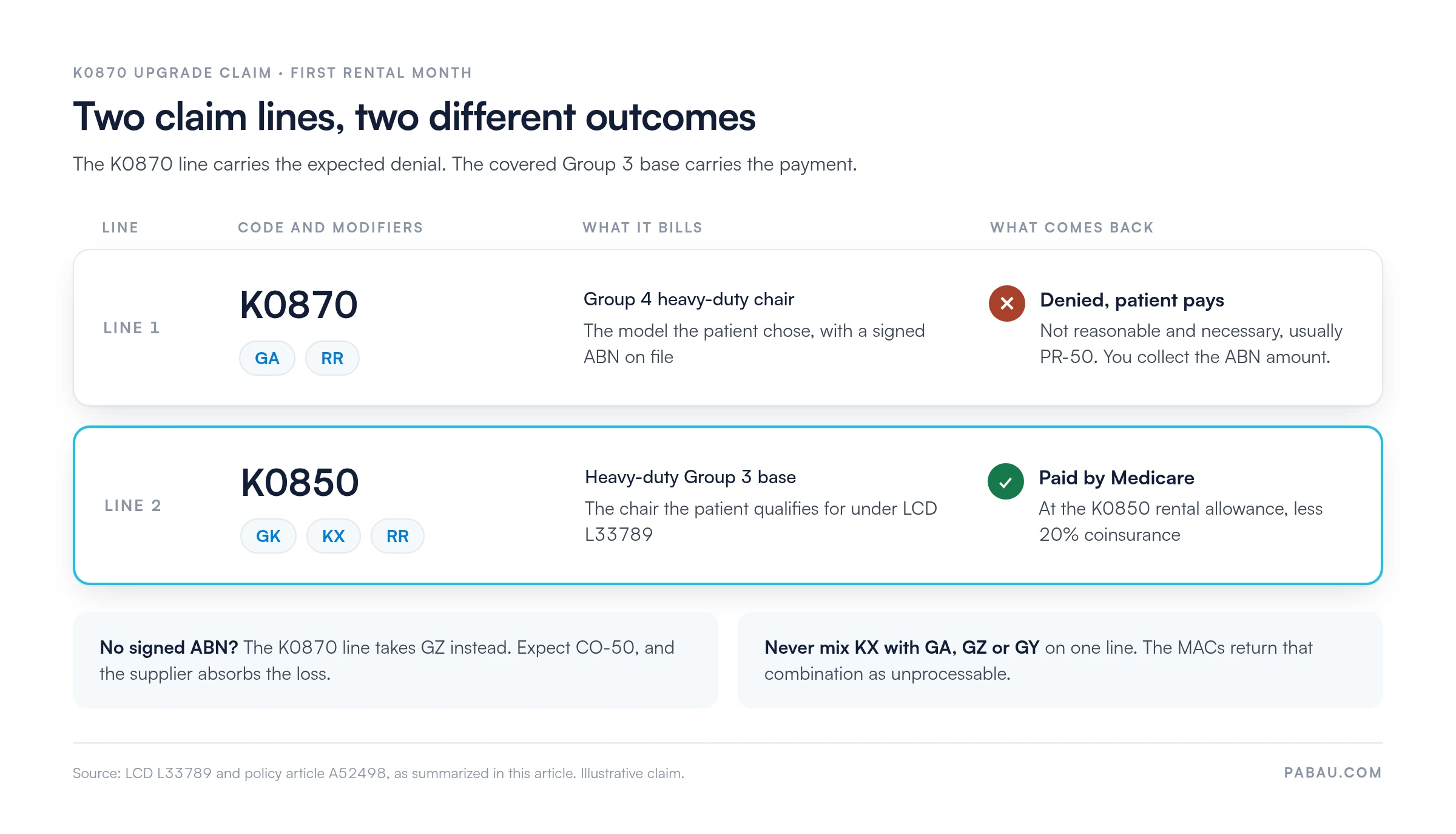
Every power wheelchair line needs one of KX, GA, GY or GZ. The policy article rejects a line without any of them as missing information, so it never reaches review.
K0870 is paid as a capped rental. Medicare pays 10% of the purchase price for each of months one to three. It pays 7.5% for months four to 13, and title passes to the patient after the 13th paid month. The patient owes 20% coinsurance once the Part B deductible is met.
On an upgrade claim, the rental math runs on the covered base line, because the K0870 line itself denies. Track rental months on that line so the cap lands where you expect.
K0870 is not on the CMS required prior authorization list. The power mobility codes on it are Group 1 and 2 chairs, scooters, and the Group 3 bases K0848 to K0864. CMS updates the list, most recently in July 2026, so check it before each order.
There’s no Certificate of Medical Necessity either. Power wheelchairs don’t use a CMN. The written order, the face-to-face notes and the medical record carry the evidence.
Some errors surface after the claim is processed. A reopening is available within one year of the initial determination for any reason, or within four years for good cause. A disputed medical-necessity denial goes to redetermination instead. Our guide to medical billing denial codes covers how to read each CARC and RARC.
Who can sign the order? The treating physician or a nurse practitioner, physician assistant or clinical nurse specialist who did the face-to-face exam.
Does a covered diagnosis make K0870 payable? No. The home-use rule applies whatever the diagnosis, so the diagnosis supports the covered base line, not the Group 4 chair.
What should the ABN say? Name the chair, give a specific reason Medicare is likely to deny it, and include a cost estimate. A blanket ABN signed for every patient doesn’t shift liability.
How long should we keep the file? Plan on at least seven years from the date of service. That covers audits that reach back beyond the reopening windows.
A K0870 upgrade spreads paperwork across people. The order, face-to-face notes, ABN and PDAC listing often sit in different folders. Someone then builds the two-line claim by hand from all of them.
Pabau, the practice management platform we build, keeps that file on the patient record. The signed order, face-to-face notes and ABN are stored with the patient, so a reviewer’s request takes one search instead of four folders.
Pabau’s claims management software tracks authorization codes, dates and sessions on the case, with a warning when one is missing. US claims go out through Claim.MD as CMS-1500/837P claims, and eligibility checks and ERA remittances come back to the same record. Choosing modifiers stays with your coders.

Pabau stores signed forms on the patient record and tracks prior authorization codes on the case. US claims go through Claim.MD, with ERAs posted back to the record.

Coding K0870 comes down to two checks, the recorded weight and the seat type. Getting paid is harder, because Medicare has already decided the chair is more than the home needs.
So treat every Medicare K0870 claim as an ABN or upgrade claim from the first conversation. The covered base line pays on its own merits, and the patient knows their share before delivery. You’re also not refunding rental months after a review six months later.
Book a demo to see how Pabau keeps signed forms, prior authorizations and Claim.MD claims on one patient record.

Billing a smaller patient on a Group 4 chair? HCPCS code K0868 covers the standard-duty Group 4 sling-seat chair for patients up to 300 pounds.
Building the covered base line on an upgrade? HCPCS code K0850 explains the heavy-duty Group 3 chair and its coverage criteria.
Reading a PR-50 or CO-50 on the remittance? Denial codes in medical billing breaks down the CARC and RARC codes behind DME denials.
Want fewer claims bounced back for missing data? Clean claim guide lists the elements a claim needs to pass payer edits the first time.
Posting rental payments from the ERA? Electronic remittance advice explained walks through ERA files and how to post them.
No. LCD L33789 denies Group 4 power wheelchairs as not reasonable and necessary, because their extra speed and range aren’t needed in the home. If the patient still wants one, bill it with a signed ABN and the GA modifier.
Weight capacity. K0870 is heavy duty, for patients from 301 to 450 pounds. K0871 is very heavy duty, for 451 to 600 pounds. Both have a sling or solid seat/back.
K0870 covers patients from 301 to 450 pounds. Patients up to 300 pounds fall under K0868 or K0869, depending on the seat.
PDAC testing sets Group 4 at a 6 mph top speed and a 16-mile range. Group 3 chairs are tested at 4.5 mph and 12 miles.
Some do, under their own medical policies, which may treat community mobility differently from Medicare. Check the plan’s wheelchair policy and its prior authorization rules before delivery.