HCPCS Code J1110: Dihydroergotamine mesylate injection billing guide
HCPCS Code J1110: Official descriptor and drug overview HCPCS Code J1110 is the ...

Last Updated: Oct 29, 2026
L1270 is the HCPCS Level II code for an addition to a TLSO (low profile): an abdominal pad. It covers the pad only, and the brace it attaches to is billed under base code L1200.
Billed without L1200 on the same claim, the L1270 line is denied as not separately payable. L1270 and L1260 are separate pads, so a brace carrying both takes one line for each.
Let Pabau's smart automation suggest the right codes, reduce claim denials, and keep your practice compliant—effortlessly.
Automate repetitive tasks and focus on what matters most—your patients.
Reduce coding errors and ensure compliance with the latest regulations.
Clean claims, fewer denials, and faster reimbursements.
Powerful insights and reporting to help your practice thrive.
HIPAA compliant SOC 2 certified GDPR-compliant Trusted by 4,000+ clinics worldwide

HCPCS code L1270 bills one component: an abdominal pad added to a low-profile TLSO, not the brace itself.
L1270 pays only when base code L1200 sits on the same claim. Billed without it, the line is denied as not separately payable.
L1270 and L1260 are different pads. L1260 is the anterior thoracic derotation pad, and L1270 is the abdominal pad.
The order and the orthotist’s notes must name the abdominal pad and explain why this patient needs it.
Medicare prices L1270 on the DMEPOS fee schedule, so check the current allowed amount for your state before billing.
HCPCS code L1270 is the Level II code for “Addition to TLSO, (low profile), abdominal pad.”
It bills an abdominal pad added to a low-profile thoracic-lumbar-sacral orthosis (TLSO). The brace itself is billed separately under base code L1200.
The Centers for Medicare & Medicaid Services (CMS) maintains the HCPCS Level II code set. It covers durable medical equipment, prosthetics, orthotics and supplies (DMEPOS). L1270 sits in the spinal orthotics section of the L-codes, among the TLSO additions for low-profile braces.
CMS revises the HCPCS Level II file every year. Confirm the L1270 descriptor in the current file before billing.
The official CMS descriptor for L1270 reads: Addition to TLSO, (low profile), abdominal pad. Each part of it shapes how the claim is built.
A low-profile TLSO is an underarm brace. It wraps the trunk from the pelvis to below the arms, and its front section covers the abdomen. The L1270 pad sits on the inside of that front section.
The abdominal pad adds firm contact over the front of the abdomen. Orthotists use it to compress the abdomen, which raises intra-abdominal pressure and helps reduce lumbar lordosis. It also steadies the trunk in the shell, so the brace’s other pads stay where they were placed.
L1270 pays for the pad only. The TLSO body is the L1200 line, and every other pad or extension on the brace has its own addition code.
L1270 covers the abdominal pad when it is added to a low-profile TLSO billed under L1200. Several scope boundaries decide whether L1270 applies or another code is needed.
Covered by L1270:
Excluded from L1270:
L1270 cannot be billed as a standalone code. The DME MAC guidance on scoliosis brace coding from CGS lists it among the additions to base code L1200. Additions billed without their base code are denied as not separately payable.
Put L1200 on the first line and L1270 on the next. A missing base line costs minutes to fix at data entry. At the DME MAC, the same error costs a denial and a resubmission. The diagram below shows how the lines stack and when the L1270 line pays.
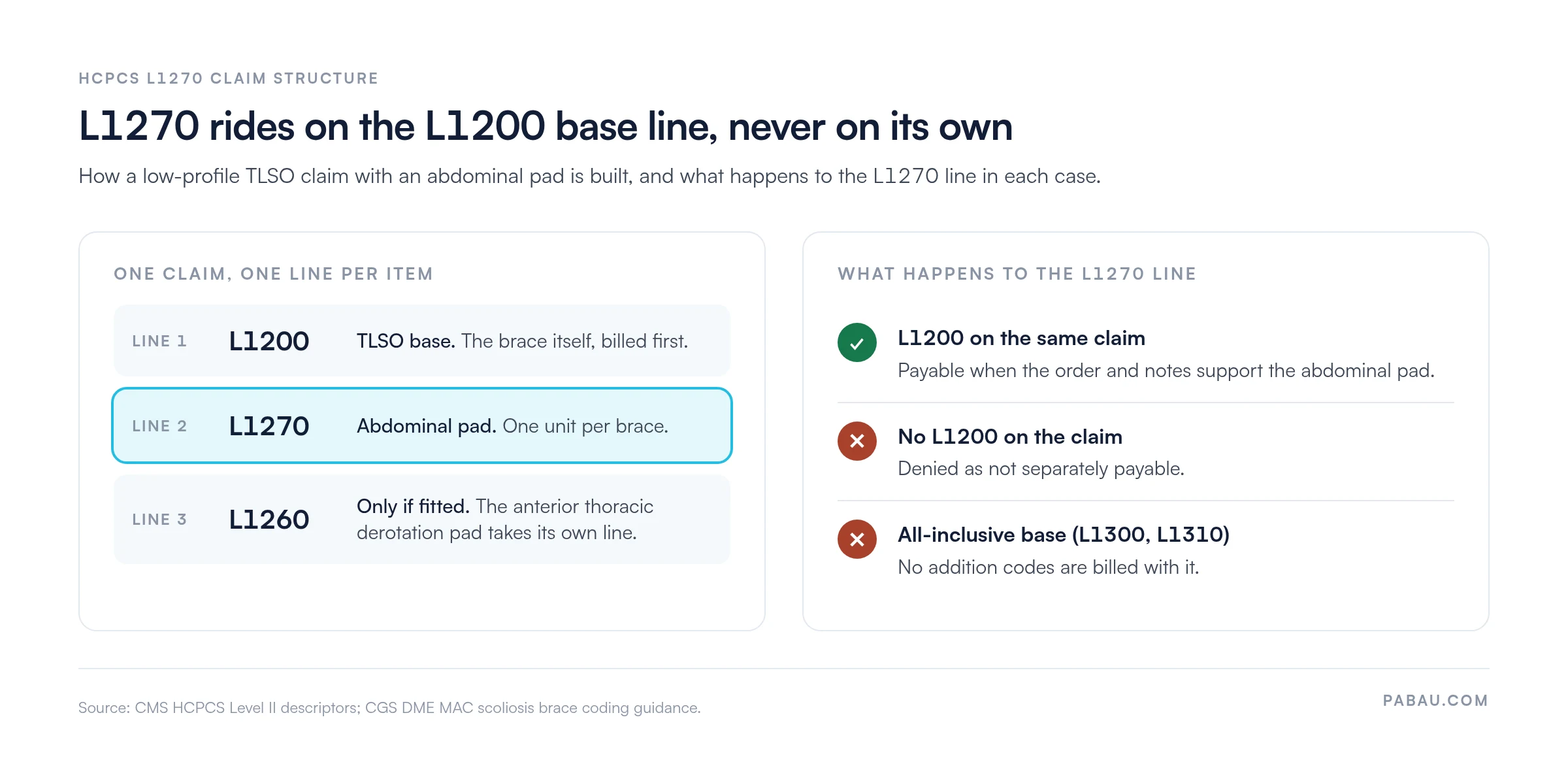
The low-profile TLSO additions each describe a different pad or component. Picking the code by the pad’s location in the fitting record keeps L1270 on the right line.
L1260 and L1270 are different pads, not two versions of one pad. L1260 bills the anterior thoracic derotation pad. If a brace carries both, bill L1260 and L1270 as separate lines.
Ask for the orthotist’s fitting record before coding. It names each pad and where it sits, so the abdominal pad goes on the L1270 line and every other pad gets its own code.
Medicare Part B covers L1270 as a DMEPOS item when the records support the abdominal pad. Coverage of the base TLSO does not carry the pad with it. The file has to show why this patient needs the pad.
Key Medicare coverage rules for L1270:
CMS updates the DMEPOS fee schedule each January, with quarterly revisions. Pull the current allowed amount for your state before you quote a patient.
Practices using claims management software can track DMEPOS allowed amounts and read remittance advice electronically. That catches fee schedule discrepancies before they age into write-offs.
Modifiers tell the payer whether coverage criteria are met and whether the patient was warned about possible non-coverage. Apply them to the L1200 and L1270 lines separately, and confirm each against your MAC’s current policy article.
Bill one unit of L1270 for the abdominal pad on each brace. KX carries the most risk, because appending it without complete documentation creates audit exposure.
Documentation decides whether an L1270 claim survives review. Each item below belongs in the patient file before the claim goes out. Good medical billing compliance means building that file at intake, not after a denial arrives.
Notes that justify the brace but never mention the pad leave the L1270 line exposed on audit. One sentence on why the abdominal pad was added protects it.
Check the CMS Required Prior Authorization List for DMEPOS before fabricating the brace, because CMS revises it. Commercial payers and Medicaid managed care plans often require prior authorization for spinal orthoses, addition codes included. Confirm the rule with each payer before ordering.
Checking insurance eligibility and benefits at referral surfaces a prior authorization requirement before the device is made. Securing approval after delivery is often not possible.
When prior authorization is required, the submission package typically includes:
A claim billed without a required approval may be denied, and appeal options vary by payer. Record every contact with the payer in the patient file.
L1270 claims fail for predictable reasons, and most trace back to its add-on structure. Strong denial management workflows address each one before submission.
The remittance names the issue through its denial codes. Grouping L1270 denials by reason code shows which intake step to fix first.
An L1270 claim follows a fixed sequence from order to payment. The addition line goes on the same claim as the base line, and the claim waits until the documentation is on file.
These base codes decide whether L1270 can appear on a claim at all. Check the base before you code the pad.
When a claim carries several additions, confirm each one matches what the orthotist documented. Verify current descriptors in the AAPC HCPCS code database before submitting.
Run a monthly report of L1270 claims. Check that each one carried L1200, an order naming the abdominal pad, and KX only where the documentation was complete.
Orthotics teams often split this workflow across systems. The fitting note sits in one place, the signed order in a scanned folder, and the claim in a billing tool. Each rekeying step is another chance for L1270 to lose its L1200 base.
Pabau, the practice management and billing platform we build, keeps the patient record and the claim in one place. HCPCS codes attached to the service carry onto the CMS-1500 charge lines, so the pad and its base travel together.
Built-in HCPCS and ICD-10-CM lookups let a biller confirm the abdominal pad descriptor without leaving the claim. Claim status and remittance sit beside the record, so an L1270 denial is worked with the order and notes on screen.

Pabau keeps the order, the fitting notes and every claim line in one record. Orthotics teams catch a missing L1200 base before an L1270 claim goes out.

Code L1270 from the fitting record rather than from memory, because the pad’s location decides the code. An abdominal pad is L1270, while a pad at the front of the chest is L1260.
The work that protects the claim happens before billing. The order has to name the abdominal pad, and the notes have to say why this patient needs it. With both in the file at fitting, the L1270 line holds up under review.
Orthotics teams that bill DMEPOS alongside clinical care gain the most from one system holding both. Book a demo to see how Pabau carries an L1270 claim from order to payment.

Need to verify HCPCS codes for other DMEPOS devices? What is medical billing explains how HCPCS Level II codes fit into the broader DMEPOS billing framework.
Want to reduce claim rejections before they reach the payer? Clean claim submission guidelines covers the front-end checks that keep DMEPOS claims from failing on technical edits.
Billing a pad when coverage is uncertain? Medicare waiver template gives you an ABN form to sign before you append the GA modifier.
HCPCS code L1270 covers an abdominal pad added to a low-profile thoracic-lumbar-sacral orthosis (TLSO). It bills the pad only. The brace itself goes on its own line under base code L1200.
L1260 and L1270 describe two different pads. L1260 is an anterior thoracic derotation pad at the front of the chest, and L1270 is an abdominal pad. A brace that carries both is billed with one line for each.
No. DME MAC guidance treats L1270 as an addition to base code L1200. Billed without L1200 on the same claim, the L1270 line is denied as not separately payable.
Yes, Medicare Part B covers L1270 as a DMEPOS item when the records support the abdominal pad. CMS prices it on the DMEPOS fee schedule. Medicare pays 80% of the allowed amount after the Part B deductible.
Each payer sets its own prior authorization rule for L1270. Check the CMS Required Prior Authorization List and each commercial or Medicaid plan before fabrication. A claim billed without a required approval may be denied, and appeal options vary by payer.
The low-profile TLSO additions around L1270 are L1240 (lumbar derotation pad), L1250 (anterior ASIS pad) and L1260 (anterior thoracic derotation pad). L1280 is an elastic rib gusset, billed each, and L1290 is a lateral trochanteric pad.