CRM for chiropractors: how to manage patients, bookings and marketing
A CRM for chiropractors is a patient relationship management system built around...

Last Updated: Oct 13, 2026

A medicare waiver is a formal document patients sign to acknowledge that a specific service may not be covered by Medicare, transferring financial responsibility before treatment begins.
The Advance Beneficiary Notice (ABN) is the core provider-facing waiver form — if you fail to issue a valid ABN before a non-covered service, Medicare holds you financially liable for the cost.
Medicaid waivers (1115, 1915(b), 1915(c)/HCBS) are state-federal agreements that expand services — they are governed by different legal authorities than Medicare waivers and serve different purposes.
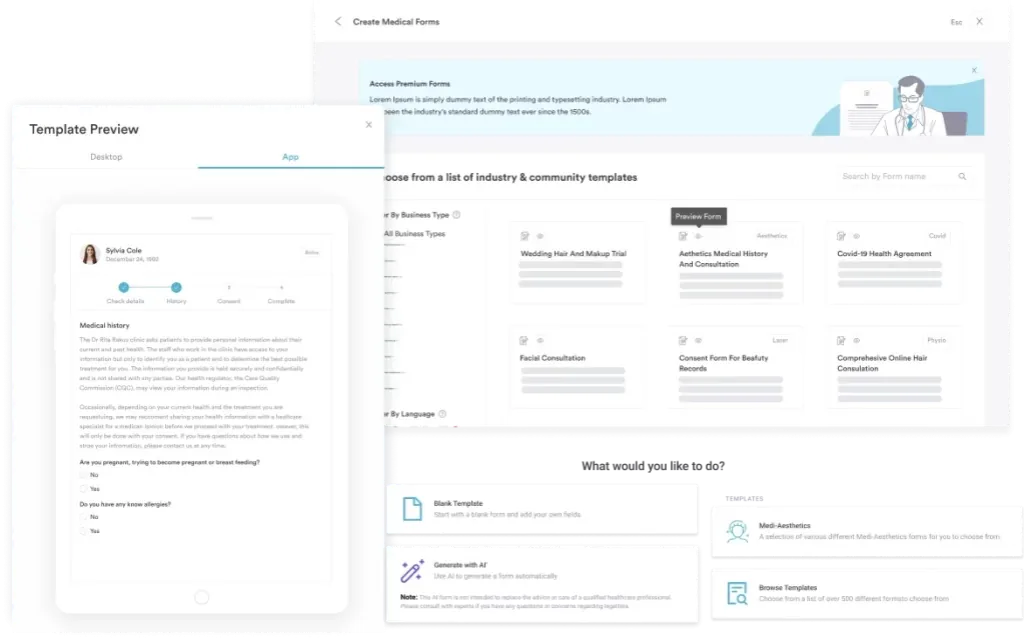
Pabau’s digital forms feature automates waiver delivery, tracks patient signatures, and keeps audit-ready records so your team never misses a compliance step.
A ready-to-use waiver form covering patient acknowledgment of non-covered services, financial responsibility disclosure, beneficiary options, and signature blocks for provider compliance.
Download templateA medicare waiver — most often the Advance Beneficiary Notice (ABN) — protects you from absorbing the cost of a service Medicare denies, but only if you issue it correctly. According to CMS, a defective or missing ABN voids your liability protection entirely.
This guide covers what every provider needs to know: which waiver type applies to your practice, how to complete the form correctly, and how to keep your documentation airtight.
A medicare waiver is a formal written notice that a provider gives a patient before delivering a service Medicare is unlikely to cover. It tells the patient that Medicare may deny the claim and asks them to acknowledge financial responsibility before treatment begins.
This is not optional paperwork. Reviewing medical forms for your healthcare practice starts here, because the waiver is a legal instrument with direct billing consequences.
The term “medicare waiver” is also used in a broader policy sense. At the federal level, waivers refer to CMS-granted permissions that allow states or providers to deviate from standard Medicare or Medicaid rules. The two contexts are very different, and conflating them is one of the most common documentation errors in multi-payer practices.
Understanding which waiver type applies to your workflow matters. The table below compares the four main waiver types providers encounter, from the everyday ABN to long-term Medicaid program waivers.
The ABN is the medicare waiver form most providers interact with daily. It applies to Medicare fee-for-service (Original Medicare) situations where a provider reasonably expects Medicare to deny a claim — for example.
Without a valid ABN on file, the provider cannot bill the patient and must absorb the cost. Strong patient compliance documentation depends on getting this step right before treatment, not after.
An ABN is not required for services that are never covered by Medicare (such as cosmetic procedures). It applies specifically when a service is ordinarily covered but is expected to be denied in this specific case.
The financial consequence is clear. If Medicare denies the claim and no valid ABN was issued beforehand, the provider cannot collect payment from the patient. The provider absorbs the full cost.
This is why the ABN must be delivered and signed before services are rendered, not on the way out. Maintaining thorough client records with timestamped form signatures is the only reliable defense in a CMS audit.
Check your ABN each year. CMS updates the approved form (CMS-R-131) periodically. Using an outdated version is treated the same as having no ABN at all. Audit your template against the current version on CMS.gov before using it with patients.
Keeping paperwork like this under control is a core part of private practice management.
The standard ABN form (CMS-R-131) has five key sections. Each must be completed correctly or the form loses its legal protection. The steps below reflect the form’s actual structure and the compliance requirements set out in CMS ABN guidance.

Pabau’s digital forms let you send waiver documents to patients before their appointment, capture legally valid e-signatures, and store everything in a timestamped audit trail. Your team spends less time on paperwork and more time on care.

Medicaid waivers are fundamentally different from the provider-facing ABN. They are state-federal agreements, approved by CMS, that allow states to deliver Medicaid services in ways that fall outside standard federal rules.
According to Medicaid.gov, there are currently over 300 approved or pending Section 1115 demonstrations across the country. Providers working with Medicaid beneficiaries encounter these most often through two waiver types.
HCBS waivers (Section 1915(c)) allow states to fund long-term care in home or community settings rather than nursing facilities. For providers, this means patients who would traditionally qualify for institutional care can receive personal care, day services, respite, and therapy in their homes.
Eligibility criteria (income thresholds, functional assessments) vary by state. Providers should confirm waiver status directly with their state Medicaid agency before assuming coverage applies. Robust medical spa compliance workflows that handle multi-payer documentation help practices serving both private-pay and Medicaid patients stay organized.
Section 1115 waivers allow states to pilot reforms that would otherwise require federal legislative change. States have used these to expand Medicaid eligibility, test work requirements, restructure benefit packages, and introduce value-based payment models.
Each 1115 waiver has state-specific approved terms. A claim processing rule under one state’s 1115 waiver may not apply in a neighboring state. Practices billing across multiple states must verify the specific approved terms with each state’s Medicaid agency.
The confusion between the two is understandable. Both involve CMS, both affect reimbursement, and both use the word “waiver.” The table below separates them clearly across the dimensions that matter most to providers.
The short answer: any practice billing Medicare fee-for-service. That covers a wide range of clinical settings. Providers running medical spa software alongside Medicare-covered services, private practices, primary care practices, and dermatology offices all need a reliable, compliant waiver process if their patient mix includes Medicare beneficiaries.
Maintaining consistent HIPAA compliance for medical offices is the surrounding framework. The ABN sits within it as a distinct billing compliance requirement.
Medical spas and aesthetic practices serving older patients are a particularly common scenario. A patient may present for a cosmetic-adjacent procedure that Medicare might cover in some clinical contexts but not others. Having a pre-completed, CMS-approved waiver template means the conversation happens before treatment, not after a denied claim.
A standardized template reduces the risk of defective forms. Each benefit below maps to a real compliance consequence.
Embedding waiver workflows into your practice management system adds another layer. Pair this with compliance management tools that flag incomplete documentation before a patient checks out, and the audit trail builds itself.
Keeping patient data security tools in place ensures all stored waiver documents meet HIPAA storage and access requirements.
The medicare waiver process is one area where a small documentation error creates a large financial exposure. A missing ABN does not just risk a denied claim. It removes your right to collect payment from the patient entirely.
Pabau’s digital forms feature handles waiver delivery, e-signature capture, and automatic filing in the patient record, so your team never misses a compliance step at the point of care. Book a demo to see how it works in a real practice workflow.

Billing a vascular lesion destruction? Vascular lesion destruction billing guide covers the CPT code for destroying vascular lesions under 10 square centimeters and how the codes split by area.
Billing a malignant facial lesion removal? Malignant lesion destruction billing guide covers the CPT code for destroying a malignant facial lesion between 3.1 and 4.0 centimeters.
Billing a large malignant facial lesion? Malignant facial lesion billing code covers the CPT code for destroying a malignant facial lesion measuring over 4.0 centimeters in diameter.
A medicare waiver is a formal written notice (typically the Advance Beneficiary Notice, or ABN) that a provider gives a patient before delivering a service Medicare may not cover. The patient acknowledges they understand the potential denial and agrees to accept financial responsibility. Without a valid, signed waiver on file before the service, the provider cannot bill the patient if Medicare denies the claim.
Medicare waivers (ABNs) are provider-issued notices that transfer financial liability for a specific non-covered service. Medicaid waivers (1115, 1915(b), 1915(c)) are CMS-approved state-federal agreements that restructure how Medicaid programs operate. They serve different populations, have different legal authorities, and require completely different provider actions.
Yes, in most provider contexts. The ABN (CMS Form CMS-R-131) is the standard medicare waiver form used in fee-for-service Medicare. The term “medicare waiver” in a clinical documentation context almost always refers to an ABN. Policy-level Medicare waivers exist but are approved by CMS and do not involve patient-signed forms.
A Section 1115 demonstration waiver is a CMS-approved agreement that gives states flexibility to test Medicaid program changes not otherwise permitted under federal law. States have used 1115 waivers to expand eligibility, restructure benefits, and pilot value-based payment models. Each waiver has unique approved terms specific to that state.
Yes. The official CMS ABN form (CMS-R-131) is available on CMS.gov. Pabau also provides a ready-to-use medicare waiver template as a free PDF download, formatted for practical use in a practice setting. Always verify you are using the current approved version, as CMS updates the form periodically.