HCPCS code P9058: Red blood cells, leukocytes reduced, CMV-negative, irradiated
HCPCS code P9058: Official descriptor and key attributes HCPCS code P9058 report...

Last Updated: Oct 26, 2026
L1230 is the HCPCS Level II code for an addition to a low-profile thoracic-lumbar-sacral orthosis (TLSO), Milwaukee type superstructure. It covers the superstructure only, and the brace it attaches to is billed under base code L1200.
Pairing is the rule that decides payment. L1230 only pays when L1200 sits on the same claim. A brace built as a full Milwaukee CTLSO from the start is billed under L1000 instead, and L1230 never rides on that code.
Let Pabau's smart automation suggest the right codes, reduce claim denials, and keep your practice compliant—effortlessly.
Automate repetitive tasks and focus on what matters most—your patients.
Reduce coding errors and ensure compliance with the latest regulations.
Clean claims, fewer denials, and faster reimbursements.
Powerful insights and reporting to help your practice thrive.
HIPAA compliant SOC 2 certified GDPR-compliant Trusted by 4,000+ clinics worldwide

HCPCS code L1230 describes a Milwaukee type superstructure added to a low-profile TLSO, not a standalone brace.
L1230 is an addition code, so it only pays when base code L1200 sits on the same claim.
A brace built as a full Milwaukee CTLSO from the start is billed under L1000, and L1230 never rides on that code.
The physician order and the clinical notes have to justify the superstructure itself, not only the base orthosis.
Pabau, the practice management and billing platform we build, keeps the order, the notes and both claim lines in one record. The pairing is checked before submission.
HCPCS code L1230 is the Level II code for “Addition to thoracic-lumbar-sacral orthosis (TLSO), (low profile), Milwaukee type superstructure.” It sits in the L-series orthotic codes on the CMS HCPCS Level II code set. The code describes one component, and the low-profile TLSO it attaches to is billed separately under L1200.
Because it describes a component, L1230 never stands on a claim by itself, and each later billing step follows from that. The table below gives the reference data to confirm before you build the claim.
CMS updates the HCPCS Level II file every year. Confirm the L1230 descriptor in the current alpha-numeric file before billing, because addition codes in this range have been revised before.
A low-profile TLSO is an underarm brace. It wraps the trunk from the pelvis to below the arms, so it controls curves in the lower thoracic and lumbar spine. It cannot reach a curve whose apex sits high in the thoracic spine.
The Milwaukee type superstructure closes that reach. It adds uprights that rise from the TLSO body to a neck ring, usually with a throat mold and occipital pads. The brace can then apply corrective force above the level an underarm design reaches.
Orthotists add the superstructure for high thoracic scoliosis curves and for some kyphosis cases. L1230 pays for that superstructure only. The TLSO body under it is the L1200 line, and any pads or extensions are their own addition codes.
L1230 cannot be billed as a standalone code. Payers deny an addition code as not separately payable when its base code is missing from the claim. For this range, the base is HCPCS code L1200, the TLSO itself.
The DME MAC guidance on scoliosis brace coding from CGS sets out which bases take additions. Only L1000 and L1200 have addition codes that can be billed with them. L1005, L1006, L1007, L1300 and L1310 are all-inclusive, so no addition code is billed with any of them.
A missing base line is cheapest to catch at data entry. Once the claim reaches the MAC, the same error costs a denial and a resubmission.
The word “Milwaukee” appears in two codes, and they describe different devices. HCPCS code L1000 is a cervical-thoracic-lumbar-sacral orthosis (CTLSO), Milwaukee, inclusive of furnishing the initial orthosis. It already includes the superstructure as part of the brace.
L1230 applies when a low-profile TLSO is extended upward with a Milwaukee type superstructure. The order of construction is what separates the two codes. The chart below maps each brace build to the lines it puts on the claim.
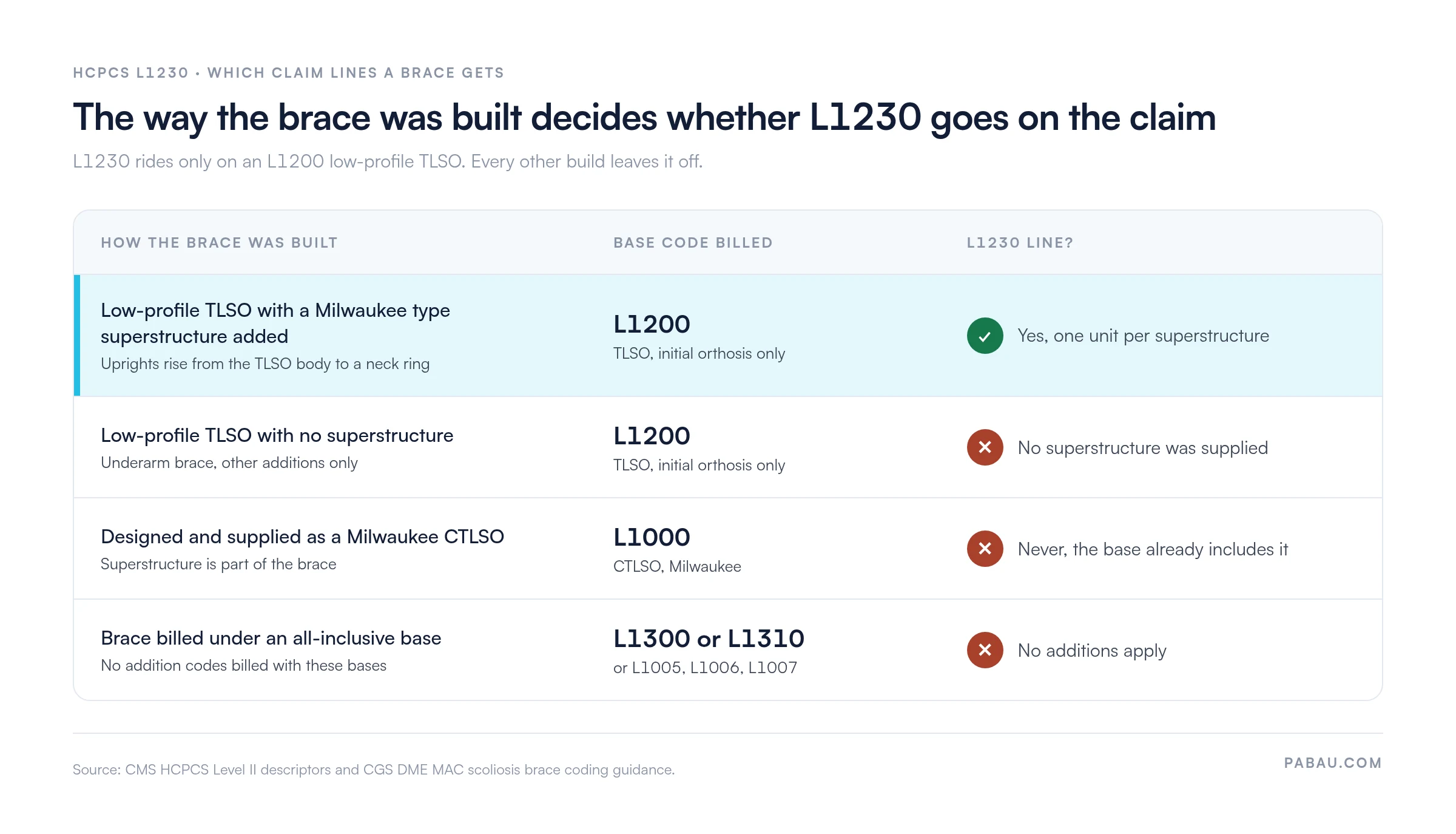
Billing L1000 and L1230 together charges for the superstructure twice. Billing a superstructured brace as L1000 when it was built on a low-profile body misstates the device. Match the code to the fabrication record, not to the brace’s common name.
One code in the L1200-L1290 range is the base orthosis, and the other nine are additions to it. The neighbors most often confused with L1230 are L1200, L1210, L1260 and L1270. Like HCPCS code L1260, each addition only pays on a claim that also carries L1200.
A brace can carry several additions on the same claim as L1200. Each one still needs its own line, its own order wording and its own medical necessity. Billing several additions off an order that names only the TLSO is a common audit finding.
Medicare prices L1230 on the CMS DMEPOS fee schedule, not the Physician Fee Schedule. Allowed amounts vary by state, so pull the current figure for your jurisdiction before you bill. One claim carries two allowed amounts, one for L1200 and one for L1230.
Medicare pays 80% of the allowed amount after the Part B deductible. The beneficiary owes the remaining 20% coinsurance unless a supplemental plan covers it.
Coverage of the base TLSO does not carry the superstructure with it. Medicare covers L1230 when the records show why this patient needs control above the reach of an underarm brace. Reviewers look for these points in the file:
Pull the spinal orthosis local coverage determination (LCD) and its policy article for your DME MAC before dispensing. Check that the diagnosis on the order appears in the covered list. Then confirm the order names the Milwaukee type superstructure as its own item, separate from the TLSO.
Modifiers tell the payer whether coverage criteria are met and whether the patient was warned about possible non-coverage. Apply them to the L1230 line and the L1200 line separately. Confirm each one against your MAC’s current policy article.
Bill one unit of L1230 per superstructure supplied. Spinal orthoses in this range are billed as purchases, so rental modifiers such as RR do not belong on the line. KX carries the most risk, because appending it without complete documentation creates audit exposure.
The diagnosis on the claim has to explain why the brace needs to reach the upper thoracic spine. The ICD-10-CM code supporting L1230 is usually the one supporting the L1200 base line. Scoliosis and kyphosis codes dominate the list.
The categories below are shown truncated. Pull the full code with the region digit from the ICD-10-CM code reference before it goes on the claim.
The diagnosis alone does not justify the superstructure. Record the curve pattern, the apex level and the Cobb angle in the clinical notes. Those details show why an underarm TLSO could not do the job on its own.
Documentation separates L1230 claims that pay from ones that get recouped on audit. Each document has to address the base TLSO and the superstructure separately. These billing compliance requirements apply before the device is dispensed, not after a denial.
Build the checklist into intake rather than the billing queue. A missing superstructure line on the order takes minutes to fix before fabrication. After a denial, it costs a full rebilling cycle.
L1230 billing follows a fixed sequence. The addition line goes on the same claim as the base line, after it, and the claim waits until the documentation is on file.
The billing supplier must be enrolled with Medicare as a DMEPOS supplier and hold current accreditation. A clinically accurate claim from an unaccredited supplier is still a compliance violation.
L1230 denials cluster around a predictable set of errors. Most trace back to the add-on structure of the code. The table maps each one to its fix.
Structured denial management turns those patterns into upstream controls. If one reason keeps recurring, fix the intake step behind it rather than appealing each claim.
Medicare offers five appeal levels for denied DMEPOS claims. Most documentation-based L1230 denials resolve at the first two.
Cite the denial reason code from the remittance in your cover letter. Then list the documents you are sending to answer it.
Run a short check before every L1230 claim leaves the practice. Look for L1200 on the claim, the superstructure named on the order, notes recording the curve apex, KX documentation complete and a signed delivery receipt.
Orthotics teams often run this workflow across separate systems. The clinical note sits in one place, the signed order in a scanned folder, and the claim in a billing tool. Each rekeying step is another chance for the L1230 line to lose its L1200 base.
Pabau keeps the patient record and the claim in one place. The HCPCS codes attached to the service carry onto the CMS-1500 charge lines. Built-in ICD-10-CM and HCPCS lookup libraries let a biller confirm a descriptor without leaving the claim.
From there, claims management software checks that required fields are complete before submission and sends the claim through Claim.MD in the US. Claim status and remittance sit beside the record. A biller chasing an L1230 denial sees the order and the notes on the same screen.
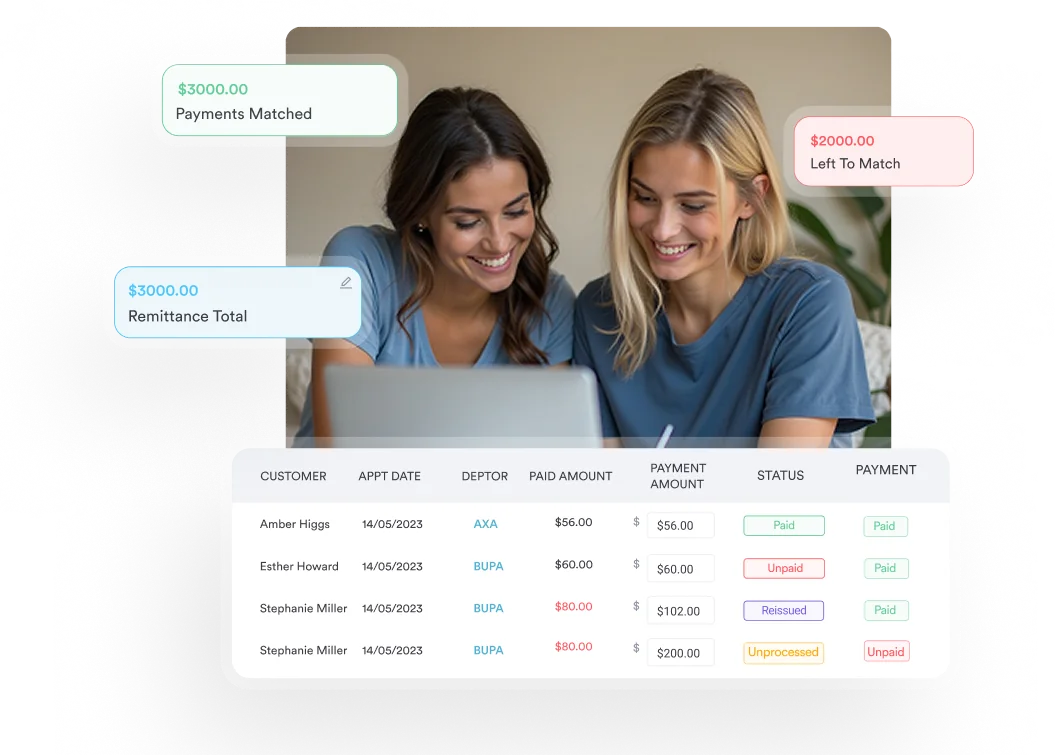

Pabau keeps the order, the clinical notes and every claim line in one record. Orthotics teams catch a missing L1200 base before an L1230 claim leaves the practice.

HCPCS code L1230 pays for one component, and most of its denials come from treating it as more than that. Bill it only on a claim that carries L1200. Choose L1000 instead when the brace was built as a Milwaukee CTLSO from the start.
The harder work sits upstream of billing. The order has to name the superstructure, and the notes have to show why an underarm brace could not reach the curve. Get those in place before fabrication and the L1230 line stops drawing records requests.
Orthotics teams that bill DME alongside clinical care gain the most from one system holding both. Book a demo to see how Pabau carries an L1230 claim from order to payment.

Need the full claims workflow from encounter to payment? What is medical billing explains each stage for DMEPOS suppliers and practices.
Want more claims paid on the first pass? Clean claim submission lists the elements every error-free claim includes.
Checking DME coverage before you fabricate? Insurance eligibility verification walks through confirming benefits before a device is made.
No. L1230 is an addition code for a Milwaukee type superstructure fitted to a low-profile TLSO. The brace body itself is billed under base code L1200, and L1230 covers only the superstructure.
No. L1230 is an addition to the low-profile TLSO, so payers deny it as not separately payable without L1200 on the same claim. Pairing it with another addition code does not replace the base line.
L1000 is a complete Milwaukee CTLSO, with the superstructure included in the brace. L1230 adds a Milwaukee type superstructure to a low-profile TLSO billed as L1200. Never bill L1230 on the same brace as L1000.
One unit per superstructure supplied. A low-profile TLSO takes one Milwaukee type superstructure, so a second unit needs clear support in the order and the fabrication record.
Scoliosis and kyphosis codes, such as M41.12x for adolescent idiopathic scoliosis or M42.0x for Scheuermann’s kyphosis. The notes also need the curve apex and Cobb angle to justify upper thoracic control.
A Medicare redetermination must be filed within 120 days of the initial determination. Send the order, the clinical notes and the delivery receipt, because most L1230 appeals turn on documentation.