HCPCS Code L0472: Hyperextension TLSO billing guide
HCPCS code L0472: Official descriptor and device definition HCPCS code L0472 des...

Last Updated: Nov 5, 2026
L0700 is the HCPCS Level II code for a custom-molded Minerva-type CTLSO, a cervical-thoracic-lumbar-sacral orthosis with anterior-posterior-lateral control. The orthotist builds it from a cast or scan of the patient, and it holds the head, neck and trunk still as one unit.
The coding risk sits next door. Add interface material and the brace becomes L0710, while a prefabricated CTLSO fitted to the patient is L0720. Medicare pays L0700 as a lump-sum purchase, at $2,323.18 to $3,097.57 in the contiguous states on the October 2026 DMEPOS fee schedule.
Let Pabau's smart automation suggest the right codes, reduce claim denials, and keep your practice compliant—effortlessly.
Automate repetitive tasks and focus on what matters most—your patients.
Reduce coding errors and ensure compliance with the latest regulations.
Clean claims, fewer denials, and faster reimbursements.
Powerful insights and reporting to help your practice thrive.
HIPAA compliant SOC 2 certified GDPR-compliant Trusted by 4,000+ clinics worldwide

HCPCS code L0700 is a custom-molded Minerva-type CTLSO, a brace that controls the whole spine and supports the head and jaw
L0710 is the same custom brace built with interface material, and L0720 is a prefabricated CTLSO customized to fit the patient
No DME MAC LCD covers L0700, so the medical record has to show why full-spine, three-plane control was necessary
L0700 is not on the CMS Required Prior Authorization List or the Face-to-Face and Written Order Prior to Delivery List
Medicare pays L0700 as a lump-sum purchase, at $2,323.18 to $3,097.57 in the contiguous states on the October 2026 fee schedule
HCPCS code L0700 describes a cervical-thoracic-lumbar-sacral orthosis (CTLSO) with anterior-posterior-lateral control, molded to a patient model, of the Minerva type. The short descriptor in the CMS HCPCS Level II file is “Ctlso a-p-l control molded”.
Three clauses in that descriptor decide the code. “Anterior-posterior-lateral control” means the brace restricts forward, backward and sideways motion. “Molded to patient model” means the orthotist builds it from a cast or scan of this patient, so it is custom fabricated.
“Minerva type” means the brace rises above the shoulders to hold the head and jaw. Combined with the CTLSO body, one device immobilizes the cervical, thoracic, lumbar and sacral spine together.
Surgeons order this level of control when a cervical collar or a thoracic-lumbar-sacral orthosis (TLSO) alone cannot hold the spine still enough to heal. Typical cases are unstable upper cervical fractures and recovery after cervicothoracic fusion.
L0700 fits when the orthotist fabricated a Minerva-type CTLSO from a model of this patient and built it without an interface layer. Several neighboring devices fall outside the code.
The fabrication record settles most L0700 questions. It should name the patient model, the materials used, and whether an interface layer was built into the shell. Run the device through four questions, in the order a reviewer would ask them.
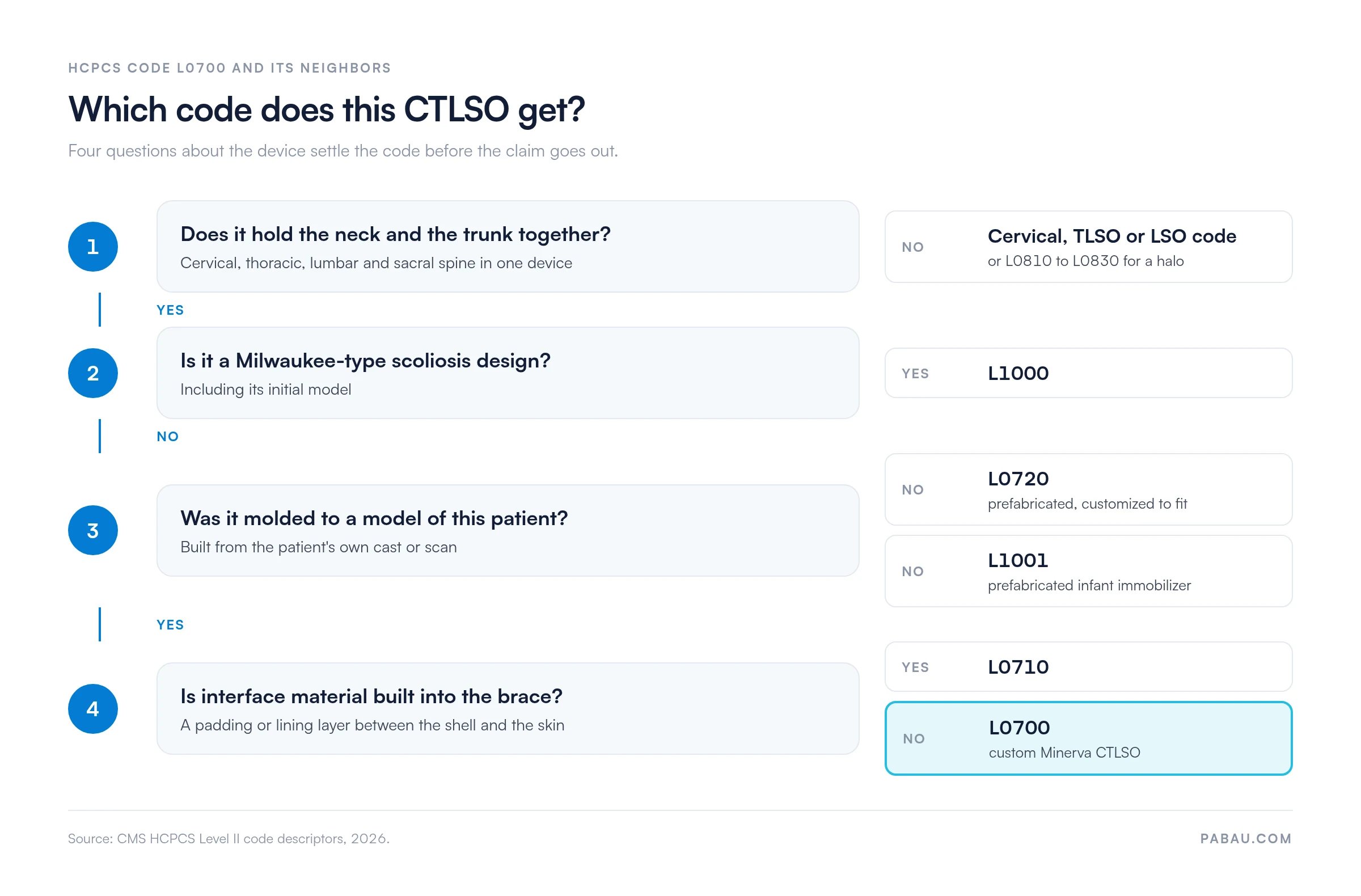
L0710 is the closest neighbor. It carries the L0700 descriptor plus the words “with interface material”, and that clause is the only difference. Our L0710 guide covers the interface-material side in more detail.
CMS does not define interface material inside the descriptor. In orthotic practice it means a padding or lining layer fabricated into the brace between the rigid shell and the skin. If the fabrication record shows no such layer, the device is L0700.
Fabrication method decides the code first, and the interface layer decides it second. Billing a stock CTLSO under L0700 overstates the device and invites recoupment on audit. Billing a custom Minerva under L0720 underpays the practice for fabrication work it already did.
The LSO codes belong to a different family. Their posterior panels end at T9, so they never describe a brace that holds the neck or the upper thoracic spine.
Medicare covers L0700 under the Part B brace benefit, set out in the Medicare Benefit Policy Manual, chapter 15, section 130. That benefit pays for rigid or semi-rigid devices that support a weak or deformed body part or restrict motion in an injured one.
No national coverage determination or DME MAC LCD sets criteria for L0700. The HCPCS file lists its coverage code as carrier judgment, so your DME MAC decides each claim on the medical record.
The DME MAC policy behind most spinal bracing is LCD L33790, Spinal Orthoses: TLSO and LSO. Its policy article lists TLSO and LSO codes only, and L0700, L0710 and L0720 do not appear in it. There is no covered-diagnosis list and no LCD criteria for a KX modifier to confirm.
The record has to do the work an LCD would otherwise do. Your clinical notes should show these points.
Referring surgeons and rehabilitation teams can help by sending their notes with the order. The orthotist’s claim stands or falls on those notes.
Ask your DME MAC how it reviews carrier-judgment orthoses before you fabricate an L0700. Note the answer in the patient file, so a later records request starts from a known standard.
No covered-diagnosis list exists for L0700, because no LCD covers the code. The diagnosis on the claim has to match the clinical record, and no single code makes the claim payable on its own.
Code each diagnosis with the prescribing clinician, and avoid unspecified codes where the imaging names the level. Our ICD-10-CM code library covers the spinal and post-surgical codes that pair with an orthotic order.
Assemble the file before the device leaves the building. A carrier-judgment code is reviewed on its record, and medical billing compliance requirements for DMEPOS mean auditors can recover payment when a document is missing.
Certificates of medical necessity do not apply. CMS discontinued certificates of medical necessity and DME information forms for claims with dates of service on or after January 1, 2023.
Those documents pile up in a set order, and each hand-off is a chance to lose one. A typical L0700 claim moves like this.
An L0700 claim takes fewer modifiers than a TLSO or LSO claim. Because no LCD covers the code, modifier habits from lumbar bracing can cause the denial they were meant to prevent.
The NU, RR and UE modifiers identify payment categories for durable medical equipment, such as capped rental items. L0700 sits in the prosthetics and orthotics category and is paid as a lump-sum purchase, so check your DME MAC’s guidance before adding them.
Medicare does not require prior authorization for L0700. The code is not on the CMS Required Prior Authorization List, last updated July 29, 2026.
It is also absent from the Required Face-to-Face Encounter and Written Order Prior to Delivery List. The spinal orthoses on these lists sit in the TLSO and LSO ranges, such as L0456, L0486, L0631 and L0637.
CMS adds codes to both lists through Federal Register notices, so check them again before each new quarter. Commercial insurers and Medicaid plans keep their own rules, so complete insurance eligibility verification before fabrication begins.
L0700 is paid under the CMS DMEPOS fee schedule, in the prosthetics and orthotics category, as a lump-sum purchase. The October 2026 file sets a floor of $2,323.18 and a ceiling of $3,097.57.
State amounts in the contiguous states fall inside that band. Alaska ($3,197.26), Hawaii ($3,418.84) and Puerto Rico ($1,615.53) sit outside it, because the ceiling and floor do not apply there.
L0700 has no separate rural rate and does not appear in the former competitive bidding area file. One state amount therefore applies across the whole state.
CMS updates the file each January and can revise it at quarterly updates. Pull the current file for the patient’s state before you quote an amount.
L0700 denials follow predictable patterns. Strong denial management for orthotic claims resolves most of them before submission rather than after.
Use this checklist as a pre-submission gate for every L0700 Medicare claim. Run it at fitting, while the patient is still there to sign the delivery record.
Checks done at fitting cut the hours your team spends working denials later. Our guide to submitting a clean claim shows how the same habits reduce first-pass denials on other codes.
In most orthotic practices, the documents behind an L0700 claim live in four places. The order sits with the surgeon, the notes in the EMR, the fabrication record in the workshop and the delivery receipt in a folder.
Reviewers ask for all four at once. On a carrier-judgment code they may ask more often, because no LCD has settled the criteria in advance.
Pabau, the practice management and billing platform we build, keeps those documents on the patient record instead. The order, clinical notes, fabrication note and signed delivery record attach to one file, and the HCPCS and ICD-10 codes carry through to the claim.
Pabau’s audit-ready claims management then submits and tracks the claim, with US claims sent through its Claim.MD integration. You can see where each submission sits, so a records request gets answered from a file that is already assembled.

Pabau keeps the written order, clinical notes, fabrication record and proof of delivery on one patient file, then submits and tracks the claim. See how it fits your orthotic billing workflow.

Code the brace from the fabrication record, not from the order. The workshop already knows whether the shell was molded and whether it carries a lining, and those two facts pick the code.
With no LCD behind L0700, the file is your whole argument. Close it at fitting, with the signature on the delivery record, and a records request months later is answered from a file that already exists.
Want orthotic orders, notes and claims on one patient record? Book a demo to see how Pabau keeps every L0700 file ready for review.

Prefabricated brace for a baby? HCPCS code L1001 covers the infant-size CTLSO immobilizer that sits just outside L0700.
Halo built into a body jacket? HCPCS code L0820 explains the halo procedure code to use instead of a Minerva CTLSO.
Got a denial on an orthosis claim? Denial codes in medical billing covers the most common CARC codes and how to respond to each one.
Posting DMEPOS payments? Electronic remittance advice (ERA) explains how to read 835 files to find denial reasons and post payments.
Where does orthotic billing fit in the bigger picture? What is revenue cycle management follows a claim from order to payment across the whole revenue cycle.
A Minerva brace, also called a Minerva jacket, is a CTLSO that rises above the shoulders. It supports the chin and the back of the head. The custom-molded version without interface material is billed as L0700.
Once the Part B deductible is met, the patient owes 20% coinsurance on the allowed amount. On the October 2026 New York amount of $2,323.18, that comes to $464.64.
It is a purchase. The HCPCS file lists L0700 with type of service P, a lump-sum purchase, so the supplier sends one claim rather than monthly rental claims.
No. A cervical halo built into a jacket vest, a plaster body jacket or a Milwaukee-type orthosis is billed with L0810 to L0830 instead.
Bill a whole replacement CTLSO with the RA modifier and a replacement part with RB. Document why the original no longer works, because the claim is reviewed on the record.
Coverage, rates and prior authorization rules vary by state Medicaid plan. Check your state’s fee schedule and confirm eligibility before the orthotist starts fabrication.