HCPCS Code G0163: Skilled nursing observation and assessment
What is HCPCS Code G0163? HCPCS Code G0163 is a deleted Level II code for skille...

Last Updated: Oct 15, 2026
L0820 is the HCPCS Level II code for a halo procedure with the cervical halo incorporated into a plaster body jacket. One code covers the whole device. The metal ring, the skull pins, the connecting rods and bars, and the body jacket are all paid under L0820. None of those parts bills separately.
The superstructure decides the code. A rigid jacket vest is L0810 and a Milwaukee type orthosis is L0830. Billing teams who read the delivery record for that one detail avoid the most common halo denial.
Let Pabau's smart automation suggest the right codes, reduce claim denials, and keep your practice compliant—effortlessly.
Automate repetitive tasks and focus on what matters most—your patients.
Reduce coding errors and ensure compliance with the latest regulations.
Clean claims, fewer denials, and faster reimbursements.
Powerful insights and reporting to help your practice thrive.
HIPAA compliant SOC 2 certified GDPR-compliant Trusted by 4,000+ clinics worldwide

HCPCS code L0820 covers a cervical halo built into a plaster body jacket, and one code pays for the whole device.
The ring, the skull pins and the connecting rods and bars are all included, so none of them bills separately.
Bill L0810 for a jacket vest and L0830 for a Milwaukee type orthosis, and note that there is no L0840.
Medicare wants a written physician order signed before delivery, plus a diagnosis that supports rigid cervical immobilization.
A halo supplied during an inpatient stay is not a DME MAC claim unless delivery falls within two days of discharge.
HCPCS code L0820 covers a cervical halo that is incorporated into a plaster body jacket. It is a Level II code, billed by an accredited DMEPOS supplier for the device delivered to the patient.
CMS maintains the HCPCS Level II code set, which is where orthotics, prosthetics and other supplies are coded outside the CPT system.
The important part is what the code includes. CGS Medicare’s advisory on halo coding spells the code out. L0820 is the metal ring encircling the head, the pins, the connecting rods and bars, and the plaster body jacket.
All four parts sit inside one payment. So the ring and the pins never go on a separate claim line, and neither does the fitting hardware.
One detail catches people out. The official descriptor still says plaster, while most halos supplied today use a thermoplastic or fiberglass shell.
HCPCS has not been updated to match, so the supplier’s device description carries the weight instead. Write it in plain words, and make sure it names the body jacket rather than a vest.
L0820 applies when the halo is built into a body jacket, and L0810 applies when it is built into a jacket vest. Nothing else divides the two codes. The head hardware is identical, so the trunk piece is the only thing a coder has to read.
A body jacket is a rigid shell that encases the trunk and is molded to the individual patient. A jacket vest is the softer, vest style component. Both anchor the ring and hold the cervical spine still while the patient walks around, but only one of them matches each code.
Here is how that plays out on a live claim. A patient goes home after a C2 fracture, and the physician order reads “halo vest”. The delivery ticket, however, describes a rigid molded trunk shell.
Those two records disagree, so the coder stops and calls the fitter. The device turns out to be a body jacket, which makes L0820 correct. Five minutes on the phone saves a denial and an appeal.
Treat the delivery record as the source of truth, not the order. Physicians write “halo vest” out of habit, because that is what patients and nurses call the device. Only the fitter knows whether the trunk piece is a molded body jacket or a vest, so ask before the claim goes out.
L0820 sits in a short family. Three codes describe the halo procedure itself, and each one names a different superstructure. Two further codes describe additions, which are supplied later and billed on their own.
The chart below shows how a coder gets from the device to the code.
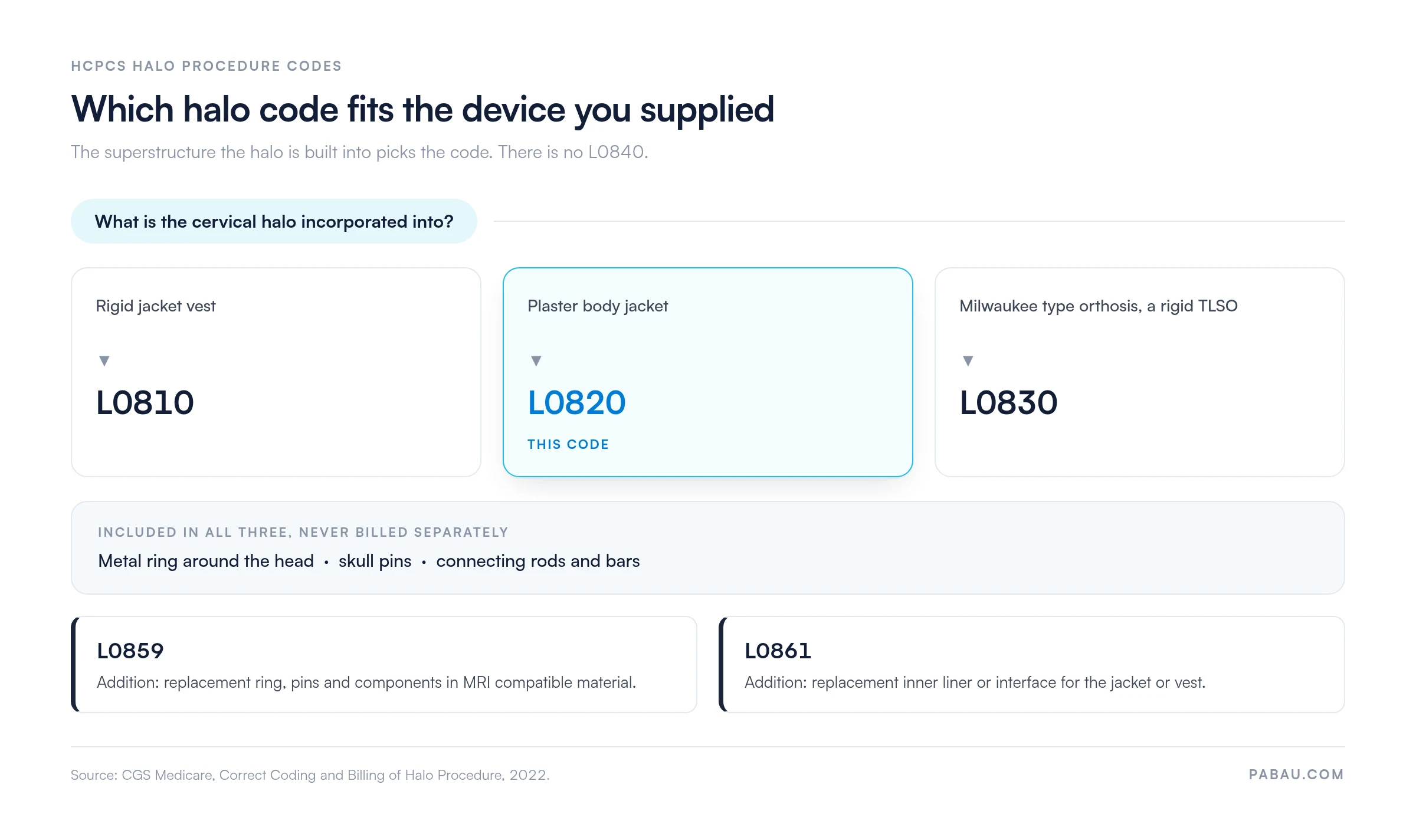
Two points are worth pinning down here. First, there is no L0840. Some payer databases and older code lists show one, but the halo procedure codes stop at L0830. Second, L0859 and L0861 belong to this family too. They are additions rather than separate device classes, so they sit alongside the base code rather than replacing it.
That matters most when a patient needs a scan. A standard halo blocks an MRI, so the rings and pins get swapped for compatible parts, and L0859 covers that replacement. A worn inner liner is the other common follow up, and L0861 covers it. Neither one is a reason to bill L0820 again.
Medicare covers L0820 when the device is medically necessary, ordered in writing by a physician, and supplied by an accredited DMEPOS supplier.
The Durable Medical Equipment Medicare Administrative Contractors, or DME MACs, run that coverage. Each one publishes a local coverage determination, so verify the beneficiary’s jurisdiction before delivery rather than after it.
Coverage turns on one clinical question. Does the patient need rigid cervical immobilization held by a thoracic body jacket?
Cervical fractures, post surgical cervical instability and injuries needing prolonged immobilization are the usual answers. The reviewer then looks for five things in the file.
Most halos go on in a hospital, which changes who bills for the device. CGS Medicare tells suppliers not to send a DME MAC claim when the orthosis is provided before admission or during an inpatient stay.
One window stays open. If the device reaches the patient within two days of discharge home, the supplier may bill the DME MAC.
So compare the delivery date against the discharge date before you key anything. A halo handed over on hospital day three falls inside the inpatient stay, and a DME MAC claim for it is wrong.
The same device delivered on the day before discharge is billable. This single date check prevents a recoupment that often surfaces years later on audit.
Payment itself comes from the CMS DMEPOS fee schedule, which is updated every year. We do not quote an allowed amount here, because the figure changes annually and varies by state.
Pull the current rate from the fee schedule file or your MAC’s published rates instead. A quarterly review of every active L code keeps those numbers honest.
After code selection, thin documentation is the most common reason these claims fail. CGS Medicare treats L0820 as one of the custom fitted orthotic codes that needs a written order before delivery. Build the file as a pre delivery checklist, and the post payment review takes care of itself.
Missing and late orders are among the most cited findings in DME audits, and they are also the easiest to prevent. Keep every order with a date stamp that clearly predates delivery. Store it where the billing team can open it without asking the fitter.
Every L0820 claim needs at least one ICD-10-CM diagnosis code that supports medical necessity. The codes below are the ones that usually appear on halo claims.
Check each one is active for the current fiscal year before you submit. A retired code rejects at the payer’s front end, so it never comes back as a denial you can appeal.
Pick the most specific code the record supports. On a fracture, the seventh character tells the MAC whether this is an initial encounter, a subsequent one or a sequela.
That detail alone can prevent a records request. An unspecified code where a precise one exists tends to pull the claim into medical review.
The claim really starts before the device does. A physician writes and signs the order, and the supplier checks that it names the configuration being supplied.
The halo and the jacket are then fitted, and the patient signs a delivery receipt on the day. Billing builds the CMS-1500, or the 837P if you file electronically, using L0820 and the supporting diagnosis.
From there the claim routes to the DME MAC for the beneficiary’s state of residence, not the supplier’s state. The MAC adjudicates against its local coverage determination and either pays, denies or returns the claim as unprocessable.
An unprocessable return is not a denial, and it has no appeal rights, so it needs correcting and resubmitting rather than appealing.
Five errors account for most of these rejections, and each one is caught upstream rather than in appeals. Tracking them by denial codes shows you which one your own team repeats.
Ask your DME MAC or the PDAC portal for the advisory article on halo procedures and keep a copy with your compliance file. It works through billing scenarios for L0810 to L0861 that commercial code lookup databases leave out, including what each base code already covers.
Most orthotic suppliers keep the physician order in one folder, the signed delivery receipt in another, and the device description in the fitter’s notes. That works until a MAC asks for records two years later. Then somebody spends a morning rebuilding a file that should have taken a minute to open.
Practice management software like Pabau keeps those documents on the same patient record. Digital forms capture the delivery signature on the day, and the signed copy attaches to the patient straight away. Nothing gets scanned in later, and nothing sits in an inbox.
Pabau’s medical claims management then handles submission and tracking. The billing team can see which L0820 claims are still with the MAC, and which ones came back. When a post payment review lands, the order, the receipt and the device notes open together.
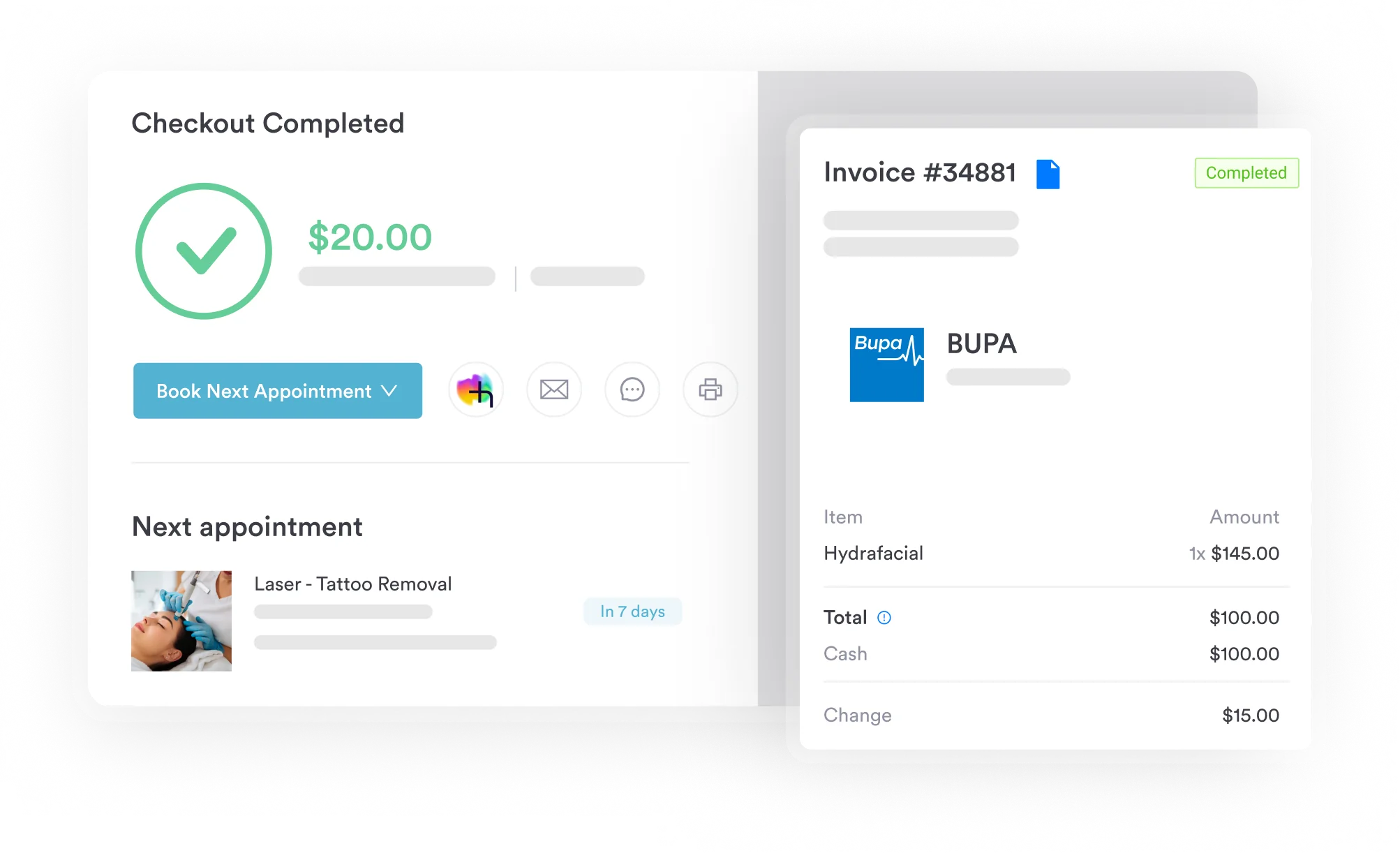

Pabau stores the physician order, the signed delivery receipt and the device notes on the patient record, then submits and tracks the claim. Your team can answer a records request without hunting through folders.

L0820 is a narrow code with two decisions behind it. Read the delivery record to confirm the trunk piece, then check the delivery date against the discharge date. Get both right and the claim is usually straightforward, because the ring, the pins and the rods are already inside the payment.
The trade off worth remembering is timing. Halo patients leave hospital quickly, and the paperwork rarely moves as fast as they do. Suppliers who hold the order, the receipt and the device notes in one system tend to submit sooner and appeal less.
If that file currently lives across three folders, it is worth seeing what one record looks like. Book a demo to see how Pabau keeps orthotic orders, delivery receipts and claim status together.

Coding the fusion surgery behind the halo? CPT code 22554 covers the anterior cervical fusion that often puts a patient in this device.
Patient stepping down to a collar? HCPCS code L0130 is the molded cervical collar billed once the halo comes off.
Want the claim right the first time? Clean claim submission covers what a DME payer checks before it pays a device this size.
Seeing the same halo claim bounce back? Denial management in healthcare sets out a process for appealing and preventing repeat DMEPOS denials.
No. L0820 is the supplier’s code for the device. The physician reports the cranial halo application with a CPT code instead. That is 20661 for a standard application, or 20664 when six or more pins are placed for thin skull osteology.
L0859. It is an addition to the halo procedure, covering the replacement ring, pins and connecting components in a material that is safe inside a scanner. Bill it when those parts are actually supplied, not as a routine add-on to L0820.
L0861 covers replacement of the inner liner or interface material for a body jacket or jacket vest. Do not rebill L0820 for a liner change, because the base code has already paid for the complete device.
Yes, through the orthotic repair codes. L4205 covers repair labor in 15 minute units, and L4210 covers minor parts such as screws and rivets. L4205 also applies to medically necessary adjustments made more than 90 days after delivery.