HCPCS Code K0900: Customized DME billing and coding guide
HCPCS Code K0900: Official descriptor and code overview HCPCS Code K0900 is a CM...

Last Updated: Nov 18, 2026
L0150 is the HCPCS Level II code for a cervical, semi-rigid, adjustable molded chin cup (plastic collar with mandibular/occipital piece). It describes a plastic neck collar with a molded chin cup that also supports the jaw and the back of the head.
The collar is semi-rigid and adjustable, and it stops at the neck, with no posts, bars or thoracic extension. Medicare's DME contractors class it as custom fitted, so a trained fitter adjusts it at delivery.
Let Pabau's smart automation suggest the right codes, reduce claim denials, and keep your practice compliant—effortlessly.
Automate repetitive tasks and focus on what matters most—your patients.
Reduce coding errors and ensure compliance with the latest regulations.
Clean claims, fewer denials, and faster reimbursements.
Powerful insights and reporting to help your practice thrive.
HIPAA compliant SOC 2 certified GDPR-compliant Trusted by 4,000+ clinics worldwide

HCPCS code L0150 is a semi-rigid, adjustable plastic neck collar with a molded chin cup and a mandibular/occipital piece.
It has no thoracic extension, no posts and no cervical bars, so SOMI-type and multi-post braces belong under L0180 to L0200.
Medicare’s DME contractors class L0150 as custom fitted, so a trained fitter must adjust it to the patient at delivery.
The same collar handed over off the shelf, with no custom fitting, is billed as L1499 rather than L0150.
Most denials trace back to a wrong code choice or a missing order, fitting note or proof of delivery.
HCPCS code L0150 describes a semi-rigid, adjustable plastic cervical collar with a molded chin cup. A built-in piece supports the jaw and the back of the head. AAPC lists the descriptor as “Cervical, semi-rigid, adjustable molded chin cup (plastic collar with mandibular/occipital piece).” The collar ends at the neck and shoulders.
That last detail matters more than it looks. Older guides, including an earlier version of this page, describe L0150 as a multi-post brace with a thoracic extension. That device is L0200, and a claim built on that reading lands on the wrong code.
Read the descriptor as a checklist. A device fits L0150 when it has every one of these features:
Some common devices look similar but fall outside the code:
Every code in this family can treat the same neck injury. What separates them is how the device is built and how it reaches the patient. Here are the official long descriptors side by side.
Two quick tests settle most cases. If the device has posts or bars, you are in L0180 to L0200. If it is a one-piece plastic collar, the chin cup decides between L0140 and L0150. The flow below adds the third question, covered in the next section, about who fitted the collar.
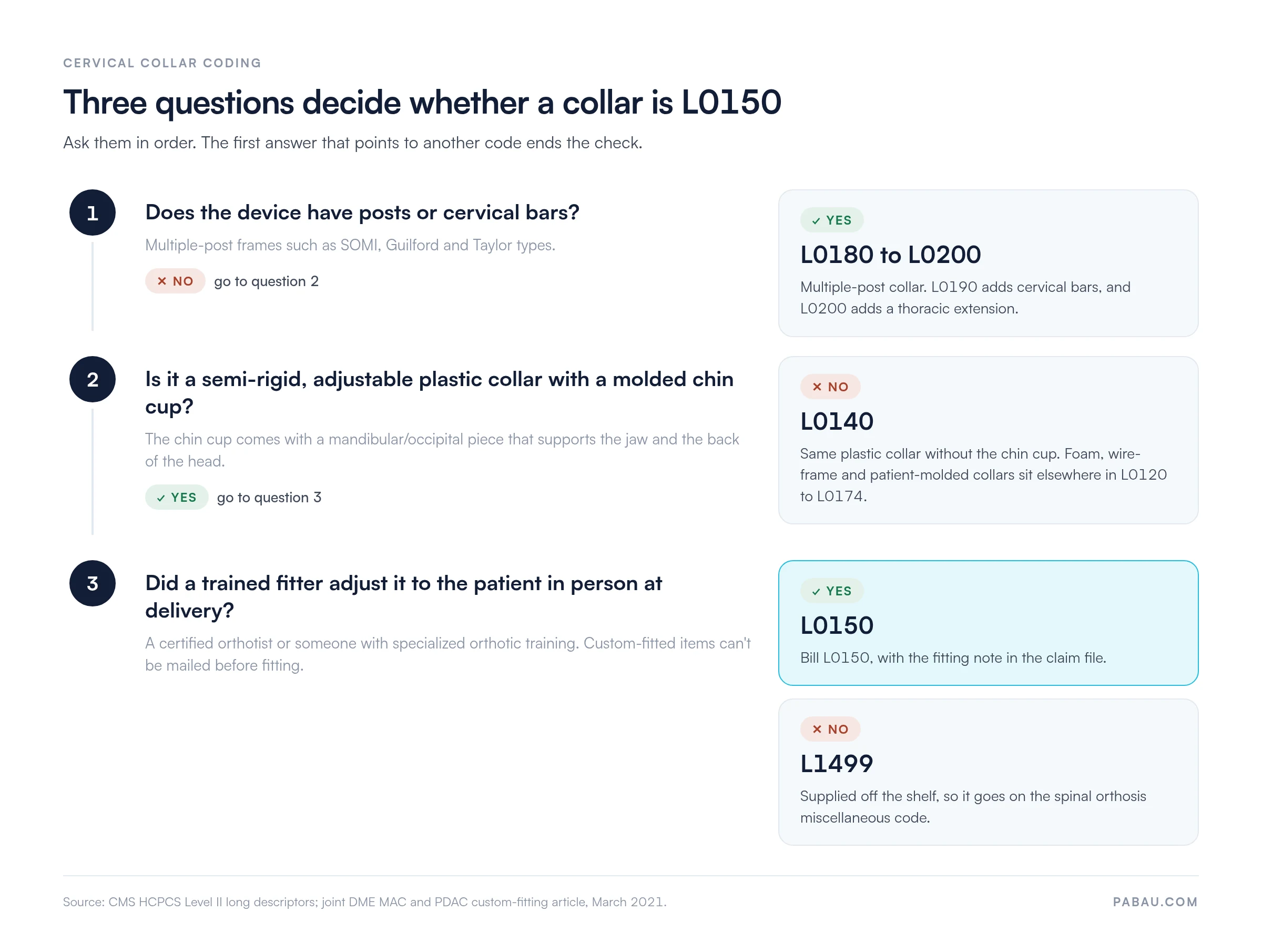
A joint DME MAC and PDAC coding article lists L0150 among custom-fitted orthoses with no off-the-shelf equivalent code. Custom fitting means a certified orthotist, or someone with specialized orthotic training, adjusts the collar to the patient at delivery.
The article sets out what happens when that fitting doesn’t take place. A custom-fitted item supplied off the shelf is billed with a miscellaneous code, which for a spinal orthosis is L1499. The same article says these items cannot be mailed to the patient before fitting.
In practice, the code depends on what happened at delivery as much as on the collar itself. Write down who fitted it, what they adjusted and why. Without that note, an L0150 claim is hard to defend on review.
Here is the path a typical Medicare claim takes, from the first order to the remittance.
A patient leaves the emergency department with a cervical sprain, coded S13.4XXA. Their surgeon orders an adjustable chin-cup collar for added support. The patient arrives at the orthotics practice with a signed order.
The orthotist sizes the collar, trims the chin cup and sets the height so the jaw rests without pressure. They note each adjustment and the patient signs the delivery receipt. That visit supports L0150.
Now change one fact. The front desk hands over the same boxed collar, and the patient fastens it at home. No fitting is recorded, so the claim belongs on L1499 instead.
Most L0150 denials come from a handful of avoidable errors. For the remittance codes you will see on the denial itself, see our guide to medical billing denial codes.
Medicare covers neck braces under the Part B braces benefit. The allowed amount comes from the CMS DMEPOS fee schedule, which sets rates by state and updates them each year.
Medicare pays 80% of the allowed amount once the Part B deductible is met. The patient or a secondary payer covers the other 20%. Check the current file rather than reusing last year’s figure.
Many orthotics teams track orders, fitting notes and delivery receipts across paper files and a separate billing tool. A missing signature often surfaces only when the denial arrives.
Pabau, the practice management and billing platform we build, keeps those documents on the patient record. Its claims management software pre-fills the CMS-1500 from the invoice and validates it for missing or invalid details before you send.
In the US, claims go out through Claim.MD, with eligibility checks and ERA posting built in. Because the order, fitting note and claim sit side by side, a missing document is easier to spot before the claim leaves.

Pabau keeps orders, fitting notes and delivery receipts on the patient record. It pre-fills the claim and validates it for missing or invalid details before you submit.

L0150 is a narrow code for a specific collar. Before you bill it, look at the device and confirm the molded chin cup and the jaw and skull support. Then check that a qualified fitter adjusted it in person.
If either answer is no, another code fits better, and choosing it now saves an appeal later. Keep the order, fitting note and delivery receipt together, and the claim can stand up to review.
Book a demo to see how Pabau keeps orthotic orders, fitting notes and claims on one patient record.

Billing the softest collar in the family? HCPCS code L0120 covers the off-the-shelf foam collar and when it applies.
Working with a two-piece foam collar? HCPCS code L0172 explains the off-the-shelf thermoplastic foam collar code.
Is the collar molded to a patient model? HCPCS code L0170 walks through the custom-molded collar code.
Need a framework for cutting denials? Denial management in healthcare covers how to find, appeal and prevent denied claims.
New to the billing cycle? What is medical billing walks through a claim from service to payment posting.
Yes. L0150 is an active HCPCS Level II code, and its descriptor still describes the semi-rigid chin-cup collar. Check the current CMS quarterly HCPCS file before each new year.
No. Medicare’s payment for an orthosis includes the fitting and adjustment at delivery. Don’t add a separate service line for the same visit.
Add the RA modifier, which marks a replaced orthotic item. Document why the collar was replaced, such as loss, theft, damage or a change in the patient’s condition.
Check the CMS DMEPOS Required Prior Authorization List for the date of service. Commercial plans and Medicaid set their own rules, so confirm each payer before delivery.
Use the ICD-10-CM code for the neck condition that needs support, such as a cervical sprain (S13.4XXA) or a cervical disc disorder (M50). The medical record must explain the need.