HCPCS Code G0163: Skilled nursing observation and assessment
What is HCPCS Code G0163? HCPCS Code G0163 is a deleted Level II code for skille...

Last Updated: Oct 15, 2026
L1001 is the HCPCS Level II code for cervical-thoracic-lumbar-sacral orthosis (CTLSO), immobilizer, infant size, prefabricated, includes fitting and adjustment.
The code pays for a ready-made infant spinal brace, supplied complete and then fitted to the child. It sits in the scoliosis orthotic device range L1000 to L1120, alongside the custom Milwaukee CTLSO at L1000. L1001 is often miscited as an ankle-foot orthosis code, but that descriptor belongs to L1930 in a separate range. Because the patient is an infant, Medicaid and commercial plans review most L1001 claims rather than Medicare. Many of those payers assess the request one case at a time.
Let Pabau's smart automation suggest the right codes, reduce claim denials, and keep your practice compliant—effortlessly.
Automate repetitive tasks and focus on what matters most—your patients.
Reduce coding errors and ensure compliance with the latest regulations.
Clean claims, fewer denials, and faster reimbursements.
Powerful insights and reporting to help your practice thrive.
HIPAA compliant SOC 2 certified GDPR-compliant Trusted by 4,000+ clinics worldwide

HCPCS code L1001 describes a prefabricated cervical-thoracic-lumbar-sacral orthosis (CTLSO) immobilizer in infant size, with the fitting and adjustment included
The code sits in the scoliosis orthotic device range L1000 to L1120. The prefabricated ankle-foot orthosis descriptor belongs to L1930 instead
The patient is an infant, so Medicaid, CHIP and commercial plans pay far more L1001 claims than Medicare ever does
No Medicare local coverage determination names L1001. LCD L33790 covers only the TLSO and LSO codes L0450 to L0651, so your DME MAC decides on the record you send
Laterality modifiers never belong on this line. A spinal orthosis has no left or right form, so RT and LT will reject the claim
Pabau’s claims management software holds the written order, the fitting note and the delivery receipt on one patient record. An L1001 file is then ready when a reviewer asks
HCPCS code L1001 is a Level II code maintained by the Centers for Medicare and Medicaid Services (CMS). Its official descriptor is: Cervical-thoracic-lumbar-sacral orthosis (CTLSO), immobilizer, infant size, prefabricated, includes fitting and adjustment. The code sits in the scoliosis orthotic device range, L1000 to L1120.
A CTLSO is a spinal brace that runs from the cervical spine down to the sacrum. L1001 describes the infant-size immobilizer version of that brace. It is supplied ready-made, then fitted to the child, and the code pays for the device plus the fitting and adjustment done at delivery.
Two attributes decide whether L1001 is the correct code. The orthosis has to be prefabricated rather than built from a mold of the child. It also has to be the infant-size immobilizer, not the custom Milwaukee scoliosis brace that L1000 describes.
Use the reference table below to confirm the attributes of L1001 before you build the claim. The descriptor and range are confirmed against the CMS HCPCS overview.
L1001 pays for one complete device and the work of fitting it. The descriptor names no component, no add-on and no custom build. The list below separates what the code includes from what belongs to a neighboring code.
A reviewer checks fabrication status first. A device made from a cast, a scan or an X-ray of that specific child is custom-fabricated, and L1001 no longer describes it. A brace assembled from stock components stays prefabricated, even when the fitter trims, bends or heat-molds it to the child.
L1001 is appropriate when an infant needs the cervical, thoracic, lumbar and sacral spine held still, and a ready-made brace can do that job. The prescriber’s notes have to name the condition, say what the immobilization is meant to achieve, and explain why a prefabricated device suits this child.
Infantile idiopathic scoliosis is the usual reason. It is diagnosed before the child’s third birthday, and bracing is one way clinicians try to control a curve while the spine is still growing. Congenital vertebral anomalies and neuromuscular curves also show up on L1001 requests.
Immobilization after surgery or injury is the other group. An infant recovering from spinal surgery, or healing a vertebral injury, may need external support while the spine consolidates. Record how long the brace is expected to be worn, because that detail often decides a manual review.
The diagnosis on the claim has to explain why an infant needs spinal immobilization. The codes below are the ones that most often accompany L1001. Check each against the payer’s own policy first, because covered diagnosis lists differ by plan and by state.
Code to the region named in the radiology report wherever the notes allow it. An unspecified-site code invites a request for records, and the reviewer then reads the same report you could have coded from.
The scoliosis orthotic device range runs from L1000 to L1120. It sits in the orthotic and prosthetic chapter of the HCPCS Level II codes, which cover devices and supplies billed outside the physician fee schedule.
Only a few codes in the range describe a complete brace. The rest are additions, which describe the pads, slings and flanges fitted to a base orthosis.
The additions in the L1010 to L1120 range are written for a base orthosis. The DME MACs treat L1000 as the base code they attach to. L1001 arrives complete, with its fitting and adjustment already in the descriptor. Check with your MAC before you bill a component beside it. The rules for L1030 show how that pairing behaves in practice.
The chart below sorts the devices in and around this range by the code that describes each one.
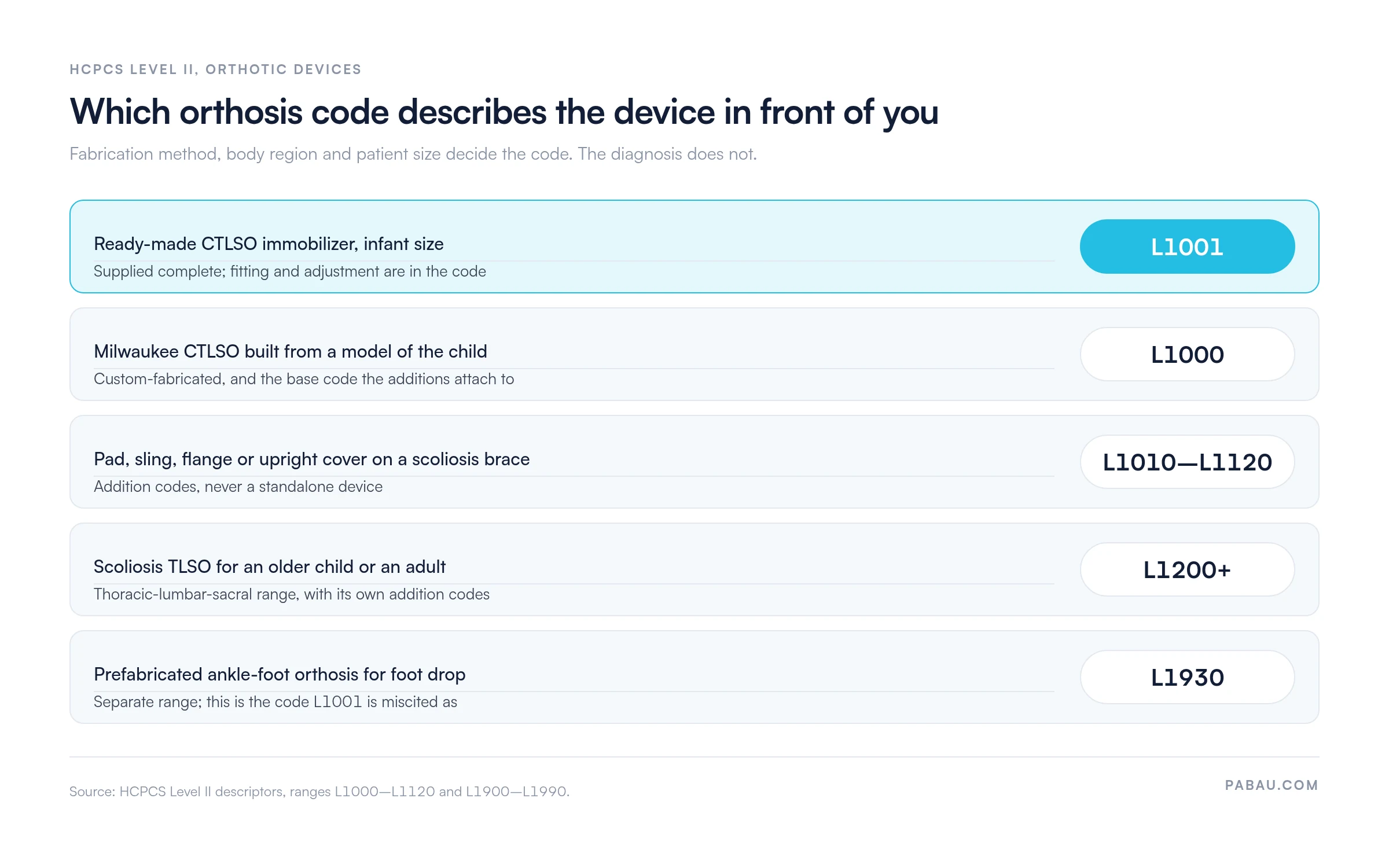
One mix-up is worth naming on its own, because it circulates widely in coding forums and cheat sheets. L1001 is often quoted as the prefabricated ankle-foot orthosis code. That descriptor belongs to L1930, in the separate L1900 to L1990 range.
The consequence is easy to predict. A foot drop diagnosis such as M21.371 will not support a spinal orthosis, so the line denies on medical necessity. If your chargemaster or billing template still labels L1001 as an AFO, correct the description before the next claim goes out.
Search your chargemaster for every L-code whose stored description mentions an ankle, a foot or a drop foot brace. Any hit in the L1000 to L1120 range is a mislabeled scoliosis code, and it will keep generating denials until someone rewrites the description.
Most L1001 requests are reviewed by a person rather than waved through by an edit. That makes the file itself the deciding factor. Assemble these six items before the brace is fitted, not after the claim is rejected.
Medicare covers L1001 under the Part B brace benefit when an enrolled DMEPOS supplier bills it and the record supports medical necessity. No local coverage determination names the code, so the decision sits with your DME MAC and the documentation you send.
Billers often reach for the spinal orthosis policy by reflex, and it does not apply here. LCD L33790 covers thoracic-lumbar-sacral and lumbar-sacral orthoses in the L0450 to L0651 range. L1001 sits outside that range, so its criteria and its required modifiers do not carry across.
Medicare beneficiaries are overwhelmingly adults, so an infant brace rarely reaches a Medicare claim form at all. The DMEPOS fee schedule still matters, because other payers use it as a reference when they set their own rate.
Medicaid is the payer most L1001 claims meet. State programs review the code on their own terms, and several assess every request individually. Connecticut’s HUSKY Health spinal orthoses policy says so directly. Requests for a CTLSO infant immobilizer are reviewed case by case against the state’s definition of medical necessity.
Federal EPSDT rules work in your favor on a pediatric denial. Early and Periodic Screening, Diagnosis and Treatment applies to every enrollee under 21. State Medicaid programs must cover medically necessary care that corrects or improves a condition found at screening. Cite that provision when you appeal.
Commercial plans generally cover scoliosis orthoses once their own criteria are met. The criteria, the paperwork and the prior authorization thresholds differ by plan. Ask for the plan’s L1001 rate while you are on the call, since it can sit well away from the Medicare allowable.
Get the payer’s L1001 decision in writing before the brace is fitted. Infant braces are frequently reviewed one at a time rather than against a published code list. A verbal approval gives you nothing to appeal with later.
L1001 takes far fewer modifiers than a limb orthosis does. The table below covers the ones a DMEPOS supplier uses on this code, plus the two that never belong on it. Confirm the requirements with each payer, because commercial rules can differ from Medicare’s.
The laterality row deserves a second look in your billing template. Many DME templates force RT or LT onto every L-code, which is correct for an ankle or a knee brace and wrong here. An L1001 line carrying LT will reject before a human ever reads it.
L1001 denials cluster around the device, the diagnosis and the paperwork. The table below maps each reason to the fix. A single change at policy level usually stops the same denial recurring across later claims.
The documents that decide an L1001 claim rarely sit together. The prescriber holds the written order. The fitting note is in the chart, the authorization number is in an email, and the signed delivery receipt is in a drawer. A reviewer asks for all four at once.
Practice management software like Pabau keeps those documents against one patient record instead. The order, the clinical note, the authorization and the delivery receipt attach to the same file. Codes carry through to the claim without retyping, so the diagnosis you documented is the diagnosis that goes out.
Pabau’s claims management software then tracks each submission through to payment. An L1001 line with a stray laterality modifier, or with no delivery record behind it, surfaces while you can still correct it. When a payer asks for the file, your team has it assembled already.

Pabau brings the written order, the fitting note and the signed delivery receipt onto one patient record. Your team submits L1001 with the right diagnosis and no stray modifiers, so fewer claims come back.

HCPCS code L1001 describes exactly one device: A ready-made CTLSO immobilizer in infant size, fitted and adjusted at delivery. Every denial pattern on this code traces back to the device, the diagnosis or the paperwork behind them.
Match the descriptor first, because L1001 is widely miscited as an ankle-foot orthosis code. Then link an infant spinal diagnosis, secure the authorization in writing, and keep laterality modifiers off the line. Those four habits cover most of what goes wrong.
Pabau’s claims management software gives orthotists and DMEPOS suppliers one place to hold the order, the fitting note and the delivery record. To see how it fits your billing workflow, book a demo.

Coding a foot drop brace instead? HCPCS code L1930 covers the prefabricated ankle-foot orthosis descriptor that L1001 gets mistaken for.
Billing a pad alongside the brace? HCPCS code L1030 explains how a lumbar bolster pad addition pairs with a base orthosis.
Replacing a worn upright cover? HCPCS code L1120 sets out how the cover for upright addition is billed, one unit at a time.
Waiting on approvals before every fitting? The prior authorization process walks through the steps that keep a brace from being supplied too early.
Seeing the same rejection twice? Denial management in healthcare shows how to fix a denial pattern at policy level rather than claim by claim.
HCPCS code L1001 covers a prefabricated cervical-thoracic-lumbar-sacral orthosis (CTLSO) immobilizer in infant size, including the fitting and adjustment done at delivery. It does not cover the custom-fabricated Milwaukee CTLSO, which is L1000, or the pads and slings in the L1010 to L1120 addition range.
No. L1001 is a spinal orthosis code in the scoliosis range L1000 to L1120. The prefabricated ankle-foot orthosis descriptor belongs to L1930, in the separate L1900 to L1990 range. Billing L1001 for an AFO is a descriptor mismatch, and a foot drop diagnosis on that line will deny.
L1000 is the custom-fabricated Milwaukee CTLSO, and its descriptor includes the model made from the patient. L1001 is the prefabricated infant-size immobilizer, supplied ready-made and then fitted. Fabrication method and patient size decide which code applies, so check the manufacturer’s documentation before you code.
Medicare can cover L1001 under the Part B brace benefit when an enrolled DMEPOS supplier bills it and the record supports medical necessity. No local coverage determination names the code, so your DME MAC decides each claim. In practice the patient is an infant, so Medicaid and commercial plans handle most L1001 claims.
The infantile idiopathic scoliosis codes M41.00 and M41.04 to M41.07 accompany L1001 most often. Neuromuscular scoliosis under M41.40 and the congenital spinal codes Q76.3 and Q67.5 are also used. Code to the region documented in the radiology report, and check the list against the payer’s own policy before you submit.
Most Medicaid programs and many commercial plans require prior authorization for a spinal orthosis. Several review an infant immobilizer request individually rather than against a published list. Connecticut’s HUSKY Health policy reviews L1001 case by case. Confirm the rule with each payer and obtain approval before the brace is fitted.
No. RT and LT report laterality, and a spinal orthosis has no left or right form. Many DME billing templates add a laterality modifier to every L-code by default, which is correct for a limb brace and wrong here. Remove RT and LT from the L1001 template so the line is not rejected on submission.