

HCPCS code E0198: Water pressure pad billing guide
HCPCS code E0198 is a water pad for a standard mattress HCPCS code E0198 is the ...

Last Updated: Oct 13, 2026
L0470 is the HCPCS Level II code for a thoracic-lumbar-sacral orthosis (TLSO) with triplanar control. A rigid posterior frame works with a flexible soft anterior apron, and subclavicular extensions supply rotational strength. The brace restricts gross trunk motion in the sagittal, coronal, and transverse planes.
The official descriptor ends with prefabricated, includes fitting and adjustment, so L0470 sits in the custom-fitted category. A qualified practitioner has to shape the brace to the individual patient. Off-the-shelf codes in the same range, such as L0469, describe different frame designs.
Let Pabau's smart automation suggest the right codes, reduce claim denials, and keep your practice compliant—effortlessly.
Automate repetitive tasks and focus on what matters most—your patients.
Reduce coding errors and ensure compliance with the latest regulations.
Clean claims, fewer denials, and faster reimbursements.
Powerful insights and reporting to help your practice thrive.
HIPAA compliant SOC 2 certified GDPR-compliant Trusted by 4,000+ clinics worldwide

HCPCS code L0470 covers a thoracic-lumbar-sacral orthosis with triplanar control, a rigid posterior frame, and a flexible anterior apron.
CMS classes L0470 as prefabricated and custom fitted, so a practitioner must shape the brace for the individual patient.
L0469 is the off-the-shelf code in this family, and billing L0470 for an unmodified brace is upcoding.
Medicare Part B covers L0470 under DMEPOS when an LCD-supported diagnosis and a signed detailed written order are on file.
The KX modifier goes on only when the claim meets the LCD criteria, and GA reports a signed ABN.
HCPCS code L0470 is a Level II L-code for a thoracic-lumbar-sacral orthosis (TLSO). The brace combines triplanar control, a rigid posterior frame, and a flexible soft anterior apron. CMS maintains HCPCS Level II codes for billing Medicare and other federal payers for durable medical equipment, orthotics, and supplies.
The official descriptor runs to one long sentence, and its closing words set the billing category. It ends with includes fitting and shaping the frame, prefabricated, includes fitting and adjustment.
Two phrases in that text carry the billing weight. Triplanar control means the orthosis restricts motion in the sagittal, coronal, and transverse planes. Prefabricated with fitting and adjustment is the CMS wording for a custom-fitted device. In short, a qualified practitioner shapes the frame to the patient before delivery, which is what separates L0470 from an off-the-shelf brace.
Medicare Part B may cover HCPCS code L0470 under the DMEPOS benefit when the claim meets medical necessity criteria. Those criteria come from the applicable Local Coverage Determination (LCD), and coverage is never automatic. Each Medicare Administrative Contractor (MAC) publishes its own LCD for spinal orthoses, so the criteria vary by jurisdiction. Read the current LCD and confirm active Part B coverage before you write the order.
Diagnoses that often support a custom-fitted TLSO include vertebral fractures, post-surgical spinal stabilization, and severe scoliosis. The treating physician also has to document why an off-the-shelf brace would not control the trunk well enough for this patient.
Coverage decisions sit at the front of revenue cycle management, where a checklist costs a few minutes to run. Practices that work through these criteria before they order the brace see far fewer after-the-fact denials on custom orthotic claims.
Medicare reimburses HCPCS code L0470 under the DMEPOS fee schedule, which CMS updates annually. CMS adjusts rates by locality, so the allowable amount differs by geographic pricing region. Verify the current figure for your billing locality in the CMS DMEPOS fee schedule before you submit.
Because suppliers purchase the device, most claims bill L0470 with the NU modifier. Medicare applies 20% coinsurance to DMEPOS items once the beneficiary meets the Part B deductible. The beneficiary owes that share unless a secondary payer picks it up. Electronic remittance advice files itemize each line-item decision, so payment is easy to track against the expected allowable.
Always verify the current-year DMEPOS fee schedule rates for your specific billing locality before quoting patients on their expected cost share. Rates on third-party sites can lag the annual CMS update by several months.
Documentation failures cause most L0470 denials and post-payment recoveries. Because L0470 requires custom fitting, Medicare expects evidence that a practitioner shaped the frame to this patient. A brace that arrives unmodified does not qualify.
These are the core documentation elements a clean L0470 claim needs:
Sequence matters here as much as content. Four of the seven steps below must be complete before the supplier dispenses the brace. A document dated afterwards cannot stand in for one of them.
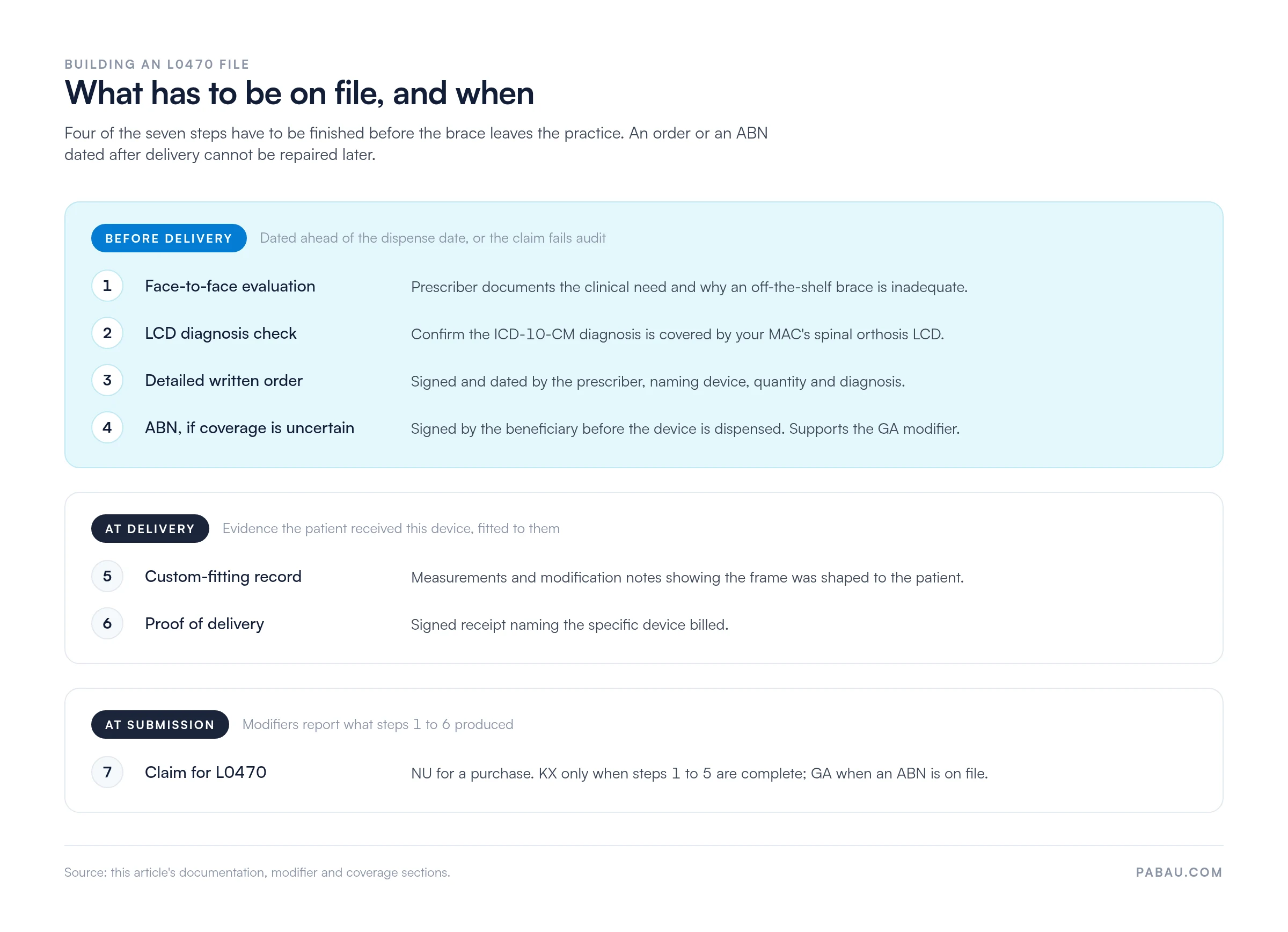
Keep the file for at least seven years. DMEPOS audits target custom orthotic claims because error rates in this category have long been high. A pre-delivery checklist works best inside the billing system itself. Software for DME billers can hold a claim back until the record is complete.
Modifier selection for HCPCS code L0470 decides whether Medicare processes the claim as covered, non-covered, or pending an ABN. Incorrect modifier use is the fastest route to a preventable denial. Verify current modifier requirements with your MAC or a certified coder before submission, as guidance changes from time to time.
KX is the modifier auditors look at first. Appending it without the supporting documentation on file creates audit exposure. Reading the denial codes on the remittance helps when a KX claim still rejects. That result usually means the payer did not find that the claim met the LCD criteria at the diagnosis-code level.
The TLSO range separates codes by the planes of motion the brace controls and by the fitting category. Picking the wrong one is a common billing error. Five of the six codes below are custom fitted, so the fitting category alone rarely settles the choice. The AAPC HCPCS code lookup and the current CMS files carry the full descriptors.
Construction is the third axis in this range. A modular segmented spinal system with three rigid plastic shells carries the same triplanar control, and it bills as L0462.
Device design decides the L0470 and L0472 choice, not how a factory made the brace. Both descriptors end in prefabricated with fitting and adjustment, so both sit in the custom-fitted category. L0472 is a hyperextension frame running from the symphysis pubis to the sternal notch. It carries one pubic pad and one sternal pad at the front. L0470 pairs a rigid posterior frame with a flexible anterior apron. Code from the device the practitioner actually fitted to the patient.
Shell construction separates one more neighboring code. A brace built as a one-piece rigid plastic shell with an interface liner bills as L0488, not as a frame and apron.
A handful of patterns account for most L0470 rejections and audit findings. Fixing them at the workflow level, before claims go out, costs far less than working appeals afterwards.
Practices that run a pre-claim audit on DMEPOS submissions reach higher first-pass acceptance. That audit checks modifier selection, documentation completeness, and diagnosis-code alignment with the LCD. A periodic review of paid claims catches systematic errors before a payer’s audit finds them.
Run a quarterly internal audit on a sample of paid L0470 claims. Pull five to ten files at random. Each one needs a signed DWO dated before delivery, plus custom-fitting documentation. Confirm that the biller appended KX only where the LCD criteria checklist is complete.
Medicare-enrolled DME suppliers and certified orthotists who meet enrollment and credentialing requirements may bill HCPCS code L0470. Billing the code without proper enrollment is a compliance violation, and Medicare will deny or recoup payment from an improperly enrolled supplier.
Medicare enrollment for DMEPOS suppliers requires site inspections, surety bonds, and ongoing accreditation maintenance. A non-enrolled provider who dispenses a custom orthotic and bills Medicare creates false-claim exposure, whatever the clinical merits of the device.
Most orthotic suppliers track documentation beside the billing system rather than inside it. The written order sits in the patient chart, the fitting notes stay with the practitioner, and the claim goes out when someone believes both exist.
Practice management software like Pabau keeps the order, the clinical note, and the claim on one patient record. Billing staff can see whether the face-to-face notes and the fitting records are on file before they submit the L0470 line.
That turns the pre-delivery checklist into part of the workflow rather than a separate habit. A KX modifier then goes out only on a claim whose file supports it. Staff now catch problems that used to surface in a remittance weeks later, before submission.

Pabau helps DME suppliers and orthotic practices track documentation requirements, manage claim submission, and reduce denial rates across DMEPOS billing codes.

The fitting decides L0470, not the billing desk. A brace that a practitioner shaped for the patient, documented before delivery, and matched to an LCD diagnosis bills cleanly. One missing element moves the whole claim into an appeal.
Three errors are worth designing out of the workflow. Someone bills an off-the-shelf brace as custom fitted, signs an order after delivery, or adds a KX modifier on faith. Each one is visible before submission if somebody is looking at the file.
Book a demo to see how Pabau keeps orthotic documentation, modifiers, and claim status in one place for DMEPOS billing teams.

Need to understand what makes a clean DMEPOS claim? Clean claim submission covers the elements every DMEPOS claim must have to pass first-time processing.
Confused about denial reason codes on your L0470 remittances? Denial codes in medical billing explains the most common DMEPOS denial reasons and how to respond.
Looking to reduce orthotic claim write-offs? Denial management in healthcare outlines a structured workflow for tracking and appealing denied claims before timely-filing limits expire.
Enrolled DME suppliers and certified orthotists use HCPCS code L0470 to bill for a thoracic-lumbar-sacral orthosis (TLSO) with triplanar control, rigid posterior frame, flexible anterior panel, and custom fitting. They submit it to Medicare Part B and other payers for this specific custom-fitted spinal brace.
Medicare Part B may cover L0470 under the DMEPOS benefit when the practitioner documents the medical necessity criteria. The diagnosis must appear in the applicable MAC Local Coverage Determination. Coverage is not automatic and varies by MAC jurisdiction. Confirm the LCD and verify the diagnosis before the supplier dispenses the device.
Required documentation includes a detailed written order signed before delivery and face-to-face encounter notes supporting medical necessity. The file also needs proof of delivery, custom-fitting records, and an LCD-qualifying ICD-10-CM diagnosis. When coverage is uncertain, a signed Advance Beneficiary Notice must be on file before the supplier dispenses the device. Verify current requirements with your MAC.
Append the KX modifier when the claim meets all LCD medical necessity criteria and documentation is complete. Use GA when Medicare coverage is uncertain and a signed ABN is on file. Use GZ when you expect a denial and obtained no ABN. NU (new equipment) is the standard purchase modifier. Verify current modifier requirements with your MAC before submission, as guidance changes.
Medicare-enrolled DMEPOS suppliers and certified orthotists holding an active supplier number from a CMS-approved accreditation organization may bill L0470. Prescribing physicians write the order but usually do not bill the code themselves. Non-enrolled providers who dispense the device cannot bill Medicare for it regardless of clinical appropriateness.



