

CCSD code XR940: Foreign body retrieval billing guide
CCSD code XR940 is the UK private healthcare code for retrieval of a foreign bod...

Last Updated: Nov 26, 2026
L0626 is the HCPCS Level II code for a prefabricated lumbar orthosis with sagittal control and rigid posterior panel(s). The posterior panel extends from L-1 to below L-5 and produces intracavitary pressure to reduce load on the intervertebral discs. An individual with expertise trims, bends, molds, assembles, or otherwise customizes it to fit a specific patient.
Three neighboring codes frame it. L0625 is a flexible lumbar orthosis supplied off the shelf, and L0627 adds a rigid anterior panel to the rigid posterior one. L0641 is the same brace dispensed off the shelf, so an L0626 claim rests on records showing an expert customized the fit.
Let Pabau's smart automation suggest the right codes, reduce claim denials, and keep your practice compliant—effortlessly.
Automate repetitive tasks and focus on what matters most—your patients.
Reduce coding errors and ensure compliance with the latest regulations.
Clean claims, fewer denials, and faster reimbursements.
Powerful insights and reporting to help your practice thrive.
HIPAA compliant SOC 2 certified GDPR-compliant Trusted by 4,000+ clinics worldwide

HCPCS Code L0626 covers a prefabricated lumbar orthosis with a rigid posterior panel that an individual with expertise has customized to fit the patient.
L0626 controls sagittal motion from L-1 to below L-5. It does not enclose the sacrum, so it is a lumbar orthosis, not a lumbar-sacral one.
L0641 is the same brace supplied off the shelf. The fitting record, not the product, decides which of the two codes applies.
Medicare pays for L0626 under LCD L33790 when the brace meets one of four indications. A standard written order and proof of delivery must be on file.
HCPCS Code L0626 describes a prefabricated lumbar orthosis (LO) with sagittal control and one or more rigid posterior panels.
The panel runs from L-1 to below L-5. The brace is made in quantity, then trimmed, bent, molded, assembled, or otherwise customized to the patient by an individual with expertise. Medicare’s spinal orthoses policy article A52500 lists L0626 among the custom-fitted codes and pairs it with the off-the-shelf L0641.
The code belongs to the HCPCS Level II L-code series, which the Centers for Medicare and Medicaid Services (CMS) maintains. L-codes cover orthotic and prosthetic devices outside the CPT system. CMS added the off-the-shelf equivalent, L0641, in 2014, alongside the custom-fitted L0626.
A brace qualifies under HCPCS Code L0626 when its construction and its fitting both match the descriptor. Each point below maps to something a reviewer can check in your records.
Several common back braces fall outside the descriptor for HCPCS Code L0626. The Office of Inspector General (OIG) has repeatedly listed orthotics in its Work Plans as an area with elevated billing error rates. Getting the exclusions right matters for compliance as much as for payment.
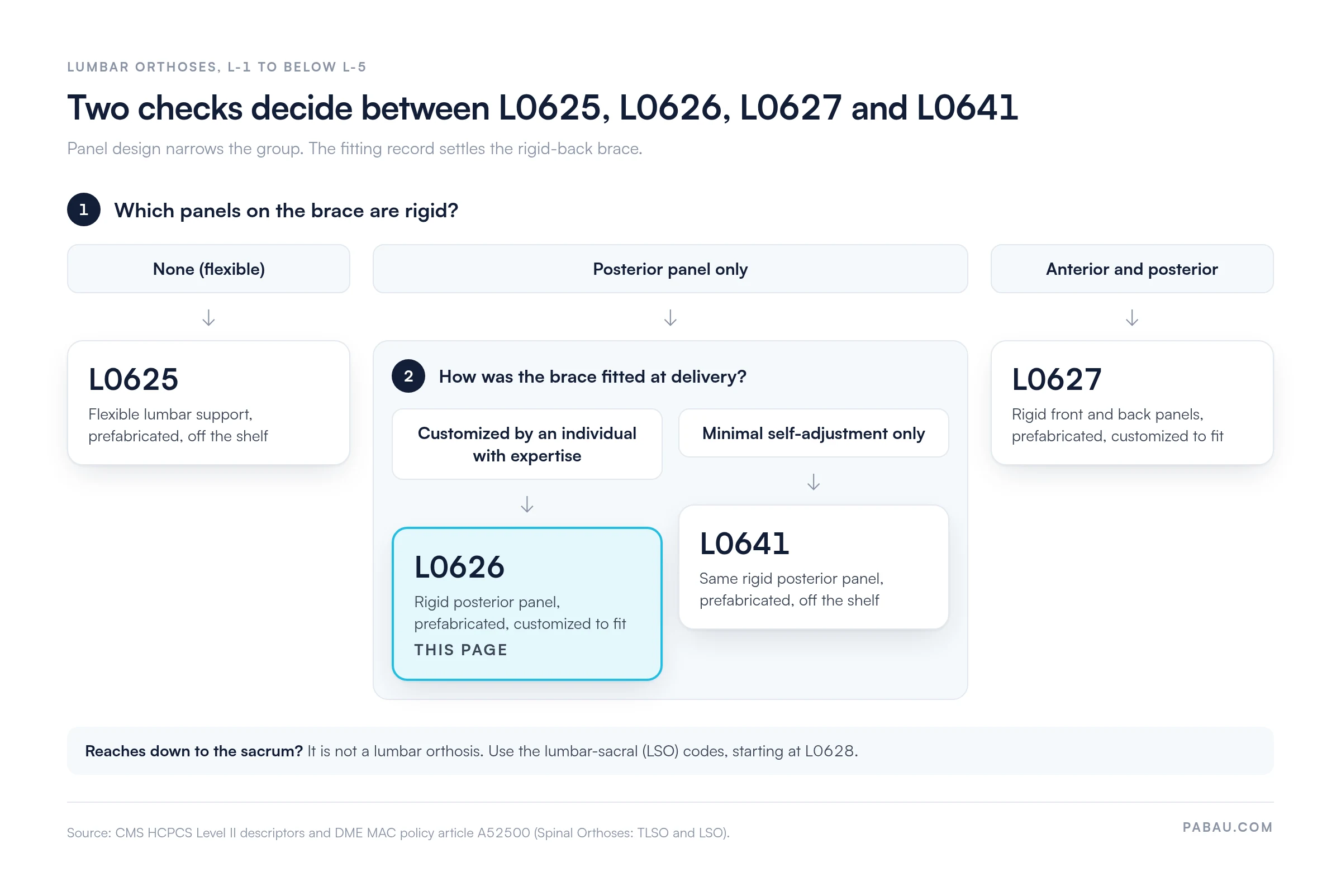
L0625, L0626, and L0627 form the lumbar orthosis group, and each one describes a brace from L-1 to below L-5. Two questions separate them: which panels are rigid, and whether an expert customized the fit. Check both before every lumbar orthosis claim.
Practical rule: If only the posterior panel is rigid and an individual with expertise fitted the brace, the code is L0626. A rigid anterior panel as well points to L0627. If the patient got the brace with only minimal self-adjustment, the code is L0641. The decision path below runs the same two checks in order.
HCPCS Code L0626 claims need an ICD-10-CM diagnosis that supports one of the coverage indications in LCD L33790, Spinal Orthoses: TLSO and LSO. The LCD and its policy article publish no covered diagnosis list. The codes below are common examples, and the medical record has to show why the patient needs the brace. Confirm the full descriptor in the ICD-10-CM diagnostic codes library before you code.
Important: M54.5 was retired on October 1, 2021, so use M54.50 or M54.59 instead. M48.06 is not billable on its own either; code M48.061 or M48.062. Pair a low back pain code with a structural diagnosis where the clinical record supports one.
Medicare covers L0626 under the DMEPOS benefit when the claim meets LCD L33790 and its policy article, A52500. The four DME Medicare Administrative Contractors (MACs) each publish the same policy for their jurisdiction.
The LCD covers a spinal orthosis when it is ordered for one of these four reasons:
A claim that meets none of them is denied as not reasonable and necessary. The claim also has to clear these requirements:
LCD L33790 does not require the KX modifier on spinal orthosis claims. Add it only if a specific payer’s policy asks for it.
Documentation for HCPCS Code L0626 has to prove two things: why the patient needs the brace, and how an expert customized it. Sound medical billing compliance starts with collecting these records at the time of service, not under audit pressure.
A superbill documentation approach captures these elements at the point of service. Records assembled after an audit request draw far closer scrutiny from MACs and OIG reviewers.
Audit each L0626 billing file before you submit the claim. Pull the standard written order, the medical record notes, the fitting record, and the proof of delivery as a four-document minimum. If the fitting record does not say what was customized, the brace reads as off-the-shelf L0641.
L0626 needs fewer modifiers than many DMEPOS codes. The KX modifier is not part of the spinal orthoses policy, and the CG modifier applies to L0625 but not to L0626. The table below shows the modifiers that do come up on L0626 claims.
Compliance note: Every modifier is an attestation about the claim. Append one only when the billing file supports it.
CMS publishes the allowed amounts for HCPCS Code L0626 in the CMS DMEPOS fee schedule. Rates vary by state. Check the schedule each January, after CMS releases the annual update.
Key reimbursement considerations for L0626:
Use the AAPC HCPCS code lookup or PGM Billing’s HCPCS lookup tool to cross-check current L0626 descriptors before you submit a claim.
L0626 denials follow a predictable pattern. Finding the root cause of each one lets you prevent the next one rather than just appealing the current one. A systematic orthotic denial management workflow works better than treating each denial as a one-off.
Many practices that dispense back braces still track orders, fitting notes, and claims across paper files and spreadsheets. Each handoff is a chance for an L0626 claim to go out without the record that supports it.
Pabau’s practice management platform keeps the patient record, the authorization, and the claim in one system. Its claims management software sends US claims through Claim.MD. The practice records the brace and its diagnosis, then sends a CMS-1500/837P claim from the same record.
For orthotists and physical therapy teams billing Medicare and private payers, that means fewer files to chase before each claim goes out.

Pabau keeps the patient record, authorizations, and Claim.MD claims in one place, so your team sends DMEPOS claims from the same file they document in.

Treat the fitting record as the document that decides an L0626 claim. A brace handed over with only minimal self-adjustment is L0641, however rigid its back panel. A rigid front panel moves it to L0627.
Claims that hold up record the fitting, show which LCD indication applies, and carry a standard written order and proof of delivery. Build those checks into delivery day rather than the appeal. Book a demo to see how Pabau handles HCPCS claims from record to remittance.

Need a framework for managing DMEPOS claim denials? Denial management in healthcare covers root-cause analysis and workflow fixes for high-denial HCPCS codes.
Want to understand how clean claims reduce rework? Clean claim submission explains the pre-submission checks that prevent the most common payer rejections.
Looking for a compliance checklist for DME billing? Medical billing compliance outlines the documentation standards Medicare and commercial payers expect from DMEPOS suppliers.
Billing the same brace off the shelf? HCPCS code L0641 covers the rigid-back lumbar orthosis dispensed with minimal self-adjustment.
Does the brace have a rigid front panel too? HCPCS code L0627 explains the custom-fitted lumbar orthosis with rigid anterior and posterior panels.
HCPCS code L0626 covers a prefabricated lumbar orthosis with sagittal control and one or more rigid posterior panels. The panel runs from L-1 to below L-5, and the brace does not enclose the sacrum. An individual with expertise trims, bends, molds, assembles, or otherwise customizes it to fit the patient.
Both codes describe a prefabricated lumbar orthosis with sagittal control that an expert customizes to the patient. L0626 has rigid posterior panels only, while L0627 has rigid anterior and posterior panels. Check which panels are rigid before you choose the code.
Yes. Medicare covers L0626 under Part B DMEPOS when the brace meets one of the four indications in LCD L33790. An enrolled DMEPOS supplier must provide it, with a standard written order and proof of delivery on file.
Keep a standard written order, the treating practitioner’s notes showing which coverage indication applies, and a fitting record. The fitting record describes the modifications the brace needed and what was done at fitting. Add the fitter’s credentials, the PDAC coding decision for the product, and proof of delivery.
LCD L33790 does not require the KX modifier for spinal orthoses, and the CG modifier applies to L0625, not L0626. Use GA when you expect a denial and the beneficiary signed an Advance Beneficiary Notice. Use GZ when you expect a denial and no notice is on file.
Prior authorization rules for L0626 vary by payer. CMS adds selected DMEPOS codes to its prior authorization program, and the list changes over time. Check the current requirement with your DME MAC or commercial payer before delivery.
LCD L33790 publishes no covered diagnosis list, so the record must tie the diagnosis to a coverage indication. Common examples include M47.816, M51.16, M43.16, M48.061 or M48.062, and S32.009A. M54.5 was retired in 2021, so use M54.50 or M54.59 for low back pain.
Common L0626 denials come from a missing fitting record, or from billing L0626 for a brace that should be L0627 or L0641. A missing standard written order is another. Notes that don’t tie the brace to an LCD indication cause denials too. A pre-submission checklist built around these points prevents most of them.



