HCPCS Code K0900: Customized DME billing and coding guide
HCPCS Code K0900: Official descriptor and code overview HCPCS Code K0900 is a CM...

Last Updated: Nov 18, 2026
K0871 is the HCPCS Level II code for a Group 4 very heavy duty power wheelchair with a sling/solid seat/back. It fits patients weighing 451 to 600 pounds. Group 4 chairs are built for outdoor use, with a 6 mph minimum top speed and a 16-mile range.
Medicare's power mobility LCD (L33789) denies every Group 4 chair as not reasonable and necessary for home use. Bill K0871 to Medicare with a signed ABN and the GA modifier, usually as an upgrade beside a covered Group 3 base such as K0852.
Let Pabau's smart automation suggest the right codes, reduce claim denials, and keep your practice compliant—effortlessly.
Automate repetitive tasks and focus on what matters most—your patients.
Reduce coding errors and ensure compliance with the latest regulations.
Clean claims, fewer denials, and faster reimbursements.
Powerful insights and reporting to help your practice thrive.
HIPAA compliant SOC 2 certified GDPR-compliant Trusted by 4,000+ clinics worldwide

HCPCS code K0871 is a Group 4 very heavy duty power wheelchair with a sling/solid seat/back, for patients weighing 451 to 600 pounds.
Medicare’s power mobility LCD (L33789) denies every Group 4 chair as not reasonable and necessary for home use.
When a patient chooses K0871, bill it as an upgrade with a signed ABN and GA, beside the qualifying base with GK.
K0871 isn’t on CMS’s required prior authorization list, but the Group 3 bases it usually upgrades from are.
Check the face-to-face date, the written order, the ABN and the line order before the claim goes out.
HCPCS code K0871 is the Level II code for a Group 4 very heavy duty power wheelchair. Its descriptor adds a sling/solid seat/back and a patient weight capacity of 451 to 600 pounds.
Medicare’s Power Mobility Devices LCD (L33789) names every Group 4 base, K0871 included, and denies them as not reasonable and necessary for home use.
The code is valid, so you can bill it. You just can’t expect Medicare to pay for the chair as a covered item. Most K0871 claims are upgrades, where the patient qualifies for a Group 3 base and chooses the Group 4 chair after signing an ABN.
The denial makes sense once you read the performance floor. Policy article A52498 says every Group 4 base, K0871 included, must meet these minimums:
Speed, range and suspension at that level help on uneven ground outside, while Medicare’s DME benefit pays for mobility in the home. That’s the LCD’s reasoning for denying the whole group.
K0871 is also a no-power-option base, so it can’t take a power tilt, recline or standing system. The policy article bundles weight-specific parts into the base, such as braces, motors, gears and upholstery. Don’t bill those reinforcements separately.
Weight capacity and seat type split the Group 4 family. For a patient in the 451 to 600 pound range, the covered alternative is a Group 3 very heavy duty base with the same capacity.
HCPCS descriptors for these bases don’t set seat width or depth. Seat size can still matter for billing. The policy article lets a Group 3 or 4 sling/solid base bill extra width above its weight-duty threshold. For the lighter Group 3 options, start at K0848.
Picture the usual case. Your patient qualifies for a Group 3 very heavy duty chair but wants the Group 4 model for outdoor use. The claim then runs in this order:
Noridian’s DME upgrade guidance, for Jurisdiction D, sets out this two-line order. Check your own DME MAC’s upgrade article, because line order and modifier pairing are where these claims fail.
Take an illustrative patient who weighs 480 pounds and can’t self-propel a manual wheelchair at home. The evaluation supports a Group 3 very heavy duty base, so K0852 is the covered item.
The patient wants the Group 4 chair to reach a local park. You get an affirmative prior authorization for K0852, then an ABN for the upgrade to K0871. The claim goes out as K0871-GA on line one and K0852-GK-KX on line two.
Medicare’s payment is based on the K0852 allowable. The K0871 line denies to patient responsibility, so the patient pays the difference the ABN described. Here’s how the two lines split the bill.
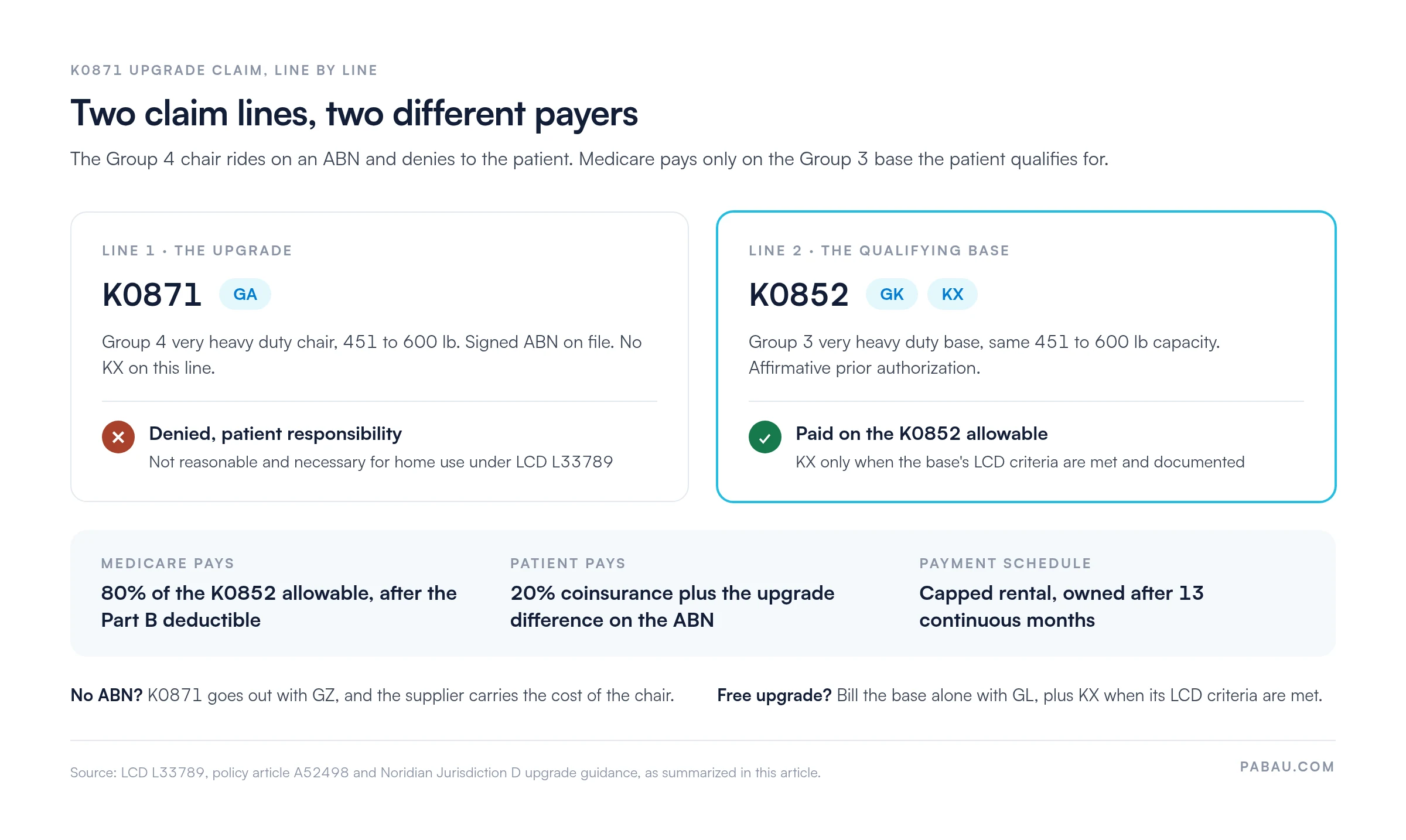
KX is an attestation, so add it only when the LCD criteria are met and the records prove it. The policy article also calls for GY when face-to-face requirements aren’t met, or when the chair is needed only outside the home.
Power mobility audits read the file in date order. Line these up before the chair leaves the warehouse:
Keep each piece in the same patient file so the reviewer never has to ask twice. A short medical billing compliance routine for power mobility orders catches a late order or an unsigned ABN before an auditor does.
K0871 isn’t on CMS’s required prior authorization list, in the comparison chart showing status as of October 28, 2026. The Group 3 bases K0848 to K0864 are on it nationwide.
That split matters for upgrades. The qualifying Group 3 base needs its affirmative decision, and delivery must follow within six months of it. CMS updates the list, so check the current chart before each new order.
Confirm the patient’s Part B coverage before you request authorization. Insurance eligibility verification at intake avoids building a file for a patient whose plan has changed.
DMEPOS allowables aren’t on the Physician Fee Schedule. Look them up in the CMS DMEPOS fee schedule files, which CMS updates during the year and lists by state.
Most K0871 denials come from billing a non-covered chair as if it were covered. These are the remittance denial codes you’ll see, and what they usually mean here:
Three habits cause most of these. Teams treat KX as routine, put the lines in the wrong order, or skip the ABN because the chair is “only” an upgrade.
Request a redetermination from your DME MAC within 120 days of the initial determination. A denial management log keeps the deadline and the missing document in one place. Fixable modifier errors often go faster as a reopening, so check what your MAC allows.
A K0871 upgrade spreads across an ABN, a Group 3 authorization and a two-line claim. When those sit in different systems, the denial that follows is hard to trace.
Pabau, the practice management and billing platform we build, keeps them on the patient record. Its claims management sends US claims through Claim.MD as 837P transactions, runs eligibility checks and posts ERA remittances back. You see the paid GK line and the denied K0871 line side by side.
Prior authorization is tracked on the case, with the auth code and dates, and Pabau warns you when one is missing. Secondary claims to the patient’s other cover go out from the same record.

Pabau sends US claims through Claim.MD, posts ERA remittances back and tracks prior authorizations on the case, with a warning when one is missing.

Billing K0871 to Medicare means knowing the chair won’t be paid as a covered item. The work sits in the paperwork around it: a qualifying Group 3 base, a signed ABN and a claim built in the right order.
Get those three right and the denial lands where everyone expected, on the patient’s share of the upgrade. Miss one and the supplier carries the whole chair.
Book a demo to see how Pabau keeps claims, remittances and prior authorizations for power mobility orders on one patient record.

Billing the next weight tier down? HCPCS code K0870 covers the Group 4 heavy duty chair for patients weighing 301 to 450 pounds.
Need a framework for recurring DME denials? Denial management in healthcare covers root-cause analysis and appeal workflows for billing teams.
Unsure whether a claim is clean before it leaves the queue? Submitting a clean claim details the pre-submission checks that prevent common payer rejections.
Looking for a broader view of the billing lifecycle? What is revenue cycle management explains how DME billing fits the claim process from eligibility to collections.
No Group 4 code goes above 600 pounds. Group 3 extra heavy duty bases cover 601 pounds or more, K0854 with a sling/solid seat/back and K0855 with a captain’s chair.
No. A sling/solid seat/back base doesn’t include a cushion, which is billed under its own wheelchair seating code. The base does include a single-mode battery charger, tires, casters and a lap belt.
In everyday use, yes. Suppliers often call a 451 to 600 pound chair bariatric. The HCPCS descriptor says very heavy duty instead, so use that wording in orders and notes.
Some do. Commercial and Medicaid plans aren’t bound by the Medicare LCD. Check the payer’s own power mobility policy and any authorization rule before delivery.
CO-4 means the procedure code is inconsistent with the modifier used, or a required modifier is missing. On K0871 it usually points to a missing GA or GZ, or KX on the Group 4 line.