HCPCS Code K0900: Customized DME billing and coding guide
HCPCS Code K0900: Official descriptor and code overview HCPCS Code K0900 is a CM...

Last Updated: Nov 18, 2026
L0174 is the HCPCS Level II code for a semi-rigid, thermoplastic foam cervical collar, two piece with thoracic extension, prefabricated and off-the-shelf. The extension must overlap the manubrium in front and reach the T-1 vertebra at the back.
The same collar without that extension is L0172. Only products that PDAC has reviewed and listed under L0174 may be billed with this code.
Let Pabau's smart automation suggest the right codes, reduce claim denials, and keep your practice compliant—effortlessly.
Automate repetitive tasks and focus on what matters most—your patients.
Reduce coding errors and ensure compliance with the latest regulations.
Clean claims, fewer denials, and faster reimbursements.
Powerful insights and reporting to help your practice thrive.
HIPAA compliant SOC 2 certified GDPR-compliant Trusted by 4,000+ clinics worldwide

HCPCS code L0174 is a semi-rigid, thermoplastic foam cervical collar, two piece with thoracic extension, prefabricated and off-the-shelf.
The thoracic extension is the deciding feature, because the same two-piece collar without it is L0172.
Only products PDAC has reviewed and listed under L0174 may be billed with this code.
A collar that needs fitting by someone with expertise, or one molded to the patient, belongs under a different code.
Most rejected L0174 claims trace back to the wrong code, a missing product listing or a missing proof of delivery.
HCPCS code L0174 is the Medicare billing code for a semi-rigid, thermoplastic foam cervical collar, two piece with thoracic extension, prefabricated and off-the-shelf.
The PDAC code details for L0174 add the physical test: front and back extensions that overlap the manubrium and reach the T-1 vertebra. It is a CMS-maintained HCPCS Level II code, billed to the DME MAC under the Medicare Part B braces benefit.
The official descriptor reads: Cervical, collar, semi-rigid, thermoplastic foam, two piece with thoracic extension, prefabricated, off-the-shelf. Every word of it is a qualifier, and the collar you hand over has to meet all four of these:
L0174 sits with the other cervical orthoses in the HCPCS code library. The quick reference below covers what a biller needs at a glance.
Coding L0174 depends on the device in your hand. Check the product against both lists before you pick the code.
Billing L0174 for a device that was custom fabricated or fitted by an expert misstates what was supplied. That error tends to surface on audit, long after the payment.
Most coding confusion sits inside the L0120-L0200 range, and the closest call is between two collars built the same way. L0172 is the two-piece foam collar on its own. L0174 is that collar plus the thoracic extension.
The comparison below lines up the codes most often confused with it.
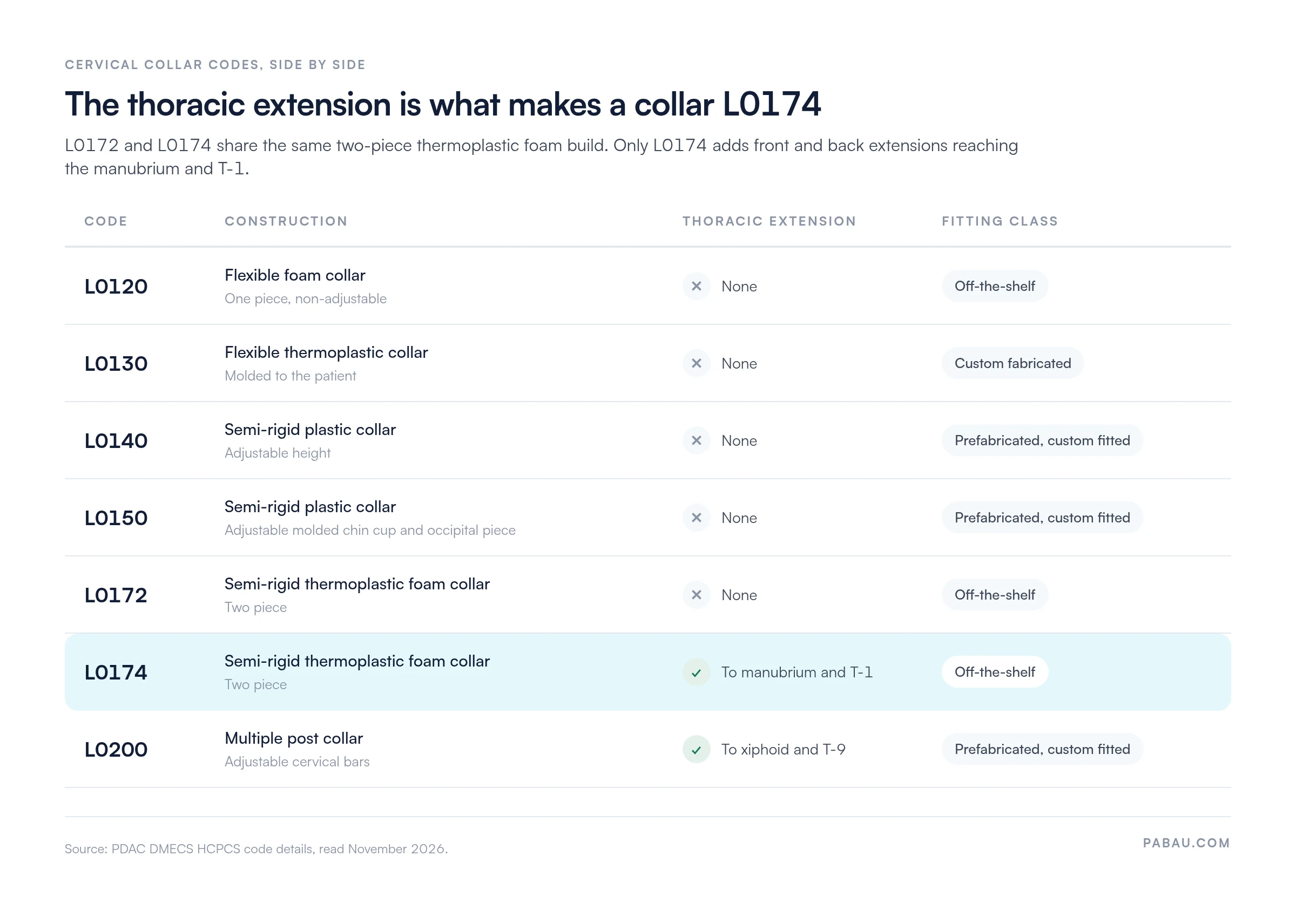
If the collar has a chin cup and an occipital piece but no chest or back extension, you are looking at L0150. It is fitted by someone with expertise, so it is not an OTS item.
Medicare Part B pays for cervical collars as braces. Chapter 15 of the Benefit Policy Manual defines a brace as a rigid or semi-rigid device. It supports a weak body part or restricts motion in an injured one, and it is furnished on a physician’s order.
The DME MAC spinal orthoses LCD, L33790, is written for TLSO and LSO back braces, not cervical collars. Before you rely on a KX modifier or a covered-diagnosis list for L0174, check your DME MAC’s current policy articles.
In practice, the record has to show why the neck needs its motion restricted. Common reasons include cervical spondylosis, such as M47.812, cervical radiculopathy, such as M54.12, a cervical strain, or recovery after neck surgery.
Send DMEPOS claims to the DME MAC for the state where the beneficiary lives. Noridian runs DME Jurisdictions A and D, and CGS runs B and C for the rest of the country. Each contractor publishes its own policy articles, so check the one paying the claim.
PDAC (Pricing, Data Analysis and Coding) reviews DMEPOS products and assigns each one a HCPCS code. In 2011, PDAC end-dated every product then coded L0174 and asked manufacturers to reapply. Only products listed since then may be billed with this code.
CGS publishes a coding verification lookup tool that tells you whether PDAC requires a product listing for any HCPCS code. For L0174, the answer shapes your whole intake process.
Run this check at intake, before the collar leaves the shelf. Once the device is dispensed, a coding problem is far harder to undo.
Here is the path a clean L0174 claim takes, and where each step usually goes wrong.
A clean claim is one that clears payer edits the first time. Keep these records for at least seven years, the retention period CMS sets for DMEPOS suppliers.
None of these modifiers belongs on every L0174 claim. Each one applies only in a specific situation.
Treat KX as a statement that you hold the policy’s required documentation. Adding it out of habit, on a claim that has no such policy behind it, creates audit risk for no gain.
L0174 is a purchased item, so Medicare pays once, at delivery. The allowed amount comes from the CMS DMEPOS fee schedule, which CMS updates each January and adjusts by state.
For a quick reference, the AAPC HCPCS code lookup and the PGM Billing HCPCS search both show fee data drawn from CMS files. Use the CMS file itself when you set a price.
L0174 denials follow a handful of patterns, and each has a fix that belongs at intake. Track them as part of your denial management routine so repeats stand out.
The replacement denial is automated. CMS lists the cervical orthoses replacement edit as an approved automated review covering L0172 and L0174. A second identical collar within its useful lifetime is denied without a records request.
If a claim was denied because the product was not listed under L0174, look the model up on DMECS again. When PDAC lists it under another code, the fix is a corrected claim with that code, through your DME MAC’s reopening or appeal process.
Most L0174 problems start as a missing piece of paper. The order sits in one inbox, the delivery receipt in a drawer, and the claim goes out before anyone notices a page is missing.
Pabau’s claims management software helps practices track documentation and submit claims. Orders, notes and signed forms sit on the patient record, so the file is complete before the claim is built. In the US, claims go out through Claim.MD, and their status stays visible in one place.
The result is fewer claims sent back for a missing signature, and less time spent chasing paper after a denial.

Pabau’s claims management helps practices track documentation and submit claims, with orders, notes and signed forms on the patient record. Book a demo to see it with your team.

L0174 is decided at the shelf, before anyone opens the billing screen. If the collar has the thoracic extension, is listed by PDAC under L0174 and fits without expert adjustment, the code is right. If any of the three fails, a different code is.
Put the PDAC check and the delivery signature into intake, and most L0174 denials never happen. The trade-off is a few extra minutes per patient, which costs far less than a reopening or an audit.
Book a demo to see how Pabau keeps orders, delivery records and claims together, so each collar claim goes out complete.

Weighing the collar without an extension? HCPCS code L0172 covers the two-piece foam collar that L0174 builds on.
Supplying a collar molded to the patient? HCPCS code L0170 explains the custom-fabricated cervical collar code.
Moving up to a multiple post device? HCPCS code L0180 covers the adjustable multiple post collar.
Getting repeat denials across codes? Denial management in healthcare sets out root-cause tracking and appeal steps.
New to the billing cycle? What is medical billing walks through how a claim moves from encounter to payment.
L0174 is the HCPCS code for a cervical collar that is semi-rigid, thermoplastic foam, two piece with thoracic extension, prefabricated and off-the-shelf. Suppliers bill it to Medicare under the braces benefit.
L0172 is the same semi-rigid, two-piece, OTS thermoplastic foam collar, but without the thoracic extension. L0120 is a flexible foam collar, and L0130 is a flexible thermoplastic collar molded to the patient.
It means the collar is made in quantity and needs only minimal self-adjustment. The patient, a caregiver or the supplier can make that adjustment without specialist expertise.
Only a supplier enrolled with Medicare as a DMEPOS supplier. The claim goes to the DME MAC for the beneficiary’s state, not to the Part B MAC that pays physician services.
Not for an identical collar within its reasonable useful lifetime. CMS runs an automated edit that denies those claims. Replacement after loss, theft or irreparable damage follows separate rules.