CCSD Code C1540: Surgical correction of trichiasis and upper lid entropion
CCSD Code C1540: Definition and official descriptor CCSD Code C1540 is the Clini...

Last Updated: Nov 16, 2026
61154 is the CPT code for burr hole(s) with evacuation and/or drainage of hematoma, extradural or subdural. It covers the session in which a surgeon drills one or more burr holes and drains an epidural or subdural blood collection, drain placement included.
The code carries a 90-day global period and a 2026 Medicare work RVU of 16.64. Coders separate it from 61108, twist drill drainage of a subdural hematoma, and from 61312 or 61314 when the surgeon opens a craniotomy instead. Traumatic cases pair with S06.4X- (epidural) or S06.5X- (subdural) diagnoses, and nontraumatic subdurals with I62.0-.
Let Pabau's smart automation suggest the right codes, reduce claim denials, and keep your practice compliant—effortlessly.
Automate repetitive tasks and focus on what matters most—your patients.
Reduce coding errors and ensure compliance with the latest regulations.
Clean claims, fewer denials, and faster reimbursements.
Powerful insights and reporting to help your practice thrive.
HIPAA compliant SOC 2 certified GDPR-compliant Trusted by 4,000+ clinics worldwide

CPT code 61154 covers burr hole(s) with evacuation or drainage of an extradural or subdural hematoma, from the first burr hole through drain placement.
For 2026, Medicare assigns 61154 a work RVU of 16.64 and 38.52 total RVUs, about $1,286.60 nationally before geographic adjustment.
Traumatic epidural cases pair with S06.4X- codes, traumatic subdurals with S06.5X- codes, and nontraumatic subdurals with I62.00 to I62.03.
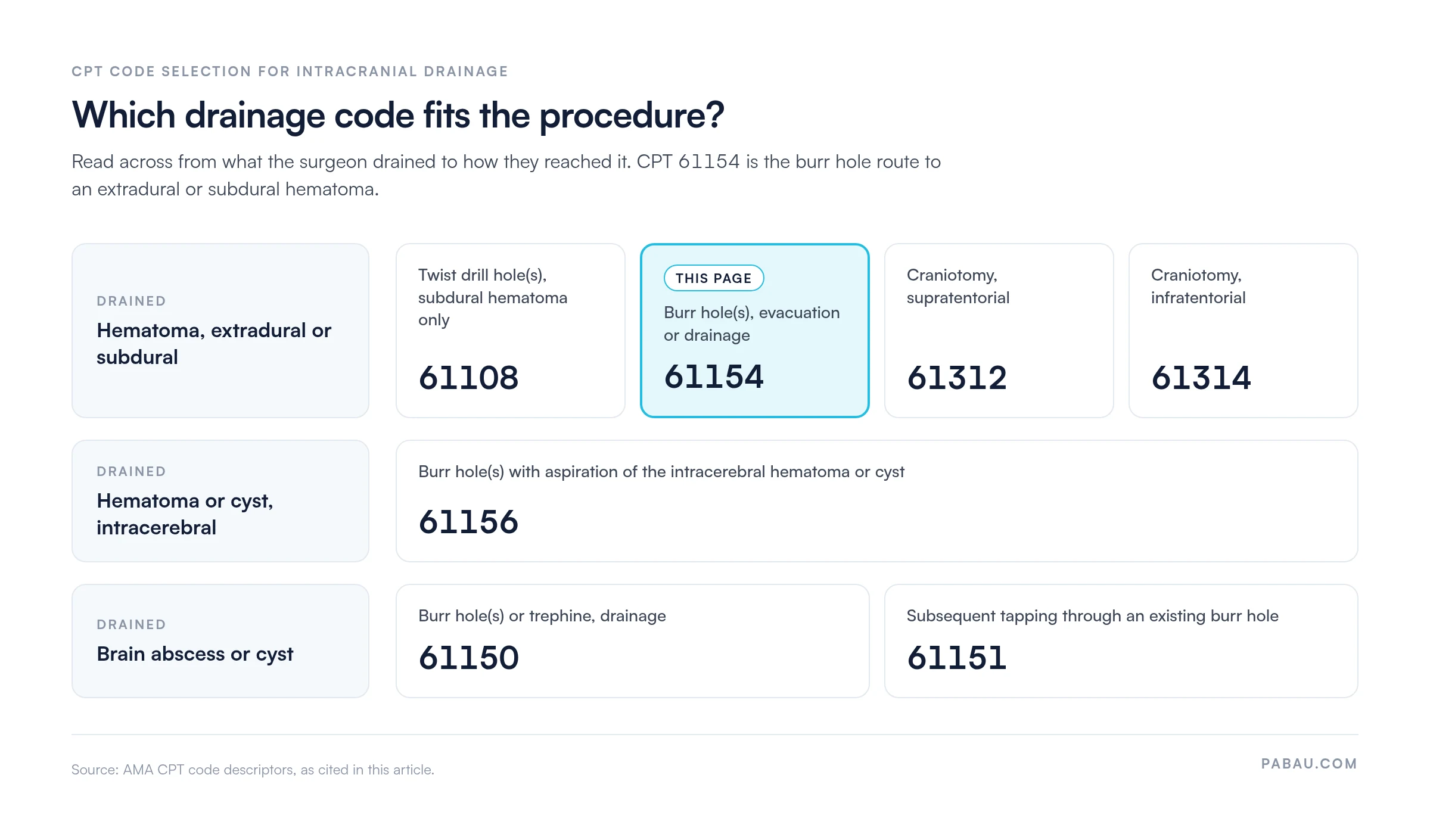
Twist drill drainage is 61108, intracerebral aspiration is 61156, and a craniotomy moves the claim to 61312 or 61314.
Pabau, the practice management platform we build, sends US claims through Claim.MD with eligibility checks and ERA remittances. Each 61154 claim and its payer response stay together.
CPT code 61154 is the procedure code for burr hole(s) with evacuation and/or drainage of an extradural or subdural hematoma. That descriptor comes from the AMA’s CPT code set, which the AMA’s CPT Editorial Panel maintains and updates.
The code applies when a neurosurgeon drills one or more burr holes to drain a blood collection. That collection sits either between the skull and the dura (extradural, also called epidural) or between the dura and the brain surface (subdural).
CPT 61154 sits in the Nervous System section of CPT (61000-64999), under Skull, Meninges, and Brain. The table below summarizes the key billing and clinical attributes at a glance.
CPT 61154 covers the full operative session needed to create a burr hole and drain a hematoma. The usual indication is a symptomatic subdural or extradural hematoma. It shows up as neurological deterioration, raised intracranial pressure, or a midline shift visible on CT.
Services included under CPT code 61154 in a single billing unit:
The code captures the initial, definitive evacuation through burr holes. Sometimes the neurosurgeon has to convert to a full craniotomy during the same session. Then the claim moves to CPT 61312 for a supratentorial extradural or subdural hematoma, or 61314 for an infratentorial one.
Document the decision to convert clearly in the operative report, because payers scrutinize any session where both codes appear.
Several related services are either separately coded or bundled into the 90-day global period. None of them can be billed alongside CPT code 61154 without a supporting modifier or a different code.
The twist drill, burr hole, and trephine codes (61105-61253) read alike, and so do the craniotomy codes that follow them. Two questions settle the choice: what the surgeon drained, and how they reached it. The grid below sorts the neighbors of 61154 by both.
The ICD-10-CM code paired with CPT code 61154 must establish medical necessity for surgical hematoma evacuation. Payers check whether the hematoma is traumatic or nontraumatic, and which layer it sits in. Traumatic epidural hemorrhage falls in S06.4X-, traumatic subdural hemorrhage in S06.5X-, and nontraumatic subdural hemorrhage in I62.0-.
Confirm the 7th character carefully for every S06.4X and S06.5X code. A covers the initial encounter, including the evacuation itself, D covers subsequent care, and S covers sequela.
For a spontaneous subdural with no documented injury, the nontraumatic codes start at I62.00, an unspecified subdural hemorrhage. Use the acuity-specific code instead whenever the imaging report names the hematoma as acute, subacute, or chronic.
The operative report is the primary document payers review when adjudicating CPT code 61154. A well-constructed op report reduces medical billing rework and supports appeal if a denial occurs. Ensuring clean claim submission starts here, before the claim ever reaches the clearinghouse.
The operative report must include all of the following elements:
Flag your CPT 61154 operative reports for a secondary coder review before claim submission. The two areas payers audit most heavily are laterality documentation and the clinical indication paragraph. Vague language in either one is a common root cause of documentation-based denials for this code.
CPT code 61154 reimbursement under Medicare Part B follows the standard RBRVS formula. Total RVUs are multiplied by the annual conversion factor, then adjusted for geographic practice cost indices (GPCI). The 2026 values below come from the CMS final rule, as listed on FastRVU’s CPT 61154 page. Check your own locality in the CMS Physician Fee Schedule search tool.
The hospital bills the inpatient facility side on the UB-04. It uses DRG 25 (craniotomy and endovascular intracranial procedures with MCC), DRG 26 (with CC), or DRG 27 (without CC/MCC). The neurosurgeon’s professional claim goes on the CMS-1500. These are separate billing streams and should never be combined.
Modifier selection for CPT code 61154 decides whether a claim processes as a bilateral procedure, a co-surgery, or a multiple-procedure claim. Using the wrong modifier, or omitting one when required, is a frequent denial driver. Payer acceptance varies, particularly for bilateral billing.
Neurosurgery claims like CPT code 61154 carry a high reimbursement value, so payers scrutinize them closely. Knowing the denial patterns before submission lets billing teams prevent them rather than appeal them. Our guide to denial management workflows and the full list of denial codes in medical billing cover broader resolution strategies.
Run a quarterly denial audit for CPT 61154 and filter it by denial reason code. If laterality or indication language drives most of the denials, start with the operative note template rather than the coder. It is usually the fastest fix.
A CPT 61154 claim is worth about $1,286.60 nationally, and one missing element can hold it up for weeks. An undocumented side, a vague indication paragraph, or a missing authorization number is enough. The fix sits upstream, before the claim reaches the clearinghouse.
In Pabau’s practice management software, US practices submit CMS-1500/837P claims through the Claim.MD clearinghouse. Eligibility checks, ERA remittances, and secondary claims run through the same connection. Pabau’s neurosurgery claims management keeps the claim and the payer’s response in one system, and the payer list comes from Claim.MD.
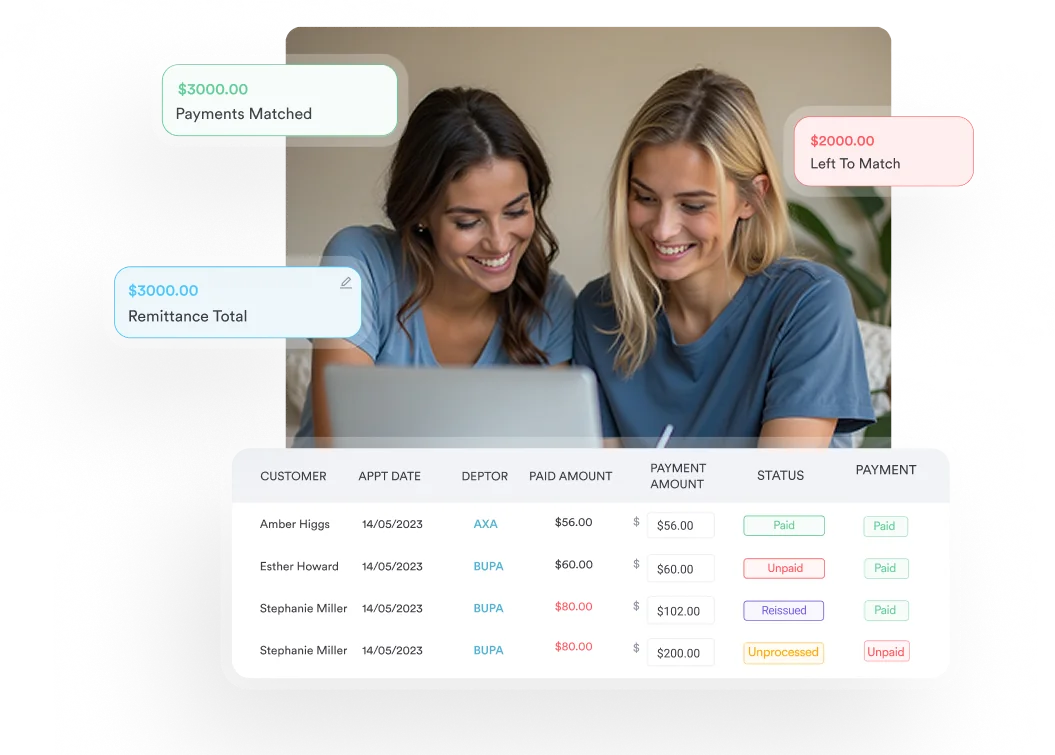
Key workflow benefits for neurosurgery billing teams:
Pairing those tools with a regular revenue cycle management review shows whether 61154 denials cluster around one payer or one coder.

Pabau sends US claims through Claim.MD, runs eligibility checks, and posts ERA remittances back to the practice. Book a demo to see how neurosurgery billing teams keep high-value surgical claims moving.

CPT code 61154 rewards the coder who reads the operative note for the approach first and the diagnosis second. A burr hole into an extradural or subdural collection is 61154. A twist drill is 61108, and a bone flap moves the claim to 61312 or 61314.
The diagnosis then has to match both the layer and the cause. Once the code pair is right and the note carries the side and the indication, most remaining denials are paperwork. Think of a missing modifier, authorization, or attachment.
Those are the denials a connected claims workflow catches before the payer does. Book a demo to see how Pabau keeps eligibility, authorization, and remittance for each neurosurgery claim in one place.

Need a broader overview of medical billing fundamentals? What is medical billing explains the full claim lifecycle from encounter to payment posting.
Dealing with high denial rates across your neurosurgery claims? Denial management in healthcare covers root-cause analysis and appeal workflows for complex surgical codes.
Want to understand how the clearinghouse fits into your billing workflow? Our Claim.MD clearinghouse guide walks through payer connectivity, ERA posting, and eligibility verification.
Coding a spontaneous subdural with no documented injury? ICD-10 code I62.00 covers the unspecified nontraumatic subdural hemorrhage code and when an acuity-specific code fits better.
CPT code 61154 is the American Medical Association’s code for burr hole(s) with evacuation and/or drainage of an extradural or subdural hematoma. It applies when the neurosurgeon creates one or more burr holes to drain a hematoma in a single operative session. It carries a 90-day global surgical period.
CPT 61154 covers burr hole evacuation or drainage of an extradural or subdural hematoma. CPT 61151 covers subsequent tapping of an intracranial abscess or cyst through an established burr hole, so it never applies to a hematoma. CPT 61156 covers burr hole aspiration of an intracerebral hematoma or cyst. CPT 61312 applies when a supratentorial hematoma is evacuated through a craniotomy instead.
Traumatic epidural hemorrhage pairs through S06.4X- codes, such as S06.4X0A. Traumatic subdural hemorrhage pairs through S06.5X- codes, such as S06.5X0A without loss of consciousness. Nontraumatic subdural hemorrhage uses I62.00 to I62.03, by acuity. Use 7th character A for the surgical encounter, D for subsequent care, and S for sequela.
The 2026 national Medicare payment for CPT 61154 is about $1,286.60 before geographic adjustment. That is 38.52 total RVUs multiplied by the $33.4009 conversion factor, and the figure is the same in facility and non-facility settings. Your local rate changes with the GPCI for your Medicare locality.
The 2026 work RVU for CPT 61154 is 16.64. It reflects the surgeon’s time, skill, and intensity across the procedure and the 90-day global period. Work RVUs do not vary by setting, so there is no separate facility or non-facility work value.
Yes. When the surgeon evacuates hematomas on both sides in one session, bill one unit of CPT 61154 with modifier -50 for most payers. Some payer contracts want -LT and -RT on separate lines instead. Never bill two units without a bilateral modifier, because that triggers a duplicate-procedure denial.
Prior authorization requirements for CPT 61154 vary by payer and MAC jurisdiction. Emergency subdural evacuations usually fall under a payer’s emergency exception. The payer still expects imaging, triage notes, and the surgical indication within its notification window. Elective or delayed surgery on a chronic subdural hematoma is more likely to need authorization. Check the payer’s policy before scheduling a non-emergency case.