CCSD Code C1540: Surgical correction of trichiasis and upper lid entropion
CCSD Code C1540: Definition and official descriptor CCSD Code C1540 is the Clini...

Last Updated: Nov 16, 2026
S0257 is the HCPCS Level II code for counseling a patient or surrogate about advance directives and end-of-life care planning. It is reported in addition to an evaluation and management (E/M) service.
It is a temporary national S-code for private payers and Medicaid, so Medicare does not pay it. Medicare patients get the same counseling billed with CPT 99497 and 99498. Commercial plans and some state Medicaid managed care organizations accept S0257, each under its own coverage policy.
Let Pabau's smart automation suggest the right codes, reduce claim denials, and keep your practice compliant—effortlessly.
Automate repetitive tasks and focus on what matters most—your patients.
Reduce coding errors and ensure compliance with the latest regulations.
Clean claims, fewer denials, and faster reimbursements.
Powerful insights and reporting to help your practice thrive.
HIPAA compliant SOC 2 certified GDPR-compliant Trusted by 4,000+ clinics worldwide

HCPCS code S0257 bills advance directive counseling to commercial plans and some Medicaid MCOs, and Medicare does not pay it.
Use CPT 99497, plus 99498 for each additional 30 minutes, when billing Medicare or any payer that rejects S-codes.
A clean claim needs a note that records face-to-face time, provider credentials, the documents discussed and the patient’s stated wishes.
Check the payer before the session, because the wrong code set for the payer is the most preventable S0257 denial.
The most common S0257 denials are Medicare submissions, thin documentation and exceeded frequency limits, and each one has a clear fix.
HCPCS code S0257 is the temporary national code for counseling a patient or surrogate about advance directives and end-of-life care planning. CMS’s quarterly HCPCS file lists S0257 with coverage code I, which means Medicare does not pay it. The official descriptor in that file reads:
Counseling and discussion regarding advance directives or end of life care planning and decisions, with patient and/or surrogate (list separately in addition to code for appropriate evaluation and management service).
S-codes are temporary national codes for private payers and Medicaid, published in the HCPCS Level II file CMS administers. That classification has two practical consequences. S0257 never appears on the Medicare Physician Fee Schedule. Each payer sets its rate in its own fee schedule, with no uniform CMS rate. Other S-codes and Level II services are covered in our HCPCS billing guides.
S0257 covers face-to-face counseling and discussion with a patient or their authorized surrogate about end-of-life planning documents and decisions. The billable service is the conversation itself, while drafting the documents falls outside the code.
Several adjacent activities look like advance care planning but fall outside S0257’s billable scope. Billing for them under this code is a documentation mismatch that payers flag on audit.
S0257 and CPT 99497 and 99498 describe the same clinical service, advance care planning counseling. They sit in different code sets and reach different payers. Choosing the wrong code for the payer is the most preventable denial in advance care planning billing.
Practical crosswalk rule: Check the patient’s insurance before the encounter. If Medicare is primary, use 99497, and add 99498 for extended sessions. For a commercial plan, pull the payer’s advance care planning policy. Bill S0257 if the policy accepts it, and switch to 99497/99498 if it redirects to CPT codes.
Never submit S0257 to Medicare in any position on the claim. The AAPC’s HCPCS code lookup is a quick way to confirm an S-code descriptor before you build a payer matrix. The grid below maps each payer type to the code it takes.
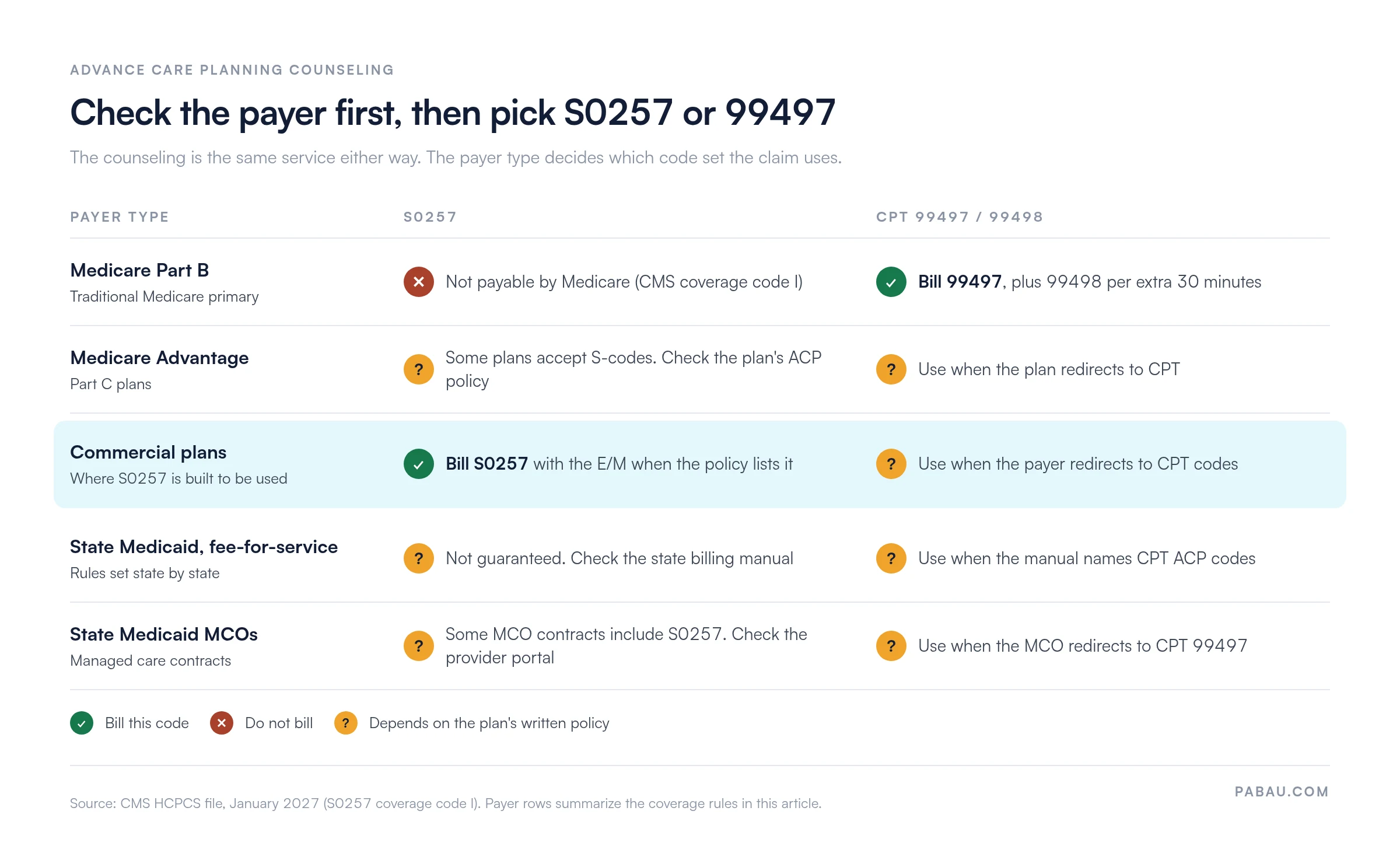
Coverage for HCPCS code S0257 varies by payer, and a practice that assumes coverage without checking will find denials on its aging report. S-codes are temporary national codes for private payers and Medicaid, so each plan decides whether to pay S0257. The CMS HCPCS overview confirms that CMS maintains the Level II set in which the code is published.
Before the first S0257 encounter with any new payer, confirm the rate and coverage in the payer’s own fee schedule or provider portal. Skipping that check is a common root cause of “non-covered service” denials.
Prior authorization for S0257 varies by payer and by plan year. No universal rule applies. Some commercial plans reimburse advance directive counseling as a preventive or wellness benefit with no prior authorization. Others require one whenever the service is billed as an add-on to an E/M visit.
Best practice before the encounter: Log into the payer’s provider portal and search for advance care planning or palliative care services. If the portal lists S0257 or its CPT equivalent as PA-required, obtain authorization before the visit. Record the authorization number in the chart and on the claim form.
With most payers, a claim sent without a required authorization number cannot simply be corrected. It has to be resubmitted with the authorization attached, which adds weeks to your collection cycle.
Documentation requirements for HCPCS code S0257 follow a time-and-content standard. The chart note must show that a qualified provider held a face-to-face discussion about advance directives. It has to read as a dedicated discussion, never a brief aside during a routine visit. Solid billing compliance documentation is the difference between a clean claim and an audit flag.
Pabau, the practice management platform we build, lets practices set up a structured ACP note that captures each element above at the point of care. For a ready-made structure, our advance care planning template covers patient values, goals of care, the healthcare proxy and POLST status.
A clean S0257 claim needs the right procedure code, POS code and modifiers, plus a chart note that holds up to payer review. Getting each of the seven steps below right prevents the denials covered in the next section.
S0257 denials tend to follow a few patterns. Knowing the root cause for each denial code speeds up the appeal and stops the same denial from recurring on the next claim. Proactive denial management strategies start with recognizing these patterns before they hit the aging report.
Run a quarterly audit of all S0257 denials grouped by CARC code. If CO-50 (non-covered) accounts for more than 20% of denials, your front desk is likely missing the payer type at booking. The insurance check has to happen before the advance care planning encounter is scheduled. Fix the intake process as well as the appeal.
Billing frequency for HCPCS code S0257 is payer-defined, not set by CMS. Most commercial plans that cover S0257 allow one billable advance care planning session per plan year per patient. Some plans are more permissive and allow a second session after a documented change in the patient’s condition, diagnosis, or stated wishes.
When a patient requires multiple ACP sessions in a single plan year, build your chart notes to show medical necessity for the repeat encounter. Payers typically accept a new terminal diagnosis or a significant change in functional status as justification. A hospitalization after a prior ACP session also qualifies, as does the death or incapacitation of a designated healthcare proxy. Document the specific clinical event in the note, not simply that the patient “wished to revisit their advance directive.”
Track S0257 utilization per patient in your practice management system. Flag any patient with two or more S0257 encounters in a plan year before billing the second claim. Pull the payer’s frequency policy and document the clinical trigger for the repeat session in the note before submission.
Provider eligibility to bill HCPCS code S0257 is determined by individual payer contracts, not by a universal CMS rule. That said, most commercial plans that cover S0257 recognize the following provider types as eligible to bill under their own NPI.
When a non-physician practitioner (NPP) delivers the counseling, confirm that the payer’s policy lets that credential bill S0257 under its own NPI. If the payer restricts the code to physicians, billing under an NP or PA NPI will generate a provider-type denial. For practices with several provider types, Pabau can organize each provider’s credentials and role. Billers can then check the rendering credential against the payer’s list before the claim goes out.
Preventable S0257 denials usually start at booking. The session goes on the calendar before anyone confirms whether Medicare is primary. Days later, the biller rebuilds the minutes and documents from a free-text note.
Pabau runs US claims through Claim.MD, which covers eligibility checks, CMS-1500 claims and ERA remittances. An eligibility check before the session shows which plan the patient is on, so the choice between S0257 and 99497 is made up front. Pabau’s end-to-end claims management then tracks the claim from submission to remittance.
Because the ACP note is structured, a payer’s records request can be answered from the chart on the first reply. Fewer S0257 lines reach appeal, and the ones that do have the documentation to back them.
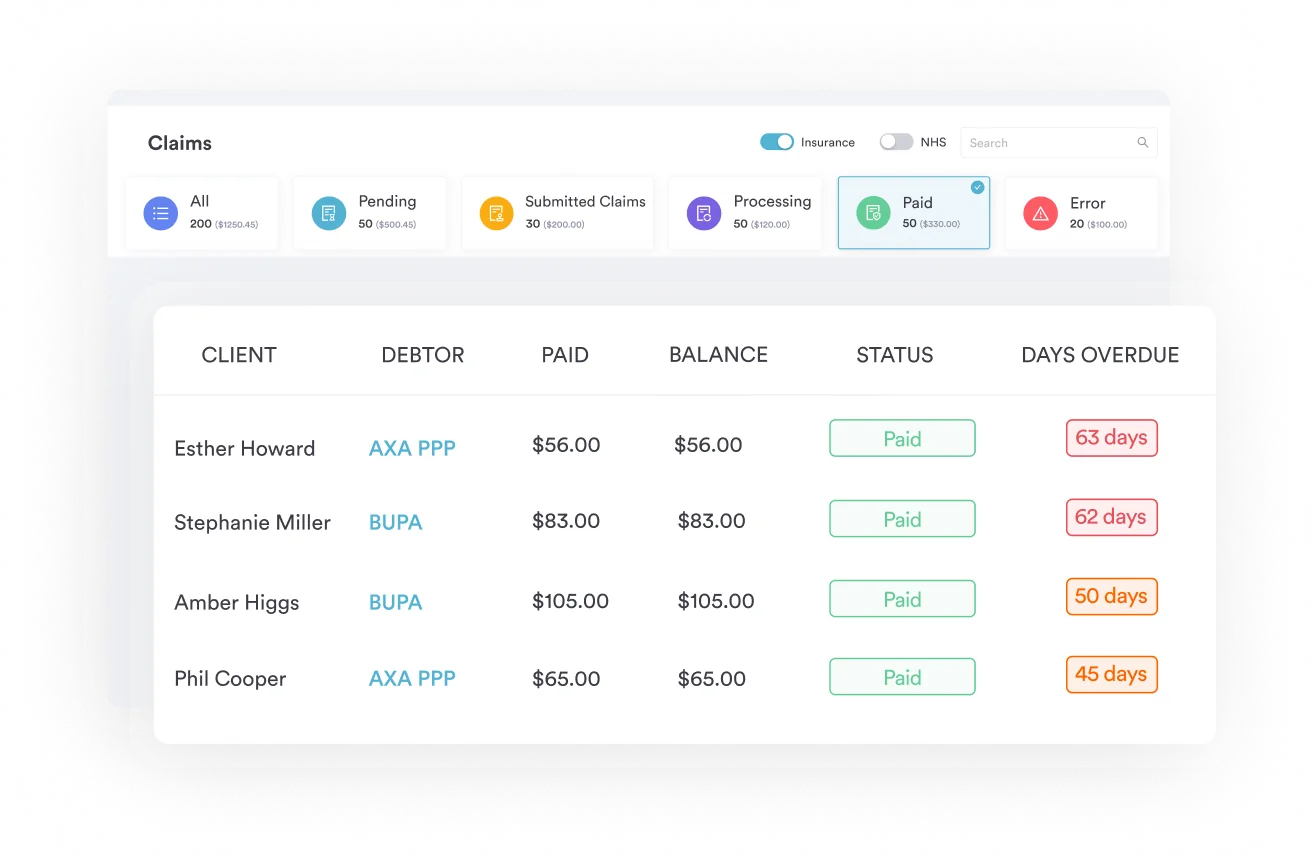

Pabau checks eligibility through Claim.MD before the visit, keeps the ACP note in structured fields and tracks each S0257 or 99497 claim to remittance.

Treat S0257 as a payer decision first and a coding decision second. Confirm the plan before the session, and use 99497 and 99498 whenever Medicare is primary or a plan rejects S-codes.
When a commercial or Medicaid plan does take S0257, the claim stands on the note. A note that names the documents, records the minutes and states the patient’s wishes is what makes it a clean claim. The cost is a few minutes of structured charting per session, and the return is a claim nobody has to rebuild from memory.
Book a demo to see how Pabau checks eligibility and tracks advance care planning claims from booking to remittance.

Need a denial management framework for HCPCS claims? Denial management in healthcare covers root-cause analysis and appeal workflows for high-volume claim denials.
Decoding a CARC on an S0257 remittance? Denial codes in medical billing explains the claim adjustment reason codes payers use most and how to answer each one.
Want a ready-made structure for the counseling note? Advance care planning visit template gives you a printable note covering values, goals of care and proxy designation.
Looking for a complete overview of medical billing fundamentals? Revenue cycle management explained breaks down the end-to-end billing process from eligibility to payment posting.
HCPCS code S0257 is a temporary Level II code for face-to-face counseling with a patient or surrogate about advance directives or end-of-life care planning. Commercial health plans and select Medicaid managed care organizations use it. Medicare does not pay it and uses CPT codes 99497 and 99498 for the same service.
No. Medicare does not reimburse S0257 or any HCPCS S-code. For Medicare patients requiring advance care planning, bill CPT 99497 (first 30-minute block, minimum 16 minutes) and CPT 99498 for each additional 30 minutes. Submitting S0257 to Medicare results in an automatic non-covered denial.
S0257 is an HCPCS S-code accepted by commercial payers and some Medicaid MCOs. CPT 99497 is an AMA code accepted by Medicare and most commercial payers. Both describe advance care planning counseling. CPT 99497 has a 16-minute minimum and a Medicare Physician Fee Schedule rate, while each payer’s contract sets the S0257 rate.
The chart note must include the date of service, the provider’s full name and credentials, and the start and stop time or total face-to-face minutes. It must also name the patient or surrogate present, the advance directive documents discussed and the expressed wishes. Generic language about end-of-life options, without naming the documents reviewed, is usually insufficient for payer review.
Prior authorization requirements vary by payer and plan year, with no universal rule. Some commercial plans cover S0257 as a preventive benefit without PA; others require it when billed as an add-on to an E/M visit. Check the specific plan’s provider portal before each encounter and document the authorization number on the claim if one is required.
Most commercial plans that cover S0257 allow one billable session per plan year. A second session may be paid when a clinical event justifies it. Examples include a new terminal diagnosis, significant functional decline or the incapacitation of a designated healthcare proxy. Document the specific clinical trigger in the note before submitting a second claim in the same plan year.
Coverage of S0257 under Medicaid varies by state and by managed care organization. Some state Medicaid MCO contracts include S0257; others redirect providers to CPT 99497. Check your state’s Medicaid billing manual and the specific MCO’s provider policy before billing. Never assume a Medicaid plan covers S0257 without payer-specific verification.