

CCSD code G5100: Bypass of duodenum billing guide
CCSD code G5100 bills a bypass that leaves the duodenum in place CCSD code G5100...

Last Updated: Oct 16, 2026
K0856 is the HCPCS Level II code for power wheelchair, group 3 standard, single power option, sling/solid seat/back, patient weight capacity up to and including 300 pounds.
The code is simple. The prior authorization and documentation sequence behind it is where Group 3 claims fail. K0856 also sits in a family of seven codes that differ only by weight band, power option count, and seat style.
Let Pabau's smart automation suggest the right codes, reduce claim denials, and keep your practice compliant—effortlessly.
Automate repetitive tasks and focus on what matters most—your patients.
Reduce coding errors and ensure compliance with the latest regulations.
Clean claims, fewer denials, and faster reimbursements.
Powerful insights and reporting to help your practice thrive.
HIPAA compliant SOC 2 certified GDPR-compliant Trusted by 4,000+ clinics worldwide

HCPCS Code K0856 covers a Group 3 standard power wheelchair with one power option, up to a 300 lb weight capacity.
Medicare requires prior authorization from the MAC, a signed standard written order before delivery, and an independent therapist evaluation.
The face-to-face encounter must fall within the 6 months preceding the written order, and the medical record must satisfy LCD L33789.
Certificates of Medical Necessity are obsolete, because CMS ended the CMN and DIF requirement for dates of service from January 1, 2023.
A patient over 300 lbs moves the claim to K0858, not K0861, which carries the same 300 lb cap as K0856.
Modifier KX confirms the medical necessity criteria are met, and practice management software like Pabau tracks that against the documentation on file.
K0856 is a Level II HCPCS code billed by DME suppliers, physicians, and physical therapists. It is active and billable in the 2026 code set. The short description used on claims is “Pwc gp3 std sing pow opt s/b.”
The “single power option” element is the defining characteristic of this code. The wheelchair frame supports one powered adjustment beyond basic drive, usually tilt-in-space, power recline, or power elevating leg rests.
A chair with two or more powered seating functions belongs to a different code in the Group 3 series. Per the Centers for Medicare and Medicaid Services (CMS) HCPCS coding framework, K0856 is updated annually as part of the DMEPOS fee schedule.
CMS updates DMEPOS reimbursement rates annually through the Medicare fee schedule process. For HCPCS Code K0856, payment amounts vary by Medicare Administrative Contractor (MAC) jurisdiction and whether the item falls within a DMEPOS Competitive Bidding Area (CBA).
Outside competitive bidding areas, the fee schedule rate applies directly. Inside CBAs, the competitive bid rate replaces the standard fee schedule amount.
Always verify current rates in the CMS DMEPOS fee schedule files, or in your DME MAC’s own fee schedule lookup. K-code rates are published there, not in the Physician Fee Schedule tool, which covers physician services. Rates in third-party databases often lag by a quarter.
Check your MAC’s fee schedule quarterly, not just at the annual CMS update. Mid-year corrections to DMEPOS rates do occur, and billing at an outdated rate is a common cause of underpayment on K0856 claims.
LCD L33789 and CMS Policy Article A52498 govern coverage for K0856. Medicare pays only when the patient meets the medical necessity criteria and the supplier holds the required documentation before delivery.
The patient must have a mobility limitation that impairs one or more mobility-related activities of daily living (MRADLs) in the home. That limitation must not be adequately addressed by a cane, walker, manual wheelchair, or less complex power wheelchair. Group 3 classification signals that the patient needs powered seating for a progressive condition or a postural management need.
The face-to-face examination must document each of these criteria explicitly. A vague note stating “patient needs power wheelchair” is not sufficient. LCD L33789 sets the bar for that note.
The treating practitioner has to record the specific functional limitation. The note must also give the clinical basis for Group 3 classification and the reason a single power option is needed.
HCPCS Code K0856 falls within the CMS Power Mobility Device (PMD) Prior Authorization Program. A prior authorization request must be submitted to and approved by the MAC before the wheelchair is delivered.
Delivering without approval puts the entire claim at risk of non-payment. Treat it as a hard prerequisite for a Group 3 chair, not an administrative afterthought.
PMD prior authorization requirements have expanded over time, so verify the current rules with your own MAC. The CMS prior authorization process for certain DMEPOS items sets out the national requirements and the review timeframes.
Incomplete documentation is the leading cause of K0856 claim denial. Every required document must sit in the file before the claim is submitted. Submitting a clean claim for a Group 3 power wheelchair means clearing a layered checklist across the practitioner, the specialty evaluator, and the supplier.
Medicare requires suppliers to retain DME documentation for at least seven years from the date of service. Store scanned copies of every signed document in an accessible, audit-ready format. The specialty evaluation carries particular weight in medical review. It supplies the clinical narrative for why a less complex device was not appropriate.
Older K0856 checklists still list a Certificate of Medical Necessity. That form is no longer part of the DME claims process. CMS eliminated CMNs and DME Information Forms for claims with dates of service on or after January 1, 2023, in MLN Matters article SE22002. A claim that arrives with a CMN attached is rejected and returned to the supplier.
Neither LCD L33789 nor Policy Article A52498 mentions a CMN anywhere in its documentation requirements. The 2026 DME MAC Jurisdiction C supplier manual gives the same instruction.
Chasing a physician signature on that form adds work and satisfies no MAC requirement. The medical record now carries the clinical justification, and the SWO carries the order.
Modifier selection on K0856 claims determines how Medicare adjudicates the claim. The wrong modifier, or a missing one, routinely triggers an automatic denial. The remittance advice names the modifier error, so read it on every rejection before resubmitting.
Using GZ on a K0856 claim without clinical justification for skipping the ABN is a significant compliance risk. A pattern of GZ claims on Group 3 devices invites a targeted probe.
Medicare requires that K0856 claims be supported by ICD-10-CM diagnosis codes that establish medical necessity. Only diagnoses listed in the supporting documentation for LCD L33789 qualify. Submitting K0856 with an unsupported ICD-10 code denies the claim, even when the rest of the documentation is complete.
This table lists common supporting diagnoses. Always cross-reference the current LCD L33789 supporting diagnosis list on the CMS coverage database, because approved diagnoses are updated periodically.
Group 3 power wheelchairs span several K-codes. Selecting the correct code depends on the chair’s weight capacity, the number of power options, and whether the seat/back is sling or captain-style. Billing the wrong code in this range is a common audit target because the revenue difference between codes is significant.
Two variables drive code selection in this range, and mixing them up is a frequent billing error. Patient weight moves the claim between the standard and heavy duty families. The count of powered seating functions moves it between the no-option, single-option, and multiple-option codes. The grid below maps both onto the seven codes.
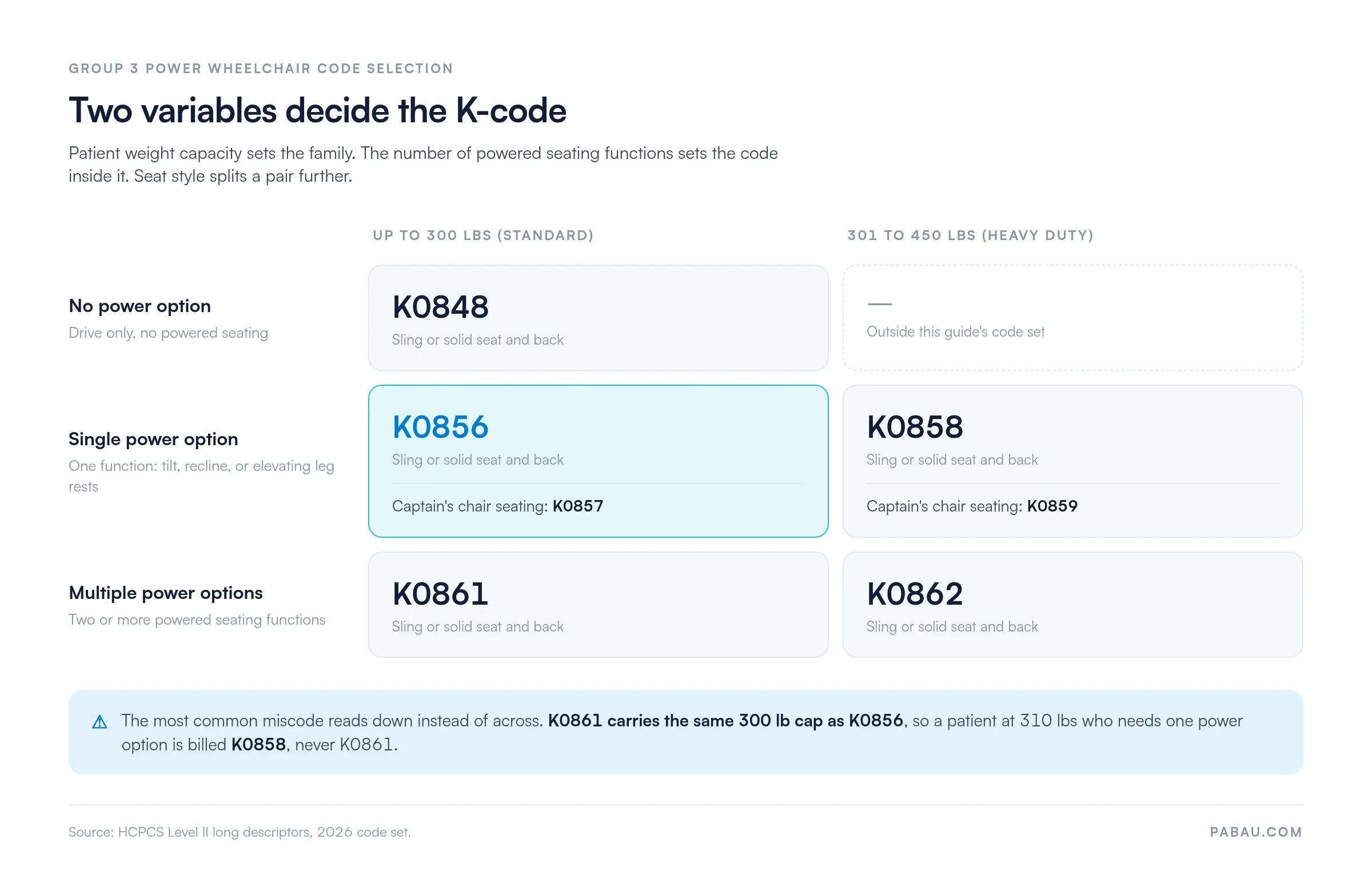
A patient weighing 310 lbs who needs the same single power option chair is billed under K0858, not K0861. K0861 sits at the same 300 lb capacity as K0856 and differs only by power option count.
Billing K0856 for a patient above 300 lbs is a coding error and an overclaim under Medicare rules. Always verify the chair’s tested weight capacity against the code specification.
A group 4 chair carries the same 300 lb ceiling, so the difference from K0856 is performance tier rather than weight. It is billed under HCPCS code K0877, which Medicare denies as not reasonable and necessary in the home under LCD L33789.
Group 3 power wheelchair claims face higher medical review rates than most DMEPOS categories. CMS and the MACs have long flagged this code range for documentation deficiencies. The denial codes that come back on K0856 point to a workflow problem more often than a coding one.
Software that flags a missing prior authorization reference or an incomplete modifier combination stops most of these denials at submission. The alternative is finding them at the appeals stage.
Run a monthly audit of all K0856 claims denied in the prior 90 days. Group denials by CARC code. If CO-57 (no prior authorization) or CO-4 (modifier inconsistent) appear repeatedly, the issue is the workflow, not a one-off error.
DME billing teams often assemble the K0856 file by hand. The face-to-face note sits in the referring practice’s system. The signed SWO lives in a scanned PDF folder. The prior authorization reference number is buried in someone’s inbox.
Practice management software like Pabau keeps that chain on one patient record. Documents attach at the claim level, so the SWO, the specialty evaluation, and the proof of delivery travel with the claim. Modifier validation runs before submission rather than after a denial lands.
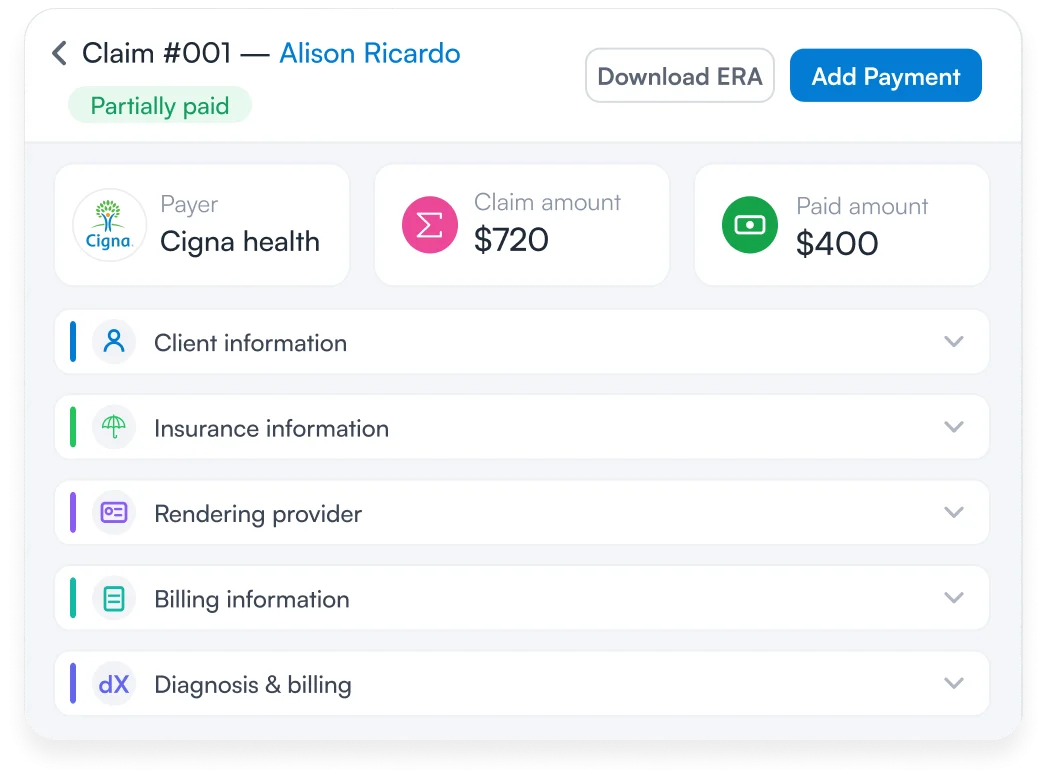
Billing staff can see which K0856 files are complete and which are still waiting on a document. Denial prevention becomes a queue someone works through each morning, instead of a discovery made three weeks after delivery.
The result is fewer technical denials and a shorter path from delivery to payment. The audit trail also holds up when a Group 3 claim is selected for medical review.

Pabau helps DME suppliers attach documentation, track modifier use, and submit clean claims to Medicare and other payers. That means fewer K0856 denials and faster reimbursement.

The code is the easy part of a K0856 claim. What decides payment is whether the prior authorization, the order, and the clinical file were complete before the chair left the warehouse. A single missing element produces a denial that costs more to appeal than it would have cost to prevent.
The one figure worth memorizing is the 300 lb line. Above it, a single power option chair is K0858, and K0861 is never the answer.
Pabau’s claims management software gives DME billing teams one place to run that checklist before a claim goes out. To see how it handles the full Group 3 power wheelchair workflow, book a demo.

Need a structured framework for managing DME denials? Denial management in healthcare covers the systematic process for tracking, appealing, and preventing claim rejections across DMEPOS categories.
Want to understand how clearinghouse submissions work? Medical claims clearinghouse explains how electronic claim routing reduces K-code processing errors before claims reach the MAC.
Looking to streamline your revenue cycle for DME billing? Revenue cycle management for DME suppliers walks through the end-to-end billing workflow from order capture to payment posting.
HCPCS Code K0856 bills Medicare and other payers for a Group 3 standard power wheelchair with a single power option. That option is usually tilt, recline, or elevating leg rests, and the chair has a sling or solid seat and back. The weight capacity runs up to and including 300 pounds. Suppliers and physicians use the code when a mobility limitation requires powered seating beyond a basic power drive system.
The 2026 Medicare reimbursement rate for K0856 varies by MAC jurisdiction and whether the delivery address sits inside a DMEPOS Competitive Bidding Area. Verify the current rate in the CMS DMEPOS fee schedule files or your MAC’s published fee schedule. K-code rates are not in the Physician Fee Schedule tool. Rates change annually, and mid-year corrections do occur.
Yes, K0856 requires prior authorization under the CMS Power Mobility Device Prior Authorization Program. The request must be submitted to and approved by the applicable DME MAC before the wheelchair is delivered. Since January 1, 2025, the MAC has no more than 7 calendar days to decide a standard request. Expedited review remains 2 business days.
Billing K0856 requires a standard written order signed by the treating practitioner before delivery. The face-to-face encounter must fall within the 6 months preceding that order. You also need medical records that meet LCD L33789 and a specialty evaluation by an independent physical or occupational therapist. Documented ATP involvement, a signed proof of delivery, and the MAC’s prior authorization approval complete the file. A Certificate of Medical Necessity is not required, because CMS eliminated CMNs for dates of service on or after January 1, 2023.
No. CMS eliminated Certificates of Medical Necessity and DME Information Forms for all claims with dates of service on or after January 1, 2023. A claim submitted with a CMN attached is rejected and returned to the supplier. Medical necessity is now proven through the standard written order and the patient’s medical record. Neither LCD L33789 nor Policy Article A52498 mentions a CMN.
K0856 and K0861 share the same 300 lb weight capacity, so weight does not separate them. The difference is the number of powered seating functions. K0856 covers a single power option, while K0861 covers multiple power options. A patient in the 301 to 450 lb range who needs one power option is billed under K0858. That is the Group 3 heavy duty single power option code, and K0861 is never correct above 300 lbs.
The primary modifiers for K0856 are KX, GA, GY, and GZ. KX means all medical necessity criteria are met, and GA means an ABN was issued. GY covers a statutorily non-covered item billed for a denial notice. GZ covers an expected denial with no ABN. The rental and purchase modifiers are NU, RR, and UE. KX is required on most covered claims. GZ carries significant compliance risk and belongs only on claims where no ABN was obtained.
Common ICD-10-CM codes supporting K0856 include G35 (multiple sclerosis), G12.21 (ALS), G20 (Parkinson’s disease), and G71.0 (Duchenne muscular dystrophy). Others include I63.x (stroke with residual motor deficit) and S14.xx (cervical spinal cord injury). Only codes on the LCD L33789 supporting diagnosis list qualify, so verify the current list on the CMS coverage database before submission.



