HCPCS Code Q4185: Cellesta flowable amnion billing guide
HCPCS Code Q4185: definition and official descriptor HCPCS Code Q4185 is the Lev...

Last Updated: Nov 20, 2026
J7639 is the HCPCS Level II code for dornase alfa, inhalation solution, fda-approved final product, non-compounded, administered through dme, unit dose form, per milligram.
Claims billed under this code without a confirmed cystic fibrosis diagnosis or a valid National Drug Code (NDC) are among the most common denial triggers billers encounter for this drug. Knowing exactly what J7639 covers, how units are calculated, and what documentation Medicare and commercial payers require is the difference between a clean claim and a correctable denial.
Let Pabau's smart automation suggest the right codes, reduce claim denials, and keep your practice compliant—effortlessly.
Automate repetitive tasks and focus on what matters most—your patients.
Reduce coding errors and ensure compliance with the latest regulations.
Clean claims, fewer denials, and faster reimbursements.
Powerful insights and reporting to help your practice thrive.
HIPAA compliant SOC 2 certified GDPR-compliant Trusted by 4,000+ clinics worldwide

J7639 bills dornase alfa (Pulmozyme) inhalation solution at 1 mg per unit, so one 2.5 mg ampule is 2.5 units.
Medicare pays it under Part B as a DME nebulizer drug, so the claim goes to the DME MAC rather than a Part D plan.
Every claim needs an E84 cystic fibrosis diagnosis, and E84.0 is the usual pairing for a lung indication.
The Medicare Nebulizers LCD lists a 78 mg monthly maximum, so a twice-daily order at 150 units needs strong supporting notes.
Most denials trace back to a missing NDC, rounded units, an absent prior authorization or the wrong billing route.
HCPCS code J7639 is the Level II code for dornase alfa inhalation solution, the FDA-approved, non-compounded unit-dose product supplied through DME, billed per milligram. Medicare’s Nebulizers LCD (L33370) names dornase alfa (J7639) as reasonable and necessary for a beneficiary with cystic fibrosis.
The Centers for Medicare and Medicaid Services (CMS) maintains the HCPCS Level II code set and publishes yearly updates to descriptors.
Dornase alfa is a recombinant human deoxyribonuclease I enzyme that cleaves extracellular DNA in airway secretions.
In cystic fibrosis (CF), neutrophil breakdown releases large amounts of DNA into the airways, which thickens the mucus. Dornase alfa breaks that DNA down, thinning the mucus and improving mucociliary clearance.
The FDA approves Pulmozyme for pediatric and adult patients with cystic fibrosis. Genentech supplies it as a 2.5 mL single-use ampule holding 2.5 mg of dornase alfa (1 mg/mL).
The label calls for a recommended jet or vibrating mesh nebulizer, such as the PARI LC Plus jet nebulizer or the eRapid system. J7639 covers inhaled use only.
J7639 applies only to FDA-approved dornase alfa, given through a recommended jet or vibrating mesh nebulizer per the label, for a covered cystic fibrosis diagnosis. A claim outside those limits denies.
One billing unit equals 1 mg of dornase alfa. The standard dose is 2.5 mg once daily from one 2.5 mL ampule, which equals 2.5 billing units a day. The label allows twice-daily dosing for some patients, and that doubles the daily count to 5 units.
Rounding to whole units is a common and expensive error. Bill 2.5 units for a 2.5 mg dose, not 2 or 3. Most billing systems accept decimal quantities for drug J-codes.
Unit calculation workflow: Multiply the milligrams per dose by the doses per day to get daily units. Then multiply the daily units by the days in the billing period for the total to report.
The monthly total matters as much as the daily one. The Nebulizers LCD lists 78 mg a month as the maximum for dornase alfa. Once-daily dosing fits under that line, while twice-daily dosing nearly doubles it.
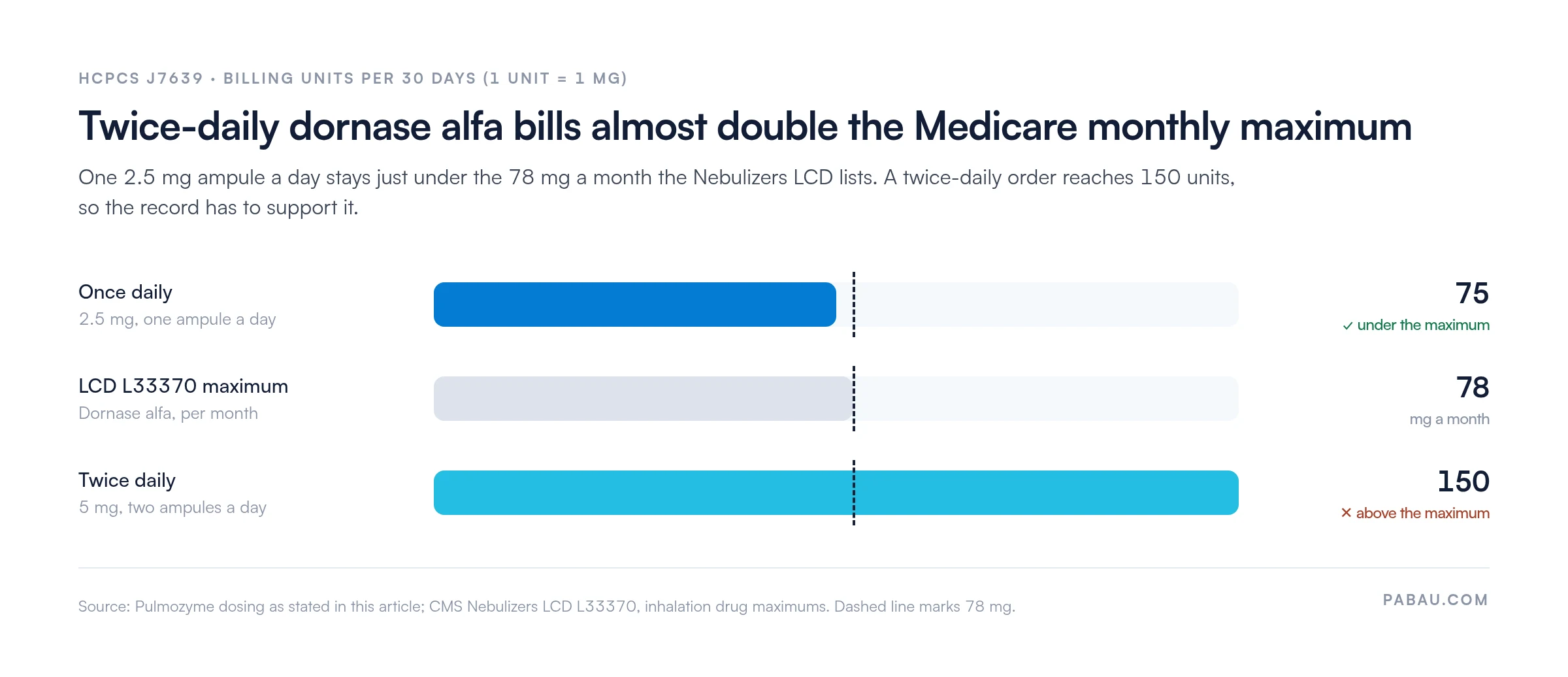
On a twice-daily order, put the prescriber’s reasoning and the patient’s response in the record before the first claim goes out.
Each J7639 claim needs an ICD-10-CM cystic fibrosis diagnosis from the E84 family. The LCD points to the diagnosis list in its policy article. A claim with any code outside that family will deny under most payer policies.
E84.0 fits most Pulmozyme claims, because dornase alfa works on the lungs. Using E84.9 when the notes document a pulmonary manifestation invites medical necessity review and can delay payment. Keep E84.8 for documented manifestations that no other E84 code describes.
Medicare Part B covers dornase alfa under the DME inhalation drug benefit, not Part D. That changes where the claim goes. It routes through the patient’s DME Medicare Administrative Contractor (DME MAC), and billing a Part D plan instead is a coverage mismatch that denies.
Coverage requires a Medicare-covered nebulizer, which counts as durable medical equipment (DME). The supplier bills the compressor separately, typically as E0570.
If none of the drugs used in the nebulizer are covered, the LCD denies the equipment too. Patients pay 20% coinsurance after the Part B deductible, with no separate drug deductible.
Most J7639 trouble starts before anyone opens the claim form. Here’s the path a clean claim takes, step by step.
Payers expect a National Drug Code (NDC) on J7639 claims. A missing or badly formatted NDC is one of the most frequent and easily prevented denial causes for this code.
Enter the NDC as 11 digits in 5-4-2 format, without hyphens, on both 837P electronic claims and the CMS-1500 paper form. On paper, the N4 qualifier goes in front of it. Report the NDC for the package dispensed, the quantity as a decimal, such as 2.5 for one 2.5 mL ampule, and the unit qualifier “ML”.
Genentech assigns Pulmozyme’s NDCs, and they can change with packaging updates. Check the NDC against the dispensed product’s label before each claim, and never submit a superseded one. A verified NDC is the cheapest part of a clean claim to get right.
Most commercial payers and many Medicaid programs require prior authorization (PA) for Pulmozyme. Medicare DME MACs may also require it for some high-cost inhalation drugs, depending on the jurisdiction and claim history. Check the DME MAC’s LCD and policy article before the first dispense.
A J7639 PA request typically includes:
Turnaround varies, but most payers process standard PA requests within 3 to 5 business days. Expedited requests for urgent clinical need may come back within 24 to 72 hours.
If a PA is denied, the practice can appeal. Include the treating physician’s notes, any spirometry or pulmonary function data, and references to the FDA-approved indication and Cystic Fibrosis Foundation guidelines.
Put the PA reference number on the claim too, because many payers deny a claim without it even when authorization was granted.
Medicare Part B pays J7639 at the Average Sales Price (ASP) plus 6%. That is the standard Part B drug method set by the Medicare Modernization Act (MMA) of 2003.
The rule is codified at 42 CFR 414.904. CMS updates the ASP figure every quarter and publishes it in the CMS Physician Fee Schedule and ASP Drug Pricing files.
Because rates change every quarter, this article quotes no dollar figure. Pull the current payment limit from the CMS ASP quarterly file before you submit or appeal a claim. The DME MAC fee schedule may differ slightly from the physician office schedule, so use the one that matches the billing setting.
Match the CMS ASP quarterly file to the quarter of the date of service, not the calendar year. A January date of service uses the Q1 file, and an April one uses Q2. Using the wrong quarter’s ASP to estimate reimbursement leads to avoidable underpayment disputes.
J7639 sits among the inhalation solution codes in the J7600-J7699 range. Coders sometimes bill the unlisted inhalation drug code J7699 or an adjacent code when J7639 applies.
Billing an unlisted code when a specific one exists is a coding error. It triggers extra payer review and can lower or deny payment.
J7639 claims deny for predictable, correctable reasons, and the remark code usually names the cause. Sound denial management practices start by stopping these errors at the point of billing.
When a remittance shows a code that isn’t in this table, look it up in our guide to denial codes before you correct anything.
CMS and the DME MAC LCDs require specific documentation in the medical record to support J7639 claims. Missing records drive many medical necessity denials on audit and during recoupment reviews. Good medical billing compliance means checking this list before the first claim and at each re-evaluation.
Audit the patient file against this checklist when the prescriber writes the order, not when the claim goes out. Finding a missing sweat chloride result at billing means the drug may already have shipped without coverage support, which complicates appeals.
A J7639 claim draws on several records at once. The order sits in the notes, the PA number arrives by email, and someone retypes both into the claim.
Pabau, the practice management platform we build, pre-fills the CMS-1500 from the patient record. The HCPCS code on the service lands on the charge line, and the ICD-10 slots draw on the recorded problem list. The claim can’t be sent until required fields, such as the authorization code, are complete.
In the US, claims go out through Claim.MD, with eligibility checks before the visit and ERA remittances posted back to the account. That helps your team catch claim errors early and spot a denial the day it lands.
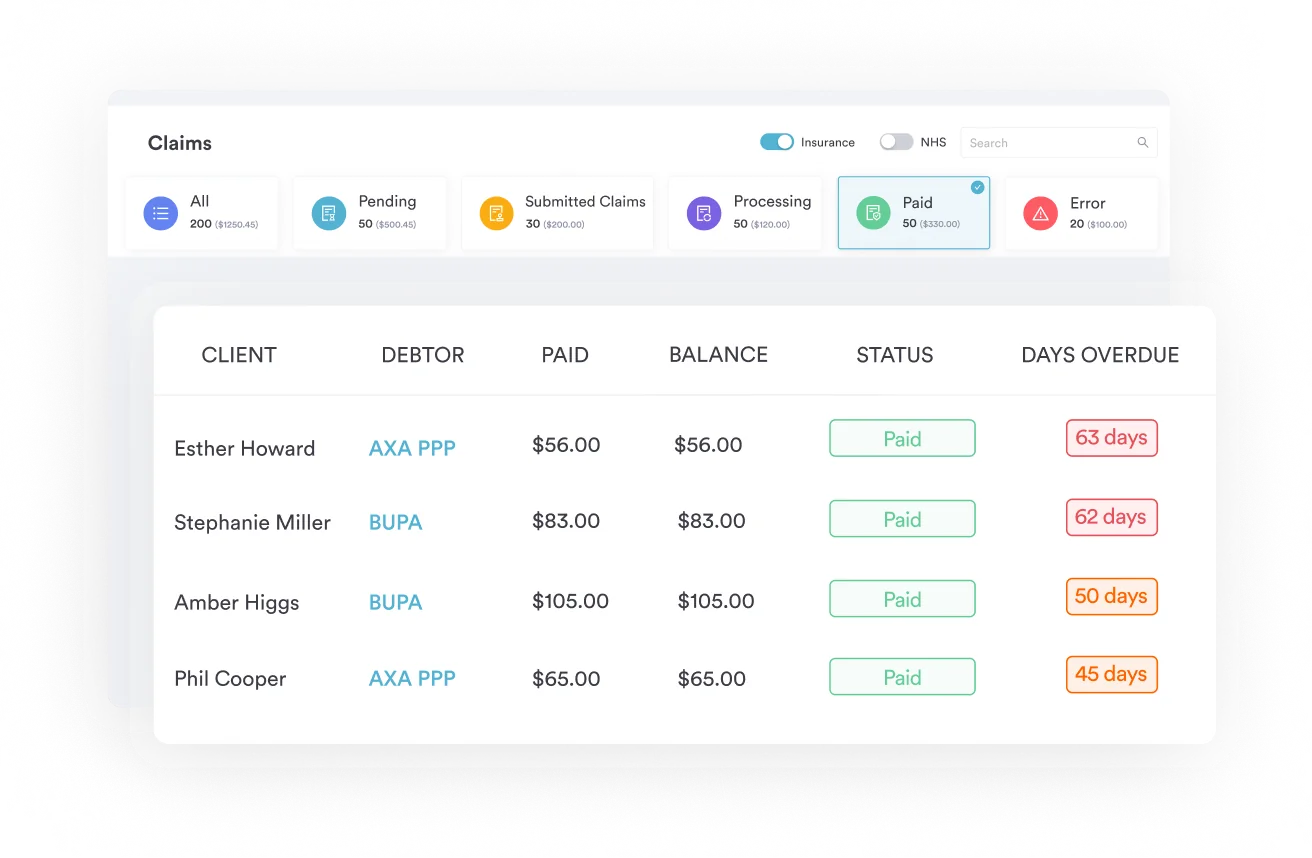

Pabau pre-fills claims from the patient record, holds them until required fields are complete and posts remittances back. Your team spends less time reworking denied inhalation drug claims.

J7639 rewards care at the front of the process. Get the E84 code, the decimal units and the NDC right on the first claim. Then most of the denial table above never comes into play.
If you change one habit, check the monthly total against the 78 mg LCD maximum before a twice-daily order ships. That way the supporting notes are in the record before a reviewer asks for them.
Book a demo to see how Pabau pre-fills inhalation drug claims and tracks each one through to payment.

Billing the inhaled antibiotic as well? HCPCS code J7682 covers tobramycin inhalation solution, another common CF claim.
Billing the compressor alongside the drug? HCPCS code E0570 explains how the nebulizer equipment claim works.
Need a refresher on working a rejected claim? Denial management in healthcare covers the workflow from remark code to corrected claim.
Want the broader compliance picture? Medical billing compliance requirements explains LCD alignment, audit risk and documentation standards.
Looking for a primer on the claims pipeline? What is revenue cycle management walks through the process from encounter to payment.
Pulmozyme bills under HCPCS J7639, dornase alfa inhalation solution, at 1 mg per unit. One 2.5 mg ampule is 2.5 units, so bill the decimal rather than rounding to 2 or 3.
For Medicare, the enrolled DME supplier bills J7639 to the DME MAC, and that supplier is often a specialty pharmacy. The prescriber’s office provides the order and the supporting notes.
Under the Medicare Nebulizers LCD, a supplier can dispense no more than a three-month supply at a time. Refill contact happens no sooner than 30 days before the current supply runs out.
Yes, when the drug is covered. The compressor bills as E0570 with a small-volume nebulizer, and the LCD denies the equipment if none of the drugs used in it are covered.
The Nebulizers LCD lists 78 mg of dornase alfa a month as the maximum. Once-daily dosing bills 75 units in 30 days, while twice-daily dosing bills 150, so the record must support the higher use.