CPT code 51797: Intra-abdominal voiding pressure add-on
What CPT code 51797 covers CPT code 51797 is the add-on code for intra-abdominal...

Last Updated: Oct 19, 2026
J7644 is the HCPCS Level II code for ipratropium bromide, inhalation solution, fda-approved final product, non-compounded, administered through dme, unit dose form, per milligram.
The full Level II descriptor runs: Ipratropium bromide, inhalation solution, FDA-approved final product, non-compounded, administered through DME, unit dose form, per milligram. Most payer systems display only the short version, "Ipratropium bromide non-comp." Every clause in the long descriptor changes how the claim gets built.
Practice management software like Pabau includes claims software for suppliers, so the HCPCS code, the units, and the diagnosis stay on one claim line.
Let Pabau's smart automation suggest the right codes, reduce claim denials, and keep your practice compliant—effortlessly.
Automate repetitive tasks and focus on what matters most—your patients.
Reduce coding errors and ensure compliance with the latest regulations.
Clean claims, fewer denials, and faster reimbursements.
Powerful insights and reporting to help your practice thrive.
HIPAA compliant SOC 2 certified GDPR-compliant Trusted by 4,000+ clinics worldwide

HCPCS code J7644 describes ipratropium bromide inhalation solution, FDA-approved, non-compounded, administered via DME nebulizer, billed per milligram.
Each standard 2.5 mL unit-dose vial contains 0.5 mg, so one vial equals 0.5 billing units. Report units in milligrams, not vials.
J7644 applies only to FDA-approved, non-compounded product. Compounded ipratropium bromide is billed under J7645, and J7643 is a glycopyrrolate code. Wrong code selection here is a frequent audit trigger.
Pabau’s claims management software tracks DME drug billing units and links diagnosis codes to claims, helping reduce J7644 denials before submission.
Ipratropium bromide is an anticholinergic bronchodilator used primarily for patients with COPD and obstructive airway disease. When it is dispensed in unit-dose vials for home nebulizer use through a DME supplier, the drug falls under the J-code HCPCS classification. It is then billed to Medicare Part B under the DME benefit rather than the Part B drug benefit.
According to the Centers for Medicare and Medicaid Services (CMS) HCPCS Level II code set, J-codes are maintained and updated annually.
The single most common J7644 billing error is reporting one unit per vial. The code is billed per milligram. One standard 2.5 mL unit-dose vial of ipratropium bromide 0.02% contains 0.5 mg of active drug. That means one vial equals 0.5 billing units, and a 30-vial monthly supply equals 15.
The CGS Medicare Nebulizer Medication Calculator confirms the following unit conversion for J7644. Apply this formula before submitting any claim:
Medicare’s quantity limits for J7644 are set per policy by each DME MAC jurisdiction. Monthly quantity limits typically align with the physician’s prescribed dosing frequency. Claims exceeding these limits without supporting documentation are subject to automatic denial. Review your MAC’s local coverage determination (LCD) before exceeding standard monthly quantities.
J7644 is billed by DME suppliers, not by treating physicians or facilities. Place of service is the patient’s home in most cases. The claim is submitted on a CMS-1500 form (or the 837P electronic equivalent) by the enrolled DME supplier. No professional service modifier is required for the drug code itself. Some MAC jurisdictions do require modifiers on the nebulizer equipment codes billed alongside J7644. Check your MAC’s policy article for current modifier requirements, as these vary by jurisdiction and change annually.
Medicare Part B covers HCPCS code J7644 when all of the following conditions are met. Failing any single condition makes the claim non-covered, regardless of the patient’s diagnosis. CMS Policy Article A52466 (Nebulizers) is the primary governing document for DME nebulizer drug coverage requirements.
Medicaid coverage requirements vary significantly by state. Some state Medicaid programs follow Medicare’s criteria; others apply different prior authorization requirements, quantity limits, or formulary restrictions. Always verify the specific state Medicaid policy before billing, as no universal Medicaid rule applies across all programs.
Linking the correct ICD-10 diagnosis code to each J7644 claim is essential for establishing medical necessity. CMS Policy Article A52466 specifies the diagnosis codes that support coverage. The table below lists the most commonly used codes across COPD, asthma, and related obstructive airway conditions. This list is subject to annual ICD-10-CM updates; always verify against the current CMS policy article for the applicable benefit year.
Code to the highest level of detail supported by the medical record. “COPD unspecified” (J44.9) is valid when the record does not specify exacerbation status, but a documented acute exacerbation should be coded as J44.1. Using a less specific code when a more specific one is supported can raise medical necessity questions during post-payment review.
Insufficient documentation is a leading reason J7644 claims are denied on appeal. The treating physician’s records and the DME supplier’s dispensing records must together support every element of coverage. Keep both sets on file for at least seven years from the date of service.
Before dispensing J7644, confirm the written order is on file and dated. Retroactively obtaining physician signatures after dispensing constitutes a compliance violation. Build a pre-dispensing checklist into your DME workflow that verifies the written order, qualifying diagnosis, and payer enrollment status before each fill.
Medicare Part B reimburses J7644 under the Medicare Part B Drug Pricing methodology. The allowable amount is set as a percentage of the Average Sales Price (ASP) for the applicable drug. Rates are updated quarterly by CMS and vary by geographic location based on the applicable payment locality. Review the remittance advice after each claim cycle to reconcile allowed amounts against submitted charges.
The CMS Physician Fee Schedule and Part B Drug Pricing lookup provides current quarterly allowable amounts by HCPCS code and locality. Because rates change at least quarterly, citing a specific dollar figure here would be outdated within weeks. Always pull the current rate from the CMS Part B Drug Pricing files before submitting or appealing claims.
Several HCPCS codes sit close to J7644. Using the wrong one, or failing to tell them apart, generates denials and can trigger fraud and abuse reviews. The AAPC HCPCS code reference carries crosswalk data for the related nebulizer drug codes. The equipment that delivers the drug is billed under E0570, on its own claim line.
One nearby J-code breaks the nebulizer pattern. J7665 covers mannitol delivered as a dry powder through an inhaler, and its unit is a 5 mg capsule rather than a milligram.
Nebulizer supplies form a third claim line. The mouthpiece the patient inhales through is billed under A4617, separately from the drug and the compressor.
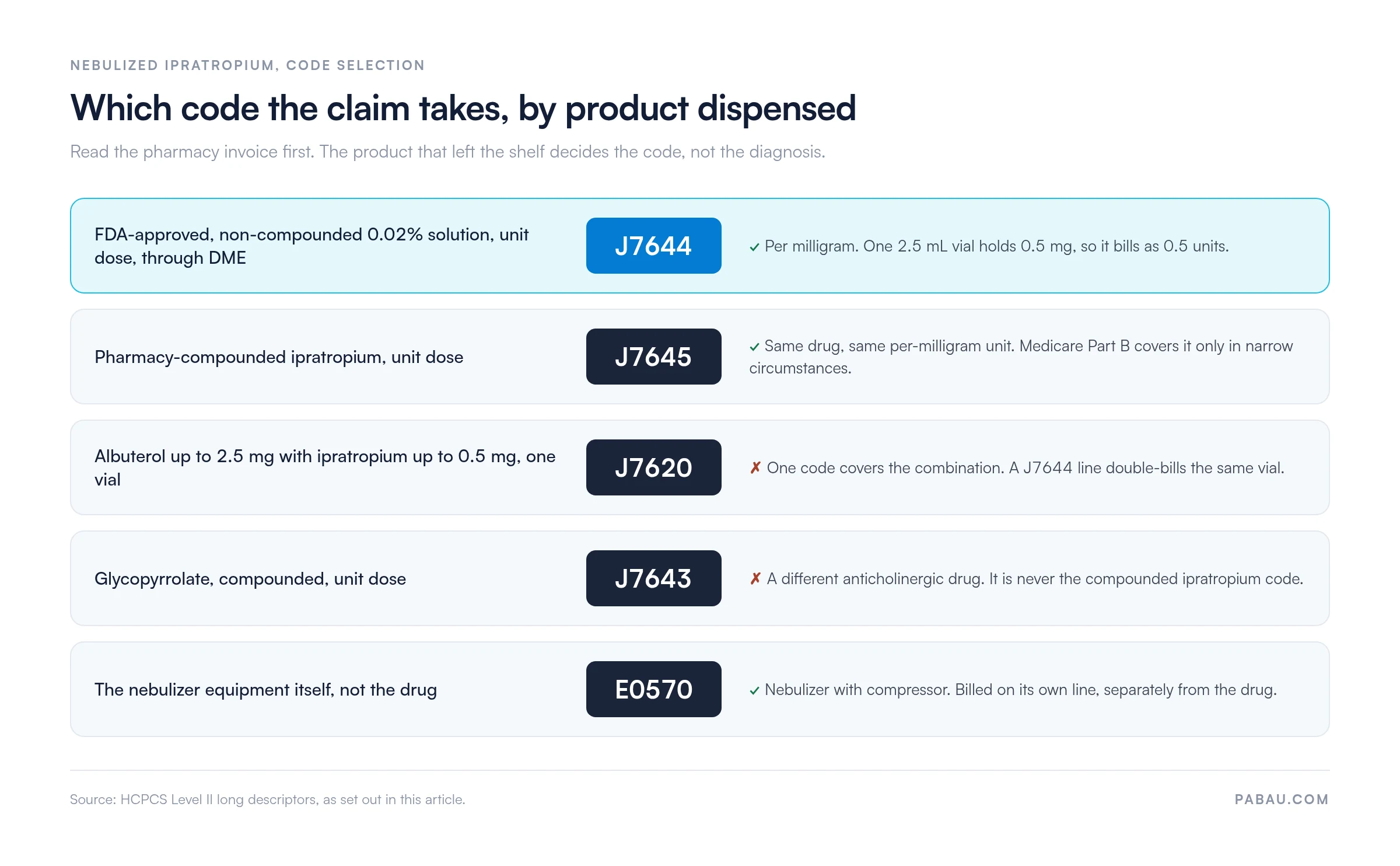
J7644 and J7645 describe the same drug, in the same unit dose form, billed per milligram. The only difference is how the product was made. J7644 is the commercially manufactured, FDA-approved solution. J7645 is a pharmacy-compounded preparation, and Medicare Part B covers it only in narrow circumstances.
Billing J7644 for a compounded product is incorrect code assignment, and payers treat it that way on review. Check the pharmacy invoice before the claim goes out. A commercially manufactured 0.02% solution with a manufacturer NDC takes J7644. A preparation made by a compounding pharmacy takes J7645.
J7643 is not an ipratropium code. Its descriptor reads: Glycopyrrolate, inhalation solution, compounded product, administered through DME, unit dose form, per milligram. Glycopyrrolate is a different anticholinergic drug. Older internal cheat sheets sometimes list J7643 as the compounded ipratropium code, and that pairing is simply wrong. Audit your ipratropium lines against J7645 instead.
One further pairing catches DME billers out. J7620 is a single code covering albuterol up to 2.5 mg together with ipratropium bromide up to 0.5 mg. When you dispense that combination solution, J7620 is the only drug code on the claim. Adding a J7644 line double-bills the ipratropium component of the same vial. The chart below sets out which code each product takes.
The majority of J7644 denials trace back to five avoidable errors. Fixing them starts with identifying which error type produced each rejection, then correcting the process behind it. Grouping denial codes by error category shows which patterns drive the most rework in a DME billing operation.
Build a pre-submission checklist that flags each of these five items, then track denial rates by error code once it is in use. Persistent CO-50 denials point at diagnosis linkage, since that code signals a service the payer does not consider medically necessary. Persistent CO-57 denials point the other way, at documentation that does not support the dosage billed.
Run a quarterly internal audit on J7644 claims by pulling all units billed and dividing by units dispensed. If the ratio is consistently 1:1 (one unit per vial), your team is billing units wrong. The correct ratio should be approximately 0.5 units per vial. Catch this before your MAC does.
Most DME billing teams find their J7644 unit errors on the remittance advice. A biller re-keys the vial count from a dispensing note. The units land at one per vial instead of 0.5, and the overpayment letter arrives months later.
Pabau moves that check forward to the point of billing. Each claim line holds the HCPCS code, the NDC, and the linked diagnosis in one record. A J7644 line missing a covered ICD-10 code shows up before submission rather than after denial.
Denial reporting then groups rejections by code and reason. When denials cluster on your ipratropium lines, you can see whether the cause is the J7644 and J7645 split or the unit math. That points you at the workflow step to correct.
The outcome is fewer reworked claims and faster payment after each dispense.

Pabau’s claims management software helps DME suppliers track HCPCS drug billing and link diagnosis codes to claims. You can spot denial patterns before they turn into audit findings.

J7644 is a per-milligram code with tight requirements on FDA approval, compounding, and DME administration. Unit calculation errors and the J7644 or J7645 choice drive most of the preventable denials in this category. Both are catchable at the point of dispensing, which is months earlier than the appeal that would otherwise fix them.
Pabau supports HCPCS drug code tracking, diagnosis linkage, and denial monitoring for multi-specialty practices and DME suppliers. To see the units and the diagnosis checked before a J7644 claim leaves your office, book a demo.

Need to understand how medical billing workflows connect to claim outcomes? Revenue cycle management explained covers the full financial lifecycle from patient intake to payment posting.
Dealing with repeated claim rejections on DME codes? Denial management in healthcare outlines the systematic approach to identifying, correcting, and preventing denial patterns.
Want fewer J7644 claims coming back at all? What makes a clean claim sets out the checks that get a claim paid on first submission.
Need the paperwork to hold up on review? Medical billing compliance covers the records a payer expects to find when it audits a claim.
Reconciling what the payer actually allowed? Electronic remittance advice explains how to read a remittance file line by line.
HCPCS code J7644 covers ipratropium bromide inhalation solution that is FDA-approved, non-compounded, and administered through a DME nebulizer, billed on a per-milligram basis. It does not cover compounded preparations (which use J7645), metered-dose inhaler formulations, or inpatient hospital administration.
Report units in milligrams, not vials. Each standard 2.5 mL unit-dose vial contains 0.5 mg of ipratropium bromide, so one vial equals 0.5 billing units. A typical 30-vial monthly supply = 15 billing units (30 x 0.5 mg = 15 mg = 15 units).
The primary covered diagnoses are the COPD codes (J44.0, J44.1, J44.9) and the asthma codes (J45.20 through J45.50). Related obstructive conditions also qualify, including emphysema (J43.9) and chronic bronchitis (J41.0). The complete covered diagnosis list is in CMS Policy Article A52466 and is updated annually.
Yes, Medicare Part B covers J7644 for a qualifying diagnosis. The drug must be medically necessary, ordered by a physician, and dispensed by an enrolled DMEPOS supplier. It must also be administered through a DME nebulizer. Coverage requires FDA-approved, non-compounded product and complete supporting documentation.
J7644 covers the FDA-approved, commercially manufactured ipratropium bromide inhalation solution. J7645 covers the pharmacy-compounded version of the same drug. Both sit in unit dose form and are billed per milligram. Medicare Part B covers J7645 only in narrow circumstances, so J7644 is the standard covered code. J7643 is a glycopyrrolate code and never applies to ipratropium.
Yes, when the two drugs are dispensed as separate vials. Each drug is then reported under its own HCPCS code, with its own units and its own NDC. The combination solution works differently. That product carries a single code, J7620, and adding a J7644 line alongside it double-bills the ipratropium.
Medicare Part B reimburses J7644 based on the Average Sales Price (ASP) methodology, updated quarterly. Rates vary by geographic locality and DME MAC jurisdiction. Pull the current quarter’s Part B Drug Pricing files from the CMS website before submitting or appealing claims. Rates change at least four times a year.