HCPCS code L0638: Custom fabricated LSO billing guide
HCPCS code L0638 is a brace built for one patient HCPCS code L0638 is the Level ...

Last Updated: Nov 2, 2026
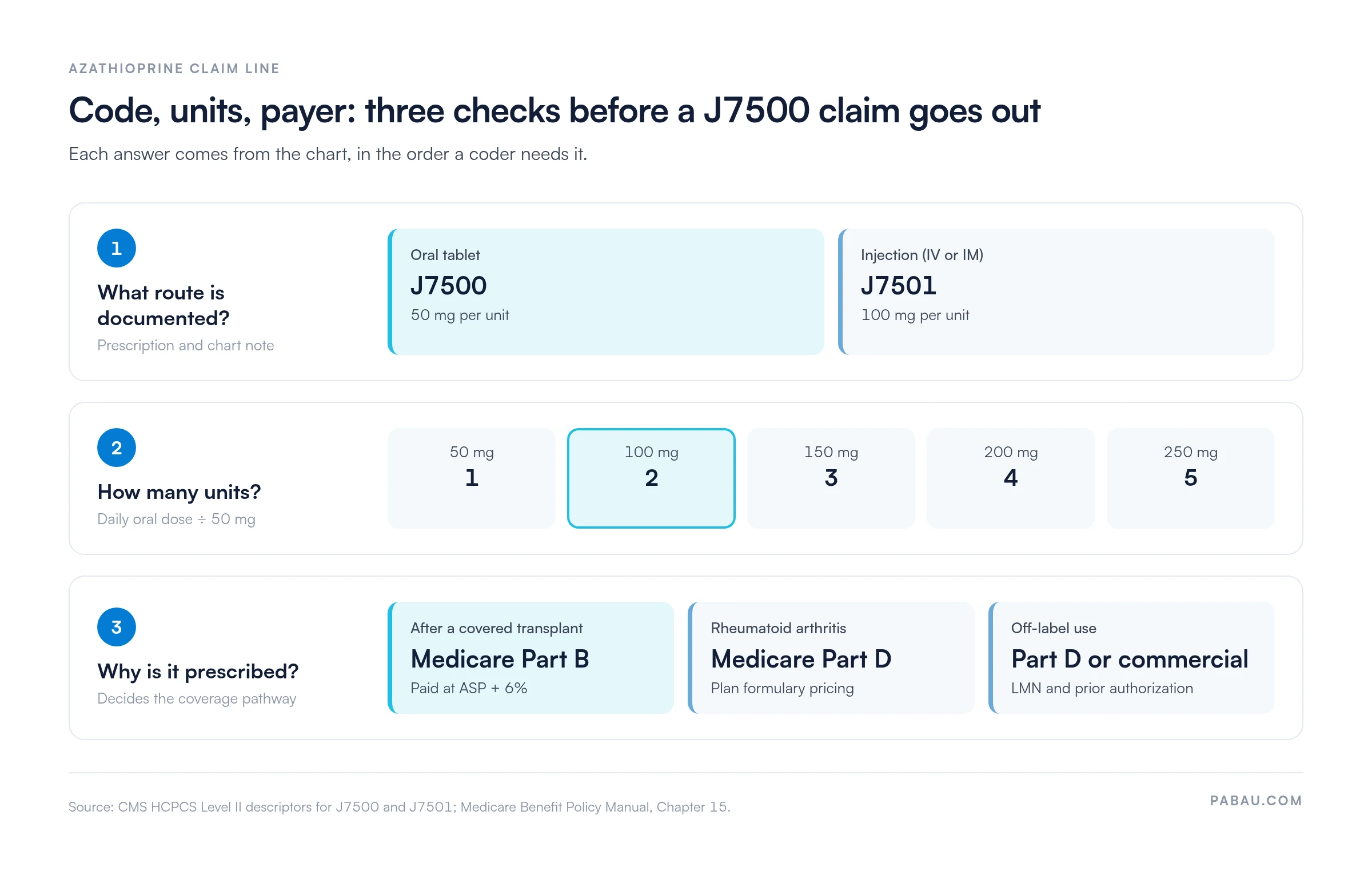
J7500 is the HCPCS Level II code for azathioprine, oral, 50 mg. One unit equals 50 mg, so a 100 mg daily dose bills as two units per day.
The code covers oral tablets only, and injectable azathioprine bills under J7501 at 100 mg per unit. Medicare Part B pays for J7500 after a covered organ transplant. Rheumatoid arthritis and other non-transplant uses usually fall under Part D.
Let Pabau's smart automation suggest the right codes, reduce claim denials, and keep your practice compliant—effortlessly.
Automate repetitive tasks and focus on what matters most—your patients.
Reduce coding errors and ensure compliance with the latest regulations.
Clean claims, fewer denials, and faster reimbursements.
Powerful insights and reporting to help your practice thrive.
HIPAA compliant SOC 2 certified GDPR-compliant Trusted by 4,000+ clinics worldwide

HCPCS Code J7500 covers oral azathioprine only, at 50 mg per billing unit, and parenteral azathioprine bills under J7501.
Units equal the total oral dose divided by 50 mg, so a 100 mg daily prescription bills as 2 units per day.
Medicare Part B covers J7500 for post-transplant immunosuppression, while rheumatoid arthritis and other non-transplant uses usually fall under Part D.
Pabau, the practice management platform with built-in claims management, scrubs each claim for missing or invalid details before it reaches the payer.
HCPCS Code J7500 is the Level II code for azathioprine administered orally, billed in 50 mg increments.
The Centers for Medicare and Medicaid Services (CMS) maintains it. It belongs to the J-code series, which covers drugs administered other than by the oral method. CMS also uses that series for oral immunosuppressives such as azathioprine, grouped under J7500-J7599. CMS updates the HCPCS Level II code set quarterly, so confirm the descriptor and status against the current release before each billing cycle.
Azathioprine is FDA-approved for two primary indications: renal transplant rejection prophylaxis and rheumatoid arthritis that has failed conventional therapy. Payers accept J7500 claims for these indications when the diagnosis code maps correctly to the clinical record. For a kidney transplant patient, that usually means Z94.0 for transplant status, or T86.11 when the chart documents rejection.
Off-label use, including Crohn’s disease, systemic lupus erythematosus and other autoimmune conditions, needs a Letter of Medical Necessity (LMN). It also needs payer-specific pre-approval before billing.
HCPCS Code J7500 bills in 50 mg increments of oral azathioprine. The number of units on the claim line equals the total dose prescribed divided by 50 mg. If the prescribed dose doesn’t divide evenly, round to the nearest whole unit and document the calculation in the chart.
NDC requirement: The National Drug Code must go on the claim. Use the N4 qualifier on the 837P, or a narrative qualifier on the CMS-1500. Medicaid mandates NDC reporting on all drug claims, and many commercial payers share this requirement. Medicare’s NDC rules vary by billing setting, so confirm them with your Medicare Administrative Contractor (MAC) before submission.
J7500 covers oral azathioprine only. J7501 covers parenteral (injectable) azathioprine at 100 mg per unit. Billing J7500 for an intravenous or intramuscular dose is a route mismatch. It’s the most common coding error on azathioprine claims and a direct cause of denial or audit exposure.
The codes are never interchangeable, so confirm the route documented in the prescription and chart note before you pick one. When a patient moves from IV to oral azathioprine after discharge, switch from J7501 to J7500 from the first oral dispensing date. The three checks below run in the order a coder needs them: route, units, then coverage pathway.
A complete J7500 claim line needs six elements before submission. Missing any one of them triggers an automated payer edit. Pabau’s claims management software checks each claim for missing or invalid details before it reaches the clearinghouse.
Run a pre-submission claim scrub specifically for unit count on J7500 claims. Pull the prescription dose from the chart, divide by 50 mg, and compare the result to the units field on the claim line. A one-unit discrepancy on a 30-day supply turns into a meaningful write-off at scale.
Medicare Part B covers oral azathioprine for beneficiaries who have received a covered organ transplant. The coverage comes from the immunosuppressive drug benefit in the Medicare Benefit Policy Manual, Chapter 15. The same benefit covers other oral transplant drugs in the J7500-J7599 group, such as J7507 for immediate-release tacrolimus.
This Part B coverage is narrow. It applies to post-transplant immunosuppression, not to autoimmune conditions such as rheumatoid arthritis (RA). RA and other non-transplant indications are typically covered under Medicare Part D.
ASP pricing: CMS reimburses Part B drugs at Average Sales Price (ASP) plus 6 percent, and the ASP file is updated quarterly. Don’t cite a fixed dollar amount in documentation or patient estimates. Direct staff to the current CMS fee schedule lookup for the applicable payment allowance in the current quarter.
Modifier selection for HCPCS Code J7500 depends on drug waste documentation, the billing setting, and payer-specific policies. Appending the wrong modifier, or leaving out a required one, is a common trigger for automated denials.
Because azathioprine is dispensed as oral tablets, drug waste scenarios are rare compared to single-dose injectable vials. Confirm the payer’s modifier policy before appending JW or JZ to a J7500 claim line. Consult the AAPC’s HCPCS code reference for modifier crosswalk details by code.
Prior authorization (PA) requirements for HCPCS Code J7500 vary by payer type and, for Medicaid, by state program. PA isn’t universal. Skipping the check, especially for commercial plans and state Medicaid, is still a top reason claims are denied after the drug has been dispensed.
Most J7500 denials are preventable. The errors cluster around four root causes: the NDC, the unit count, the diagnosis pointer and prior authorization. Good denial management strategies address each before the claim leaves the practice.
Chart documentation must exist before the claim is submitted. Payers audit azathioprine claims closely because the drug crosses two coverage pathways (Part B and Part D) and has on-label and off-label uses. Strong medical billing compliance means each element below is retrievable in the chart on the date of service.
Build a J7500 pre-billing checklist: NDC confirmed, units calculated from chart dose, transplant or DMARD records on file, PA number captured, and ICD-10 linked. Running it before submission catches the four most common denial causes while the chart is still open.
Billing errors on J7500 rarely come from not knowing the rules. Coders know the unit formula. The failures are operational. The NDC sits in the pharmacy system and never reaches the electronic claim, or someone hand-keys units that don’t match the dose in the chart.
Pabau checks each claim for missing or invalid details before it goes to the clearinghouse. A rejected claim comes back flagged with the field to fix. US practices can also produce a superbill or a CMS-1500 from the visit, so the claim starts from the encounter record.
Prior authorization cases attach to the appointment, so a claim still missing its authorization is flagged before it goes out. For transplant and rheumatology practices with steady azathioprine volume, those two checks stop the denials this article covers.

Pabau scrubs each claim for missing or invalid details and tracks prior authorizations against the appointment. See how transplant and rheumatology practices send azathioprine claims out clean the first time.

Most of the risk on J7500 sits in three decisions made before the claim exists: the route, the units and the coverage pathway. Take all three from the chart, and the code itself rarely causes trouble.
The trade-off worth remembering is the Part B and Part D split. A transplant patient and an RA patient can take the same 100 mg tablet, yet their claims go to different payers. Check the indication first, and you never bill the wrong benefit.
Book a demo to see how Pabau’s claim scrubbing and authorization tracking keep azathioprine claims clean for transplant and rheumatology practices.

Need to understand how drug claims move through the system? What is revenue cycle management explains how each billing touchpoint connects from encounter to payment.
Dealing with recurring HCPCS claim rejections? Denial codes in medical billing maps common CARC reason codes to corrective actions.
Need a prior authorization request ready for azathioprine? Medical prior authorization form gives you a template for the clinical rationale payers ask for.
HCPCS Code J7500 is the billing code for oral azathioprine, 50 mg per unit. It reports immunosuppressive drug therapy on medical claims, most commonly for post-transplant rejection prophylaxis and rheumatoid arthritis. It belongs to the HCPCS Level II J-code series maintained by CMS.
J7500 covers oral azathioprine at 50 mg per unit, while J7501 covers parenteral (injectable) azathioprine at 100 mg per unit. The codes reflect different routes of administration and are never interchangeable. Billing J7500 for an IV or IM dose is a coding error that triggers denial.
Units equal the total oral dose divided by 50 mg. A 100 mg daily dose bills as 2 units, and a 150 mg dose bills as 3 units. Document the dose and the calculation in the chart before submitting the claim.
Yes, under Medicare Part B for beneficiaries who have received a covered organ transplant, specifically for post-transplant immunosuppression. Non-transplant indications such as rheumatoid arthritis usually fall under Medicare Part D, not Part B.
Sometimes, depending on the payer and the indication. Medicare Part B post-transplant coverage generally doesn’t require PA, and Medicaid requirements vary by state. Commercial payers commonly require PA for J7500, especially for rheumatoid arthritis, and almost always for off-label use. Verify with the specific payer before dispensing.
The most common reasons are a missing or invalid NDC, a wrong unit count or an unsupported ICD-10 code. Missing prior authorization, a route mismatch with J7501 and a place-of-service error round out the list. Each is correctable with claim scrubbing and a pre-billing documentation review.