CCSD Code X1420: Billing guide for UK private practice
CCSD Code X1420: Definition and clinical description CCSD Code X1420 is a proced...

Last Updated: Nov 23, 2026
Billable Code
P2210 is the CCSD code for anterior +/– posterior colporrhaphy and amputation of cervix uteri (including primary repair of enterocele). It covers repair of the anterior vaginal wall and removal of the cervix while the uterus is conserved, the pattern of the Manchester (Fothergill) repair.
Posterior colporrhaphy may be added in the same session without changing the code. Primary enterocele repair is bundled in, so neither one takes a separate claim line. Without cervical amputation, the same repair is coded P2310.
Let Pabau's smart automation suggest the right codes, reduce claim denials, and keep your practice compliant—effortlessly.
Automate repetitive tasks and focus on what matters most—your patients.
Reduce coding errors and ensure compliance with the latest regulations.
Clean claims, fewer denials, and faster reimbursements.
Powerful insights and reporting to help your practice thrive.
HIPAA compliant SOC 2 certified GDPR-compliant Trusted by 4,000+ clinics worldwide

CCSD code P2210 covers anterior repair, cervical amputation, and optional posterior repair, with primary enterocele repair always included as a bundled component.
The +/- notation in the descriptor means posterior colporrhaphy may or may not be performed without changing the code.
Posterior colporrhaphy (P2230 on its own) and primary enterocele repair sit inside the P2210 descriptor, so neither gets a separate line for the same session.
Operative notes must state that the cervix was amputated. Without that, the procedure reads as P2310, the same repair with no cervical amputation.
No CCSD code covers anterior colporrhaphy alone. An anterior repair is P2310 with the cervix conserved, P2210 with it amputated, and P2380 with vaginal hysterectomy.
CCSD code P2210 covers anterior colporrhaphy with amputation of the cervix uteri, with or without posterior colporrhaphy, and it includes primary repair of enterocele. It sits in group 14.4.0 (Vagina, perineum) of the CCSD procedure codes schedule, which UK private health insurers use for billing. The official descriptor reads: Anterior +/- posterior colporrhaphy and amputation of cervix uteri (including primary repair of enterocele).
Each part of that descriptor is a separate surgical step, and each one changes what the operative note has to show.
The +/- notation is a standard CCSD convention. It signals that posterior colporrhaphy may be performed in the same operative session and, if it is, P2210 still applies. The code does not change whether the posterior repair is included or omitted. This matters because coders occasionally query whether omitting the posterior repair downgrades the claim to a different code.
The surgery coded as P2210 is performed under general or regional anesthesia with the patient in the lithotomy position. The surgeon works through the vagina from start to finish, so there is no abdominal incision.
The operative sequence typically proceeds in the following order:
The uterus is conserved throughout. This is clinically important, and it separates P2210 from hysterectomy-based prolapse repairs. The closest of those is P2380, anterior (+/- posterior) colporrhaphy with vaginal hysterectomy.
P2210 is indicated when a patient has symptomatic uterovaginal prolapse requiring both anterior pelvic floor repair and cervical amputation. The surgeon and patient must also prefer a uterus-conserving approach. Conservative management, such as pelvic floor physical therapy or a pessary, should typically have been tried first. Many private payers want documented evidence of that before they authorize surgery.
The principal diagnoses supporting a P2210 claim are drawn from the ICD-10 N81 series. Common mapped codes include:
Coders should select the most specific diagnosis code the operative note supports. Base it on the prolapse classification the surgeon documented, rather than defaulting to N81.4.
The bundling structure of P2210 is where most coding errors originate. The descriptor is explicit about what is included. The CCSD schedule’s general business rules prohibit separately coding components that form part of a bundled procedure.
The key practical risk is claiming the same work twice. Adding P2230 for the posterior repair, or P2340 for a primary enterocele repair, bills components the P2210 descriptor already covers. Expect the extra line to be queried, rejected or recovered after payment.
Several codes sit beside P2210 in group 14.4.0 (Vagina, perineum) of the full CCSD code library. Their descriptors overlap with the work in P2210, so the operative note decides which one applies. Three facts in that note settle the choice, as the decision path below shows.
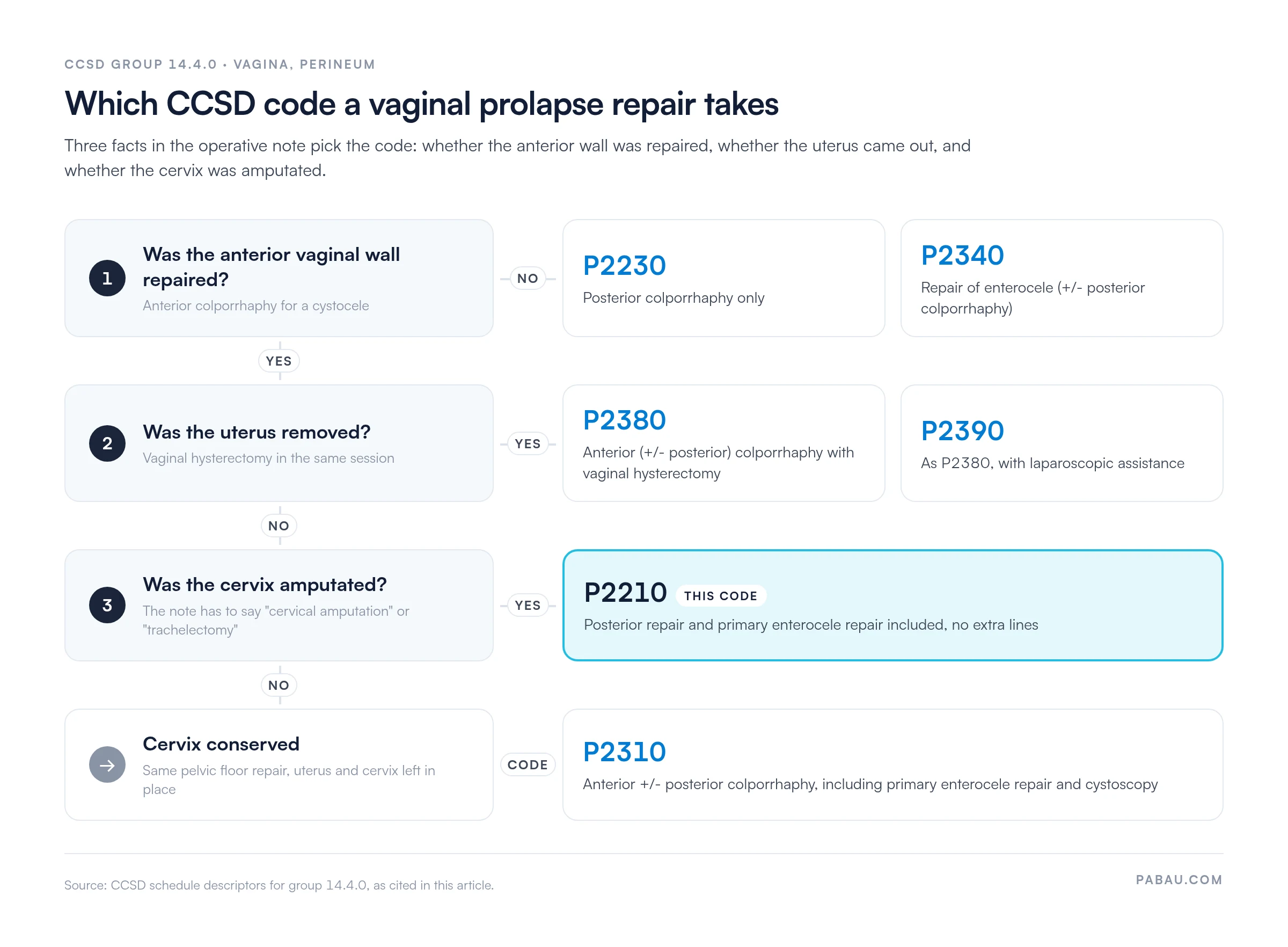
The most consequential distinction is between P2210 and P2310. Both cover anterior colporrhaphy, with or without posterior repair, and primary repair of enterocele. The difference is cervical amputation. P2210 includes it, and P2310 does not. If the operative note does not clearly record the amputation, expect the claim to be paid as P2310 at best, or denied.
There is no CCSD code for anterior colporrhaphy alone. An anterior-only repair without cervical amputation also falls under P2310, because its descriptor makes the posterior repair optional.
The Manchester procedure (also known as the Fothergill procedure or Manchester repair) is a well-established surgical technique for uterovaginal prolapse. It combines anterior colporrhaphy with amputation of the cervix and shortening of the cardinal ligaments. It is widely accepted in clinical practice that the Manchester procedure maps to CCSD code P2210. Coders should still verify this against the current edition of the CCSD schedule, as schedule revisions can affect code assignments.
Key characteristics of the Manchester procedure that align with P2210:
An anterior-only Manchester repair, with no posterior colporrhaphy, is still P2210. The +/- notation covers that variation, as the descriptor breakdown above explains.
An operative note that does not explicitly record each billable component is the single most preventable cause of P2210 claim failure. UK private health insurers audit operative documentation, and a vague note is treated as evidence the procedure was not performed.
The operative note for a P2210 claim must include all of the following:
Structured digital operative note templates help surgical teams capture each required element at the time of dictation, before the claim is submitted.

Audit your last ten P2210 operative notes before submitting claims. Check each one for explicit mention of ‘cervical amputation’ or ‘trachelectomy’. If the phrase is absent, request an addendum from the surgeon before billing. Payers do not accept post-denial clarifications as routine practice.
CCSD code P2210 covers a major gynecological operation, and most UK private health insurers require preauthorization before it takes place. The requirements vary by insurer and by policy, so coders should check with the payer at the time of booking.
Typical preauthorization requirements across major UK payers include:
Payer-specific details worth noting:
Payer rules change between policy years. Always verify current requirements directly with the insurer before scheduling the procedure.
P2210 claims are denied for a predictable set of reasons. Most are preventable with pre-submission checks.
In many gynecology practices, the operative note lives in one system and the claim is keyed into another. The coder then reads the note days later and decides whether the cervix was amputated. Pabau, a practice management platform with built-in insurer billing, keeps CCSD code entry and claim submission in the same record as scheduling and clinical notes. Its claims management tools send UK claims through Healthcode.
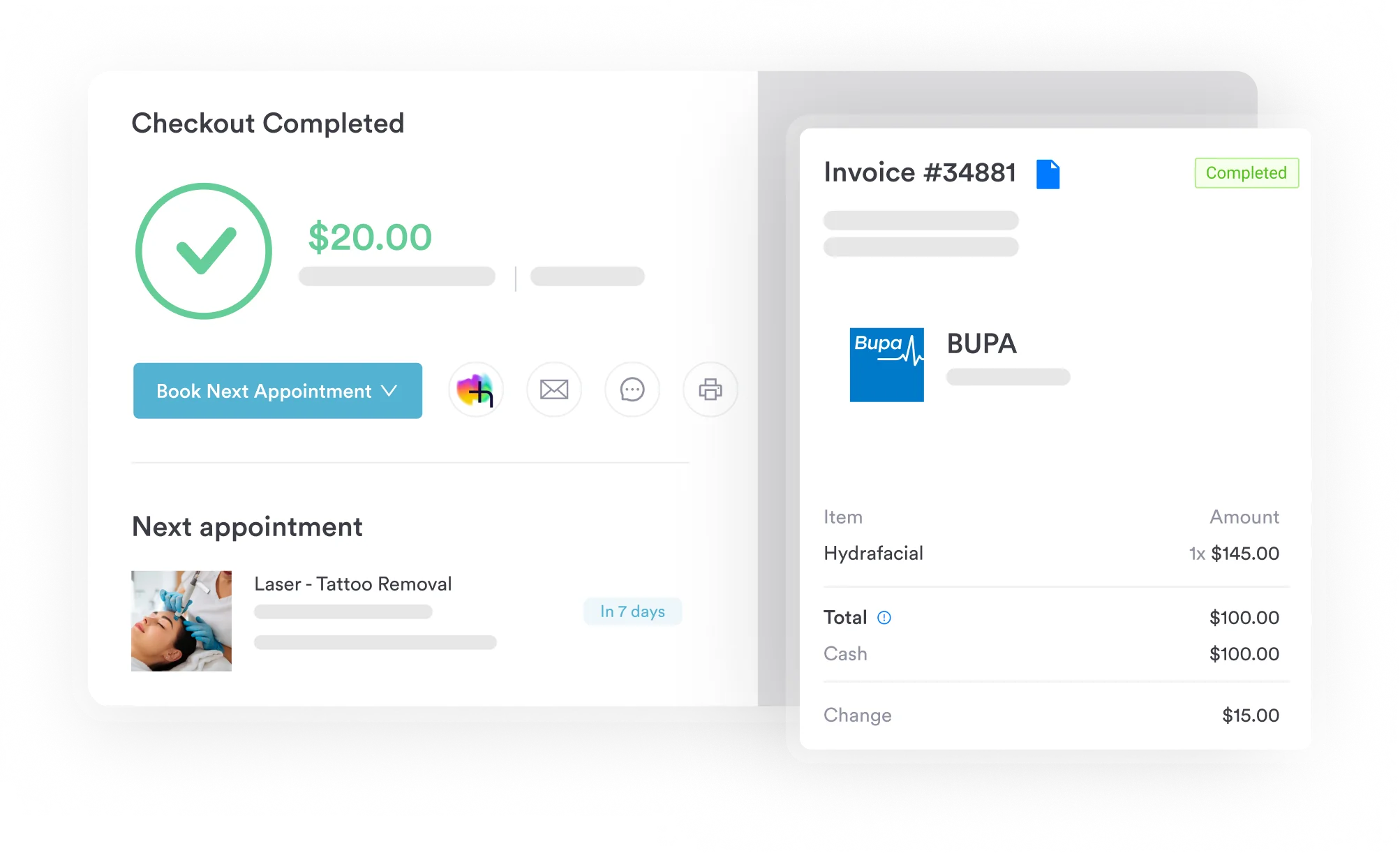
With the note and the claim in one record, the coder confirms the amputation against the surgeon’s own wording before the claim goes out. An insurer query months later is answered from the linked note rather than from memory.

Pabau lets UK gynecology practices record CCSD codes, link operative notes, and submit claims to Bupa, AXA, Aviva, and other insurers in one workflow.

Before a P2210 claim leaves the practice, read the operative note for one phrase: cervical amputation or trachelectomy. If it is there, bill P2210 alone and drop any line for the posterior or primary enterocele repair. If it is missing, ask the surgeon for an addendum now, because the insurer will otherwise pay P2310 or deny the claim.
The trade-off is a few minutes of checking per case against a claim that is downgraded or clawed back after payment. Book a demo to see how Pabau links each operative note to its CCSD claim, so that check happens before submission.

Looking for the full Bupa CCSD code schedule? Bupa CCSD codes overview covers the complete Bupa procedure code list with guidance on submission requirements.
Coding the same repair with the cervix conserved? CCSD code P2310 covers anterior and posterior colporrhaphy without cervical amputation, including its cystoscopy component.
Want to reduce claim rejection rates across your practice? Claims management software outlines how Pabau streamlines private health insurer claim submission and tracking.
CCSD code P2210 covers anterior colporrhaphy, amputation of cervix uteri, and optional posterior colporrhaphy, with primary repair of enterocele always included as a bundled component. It is used for combined pelvic floor repair and cervical amputation in patients with uterovaginal prolapse who prefer a uterus-conserving approach.
Primary enterocele repair is explicitly included in P2210 and must not be separately coded. The descriptor states “including primary repair of enterocele.” Complex or secondary enterocele repair (revision of a previously repaired enterocele) may be separately billable, so verify it with the insurer.
P2310 covers anterior +/- posterior colporrhaphy, including primary repair of enterocele and cystoscopy, with no cervical amputation. P2210 adds amputation of the cervix uteri to the same repair. If the surgeon conserved the cervix, use P2310. If the cervix was amputated, use P2210 and record the amputation in the operative note.
No. CCSD chapter 14.4.0 (Vagina, perineum) has no standalone anterior colporrhaphy code. An anterior repair is coded P2310 when the cervix is conserved and P2210 when it is amputated. With a vaginal hysterectomy, it is P2380, or P2390 with laparoscopic assistance.
The Manchester (Fothergill) procedure combines anterior colporrhaphy, cervical amputation, and cardinal ligament shortening to treat uterovaginal prolapse while conserving the uterus. It is widely accepted that the Manchester procedure maps to CCSD code P2210. Coders should verify this against the current CCSD schedule edition, as revisions can affect code assignments.
No. P2210 is a uterus-conserving procedure. If a vaginal hysterectomy was performed with anterior (+/- posterior) colporrhaphy, the code is P2380, or P2390 when the hysterectomy is laparoscopically assisted. Submitting P2210 alongside either one claims incompatible procedures and is likely to be denied.
The most common reason is claiming bundled work twice, such as adding P2230 for the posterior repair. Another is an operative note that does not record cervical amputation, which points to P2310 instead. Missing preauthorization and diagnosis codes outside the ICD-10 N81 series also cause denials. Pre-submission documentation checks prevent all four.