CCSD code M5630: Therapeutic injection into bladder neck
CCSD code M5630: Definition and clinical description CCSD code M5630 covers ther...

Last Updated: Nov 23, 2026
J7501 is the HCPCS Level II code for azathioprine, parenteral, 100 mg. One unit equals 100 mg of azathioprine sodium for injection, the IV form used after kidney transplant and for rheumatoid arthritis.
Before you bill it, check the unit count in 100 mg steps and the NDC and JZ or JW modifier on the line. Then confirm the diagnosis matches the coverage route.
Let Pabau's smart automation suggest the right codes, reduce claim denials, and keep your practice compliant—effortlessly.
Automate repetitive tasks and focus on what matters most—your patients.
Reduce coding errors and ensure compliance with the latest regulations.
Clean claims, fewer denials, and faster reimbursements.
Powerful insights and reporting to help your practice thrive.
HIPAA compliant SOC 2 certified GDPR-compliant Trusted by 4,000+ clinics worldwide

HCPCS Code J7501 is azathioprine, parenteral, 100 mg, the IV form of azathioprine, billed at one unit per 100 mg.
Bill tacrolimus injection as J7525 and azathioprine tablets as J7500, never under J7501.
Medicare covers J7501 under the Part B immunosuppressive drug benefit after a covered transplant.
The FDA label and the DME MAC policy limit the IV form to patients who cannot take oral azathioprine.
Rheumatoid arthritis is a labeled use, but the transplant drug benefit does not cover it, so RA claims take a different route.
J7501 has no payment limit in the October 2026 CMS Part B file, so your contractor sets the allowance.
HCPCS Code J7501 is the Level II code for azathioprine, parenteral, 100 mg, the IV form of azathioprine billed at one unit per 100 mg. CMS maintains Level II codes like this one in the Healthcare Common Procedure Coding System. J7501 sits in the J7500-J7599 immunosuppressive drug range, and the table below gives the reference data to check before you bill it.
J7501 covers the injectable form of azathioprine, an antimetabolite immunosuppressant. The October 2026 CMS OPPS crosswalk on the ASP pricing files page lists one product for the code. It is Hikma’s Azathioprine Sodium for Injection, a 100 mg vial of freeze-dried powder.
The FDA label carries two indications. Azathioprine is an adjunct for preventing rejection in kidney transplantation. It is also indicated for active rheumatoid arthritis, to reduce signs and symptoms.
The label restricts the IV form to patients unable to tolerate oral medications. Transplant patients often start on IV azathioprine and move to tablets at the same dose after the postoperative period. Tablets are billed as J7500.
The label also carries a boxed warning. Chronic immunosuppression with azathioprine increases the risk of malignancy, including post-transplant lymphoma.
One unit of J7501 equals 100 mg of azathioprine. Divide the dose given by 100, and round a partial unit up to the next whole unit.
Transplant doses depend on weight. The label gives a usual starting dose of 3 to 5 mg/kg a day, so the unit count changes from patient to patient.
Medicare requires the JZ or JW modifier on drugs from single-dose containers. Check how your MAC classifies the azathioprine vial. Then add JZ when none is discarded, or report the discarded amount on its own line with JW.
Medicaid programs require the National Drug Code on drug claim lines, and many commercial payers do too. Report the N4 qualifier and the 11-digit NDC from the vial you used, such as 00143-9566-01. Add the unit qualifier and quantity your payer asks for.
Section 1861(s)(2)(J) of the Social Security Act covers immunosuppressive drugs under Part B after a Medicare-covered organ transplant. The benefit covers oral immunosuppressants as well as injectables. Part D pays for them only when the Part B transplant criteria are not met.
A covered transplant is one that meets Medicare’s criteria, whether Medicare or another insurer paid for it. Under DME MAC policy article A52474, the patient needs Part A at the time of the transplant. They also need Part B when the drug is dispensed.
For J7501 itself, the DME MAC policy is narrower. LCD L33824 limits parenteral azathioprine to patients who cannot tolerate or absorb the oral drug and who self-administer it. Claims outside that limit are denied as not reasonable and necessary.
Kidney transplant recipients can lose Medicare 36 months after the transplant. Since January 1, 2023, they can enroll in the Part B immunosuppressive drug benefit (PBID), which covers these drugs only.
Rheumatoid arthritis sits outside the transplant benefit. Article A52474 names it among the non-transplant diagnoses the benefit does not cover. An RA infusion given incident to a physician’s service goes to the Part B MAC instead, which applies its own reasonable and necessary review.
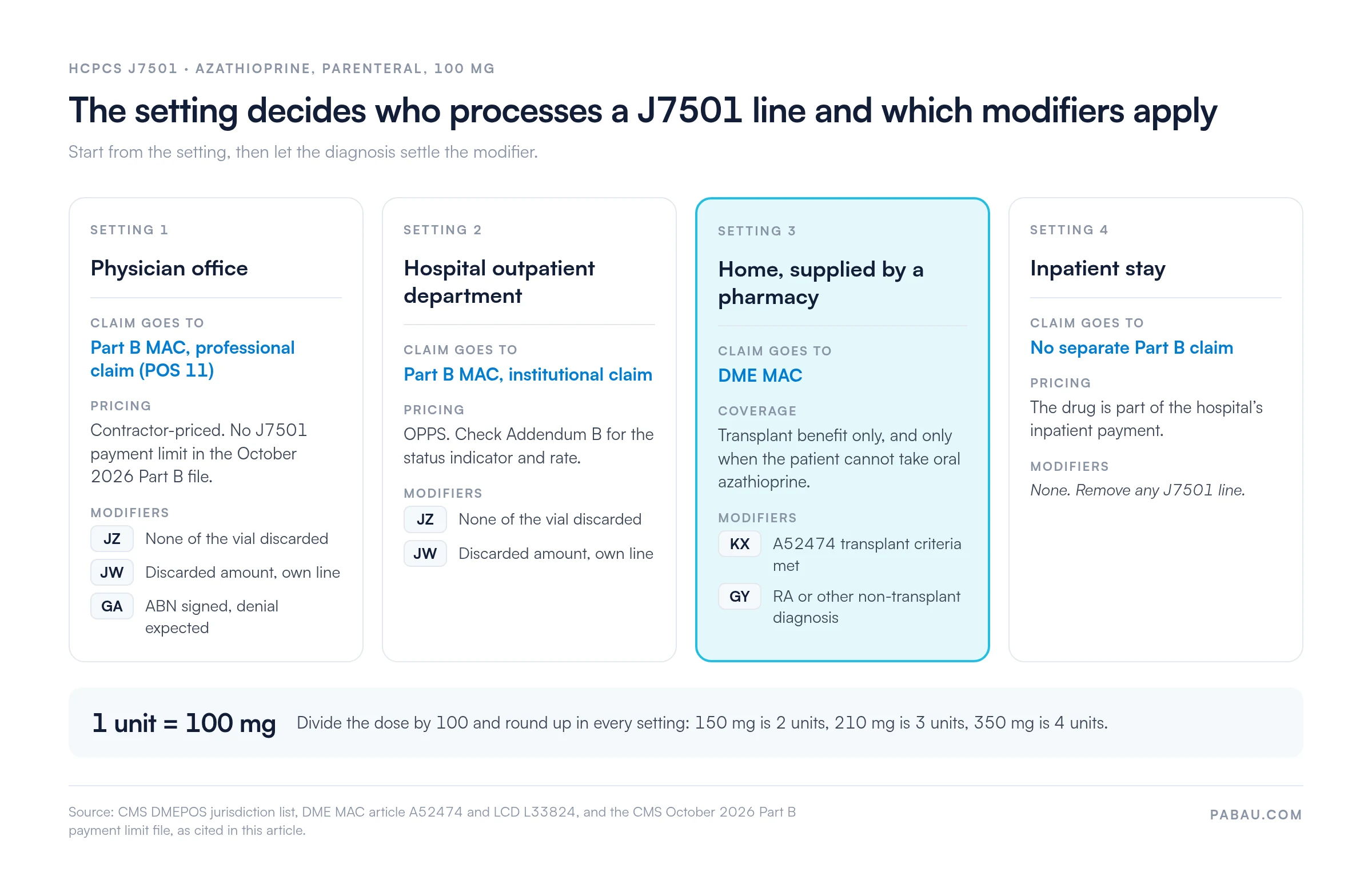
The DMEPOS jurisdiction list sets the split for J7500 through J7504. The Part B MAC processes the drug when it is given incident to a physician’s service or used in an implanted infusion pump. Otherwise, the DME MAC processes it.
The setting also decides which modifiers belong on the line, and the diagnosis settles the rest on a DME MAC claim.
CMS publishes a quarterly Part B payment limit file built on average sales price data. J7501 does not appear in the October 2026 file, while J7500, J7516 and J7525 do.
Without a published limit, the MAC prices the office claim. Ask your MAC how it prices J7501 before you set a patient estimate.
Hospital outpatient claims follow OPPS. The October 2026 OPPS NDC-HCPCS crosswalk maps the Hikma vial to J7501 at one billing unit per vial. Under the transplant benefit, the patient owes the usual Part B deductible and 20% coinsurance.
Search the current quarter’s Part B payment limit file for J7501 before you quote a price. If the code is still absent, ask your MAC for its pricing method and note the answer in your fee schedule.
The diagnosis has to match the coverage route. Transplant-benefit claims to the DME MAC need a code from the covered list in article A52474. A kidney rejection episode coded T86.11 is one of them. Office RA claims go to the Part B MAC instead. The codes below are examples, not a coverage guarantee.
The J7500-J7599 range splits by drug, route and unit size. One mix-up matters most on this code: tacrolimus injection billed as J7501. It changes the drug and the unit size at once.
Code from the drug on the administration record, then the route, then the unit. A 300 mg azathioprine infusion is 3 units of J7501. A 5 mg tacrolimus infusion is 1 unit of J7525. Check current descriptors with the AAPC HCPCS code lookup before filing. Our HCPCS reference for billers has a page for each neighboring code in the range.
The modifiers on a J7501 line depend on who processes the claim and whether any of the vial was discarded.
KX and GY come from the DME MAC policy article. On office claims to the Part B MAC, the modifiers that usually matter are JZ or JW. Add GA when you issued an Advance Beneficiary Notice.
Original Medicare has no prior authorization requirement for J7501. Medicare Advantage plans, Medicaid programs and commercial payers set their own rules, so check the plan before the first dose. A request usually needs the following.
J7501 denials usually trace back to the drug, the unit or the coverage route. The table maps each pattern to its fix.
Systematic denial management in healthcare tracks these patterns by payer and catches repeat errors early. A clean claim process that checks the code against the drug name on the vial prevents the costliest one.
The record has to show why the patient needs azathioprine, why it was given IV, and that the dose matches the billed units.
A record that ties each of these items to the billed line protects the practice in a MAC or OIG review.
Infusion billing breaks when the order, the vial and the claim live in different places. Pabau, a practice management platform with built-in billing, keeps all three on one patient record.
Your team records the dose, NDC and discarded amount at the chair, then enters the code, units and modifiers on the claim. Pabau’s claims management software submits the claim through Claim.MD and tracks its status. Pabau’s digital forms hold the signed ABN against the same patient.
When a denial comes back, the administration record sits on the same patient file as the remittance. Your billers can fix the unit or the modifier without chasing paper charts.

Pabau keeps the infusion order, the administration record and the claim on one patient record. Your team submits J7501 claims through Claim.MD and tracks every response in one place.

J7501 looks like a routine immunosuppressant code, but its worst errors start with the drug itself. Confirm that the vial is azathioprine, not tacrolimus, before you count a single unit.
Then let the coverage route decide the rest. A transplant patient who cannot take tablets fits the Part B benefit. An RA infusion goes to the Part B MAC on its own merits. CMS publishes no payment limit for the code, so confirm pricing with your MAC each quarter.
Book a demo to see how Pabau keeps drug claims tied to the record behind them.

Billing azathioprine tablets instead? HCPCS Code J7500 covers oral azathioprine, billed per 50 mg.
Need a framework for reducing drug claim rejections? Denial management in healthcare covers the systematic approach to tracking and resolving CARC-coded rejections across drug and procedure codes.
Want to understand the full superbill requirements for immunosuppressant billing? Superbill documentation explains what a compliant superbill must include to support drug code claims like J7501.
Exploring how to build a cleaner billing operation? Revenue cycle management walks through the end-to-end process from encounter to paid claim for specialty and transplant practices.
HCPCS Code J7501 covers azathioprine, parenteral, 100 mg. It is the injectable form of azathioprine, given IV and billed at one unit per 100 mg. Tacrolimus injection is a different code, J7525, and azathioprine tablets are J7500.
Divide the dose in milligrams by 100 and round a partial unit up. A 150 mg dose is 2 units, and a 300 mg dose is 3 units. Check that the units match the dose on the administration record.
Under the Medicare transplant benefit, use a code from the covered list in DME MAC article A52474. Examples are Z94.0 for kidney transplant status and T86.11 for kidney transplant rejection. RA codes such as M06.9 support the labeled RA use, but the transplant benefit does not cover RA.
Yes, under the Part B immunosuppressive drug benefit after a covered transplant. The DME MAC policy limits the IV form to patients who cannot tolerate or absorb oral azathioprine. Original Medicare has no prior authorization requirement for the code.
J7501 is azathioprine injection, billed per 100 mg. J7525 is tacrolimus injection, billed per 5 mg. They are different drugs with different unit sizes, so code from the drug name on the administration record.
Typical causes are units not in 100 mg steps and a missing NDC or JZ or JW modifier. A diagnosis that does not match the coverage route is another, as is tacrolimus billed under this code. On DME MAC claims, a patient who can take oral azathioprine also leads to denial.