

HCPCS code E0198: Water pressure pad billing guide
HCPCS code E0198 is a water pad for a standard mattress HCPCS code E0198 is the ...

Last Updated: Oct 13, 2026
J7315 is the HCPCS Level II code for mitomycin, ophthalmic, 0.2 mg.
Three errors account for most J7315 denials: the wrong unit count, thin medical necessity documentation, and a misread of the buy-and-bill process.
One historical note. Some older coding references associated J7315 with sodium hyaluronate. That assignment has been superseded, and J7315 now maps only to mitomycin, ophthalmic, 0.2 mg. Confirm the current descriptor with the AAPC HCPCS code lookup or CMS before you bill.
Let Pabau's smart automation suggest the right codes, reduce claim denials, and keep your practice compliant—effortlessly.
Automate repetitive tasks and focus on what matters most—your patients.
Reduce coding errors and ensure compliance with the latest regulations.
Clean claims, fewer denials, and faster reimbursements.
Powerful insights and reporting to help your practice thrive.
HIPAA compliant SOC 2 certified GDPR-compliant Trusted by 4,000+ clinics worldwide

HCPCS Code J7315 covers mitomycin, ophthalmic, 0.2 mg, sold as Mitosol for glaucoma filtration surgery and pterygium excision.
Medicare Part B pays J7315 on average sales price plus a percentage add-on, and the rate changes every quarter.
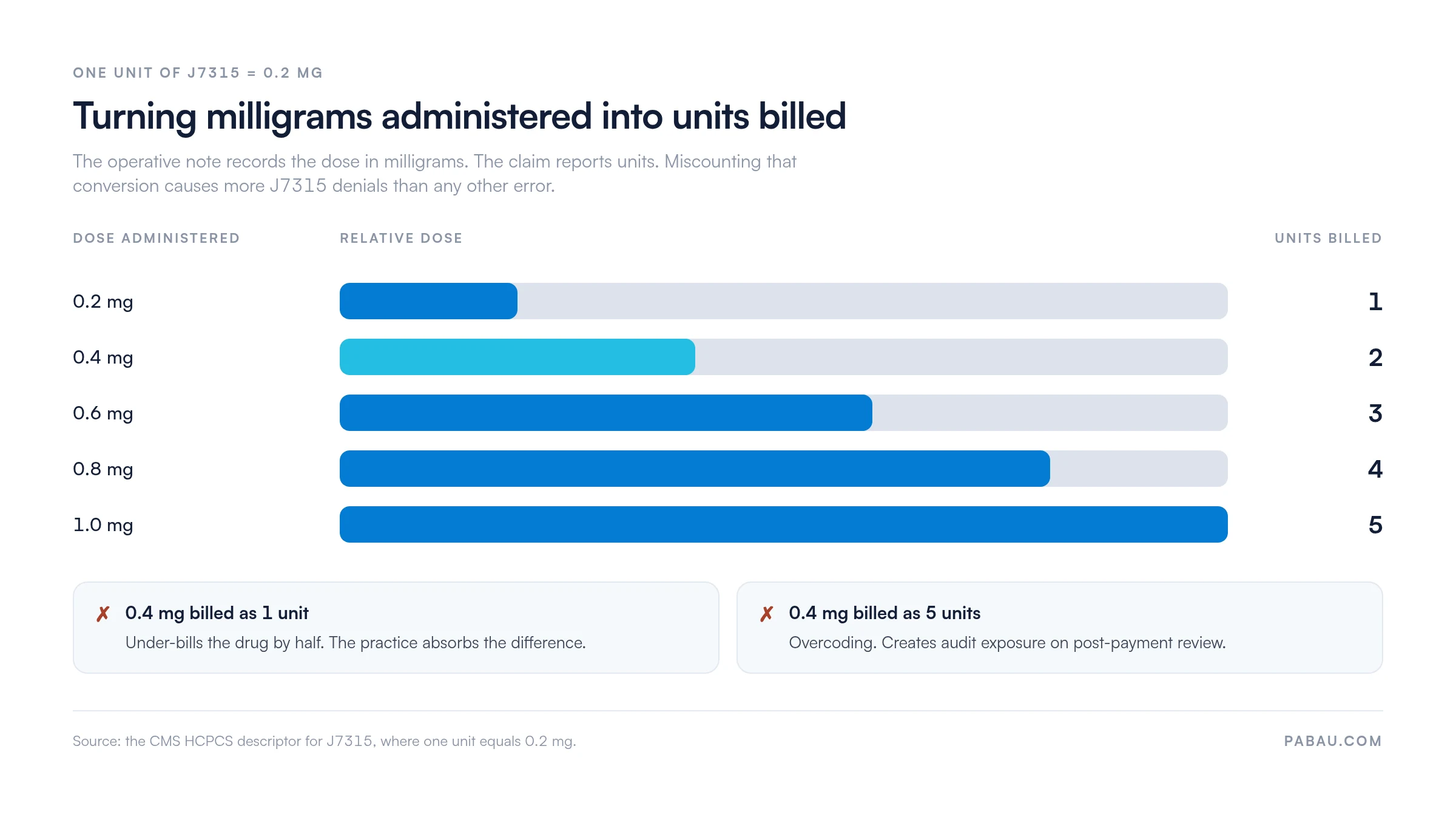
Each billed unit equals 0.2 mg, so a miscounted unit is the most common trigger for a J7315 denial.
Practice management software like Pabau keeps lot numbers, doses, and authorization numbers on the encounter the billing team works from.
Mitomycin C is an antimetabolite derived from Streptomyces caespitosus. In eye surgery it works as an antifibrotic, suppressing the fibroblast activity that scars a surgical site. Mitosol is the FDA-approved single-use ophthalmic formulation. It ships as a sterile powder, reconstituted and applied topically at the surgical site.
Clinicians reach for J7315 during two types of procedure. Knowing which one applies tells the coder which companion CPT code to pair with the drug. It also shapes the medical necessity statement in the record.
The American Academy of Ophthalmology treats mitomycin C as a standard adjunct in filtration surgery where the risk of bleb failure is elevated. Check the current AAO guidance before you write the indication into a payer submission.
Medicare covers J7315 under Part B as a drug administered in a physician office or a facility. Payment follows the average sales price (ASP) methodology. CMS sets the rate as ASP plus a percentage add-on, typically ASP+6% for Part B drugs. Rates are set quarterly and move with each policy update.
Because ASP changes every quarter, treat any figure in an article as a framework rather than a current rate. Pull the live J7315 payment rate from the CMS Physician Fee Schedule lookup and the quarterly ASP Drug Pricing File before you submit.
Where J7315 is administered changes how Medicare pays the claim. In a hospital outpatient or ambulatory surgery center (ASC) setting, the facility bills separately. The drug may be bundled into the facility payment rather than paid to the physician. In a physician office, the practice can bill J7315 alongside the surgical procedure code.
J7315 also carries an ASC status indicator, published in Addendum B of the CMS Outpatient Prospective Payment System (OPPS). That indicator decides whether the drug is separately payable or packaged into the procedure’s APC payment. Annual OPPS updates can change it, so confirm the current indicator before billing in a facility.
Tracking electronic remittance advice for J7315 claims shows whether a payer packaged the drug or paid it separately. Many billing errors only surface at that stage.
J7315 uses the buy-and-bill model. The practice purchases Mitosol, administers it during surgery, and then bills the payer for the drug. It is the same model infusion centers work with, and it differs from pharmacy-dispensed drugs that the patient obtains separately.
Each step below feeds the next one. Reading the medical billing process from acquisition through payment is what keeps an ophthalmology drug claim moving.
Talk to a healthcare compliance officer before you set up a buy-and-bill workflow. CMS has specific rules for physician-acquired drug billing, and a misstep carries financial and legal risk.
Payers rarely deny J7315 over the code itself. They deny it over what the medical record leaves out. Medicare and commercial payers both need the record to support medical necessity and the drug administration. Meeting billing compliance requirements starts with knowing what each claim has to carry.
Capturing lot numbers and units at the point of care, rather than transcribing them later, leaves the billing team working from the surgeon’s own entry. Copying figures out of a paper surgical note into billing software adds error risk for no benefit.
Coverage for J7315 is not uniform. Medicare Part B covers mitomycin ophthalmic as a separately billable drug when it is administered in a covered setting. Commercial payers and state Medicaid programs write their own coverage determinations, which can differ sharply from Medicare.
Running insurance eligibility verification before surgery is the most effective way to avoid a coverage dispute afterward. Verify the procedure and the drug separately, because some plans cover the surgery and exclude the drug.
Medicare fee-for-service does not usually require prior authorization for J7315. Medicare Advantage plans and most commercial payers do require it before the drug is administered. A claim submitted without an approved authorization on file is denied automatically.
A prior authorization request for J7315 needs the diagnosis code, the planned procedure CPT code, the planned dosage, and clinical documentation of medical necessity.
Send a complete billable diagnosis code rather than a subcategory. H40.11 for primary open-angle glaucoma is not billable on its own, so H40.11X0 is the code to use for unspecified stage.
Response timelines and submission portals vary by payer, so build authorization into surgical scheduling. The prior authorization process runs the same sequence for a J-code drug as it does for a procedure.
Start prior authorization at the point of scheduling, not the week of surgery. For commercial payers that require it, allow 5 to 10 business days for a response. Flag Medicare Advantage and commercial plans at booking, and route the request to your billing team the same day.
J7315 does not stand alone in the HCPCS drug code landscape. Other physician-administered drug codes, such as J0132 and J7301, follow the same unit-reporting and buy-and-bill logic. Reading the codes that sit alongside J7315 is how coders avoid bundling and crossover errors.
Companion CPT codes describe the surgical procedure. J7315 describes the drug. Both belong on the same claim, and submitting one without the other usually returns a rejection for a missing accompanying code.
Wrong-unit billing causes more J7315 denials than any other error. Each unit equals 0.2 mg, so a practice that administers 0.4 mg and bills 1 unit is under-billing by half. Billing 5 units for that same 0.4 mg is overcoding, and it creates audit exposure.
The conversion runs in one direction, from the milligrams in the operative note to the units on the claim. Effective denial management for J7315 starts with checking it at the point of administration, not at the billing desk.
Audit your last 20 J7315 claims. Cross-reference the units billed against the dose in milligrams in each operative note. If any pair does not match, the number is getting lost between administration and billing. Fix the process before the next surgical case, not after a payer audit.
Ophthalmology and optometry practices hold the information a J7315 claim needs in three places at the time of surgery. The surgeon knows the dose. The front desk holds the authorization number. The billing team needs both, tied to the right encounter, before the claim goes out.
Every manual hand-off between those three points is a chance to lose a lot number or a unit count. Practice management software like Pabau closes the distance by capturing drug administration details in the clinical record, where the billing workflow reads them directly.
With Pabau’s claims management software, the billing team works from a pre-populated encounter record instead of copying lot numbers off a paper surgical note. When a payer packages the drug or questions the units, the supporting record is already attached to the claim.
For practices comparing medical billing software, the criteria that matter for J-code drug billing are narrow. Look for a direct link between clinical documentation and billing, support for unit-quantity billing, and authorization tracking against the patient’s plan.

Pabau keeps the lot number, the dose, and the authorization number on the encounter your ophthalmology claims are built from. See how the drug details reach the billing team in a live demo.

J7315 is a short code with a long paper trail. The descriptor is fixed and the unit rule is one line, so what decides whether the claim gets paid is the record sitting behind it.
Put the unit check at the point of administration, keep the lot number and dose on the encounter, and confirm authorization before the surgical date. Do those three and the quarterly ASP change becomes the only variable left to watch.
Book a demo to see how Pabau keeps drug administration details and authorization numbers on the encounter your ophthalmology claims are built from.

Billing another physician-administered drug? J1556 covers the buy-and-bill and unit-reporting rules for an immune globulin claim.
Reporting a drug measured in something other than milligrams? J3470 is billed in enzyme units, so the conversion works differently.
Handling a high-cost specialty drug claim? J7189 covers a coagulation factor billed per microgram.
HCPCS Code J7315 reports mitomycin, ophthalmic, 0.2 mg, sold as Mitosol. It is an antimetabolite used as a surgical adjunct in eye procedures. Practices bill it most often with trabeculectomy, CPT 66170 or 66172, and with pterygium excision, CPT 65420 or 65426. Each unit billed equals 0.2 mg.
J7315 is billed to Medicare Part B under the buy-and-bill model. The practice purchases Mitosol, administers it during surgery, and submits J7315 with the companion CPT code. Medicare pays average sales price plus a percentage add-on. Rates change quarterly, so verify the current one in the CMS ASP Drug Pricing File.
Traditional Medicare fee-for-service does not usually require prior authorization for J7315. Medicare Advantage plans and most commercial payers do. Check the specific plan before the surgical date, and get an authorization number before the drug is administered. A claim submitted without a required authorization is denied automatically.
Yes, but whether it is separately payable depends on the ASC status indicator that CMS assigns in Addendum B of the OPPS rules. In some cases the drug payment is packaged into the procedure’s APC payment instead of being paid to the physician. Confirm the current indicator with CMS before billing in a facility.
Medicare pays J7315 on the drug’s average sales price (ASP) plus a percentage add-on, typically ASP+6% for Part B drugs. The dollar amount changes every quarter. Pull the current figure from the CMS quarterly ASP Drug Pricing File or the Physician Fee Schedule lookup rather than from a reference article.
The record needs a medical necessity statement, the drug name and lot number, and the exact dose administered in milligrams. It also needs the operative note covering the application method and surgical site, plus the place of service. Units billed must match the dose, at 0.2 mg per unit.



