CPT code 63081: Vertebral corpectomy, cervical spine
CPT code 63081: official descriptor and procedure overview CPT code 63081 descri...

Last Updated: Oct 6, 2026
J2310 was the HCPCS Level II code for injection, naloxone hydrochloride, per 1 mg. CMS deleted it effective July 1, 2025, so the last valid date of service was June 30, 2025.
There is no grace period and no direct crosswalk. Bill J2312 for naloxone injection not otherwise specified, or J2313 for Zimhi. Both count 0.01 mg per unit, so 1 mg is 100 units.
Let Pabau's smart automation suggest the right codes, reduce claim denials, and keep your practice compliant—effortlessly.
Automate repetitive tasks and focus on what matters most—your patients.
Reduce coding errors and ensure compliance with the latest regulations.
Clean claims, fewer denials, and faster reimbursements.
Powerful insights and reporting to help your practice thrive.
HIPAA compliant SOC 2 certified GDPR-compliant Trusted by 4,000+ clinics worldwide

J2310 was deleted effective July 1, 2025, and the last valid date of service was June 30, 2025, with no grace period.
J2312 now bills naloxone hydrochloride injection not otherwise specified, and J2313 bills Zimhi. Both are counted in 0.01 mg units.
One milligram equals 100 units under the new codes, so a 0.4 mg dose is 40 units and a 2 mg dose is 200 units.
J2311, the former 1 mg Zimhi code, was deleted on the same date and replaced by J2313.
Claims software such as Pabau holds each drug line for review, so a deleted code or a 1 mg unit count is caught before submission.
HCPCS Code J2310 was the billing code for injection, naloxone hydrochloride, per 1 mg. CMS deleted it effective July 1, 2025, so the last valid date of service was June 30, 2025.
There was no grace period and no direct crosswalk. From July 1, 2025, injectable naloxone is billed with J2312 or J2313. Both codes count 0.01 mg per unit rather than 1 mg.
J2310 was an HCPCS Level II drug code maintained by the Centers for Medicare and Medicaid Services. It reported the drug supply only. The injection service was always billed separately with a CPT administration code.
Use this reference when you correct an older claim or update a charge master that still lists J2310.
No. HCPCS Code J2310 has not been valid since July 1, 2025, and CMS has not reinstated it through 2026. The July 2025 quarterly HCPCS update terminated it alongside J2311.
Medicare contractors confirmed the change in their bulletins. The CGS Medicare July 2025 HCPCS update lists both codes as discontinued, and Noridian’s July 2025 HCPCS changes match it. A claim with J2310 on a date of service after June 30, 2025 is rejected as an invalid code.
Commercial payers whose edits follow the CMS HCPCS Level II files reject it as well. Those rejections usually trace back to stale data, such as a charge master or an emergency order set still mapped to J2310.
Search your charge master, EHR order sets, and emergency protocol templates for J2310 and J2311. Update each entry to J2312 or J2313, and change the unit multiplier at the same time, because the new codes count 0.01 mg per unit.
CMS replaced the naloxone injection codes with two new codes on July 1, 2025. The product given decides which one applies, and both are billed per 0.01 mg.
Because there is no direct crosswalk, do not swap J2310 for J2312 line by line without checking the product. Work through each naloxone product you stock in this order.
The decision path below runs those checks in the order a coder meets them, starting with the date of service.
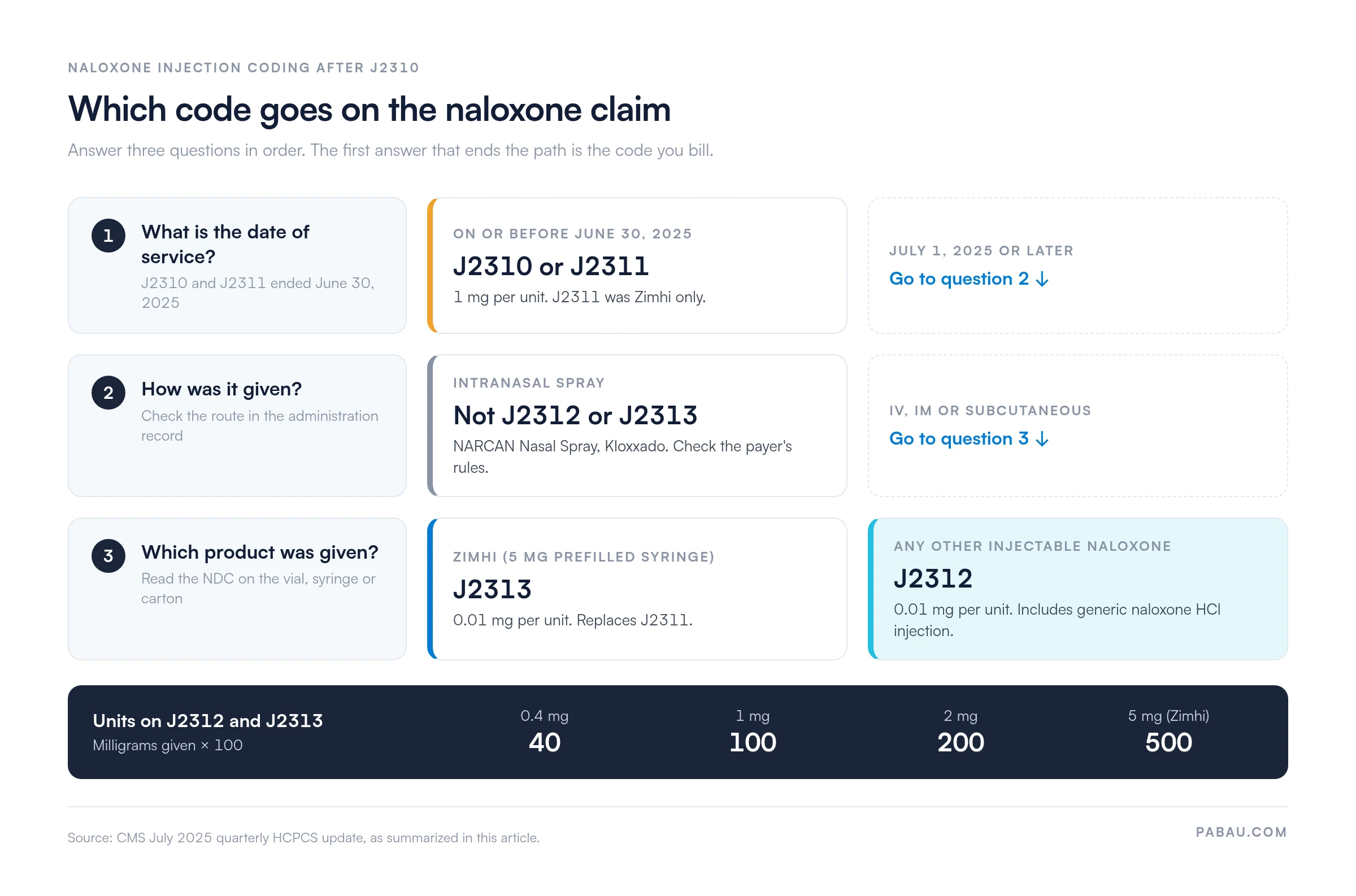
J2312 and J2313 are billed at 1 unit per 0.01 mg, so multiply the milligrams given by 100. J2310 counted 1 mg per unit. A J2310 unit count carried into the new codes under-reports the drug a hundredfold.
Bill the milligrams given, taken from the administration record. If a provider gives 0.4 mg twice in one encounter, report 0.8 mg as 80 units of J2312. The smaller unit lets a 0.4 mg dose be reported exactly, where J2310 rounded it up to a full unit.
Medicare’s JW and JZ modifier policy applies to drugs from single-dose containers. Report any discarded amount on its own line with JW, or add JZ when none was discarded. Payers also apply Medically Unlikely Edits to the unit count, so check the current value before you submit a high dose.
Injectable naloxone is an opioid antagonist given IV, IM, or subcutaneously to reverse opioid overdose. Generic naloxone HCl injection, including the unbranded product made by Hikma Pharmaceuticals, bills under J2312 from July 1, 2025.
Zimhi, a 5 mg prefilled syringe, has its own code, J2313. Nasal sprays such as NARCAN Nasal Spray from Emergent BioSolutions and Kloxxado from Hikma are not injections. They are never billed with J2312, J2313, or the deleted J2310.
Most Medicare contractors and many commercial payers expect a National Drug Code (NDC) alongside the HCPCS drug code. A missing or invalid NDC is a common first-pass denial, and the same rules applied to J2310 claims.
Report the NDC as an 11-digit number in the 5-4-2 format. Labels often print a 10-digit NDC, so add a leading zero to the short segment. On the CMS-1500 and the 837P, the NDC follows the N4 qualifier on the drug line.
Building a clean claim for naloxone means validating the NDC before submission rather than after a denial. The NDC also proves which code applies, since a Zimhi NDC belongs on J2313.
Naloxone claims need an ICD-10-CM code that establishes why the drug was given. The pairings below applied to J2310 and now apply to J2312 and J2313.
Older references still list T40.4X1A for fentanyl, but that code was deleted on October 1, 2020. Some commercial plans cover injectable naloxone only for acute reversal and deny claims paired with an F11 code alone. Check the payer’s drug policy before you submit.
The HCPCS naloxone codes report the drug only. The injection itself is billed separately with a CPT code that matches the documented route. An IM or subcutaneous dose usually goes on 96372.
Facility rules for the administration line differ from office rules. Confirm with your billing team how the payer treats it before you add the line.
Prior authorization (PA) for injectable naloxone varies by payer, setting, and plan year. Emergency administration is generally exempt, while scheduled use in a substance use disorder program more often needs approval.
An authorization issued under J2310 may not cover a J2312 or J2313 claim. Ask the payer which code the authorization names, and put the authorization number on the claim. In an emergency, document the emergency nature of the dose in the record.
Medicare Part B pays separately payable drugs in the physician office from the Average Sales Price (ASP) files, generally at ASP plus 6%. CMS updates those files every quarter. Check the current quarter’s rate for J2312 or J2313 rather than any old J2310 figure.
Emergency department and hospital outpatient claims are paid under the Outpatient Prospective Payment System (OPPS), which can package low-cost drugs into the related service. The place-of-service code decides which rate applies. Good superbill documentation that captures the setting avoids rework.
Medicaid coverage is set by each state. Some programs cover injectable naloxone for both overdose reversal and substance use disorder treatment, while others limit it to acute reversal. Check your state’s fee schedule or drug bulletin for J2312 and J2313.
J3490 is the unclassified injectable drug code, used only when no specific J-code describes the drug. J2312 is a not-otherwise-specified naloxone code, so it already covers injectable naloxone other than Zimhi. J3490 is rarely correct for naloxone.
Billing J3490 when J2312 or J2313 fits sends the claim to manual review and slows payment. If a payer does instruct you to use J3490, attach the invoice, the NDC, and a statement of medical necessity.
The clinical record must support the drug, route, dose, indication, and setting before a coder assigns the code. Records behind J2310 dates of service are held to the same standard in an audit.
Scheduled administration in a substance use disorder program also needs the treatment plan that supports medical necessity. Strong medical billing compliance means capturing both records at the point of service, not rebuilding them at audit time.
Naloxone denials follow recognizable patterns, and the July 2025 code change added two new ones. The table pairs each cause with its fix.
Systematic denial management processes that sort naloxone denials by cause surface these patterns quickly. Knowing the denial codes your payers send helps you route each one to the right fix.
Run a monthly audit of naloxone claims sorted by denial reason. A cluster of claim adjustment reason code (CARC) 181 denials means the code was invalid on the date of service. It points to J2310 or J2311 still in your system.
Practices that bill injected drugs carry a quarterly risk. CMS can delete a J-code or change its unit size at any HCPCS update, as it did with naloxone in July 2025.
Pabau holds each claim for review in its claims management software before it goes out. Billers see the HCPCS code, unit count, and linked diagnoses on one screen. A J2310 line or a 1 mg unit count gets caught there instead of at the payer.
Administration notes, the NDC, and authorization details sit on the patient’s record, so they are on hand when the claim is built. Denials are grouped by reason code, so a wave of invalid-code rejections shows up within days.

Pabau holds each claim for review with the HCPCS code, units, and linked diagnoses on one screen. Billers fix a deleted code or a wrong unit multiplier before the payer sees it.

J2310 is gone, and the remaining risk sits in stale system data. Start with any charge master, order set, or emergency template that still carries J2310, J2311, or a 1 mg multiplier.
Then map each naloxone NDC you stock to J2312 or J2313 and multiply every dose by 100. Keep J2310 for corrections and audits on dates of service up to June 30, 2025. Book a demo to see how Pabau helps you catch drug-code changes before they reach your denial queue.

New to the billing cycle behind drug codes? What is medical billing covers the end-to-end revenue cycle and where J-code claims fit within it.
Want a structured approach to reducing rejections? Electronic remittance advice explains how to read ERA files to spot naloxone denial patterns quickly.
Billing across multiple payer types? Insurance eligibility verification walks through how to confirm coverage and prior auth requirements before the claim is submitted.
Billing a combination product? HCPCS code J0572 covers buprenorphine/naloxone and how its units are reported.
Giving naloxone by IV push? CPT code 96374 explains the administration code for a single or initial IV push.
J2310 covered injectable naloxone hydrochloride given IV, IM, or subcutaneously, billed per 1 mg. It applied to generic naloxone HCl injection from any manufacturer. It never covered intranasal naloxone, and CMS deleted it on July 1, 2025.
Yes. CMS deleted J2310 effective July 1, 2025, so the last valid date of service was June 30, 2025. There is no grace period, and the code has not been reinstated. A claim with J2310 for a later date of service is rejected as an invalid code.
CMS added J2312 for naloxone hydrochloride injection not otherwise specified, and J2313 for Zimhi. Both are billed per 0.01 mg. There is no direct crosswalk, so the product given decides the code. J2311, the old Zimhi code, was deleted on the same date.
Multiply the milligrams given by 100, because J2312 and J2313 count 0.01 mg per unit. A 0.4 mg dose is 40 units, and a 2 mg dose is 200 units. Under J2310, the same 2 mg dose was 2 units.
J2312 is the specific code for injectable naloxone that has no product-specific code. J3490 is the unclassified code for drugs with no specific J-code at all. Because J2312 already covers those naloxone products, J3490 is rarely correct and triggers manual review.
Report the 11-digit NDC of the product given, after the N4 qualifier, with the unit qualifier and quantity. Take it from the product label rather than a reference table. The NDC also confirms whether J2312 or J2313 applies.
Medicaid coverage is set by each state. Most programs cover injectable naloxone for emergency overdose reversal, billed as J2312 or J2313 since July 1, 2025. Coverage for scheduled use in substance use disorder treatment is less consistent and may need prior authorization.
Only for dates of service on or before June 30, 2025. Medicare’s 12-month timely filing limit has now closed for those dates. J2310 appears mainly on corrected claims, appeals, and audit responses for that period.