

HCPCS Code Q4185: Cellesta flowable amnion billing guide
HCPCS Code Q4185: definition and official descriptor HCPCS Code Q4185 is the Lev...

Last Updated: Nov 20, 2026
J2300 is the HCPCS Level II code for injection, nalbuphine hydrochloride, per 10 mg. It reports the drug itself, billed as one unit for each 10 mg given, while the injection service takes a separate CPT administration code.
Nalbuphine is an opioid agonist-antagonist used for moderate-to-severe pain. Coders sometimes confuse it with naloxone, an opioid antagonist with the opposite purpose, which now bills under J2312 or J2313. Many payers also require the vial's 11-digit NDC on the claim line.
Let Pabau's smart automation suggest the right codes, reduce claim denials, and keep your practice compliant—effortlessly.
Automate repetitive tasks and focus on what matters most—your patients.
Reduce coding errors and ensure compliance with the latest regulations.
Clean claims, fewer denials, and faster reimbursements.
Powerful insights and reporting to help your practice thrive.
HIPAA compliant SOC 2 certified GDPR-compliant Trusted by 4,000+ clinics worldwide

HCPCS Code J2300 reports injectable nalbuphine hydrochloride, billed in 10 mg units rather than per vial or per dose.
Units equal the total milligrams given divided by 10, and most payers expect a partial unit to round up.
The discarded part of a single-dose vial goes on its own claim line with the JW modifier.
Many payers require the vial’s 11-digit NDC with the N4 qualifier, and a missing NDC is a common denial trigger.
Pabau records the vial’s lot against the patient and sends CMS-1500 claims through the Claim.MD clearinghouse.
HCPCS Code J2300 is the CMS-maintained Level II drug code for “Injection, nalbuphine hydrochloride, per 10 mg.” CMS’s HCPCS Table of Drugs lists nalbuphine HCl under J2300, per 10 mg, for IM, IV and SC use. The code covers physician-administered nalbuphine in every injectable strength, billed per 10 mg.
J2300 sits in the HCPCS Level II “Drugs Administered by Injection” range, J0120-J7175.
What J2300 covers: Injectable nalbuphine HCl in 10 mg/mL and 20 mg/mL concentrations, given parenterally by a qualified provider. What it does not cover: Oral formulations, compounded preparations that don’t match the official descriptor, or the administration service, which takes a separate CPT code.
Medicaid coverage varies by state, so check the state’s Medicaid fee schedule before billing.
Billing units for HCPCS Code J2300 equal the total milligrams administered divided by 10. Each 10 mg increment is one billable unit. When the dose doesn’t divide evenly, most payers expect it rounded up to the next whole unit. Confirm the payer’s rounding policy before you claim a partial increment.
Wastage documentation: When a single-dose vial holds more nalbuphine than the patient receives, record the amount drawn, administered and discarded in the clinical note. Medicare pays for the discarded portion of a single-dose vial when that record is explicit. Multi-dose vials don’t qualify for wastage billing.
Report the wasted amount on a separate claim line with the JW modifier, which CMS has required since January 1, 2017. The rule sits in the Medicare Claims Processing Manual, Pub. 100-04, Chapter 17, §40. Put together, one IM dose drawn from a larger vial produces three claim lines, as the example below shows.
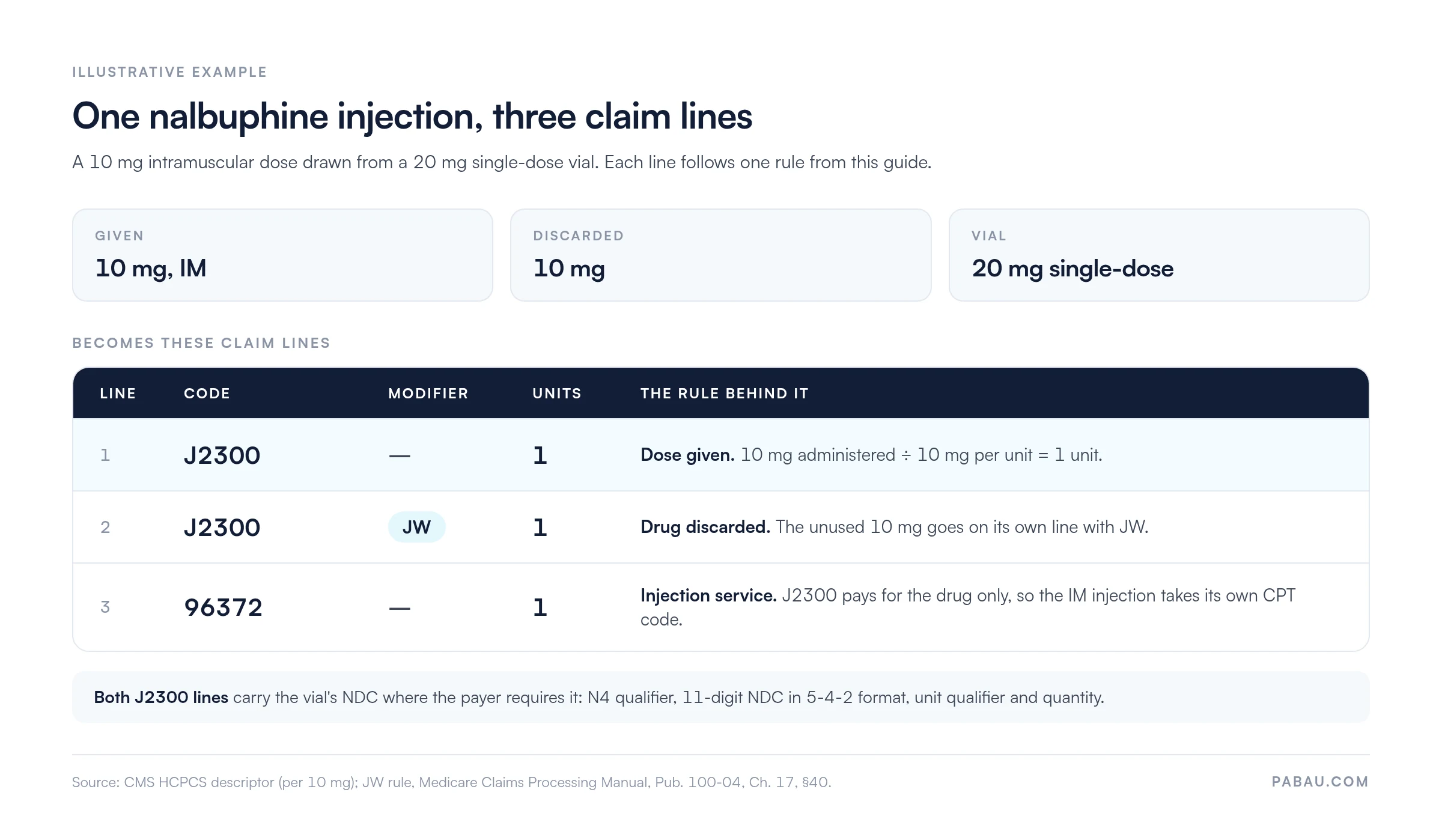
Many payers, including Medicaid managed care plans and some commercial insurers, require an NDC (National Drug Code) on the claim line alongside J2300. Medicare fee-for-service doesn’t usually require the NDC on the CMS-1500. Submitting without it when the payer requires one triggers an automatic denial.
A correctly formatted NDC entry on the claim has four parts:
An NDC changes when the manufacturer, strength or package size changes, and discontinued products drop out. Take the NDC from the vial you used, checked against FDA DailyMed or the package insert, not from a static list. Then run an NDC-to-HCPCS crosswalk check to confirm that NDC maps to J2300.
Re-run the NDC-to-HCPCS crosswalk whenever your nalbuphine supply changes. A new manufacturer or package size brings a new NDC, even when the drug name and strength stay the same. An NDC on file that no longer matches the vial is a quiet denial trigger.
J2300 covers only the drug. The injection service takes a separate CPT administration code on the same claim. For nalbuphine given IM or SC, the usual pairing is CPT 96372, the therapeutic, prophylactic or diagnostic injection code. An IV push takes CPT 96374, and an IV infusion takes 96365 or 96366, depending on duration and sequence.
In an ambulatory surgical center (POS 24) or outpatient hospital (POS 22), bundling edits may block separate payment for the administration CPT. The facility fee already includes that service.
J2300 itself may still be separately payable, depending on how the payer processes the encounter. Check the NCCI edits for the pairing before you submit.
Medicare Part B covers physician-administered drugs, nalbuphine included, when the drug is reasonable and necessary for the patient’s diagnosis or treatment. Payment for J2300 follows the Average Sales Price (ASP) method, typically ASP plus 6%, which CMS updates each quarter.
Because the rate moves every quarter, take the figure from the current file rather than an old fee sheet. The CMS ASP pricing files list this quarter’s payment limit for J2300.
Incident-to rules apply when a nurse or other auxiliary staff member gives nalbuphine under physician supervision in an office setting. The supervising physician must be present in the office suite, and the documentation must show that direct oversight. Incident-to errors are a frequent Medicare audit trigger on drug claims.
Prior authorization (PA) requirements for J2300 vary by payer and plan year. Medicare fee-for-service doesn’t currently require PA for nalbuphine in most covered settings, but Medicare Advantage plans and commercial payers may. Medicaid PA rules differ by state, so check each payer’s current policy before you assume none applies.
When PA is required, the request usually needs:
Expedited PA pathways exist for urgent cases where waiting for a standard decision could harm the patient.
The ICD-10-CM codes below commonly pair with J2300 to establish medical necessity. For a diagnosis outside this list, search our ICD-10-CM code library for the most specific code the record supports.
Place of service (POS) codes affect both claim routing and payment rates for J2300. The POS on the claim reflects where the drug was given, not where the prescription was written.
Confusing nalbuphine with naloxone is the most frequent miscoding error on these claims. J2300 covers nalbuphine hydrochloride, an opioid agonist-antagonist analgesic.
Naloxone hydrochloride is an opioid antagonist used to reverse overdose, and it billed under J2310 until CMS deleted that code on July 1, 2025.
Injectable naloxone now bills under J2312, or J2313 for Zimhi, at 0.01 mg per unit. The two drugs have opposite clinical purposes, so the wrong code is a billing error and a documentation error at once. Confirm the drug name on the administration record before you pick the J-code.
J2300 claims are denied for predictable reasons, and each one has a fix to make before resubmission. If your team runs denial management in healthcare as a formal workflow, track J-code denials separately. Unit and NDC errors are avoidable, so each one you catch is revenue you keep.
A J2300 claim holds up when the note answers three audit questions. Was the drug given? To whom, and why? What dose? The chart note needs each item below to survive payer review. Submitting a clean claim starts with capturing these details at the point of care, not rebuilding them later.
Most J2300 errors start with re-keying. A nurse writes the dose and vial in the chart, then someone in billing copies units, NDC and diagnosis onto a claim form. Each copy is a chance to bill 2 units for a 10 mg dose or drop the NDC.
Pabau, the practice management and billing platform we build, keeps the clinical record and the claim in one system. The vial’s lot is recorded against the patient and the appointment, so the documentation an auditor asks for is already on file.
Our automated claims management software sends CMS-1500 claims through the Claim.MD clearinghouse, checks eligibility and posts ERA remittances.
Where a payer requires prior authorization, the auth code, dates and sessions sit on the patient’s case, with a warning when one is missing. For self-pay or out-of-network patients, Pabau can issue a superbill that lists each drug line with its ICD-10 code. The result is a record that supports a medical billing compliance review without a scramble for paperwork.

Pabau keeps the dose, vial lot and diagnosis in the patient record and sends CMS-1500 claims through the Claim.MD clearinghouse. See how it handles drug claims from note to remittance.

J2300 rewards a coder who works from the vial, not the order. The milligrams given set the units, the milligrams discarded set the JW line, and the vial label supplies the NDC. When those three come straight from the chart note, the claim rarely needs a second look.
The one judgment call left is the diagnosis. A pain or pruritus code that matches the documented indication protects the claim far better than any appeal letter written after a denial.
Book a demo to see how Pabau turns a documented injection into a clean drug claim without re-keying.

Want to understand how clearinghouse scrubbing reduces J-code errors? Claim.MD clearinghouse overview explains how electronic claim validation catches format and NDC errors before payer submission.
Looking for an overview of the revenue cycle context for injectable drug billing? What is revenue cycle management maps the full billing lifecycle from encounter to payment posting.
Billing another injectable drug? HCPCS code library indexes the Level II J-codes with units, modifiers and documentation notes.
HCPCS Code J2300 covers the injection of nalbuphine hydrochloride, billed per 10 mg administered. It applies to all injectable strengths of nalbuphine given parenterally by a qualified provider. The code does not cover the administration service itself, oral formulations, or compounded preparations that do not match the official descriptor.
Bill one unit per 10 mg administered. A 20 mg dose is 2 units; a 30 mg dose is 3 units. When the dose does not divide evenly, most payers expect it rounded up to the next whole unit. Confirm the rounding rule with the payer before billing a partial increment.
NDC requirements depend on the payer. Many Medicaid managed care plans and commercial payers require it on the claim line. Report the N4 qualifier, the 11-digit NDC in 5-4-2 format, the unit-of-measure qualifier and the quantity. Pull the NDC from the vial you used and verify it against FDA DailyMed, because a new manufacturer or package size brings a new NDC.
J2300 covers nalbuphine hydrochloride, an opioid agonist-antagonist used for pain management. J2310 covered naloxone hydrochloride, an opioid antagonist used to reverse opioid overdose, until CMS deleted it on July 1, 2025. Injectable naloxone now bills under J2312 or J2313. The two drugs have opposite clinical functions. Billing a nalbuphine dose under a naloxone code is both a coding error and a documentation error.
Prior authorization requirements for J2300 vary by payer. Medicare fee-for-service does not currently require PA for nalbuphine in most covered settings. Medicare Advantage plans, commercial insurers and state Medicaid programs may require it, so check the plan’s current policy before a non-emergency dose.
The most common causes are nalbuphine and naloxone code confusion, a wrong unit count, and a missing or badly formatted NDC. Others are a diagnosis that doesn’t support nalbuphine, missing prior authorization, and administration bundling conflicts in facility settings. Each of these is preventable with pre-submission claim edits.





