CPT Code 62284: Injection procedure for myelography
CPT Code 62284: official descriptor and procedure overview The American Medical ...

Last Updated: Oct 19, 2026
J0572 is the HCPCS Level II code for buprenorphine/naloxone, oral, less than or equal to 3 mg buprenorphine.
Billers who read the product name instead of the strength land on the wrong rung of the J0570-J0575 ladder. The payer then underpays or denies.
Let Pabau's smart automation suggest the right codes, reduce claim denials, and keep your practice compliant—effortlessly.
Automate repetitive tasks and focus on what matters most—your patients.
Reduce coding errors and ensure compliance with the latest regulations.
Clean claims, fewer denials, and faster reimbursements.
Powerful insights and reporting to help your practice thrive.
HIPAA compliant SOC 2 certified GDPR-compliant Trusted by 4,000+ clinics worldwide

HCPCS code J0572 covers oral buprenorphine/naloxone products holding 3 mg or less buprenorphine per unit, and it has been active since January 1, 2015
The tier comes from total milligrams dispensed, so match the dose to one code and bill a single unit of it
J0571 through J0575 form the oral dosage ladder, while J0570 is a fixed 74.2 mg buprenorphine implant
Every claim carries the 11-digit NDC of the exact product dispensed, written in 5-4-2 format
Practices inside an opioid treatment program bundle rarely bill J0572 separately, since the weekly payment already covers the drug
J0572 is a Level II J-code for oral buprenorphine/naloxone combination products at 3 mg or less buprenorphine per unit. The J section of the HCPCS Level II codes covers drugs a practice supplies rather than a pharmacy.
The Centers for Medicare and Medicaid Services maintains that code set and republishes it quarterly.
The descriptor says “oral” because it covers sublingual and buccal formulations that dissolve in the mouth, including films, strips, and tablets.
Patients do not swallow buprenorphine/naloxone whole. That distinction matters at the NDC step, since injectable buprenorphine products never report under J0572.
Any oral buprenorphine/naloxone product carrying 3 mg or less buprenorphine per unit maps to J0572. In practice, that means the low-strength films and tablets from the two brand families, plus the generics that match them.
One caution. NDC numbers change as manufacturers enter and leave the market, so treat no printed list as complete. Verify the current NDC-to-HCPCS mapping in your MAC’s crosswalk file or a maintained tool such as the AAPC code lookup before you bill. A product above 3 mg per unit belongs to J0573, J0574, or J0575 instead.
Medicare Part B covers J0572 when a clinician supplies the drug in an outpatient setting and bills for it directly. Coverage rarely turns on the drug itself. It turns on where the encounter happened and how that setting gets paid, so start there.
Opioid treatment programs certified by SAMHSA and enrolled in Medicare bill a weekly bundle instead of individual services. That bundle, built on the G2067 series, pays for medication, counseling, and toxicology across the week.
Adding a separate J0572 line on top duplicates the drug payment, and reviewers look for exactly that pattern. Read your MAC’s local coverage article and the CMS guidance on OTP billing before you bill J0572 inside a program.
Office-based opioid treatment, or OBOT, is the setting this code was built for. The Consolidated Appropriations Act of 2023 removed the DEA X-waiver, so any DEA-registered practitioner can now treat opioid use disorder without extra certification. That change widened who can prescribe, not what can be billed.
Prescribing and administering still part company at the claim. The clinician has to supply and give the dose in the office for J0572 to apply. If the patient carries the medication home, a pharmacy claim replaces the J-code entirely.
Most state Medicaid programs cover buprenorphine/naloxone for opioid use disorder. Past that point, the details diverge. Prior authorization, quantity limits, and preferred drug list placement all vary by state, and states revise them regularly.
California, for one, reinstated a controlled substance policy for buprenorphine products in 2023. Check the current formulary for the state you bill, then confirm the requirement with the plan before the visit.
Medicare’s allowed amount for J0572 comes from the Physician Fee Schedule, and CMS republishes it each January. No printed dollar figure survives that cycle, so none appears here.
Look the code up in the CMS fee schedule search for your MAC locality, and repeat that at the start of every year.
Two rates exist for the same code. The non-facility rate applies in a physician office and runs higher, because it absorbs the practice’s own overhead. The facility rate applies in a hospital outpatient department or an ambulatory surgical center.
There, the facility bills its own overhead through OPPS or the ASC payment system. Clinicians who see patients in both settings are the ones who mix these up.
POS 11 on a hospital encounter creates a facility mismatch, and the payer usually trims the payment rather than denying the line. Those adjustments slip past a team that reconciles on the deposit alone.
Read the remittance instead, and scan adjustment codes against J0572 lines once a month. A pattern shows up there long before an audit finds it.
CMS requires the National Drug Code on every outpatient drug claim, and a missing or malformed NDC rejects the line automatically. Use the 11-digit 5-4-2 format, taken from the package the patient actually received.
On a professional claim, CMS-1500 or 837P, the NDC rides in the drug identification field. On an institutional claim, it sits in the revenue code loop instead.
Documentation behind a clean claim then has to establish three facts:
Five questions, half a minute, before the claim leaves the queue:
Buy-and-bill means the practice buys the drug, gives it to the patient, and bills the payer for the product. Oral buprenorphine sees far less of this than infused drugs do. It still happens in office-based treatment, usually when a clinician observes a first dose to confirm the patient tolerates it.
Opioid use disorder claims rarely travel alone. E/M codes, psychotherapy codes, and toxicology codes often share the same date of service. SAMHSA expects treatment programs to pair medication with counseling and monitoring, so the services stack up on one day.
One rule sets this work apart from general medical billing. 42 CFR Part 2 protects substance use disorder treatment records more tightly than HIPAA does. Sharing them with another provider needs the patient’s explicit consent, not a routine treatment disclosure.
Billing data attached to a J0572 claim can itself fall under Part 2, depending on the context. Have counsel review how your billing and record-sharing procedures handle it. A system that keeps SUD records separate from general health records makes the rule far easier to honor day to day.
Capture the dispensed NDC at the point of care, not afterwards. Billers who chase the number down later tend to pull the wrong lot or record a generic NDC when the patient received a brand product. A barcode scan, or one structured field in the record for the administered NDC, takes that error out of the cycle.
Four codes describe the same combination drug at different doses. One covers buprenorphine on its own. The last one is not even an oral product. The thresholds sit close together, which is why selection in this family turns up so often in opioid use disorder audits. The ladder below shows where each dose lands.
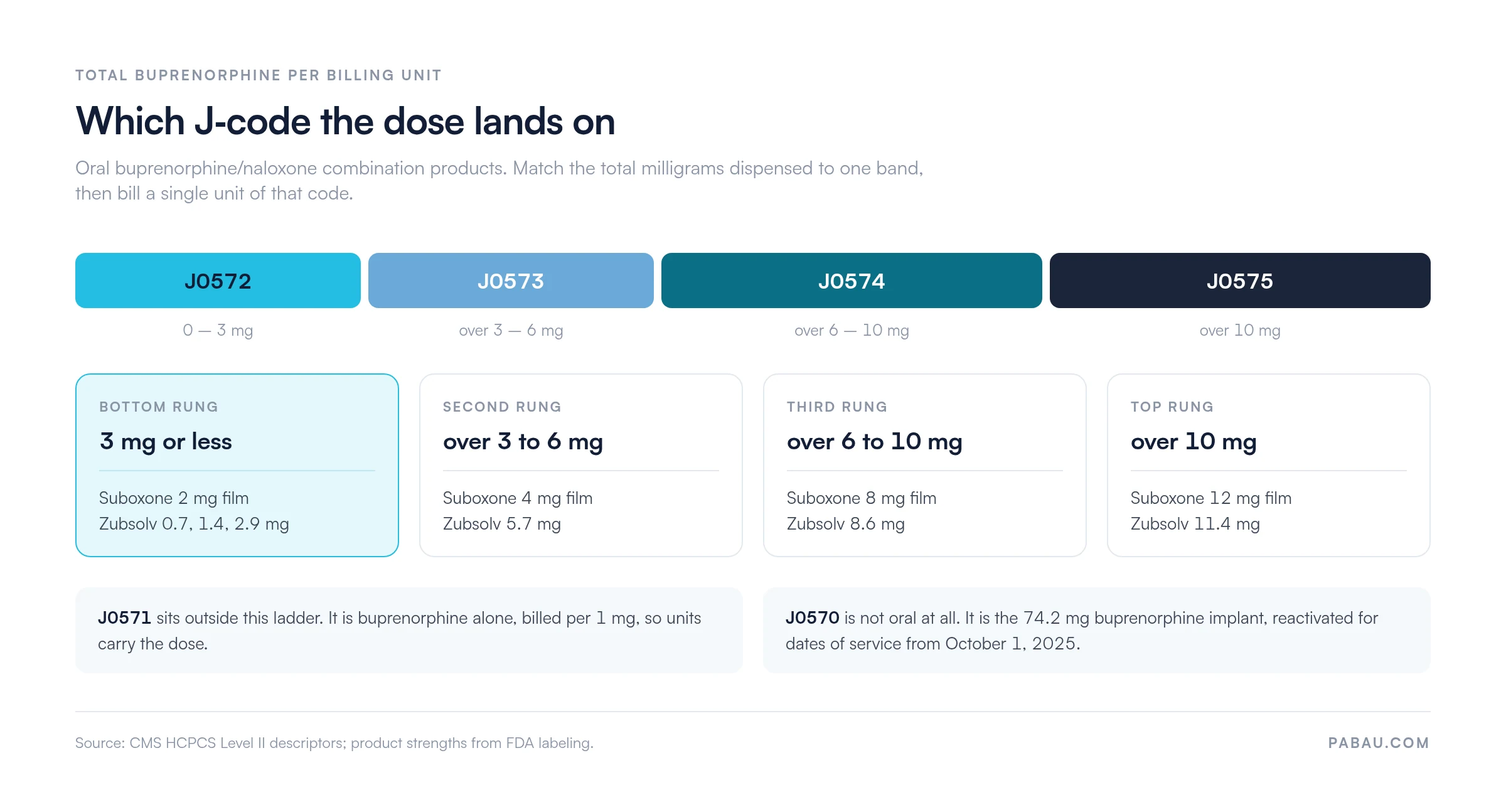
Start from the milligrams and read across. Three encounters make the pattern obvious.
Billers who recognize the brand and stop reading are the ones who file 4 mg and 8 mg doses as J0572. A short lookup sheet, mapping every strength you stock to its code, closes that off. Review the sheet each quarter, since generic strengths reach the market on their own schedule.
Check that every code in the J0570 to J0575 range is still active in the current HCPCS release before the January billing cycle starts. CMS revises descriptors, end-dates codes, and occasionally brings one back, as it did with J0570 in October 2025. An annual pass against the published Level II file keeps you off a code whose descriptor no longer matches what you dispensed.
Most billing teams work a J0572 claim across two screens. The encounter note sits in one system and the claim form in another, so the NDC and the unit count get retyped somewhere in between. Every retype is a chance to transpose a digit or grab last month’s package.
Pabau is practice management software that keeps the record and the claim in one place. Its claims management software pre-fills the CMS-1500 straight from the encounter.
The code attached to the service lands on the charge line, and the diagnosis comes from the client’s recorded problem list. Built-in ICD-10-CM and CPT/HCPCS lookup libraries let a biller confirm a descriptor without leaving the claim.
Before the send button unlocks, Pabau checks that the claim’s required fields are complete. On US claims it also runs real-time eligibility, posts ERA remittances back against the original charge, and tracks claim status.
Your team then spends its time on the doses that need a judgment call. Nobody chases a membership number that never reached the form.
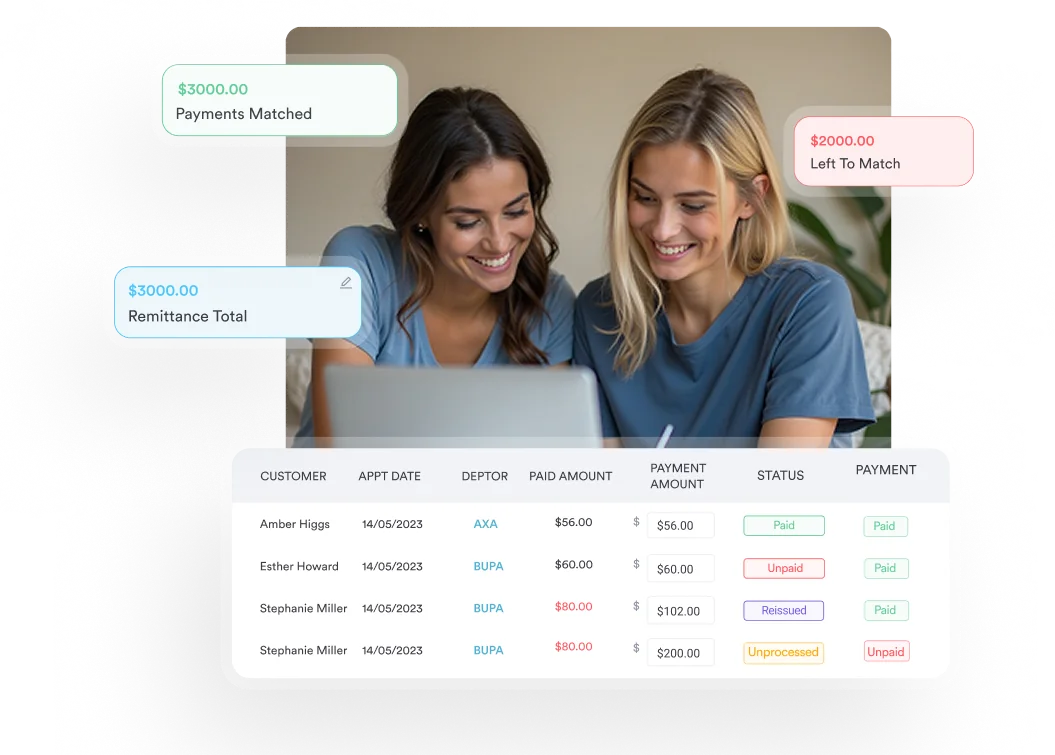

Pabau pre-fills the CMS-1500 from the encounter record and checks that required claim fields are complete. It also posts ERA remittances back against the original charge, so your billers work one screen instead of three.

Three decisions carry a J0572 claim. Match the total milligrams to the right rung of the ladder. Attach the NDC of the product the patient actually received. Then confirm that no OTP bundle already pays for the drug. Miss one and the claim comes back.
None of that is difficult once. It gets difficult at volume, across a team, on codes that sit 3 mg apart. So write the dose-to-code sheet, run the pre-submission check, and let your system carry the steps that never needed a person.
Book a demo to see how Pabau moves an opioid use disorder claim from the encounter note to the remittance.

Need the reason code behind a rejection? Denial codes in medical billing lists the remittance adjustment codes that hit drug claims most often.
Working denials one at a time? Denial management in healthcare covers the workflow from remittance code to resubmission.
Not sure how to read a remittance? Electronic remittance advice explains what each adjustment line says about the payment.
Building the encounter record behind the claim? What a superbill includes shows the fields that support a drug charge under audit.
New to the revenue cycle? Medical billing explained walks through the full path from encounter to payment.
No modifier is standard on a J0572 line. The JW and JZ discarded-drug modifiers apply to single-dose vials and single-use packages, so an oral film or tablet does not trigger them. Individual payers can still ask for their own modifier, often one identifying an opioid treatment setting. Check the plan’s policy before you append one.
No. J0572 is a medical benefit code for a drug the practice supplies and administers. A pharmacy dispensing Suboxone or Zubsolv bills the pharmacy benefit on an NCPDP claim instead, using the NDC rather than a J-code. If the patient collects the prescription, J0572 does not apply.
Opioid dependence codes carry most of these claims, with F11.20 for uncomplicated dependence in the lead. F11.21 covers dependence in remission and F11.23 covers dependence with withdrawal. Pick the code the note actually documents. Payers read the diagnosis against the treatment plan, so a mismatch invites a records request.
Yes, whenever the product contains no naloxone. J0571 covers buprenorphine alone at 1 mg per unit, so a 2 mg monoproduct tablet bills as two units rather than one. Prescribers sometimes choose the monoproduct in pregnancy. Read the label for naloxone before you pick between the two codes.