CPT code 57283: Uterosacral ligament suspension billing guide
CPT code 57283: official descriptor and procedure overview CPT code 57283 descri...

Last Updated: Oct 15, 2026
J0360 is the HCPCS Level II code for injection, hydralazine HCl, up to 20 mg. It reports the drug itself when hydralazine is given IV or IM, at one unit for each 20 mg or less administered.
The injection's labeled use is severe essential hypertension when oral therapy isn't possible or blood pressure must come down urgently. The injection service is billed on a separate CPT line, and J3490 doesn't apply because a specific code exists.
Let Pabau's smart automation suggest the right codes, reduce claim denials, and keep your practice compliant—effortlessly.
Automate repetitive tasks and focus on what matters most—your patients.
Reduce coding errors and ensure compliance with the latest regulations.
Clean claims, fewer denials, and faster reimbursements.
Powerful insights and reporting to help your practice thrive.
HIPAA compliant SOC 2 certified GDPR-compliant Trusted by 4,000+ clinics worldwide

HCPCS code J0360 describes hydralazine HCl injection, up to 20 mg. Its labeled use is severe essential hypertension when oral dosing isn’t possible or blood pressure must drop urgently.
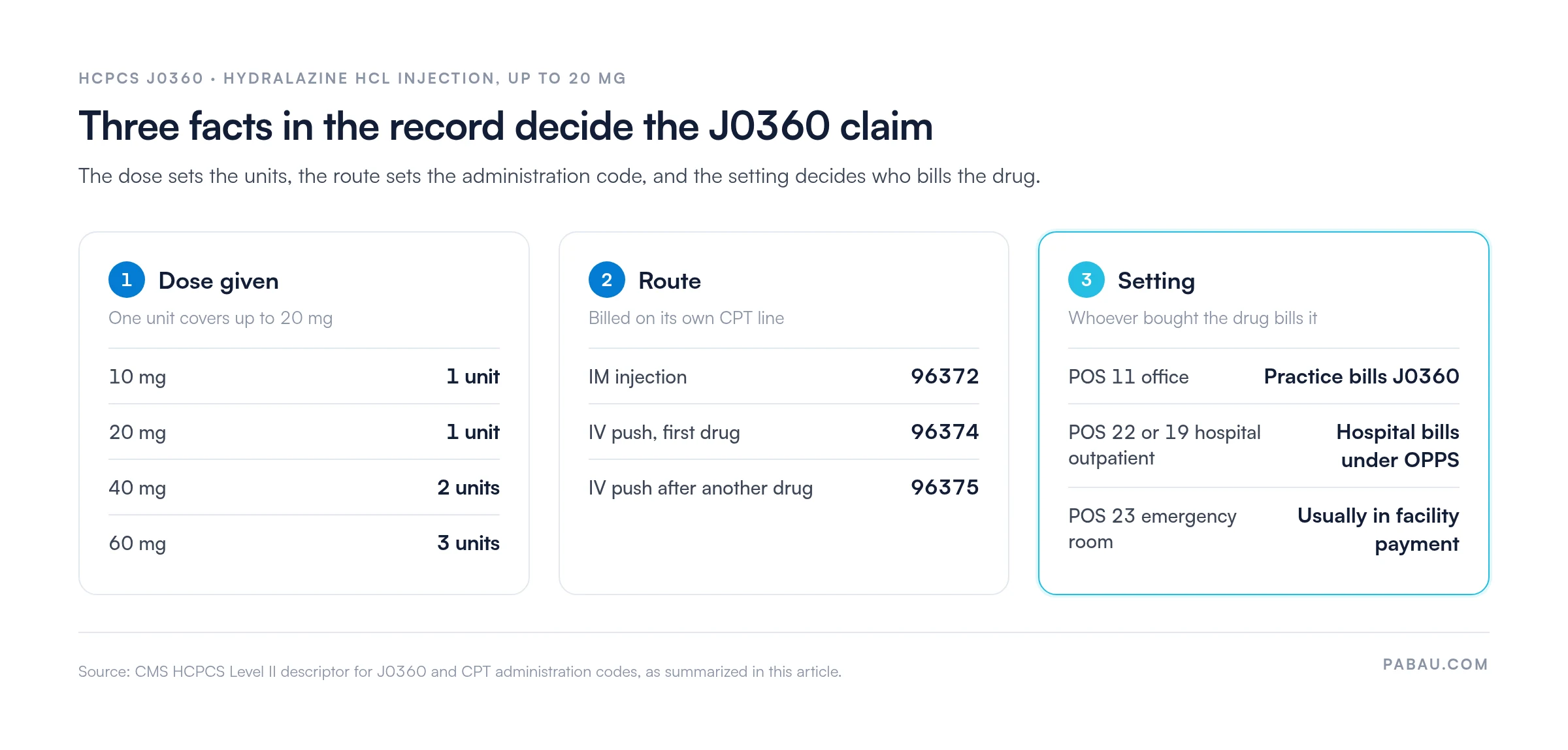
One unit covers up to 20 mg of the dose given, so 40 mg bills as two units and 10 mg bills as one.
Medicare Part B pays J0360 at ASP plus 6%. NDC reporting is required by Medicaid and many commercial payers, but Medicare Part B generally does not require it, so check the MAC.
J3490 is the wrong code when J0360 exists, because unclassified drug claims go to manual review and risk denial or downcoding.
HCPCS code J0360 covers hydralazine hydrochloride injection, up to 20 mg, as published in the CMS HCPCS Level II code set. One unit covers up to 20 mg given IV or IM, and the injection service is billed separately with a CPT administration code.
The code sits in the J-code range, J0000 through J9999. The Centers for Medicare and Medicaid Services maintains that range for injectable drugs and biologicals billed separately from a procedure.
The official long descriptor is: Injection, hydralazine HCl, up to 20 mg. Each part of that descriptor carries billing weight.
“Injection” confirms the route of administration. “Up to 20 mg” sets the billing unit, so any amount up to 20 mg counts as one unit. Documentation of a different route, such as oral hydralazine, or a different formulation does not support J0360.
Hydralazine hydrochloride is a direct-acting vasodilator that relaxes arteriolar smooth muscle and lowers blood pressure. The injection is FDA-approved for severe essential hypertension when the drug can’t be given by mouth or blood pressure must be lowered urgently. Oral hydralazine combined with nitrates is a heart-failure regimen, but that use falls outside the injection J0360 describes.
Billers need enough clinical context to confirm that the administered drug matches the code. Hydralazine HCl injection is given IV or IM in acute settings, never by mouth.
Apresoline is no longer marketed, so the product on the shelf is generic hydralazine HCl injection (formerly Apresoline). Any manufacturer’s product bills under J0360, provided the dose given is documented in the clinical record.
J0360 is billed in units of up to 20 mg. Divide the total dose by 20 and round any remainder up to a whole unit. Document the exact milligrams given rather than the vial size, because payers reimburse the dose administered, not the amount drawn up.
Because each unit covers up to 20 mg, a partial increment still counts as a full unit. A 10 mg dose bills as one unit, and 30 mg bills as two. Billing more units than the medical record supports is a common audit trigger for J0360.
The National Drug Code (NDC) is required on J0360 claims by Medicaid and many commercial payers. Medicare Part B generally does not require it, so check the instructions from your Medicare Administrative Contractor (MAC).
Where it is reported, the NDC links the billed quantity to a specific drug package. That gives auditors a cross-check between what was administered and what was purchased. An NDC that doesn’t match the pharmacy invoice triggers a denial.
Medicare Part B covers J0360 when hydralazine hydrochloride is administered in a qualifying outpatient setting by or under the direct supervision of a Medicare-enrolled physician. Coverage falls under the Part B drug benefit for drugs that cannot be self-administered, which hydralazine injection clearly satisfies.
Reimbursement is calculated on the Average Sales Price (ASP) methodology. For most Part B drugs, the allowed amount is ASP plus 6%. Because ASP rates are updated quarterly by CMS, the exact dollar figure for J0360 changes every three months. Check the current payment limit in the CMS ASP pricing files before projecting revenue or setting patient cost-share estimates.
Prior authorization requirements for J0360 vary by payer. Traditional Medicare fee-for-service generally does not require PA for hydralazine injection, but Medicare Advantage plans and commercial payers may. Check each plan’s formulary and PA policy before administration when the setting is non-emergent.
Verify J0360 reimbursement rates each quarter using the CMS ASP drug pricing file, which you can download from cms.gov. Flag the quarterly release date on your billing team’s calendar so rates are updated before the first claim of the new quarter goes out.
Every J0360 claim must carry at least one ICD-10-CM diagnosis code that establishes medical necessity. The injection’s labeled indication is severe essential hypertension, so most claims draw on the hypertension codes below.
Code to the highest specificity the documentation supports. IV hydralazine given for a hypertensive emergency is far more defensible with I16.1 than with I10, because the urgency of the treatment matches the diagnosis. Auditors flag mismatches between diagnosis specificity and treatment intensity.
J3490 is the unclassified injectable drug code, meaning it applies when no specific J-code exists for the drug administered. Because J0360 exists specifically for hydralazine hydrochloride injection, J3490 is the wrong code here. Using it in place of J0360 triggers several downstream problems.
The one scenario where J3490 may be appropriate is a compounded hydralazine formulation that differs meaningfully from the commercially available injectable. Compounded drugs don’t always map cleanly to standard J-codes. In that situation, ask the payer whether J0360 still applies or whether J3490 with an invoice is required. Get the answer in writing where you can.
The drug code J0360 covers the cost of the drug only. Giving it is billed separately with a CPT administration code, subject to bundling rules. The route decides which code applies, and hydralazine pushed IV as the first drug is reported with 96374.
National Correct Coding Initiative (NCCI) edits decide what happens when an office visit and the injection fall on the same day. The administration code is generally payable, and the evaluation and management (E/M) service is the one at risk of bundling. Bill the E/M only when a significant, separately identifiable service is documented, and append modifier 25 to it.
A J0360 claim without complete supporting documentation is a delayed or denied claim. The medical record must contain every element below before the claim is submitted. Incomplete records that surface during a post-payment audit result in recoupment.
A disciplined medical billing workflow captures these elements at the point of care rather than reconstructing them later. The further documentation drifts from the encounter, the higher the error rate and the slower the payment. The administering clinician or nurse should complete the drug administration record before leaving the patient room.
Keep a clean claim submission checklist for J0360 where the nursing staff chart. It puts the eight elements above in front of the person who records them.
J0360 denials tend to repeat the same six causes, and each one has a fix you can build into charge capture.
Structured denial management in healthcare tracks these patterns by HCPCS code. Your billing team then sees whether J0360 denials cluster around NDC errors or unit miscalculations, and fixes the root cause once. A list of medical billing denial codes helps staff turn payer reason codes into next steps when a J0360 claim comes back.
The place of service (POS) code on a J0360 claim affects both coverage determination and the allowed reimbursement rate. CMS applies a facility rate to claims billed from hospital outpatient settings and a non-facility rate to office-based claims, and those rates differ.
The most common POS error on J0360 claims is billing POS 11 (office) for a drug given in a hospital outpatient department. It happens most where the physician is employed or contracted by the hospital.
If the hospital purchased the drug supply, the physician cannot bill J0360. The hospital bills the drug under its own NPI. Billing the drug from the wrong entity results in a denial and potential overpayment demand.
Dose, route and setting together decide the lines on a J0360 claim, and the map below puts the three decisions side by side.
Audit your J0360 claims quarterly by POS code. If you see J0360 billed from POS 22 or 23 under a physician’s NPI, investigate whether the drug was sourced from the facility. That is a billing error waiting to become an audit finding.
J0360 claims often go wrong in the handoff. A nurse records the dose and route, and someone retypes them into a claim days later. A unit count or payer price slips on the way.
Pabau, the practice management platform we build, keeps the treatment note, the invoice and the claim on one patient record. Its error-checking claims management holds insurer-specific price lists, so a quarterly J0360 rate change is entered once per payer. Background validation checks flag missing membership numbers and authorization codes before a claim goes out.
For US practices, claims go out electronically to thousands of payers through the Claim.MD clearinghouse integration, with eligibility checked in real time before the visit. Each claim then shows as pending, submitted, processing, paid or error, and electronic remittance advice posts back to the same record. Your billing team sees which J0360 claims need attention without keeping a separate spreadsheet.

Pabau checks claim details before submission, applies insurer-specific prices, and tracks every J0360 claim through to payment.

Treat J0360 as a documentation job before it becomes a coding one. When the record shows the milligrams given, the route and a diagnosis that matches the urgency, the units and the administration code follow from it.
The trade-off is a minute of charting at the bedside against weeks of rework on a denied claim. Payer rules still differ on NDC reporting and prior authorization, so keep a one-page payer sheet and refresh it with each quarterly ASP file.
Book a demo to see how Pabau turns a signed treatment note into a clean J0360 claim for your practice.

Need to understand how your claims move through the system? Medical claims clearinghouse guide walks through how electronic claims are validated and routed before reaching the payer.
Want to reduce payment delays from eligibility issues? Insurance eligibility verification covers how real-time eligibility checks prevent front-end denials before drug administration.
Looking for the full picture on revenue cycle management? Revenue cycle management explained covers the end-to-end billing process from charge capture through payment posting.
Giving hydralazine as an IM injection? CPT code 96372 covers intramuscular injection billing, modifiers and reimbursement.
Pushing hydralazine after another IV drug? CPT code 96375 explains how each additional IV push is billed.
HCPCS code J0360 covers hydralazine hydrochloride injection, up to 20 mg, given intravenously or intramuscularly in an outpatient setting. It does not cover oral hydralazine or other formulations.
One unit covers up to 20 mg administered. A 40 mg dose equals two units, and a 10 mg dose is one unit because it falls within the first 20 mg.
Yes, J0360 is covered under Medicare Part B when hydralazine HCl injection is administered in a qualifying outpatient setting under physician supervision. Reimbursement is based on the ASP+6% payment methodology, updated quarterly by CMS.
J0360 is the specific code for hydralazine hydrochloride injection. J3490 is the unclassified injectable fallback, used only when no specific J-code exists. Because J0360 exists for this drug, J3490 is the wrong code and typically leads to denial, delayed payment or downcoding.
The most common pairings are I16.0 (hypertensive urgency), I16.1 (hypertensive emergency) and I10 (essential hypertension). Heart failure is not a labeled indication for the injection. Report an I50 code only when the record documents it as the reason for the dose.
Traditional Medicare fee-for-service generally does not require prior authorization for J0360, but Medicare Advantage plans and commercial payers may. Always verify PA requirements with each plan before non-emergent administration.