HCPCS code P9058: Red blood cells, leukocytes reduced, CMV-negative, irradiated
HCPCS code P9058: Official descriptor and key attributes HCPCS code P9058 report...

Last Updated: Oct 26, 2026
H1001 is the HCPCS Level II code for prenatal care, at-risk enhanced service; antepartum management. It covers the ongoing management visits a pregnant patient receives once a state Medicaid program has classed the pregnancy as at-risk.
H1001 is a state Medicaid code that Medicare doesn't pay. It's one of four components in the H1005 package, alongside H1002, H1003 and H1004. The at-risk assessment itself is billed separately as H1000.
Let Pabau's smart automation suggest the right codes, reduce claim denials, and keep your practice compliant—effortlessly.
Automate repetitive tasks and focus on what matters most—your patients.
Reduce coding errors and ensure compliance with the latest regulations.
Clean claims, fewer denials, and faster reimbursements.
Powerful insights and reporting to help your practice thrive.
HIPAA compliant SOC 2 certified GDPR-compliant Trusted by 4,000+ clinics worldwide

H1001 is a state Medicaid H-series code for enhanced antepartum management of at-risk pregnant patients, beyond routine prenatal care.
Each H1001 claim needs documented clinical risk criteria, and a missing or undated risk assessment is a common reason for denial.
H1005 is a package that includes H1001 through H1004, so billing H1001 on its own when H1005 applies is unbundling.
H1000, the at-risk assessment, is a separate code and is not part of the H1005 package.
Pabau’s claims management software submits claims and tracks their status, so billers can follow each H1001 claim from one screen.
HCPCS code H1001 is the Level II code for prenatal care, at-risk enhanced service; antepartum management. The descriptor is published by the Centers for Medicare & Medicaid Services (CMS). It covers the ongoing management visits a pregnant patient receives once a state Medicaid program has classed the pregnancy as at-risk.
H1001 sits in the H-series of HCPCS Level II. CMS reserves that range mainly for behavioral health and substance use services. State Medicaid agencies also use it for programs such as at-risk obstetric care. That makes H1001 a Medicaid code. Medicare doesn’t pay it, and most commercial payers don’t recognize the H-series at all.
No single national rate exists for H1001. Each state Medicaid agency sets its own fee, and managed care organizations (MCOs) that contract with Medicaid may pay from their own schedules. Never apply one state’s rate to a claim in another state.
H1001 covers enhanced antepartum management for pregnant patients who meet their state Medicaid program’s definition of “at-risk.” It pays for the extra assessment and monitoring that at-risk status requires on top of a standard prenatal visit.
Clinical elements typically billed under H1001:
Care coordination and patient education have their own codes in this series, H1002 and H1003. Where a state recognizes those codes, bill the service under them rather than folding it into H1001.
The patient population H1001 targets is narrower than general prenatal care. A low-risk patient seen for standard visits under CPT global OB codes doesn’t qualify. The state Medicaid program’s accepted clinical criteria must support the at-risk designation in the record.
Payers use the descriptor’s boundaries to spot inappropriate billing, and the lines between H1001 and its neighboring codes are where auditors look first.
H1000 is the at-risk assessment, and H1001 is the antepartum management that follows it. Billing teams mix them up because both appear for the same patients, yet they describe different moments in the care sequence.
A simple test settles most cases. If the note documents the risk screening itself, H1000 leads. If it documents management of risk factors already established, H1001 applies.
H1005 is a Medicaid package code whose descriptor reads “prenatal care, at-risk enhanced service package (includes H1001-H1004).” When a state pays H1005, billing H1001 as a separate line for the same services is unbundling. Payers flag it in post-payment audits.
H1000 sits outside the package, so the assessment is billed under its own code either way. The diagram below shows how the five codes fit together.
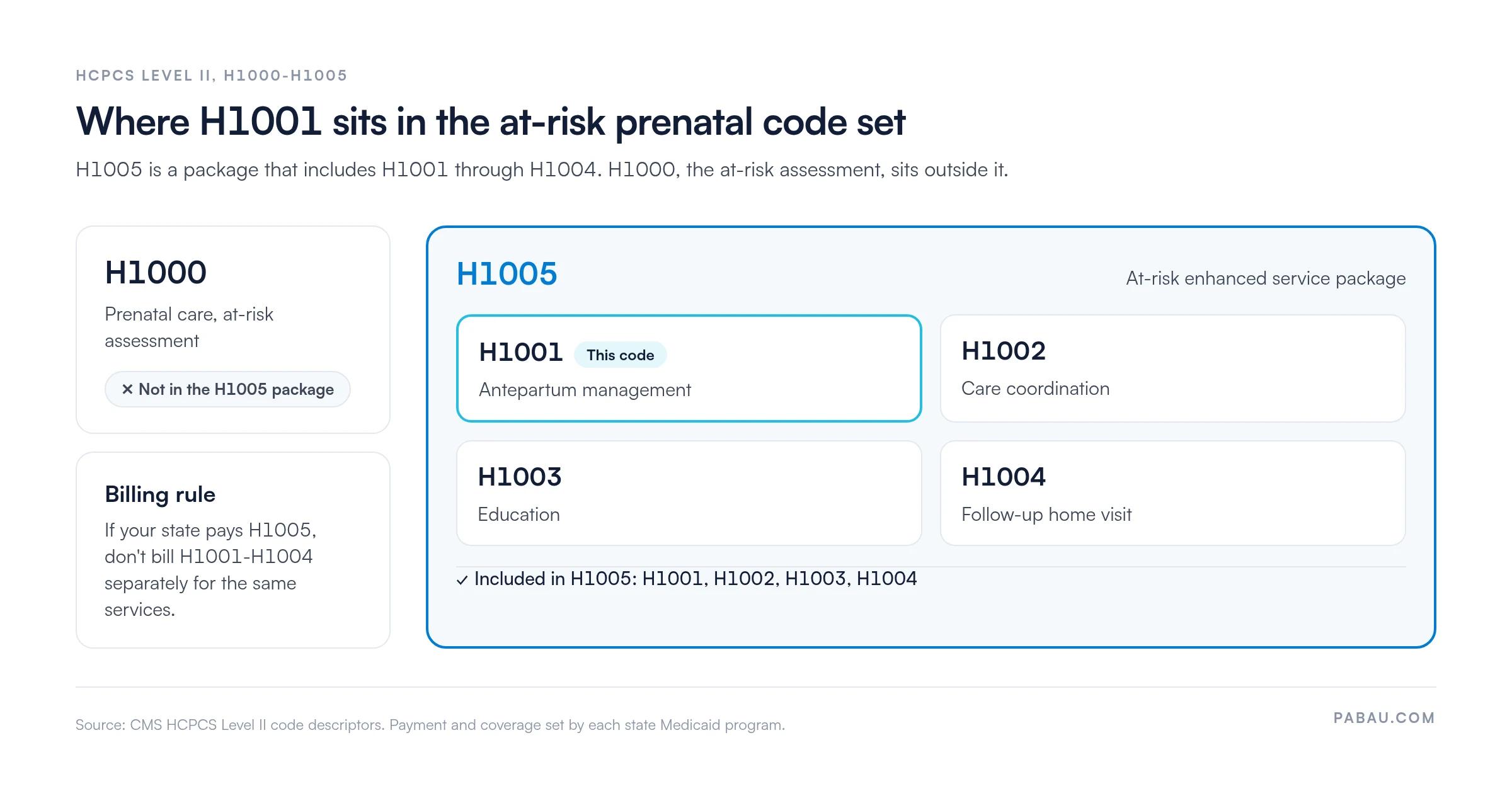
Whether to bill H1001 on its own or under H1005 depends on state Medicaid policy. Some programs require the H1005 package when the component services are delivered in the same episode of care. Others pay each component separately. Check your state’s Medicaid billing manual before you default to either approach.
Run a quarterly audit of H1001 claims against H1005 submissions. Look for dates where H1001 and H1005 both went out for the same patient. Each one is an unbundling exposure that a post-payment audit will surface. Separate the H1001-H1004 services you billed individually from those the package already paid for, and adjust your claim logic.
H1001 is a Medicaid code, and Medicaid rules are state-specific. A code billable in Florida isn’t automatically billable in Texas. OB billing teams serving Medicaid patients in more than one state need separate billing logic for each.
Key payer considerations:
The claim form can’t show that a patient is at-risk, so payers expect the medical record to establish it. Medical billing compliance audits check exactly this link between the record and the claim.
Required documentation elements:
Billing H1001 cleanly takes six checks, spread before and after the encounter. Each one you skip leaves a denial that only an appeal can recover. The steps follow the same medical billing workflow as any other claim, with the H1005 decision added.
H1001 denials cluster around a small set of preventable errors, and catching them before submission costs less than an appeal. The denial management strategies that work for most claim types apply here too, plus a few triggers specific to H1001.
When an H1001 claim comes back denied, look up the code in our guide to common denial codes. It shows whether the denial is administrative, such as a wrong payer or NPI, or clinical.
Build a pre-submission checklist for every H1001 claim. (1) Is the risk assessment in the record? (2) Are the risk factors named in the encounter note? (3) Was prior authorization obtained if required? (4) Is the provider type eligible under this state’s policy? (5) Is H1005 billed for the same services on this date? Run it before claim drop, not during the appeals process.
Coders billing at-risk prenatal services need to know the whole H10xx series to avoid duplicate lines, missed codes, and unbundling. H1002 covers care coordination and H1004 covers the follow-up home visit, and both sit inside the H1005 package with H1001.
Medicare doesn’t pay H-codes, so they aren’t priced on the Medicare Physician Fee Schedule. Check each H10xx code’s current status in the CMS HCPCS quarterly update file, then confirm the rate in your state Medicaid fee schedule.
Practices billing H1001 often work several Medicaid MCO contracts at once. Billers end up checking each payer’s portal to see which at-risk prenatal claims were paid, pended, or denied.
Pabau, the practice management and billing platform we build, keeps that work in one place. Its claims management software pulls the details already on the patient record into the claim, submits it electronically, and tracks its status until it closes.
Your team can also build the state’s risk screening tool as a digital form, so the signed, dated copy sits on the patient record. The result is fewer portal logins and faster follow-up when an H1001 claim comes back denied.

Pabau’s claims management software submits your claims electronically and tracks each one’s status, so your billing team spends less time in payer portals.

H1001 pays only when three conditions line up: your state covers it, the record proves at-risk status, and the services aren’t already paid through H1005. Check all three before the claim goes out, and most H1001 denials never happen.
The trade-off is time spent up front on the risk assessment and the state manual, which costs far less than an appeal. Book a demo to see how Pabau helps OB billing teams submit and track every prenatal claim from one screen.

Want to understand the broader billing landscape for your OB practice? Revenue cycle management explained covers how claim submission, denial tracking, and payment posting connect across the full billing cycle.
Need to verify eligibility before each at-risk prenatal encounter? Insurance eligibility verification outlines the steps for confirming Medicaid enrollment and coverage at the visit level.
Building a clean-claim standard for your billing team? Clean claim requirements in medical billing explains the submission criteria that minimize edit-related denials across HCPCS codes.
HCPCS code H1001 is a Level II code for prenatal care, at-risk enhanced service; antepartum management. State Medicaid programs use it to pay for enhanced management of pregnant patients whose documented risk factors go beyond routine prenatal care.
H1000 covers the prenatal at-risk assessment, the encounter where at-risk status is documented. H1001 covers the enhanced antepartum management visits that follow. H1000 also sits outside the H1005 package, while H1001 is one of its components.
Yes, H1001 is a Medicaid code, but coverage depends on the state program. Not every state has added H1001 to its fee schedule. Check your state’s current Medicaid fee schedule before billing, because coverage in one state doesn’t carry over to another.
You need a completed at-risk screening tool with the patient’s risk score and the specific risk factors named in the encounter note. The note must also describe the enhanced services delivered beyond routine prenatal care. Payer-specific items, such as authorization numbers or attestation language, must appear on the claim where required.
The most frequent triggers are missing or undated risk assessments and unbundling H1001 with H1005. Others include an ineligible rendering provider type, missing MCO prior authorization, and the code not appearing on the state Medicaid fee schedule.