

HCPCS Code E0272: Foam rubber mattress billing guide
HCPCS Code E0272: official descriptor and code overview HCPCS Code E0272 is the ...

Last Updated: Nov 6, 2026
H1005 is the HCPCS Level II code for prenatal care, at-risk enhanced service package (includes H1001-H1004). It reports the enhanced services for a patient with an at-risk pregnancy as one package, in place of billing each component separately.
The package bundles antepartum management, care coordination, education and follow-up home visits. The H1000 at-risk assessment sits outside it. State Medicaid plans set coverage, unit definitions and payment, and billing H1001-H1004 alongside H1005 for the same services duplicates the package.
Let Pabau's smart automation suggest the right codes, reduce claim denials, and keep your practice compliant—effortlessly.
Automate repetitive tasks and focus on what matters most—your patients.
Reduce coding errors and ensure compliance with the latest regulations.
Clean claims, fewer denials, and faster reimbursements.
Powerful insights and reporting to help your practice thrive.
HIPAA compliant SOC 2 certified GDPR-compliant Trusted by 4,000+ clinics worldwide

HCPCS code H1005 is the at-risk prenatal enhanced service package, which bundles the four component codes H1001-H1004 into one billable service.
The package covers antepartum management, care coordination, education and follow-up home visits for a Medicaid-enrolled patient with an at-risk pregnancy.
Bill the package or its components for the same services, never both, because a component line billed with H1005 duplicates the package.
H1000, the at-risk assessment, sits outside the package and documents the risk status that every enhanced service depends on.
H1005 is a state Medicaid code, so coverage, the unit definition and prior authorization rules come from your state plan, not Medicare.
Pabau’s claims management software supports HCPCS charge capture, modifier defaults and claim scrubbing to catch H1005 errors before submission.
HCPCS code H1005 is the Level II code for “prenatal care, at-risk enhanced service package (includes H1001-H1004).” It is maintained by the Centers for Medicare and Medicaid Services (CMS) as part of the annual HCPCS Level II code set.
H1005 does not describe a single visit. It reports the enhanced services an at-risk pregnant patient receives as one package, in place of billing each service under its own code.
H codes are national codes, but state Medicaid programs decide how to use them. A state plan can recognize the package, the individual components, or both. Each plan also sets its own rates, unit definitions and prior authorization rules.
The six codes in the H1000-H1005 range split at-risk prenatal care into one assessment, four component services and the package that bundles them:
H1005 covers the full set of enhanced services for a Medicaid-enrolled patient whose pregnancy has been assessed as at risk. The descriptor names four components inside the package:
What H1005 does not cover matters just as much for clean billing:
The choice turns on whether the practice reports the whole enhanced service package or each service on its own. H1000 sits upstream of both routes, because the assessment establishes the risk status they depend on. The diagram below lays the two routes side by side.
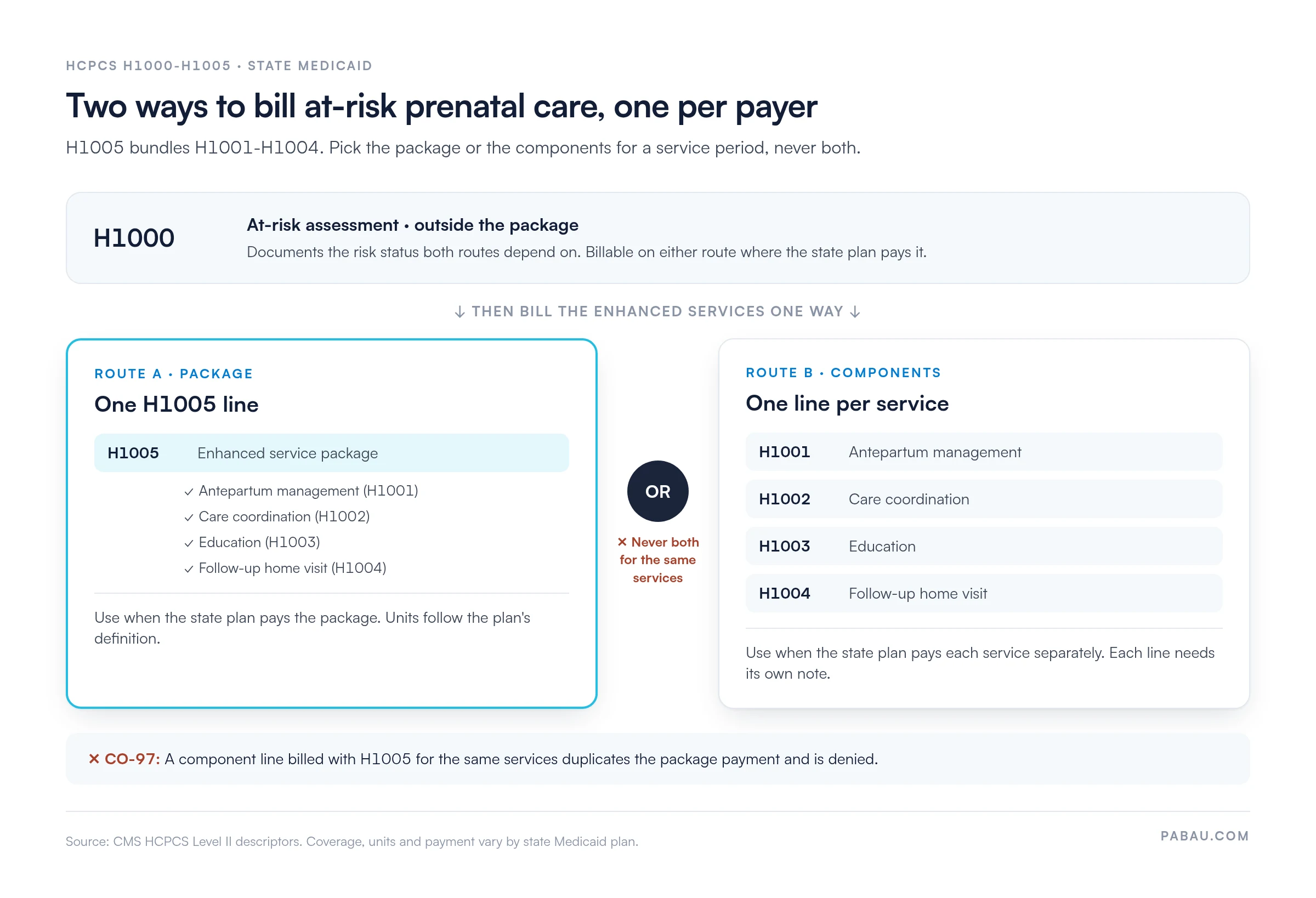
Practical rule: Pick one route per payer and per service period. Bill H1005 where the state plan pays the package, or H1001-H1004 where it pays services one by one. Report H1000 for the assessment on either route, where the plan covers it.
Provider eligibility for HCPCS code H1005 is set by each state. Two practices in different states may have different qualified provider lists for the same code. The following provider types are commonly eligible, though practices must confirm with their state Medicaid plan:
Because the package spans several services, more than one provider type may deliver its components. Check whether your state plan wants the package billed under one rendering provider or under each provider who delivered a component.
Place-of-service codes used on H1005 claims typically include:
A POS code the state plan does not accept for H1005 generates a CO-5 denial (procedure code inconsistent with the place of service). Verify the accepted POS list in your state’s Medicaid provider manual before submitting.
The descriptor defines H1005 as a package, so one unit stands for the bundled services rather than a single encounter. That is the main billing difference from H1001-H1004, where each unit reports one service.
Each state plan decides what one package unit covers. The definition can take one of these forms:
Check the unit definition in your state’s fee schedule or provider bulletin before billing more than one unit of H1005. The NLM Clinical Table Search API can confirm the current code descriptor, though it does not reflect state-specific unit rules.
H1005 requires a supporting ICD-10-CM diagnosis code that establishes medical necessity for enhanced at-risk services. The diagnosis must reflect an identified risk factor, because a routine pregnancy code alone will trigger denial in most state Medicaid systems.
Commonly paired ICD-10-CM codes for H1005 claims:
Routine prenatal codes typically trigger denial when listed as the only supporting diagnosis for H1005. Examples are Z34.00 (encounter for supervision of normal first pregnancy, unspecified trimester) and Z34.90 (encounter for supervision of normal pregnancy, unspecified, unspecified trimester).
Neither code records a risk factor, so neither justifies enhanced services. Use the AAPC HCPCS code lookup to check current code pairing guidance for your state.
Missing documentation is the most preventable cause of H1005 denials. A package claim stands on the records behind every component it includes. Meeting medical billing compliance standards for this code requires the medical record to contain the following before the claim is submitted:
Audit your H1005 claims each quarter. Pull 10 random package claims from the prior 90 days. Check each chart for the risk assessment, the care plan and a note for every component. A quarterly audit surfaces missing notes before a payer audit does.
Prior authorization (PA) for H1005 is not universal. Some state Medicaid plans require it and others do not. Managed Medicaid organizations (MCOs) in the same state may also apply different rules from the fee-for-service program, so verify with each payer.
A clean claim starts with confirming PA status before the first enhanced service in the package. When PA is required, enter the authorization number in Box 23 of the CMS-1500 or the equivalent field in the 837P electronic transaction.
Most H1005 denials fall into a small number of repeating patterns. The table below maps the most frequent CARC denial codes to their root causes and corrective actions. Effective denial management in healthcare starts with identifying which of these patterns your practice hits most often.
Same-day questions for H1005 split into two groups. Codes inside the package should never be billed alongside it for the same services. Codes outside the package can be, with separate documentation.
Confirm same-day combinations against the current quarter’s NCCI edits and your state’s bundling policy, as CMS updates the edits regularly. Never use modifier 59 to push a component code through against H1005. The modifier signals a distinct service, and a component of the package does not qualify.
Practices that bill H1005 across several providers benefit from enforcing the package rules at charge entry. Catching a bundling or documentation error there costs far less than appealing a denial later.
Key configuration steps for H1005 in a practice management system:
Pabau, the practice management and billing platform we build, handles this workflow through its claims management software. It supports HCPCS charge capture with customizable required fields, modifier defaults and pre-submission claim scrubbing. For a broader view of the process, see our overview of medical billing workflows.
Build an H1005 claim template that holds the risk assessment date, the care plan date and a checklist of delivered components. Add the rendering provider credential and the PA number. A complete template at charge entry prevents the most common denial reasons before the claim leaves your system.

Pabau’s claims management software includes HCPCS charge capture, modifier defaults and claim scrubbing that catches bundling, diagnosis and authorization errors before submission. See how it works for OB/GYN and women’s health practices.

Most H1005 errors start with one decision made at charge entry. Bill the package where your state plan pays the package, and the components where it pays them separately. Making that choice once per payer removes the most common bundling denial before it happens.
The trade-off is flexibility. The package keeps claims simple but ties the practice to the state’s unit definition. The component route captures each service, but every line needs its own note.
Settle the route for each payer, build it into your charge master and audit against it each quarter. Book a demo to see how Pabau catches H1005 bundling and authorization errors before claims leave your practice.

Billing routine obstetric care next to the package? CPT code 59400 covers the global obstetric package of antepartum care, vaginal delivery and postpartum care.
Building your denial prevention process? Denial codes in medical billing explains the most common CARC and RARC codes and how to address them systematically.
Want to understand clearinghouse claim processing? How a medical claims clearinghouse works explains the 837P transaction flow and how claims move from your system to the payer.
HCPCS code H1005 covers the prenatal care at-risk enhanced service package, which includes H1001-H1004. Those codes are antepartum management, care coordination, education and follow-up home visits for a Medicaid-enrolled patient with an at-risk pregnancy. The at-risk assessment (H1000) and routine obstetric care are billed separately.
H1005 reports the enhanced services as one package, while H1001-H1004 report each service on its own code. Your state plan decides which route it pays. Bill one or the other for the same services, never both, or the component lines will deny as duplicates of the package.
Yes, where the state plan pays the assessment separately. The H1005 descriptor includes only H1001-H1004, so the H1000 at-risk assessment sits outside the package. Confirm that your state does not build the assessment into its package rate before billing both.
Prior authorization for H1005 is set by each state Medicaid plan and managed care organization, so the answer differs by payer. Some states require PA or program enrollment before any H1005 claim is accepted, and others do not. Document the PA number in Box 23 of the CMS-1500 whenever authorization is required.
Eligible providers typically include OB/GYN physicians, certified nurse-midwives, licensed clinical social workers, certified health educators and community health workers enrolled in the state Medicaid program. Provider eligibility is set by each state. Confirm the approved provider list in your state’s Medicaid provider manual before billing.
H1005 is a Medicaid code. HCPCS Level II H-series codes are designed for state Medicaid and behavioral health programs, and no national Medicare coverage policy exists for H1005. For a dual-eligible patient, confirm with the state plan which payer is primary for enhanced prenatal services.
Usually, yes, when the medical record separates the enhanced services from the routine prenatal visit note. Some payers require modifier 59 or XE to mark a distinct service. Verify the current NCCI edits and your state’s bundling policy before submitting same-day combinations.




