

HCPCS code E0198: Water pressure pad billing guide
HCPCS code E0198 is a water pad for a standard mattress HCPCS code E0198 is the ...

Last Updated: Oct 13, 2026
H1004 is the HCPCS Level II code for prenatal care, at-risk enhanced service; follow-up home visit. It covers a follow-up visit at the home of a pregnant patient formally identified as at risk, billed to state Medicaid programs rather than Medicare.
H-series codes are administered by individual state Medicaid agencies, so coverage rules, prior authorization requirements, and fee schedule rates all vary by state.
Let Pabau's smart automation suggest the right codes, reduce claim denials, and keep your practice compliant—effortlessly.
Automate repetitive tasks and focus on what matters most—your patients.
Reduce coding errors and ensure compliance with the latest regulations.
Clean claims, fewer denials, and faster reimbursements.
Powerful insights and reporting to help your practice thrive.
HIPAA compliant SOC 2 certified GDPR-compliant Trusted by 4,000+ clinics worldwide

HCPCS Code H1004 covers at-risk enhanced prenatal follow-up home visits billed to Medicaid, not standard office prenatal visits.
H1004 is an H-series code administered by state Medicaid agencies, and Medicare does not cover it.
Billing H1004 alongside H1002 for the same service period creates an unbundling risk and is a leading denial trigger.
H1005 is the enhanced service package that includes H1001-H1004, so a visit paid inside it is not billed again as H1004.
Pabau’s claims management software helps prenatal billing teams track prior authorization status and catch missing documentation before submission.
HCPCS Code H1004 is the Level II code for a follow-up home visit delivered as part of an at-risk enhanced prenatal care service.
The Centers for Medicare and Medicaid Services (CMS) maintains it within the H-series, which covers mental health, substance use, and state Medicaid agency services. The code’s full official descriptor is: Prenatal care, at-risk enhanced service; follow-up home visit. It is active in the 2025 and 2026 HCPCS code sets.
H-series codes exist because state Medicaid programs need billing codes for services that fall outside the standard CPT system. H1004 captures the home visit component of enhanced prenatal programs for pregnant patients identified as high-risk due to medical, behavioral, or social factors. You can browse its neighbors in our full HCPCS code reference. If Medicaid claims are new to you, medical billing fundamentals explains why H-series codes behave differently from the CPT codes most clinical staff use daily.
HCPCS Code H1004 covers the follow-up home visit component of an enhanced prenatal care program, delivered to a pregnant patient formally identified as at risk. The visit must occur at the patient’s home or usual residence. An office visit does not satisfy the service definition.
Several adjacent services are explicitly outside the scope of H1004:
H1002, H1004, and H1005 are the prenatal H-series codes most often confused. Two describe single services, and the third bundles several of them into one package. Picking the wrong one, or billing more than one without clear clinical justification, triggers payer audits and denials.
The line between H1002 and H1004 is written into the descriptors. H1002 explicitly says “not visits.” A care coordinator scheduling appointments and tracking patient status bills H1002. A clinician traveling to the patient’s home to deliver a structured assessment or intervention bills H1004.
Both can appear on the same claim only when they reflect separate, documentable activities on the same date. H1005 sits above both. Its package includes H1001-H1004, so a payer that reimburses H1005 has already paid for the follow-up home visit. The grid below matches each service to its code.
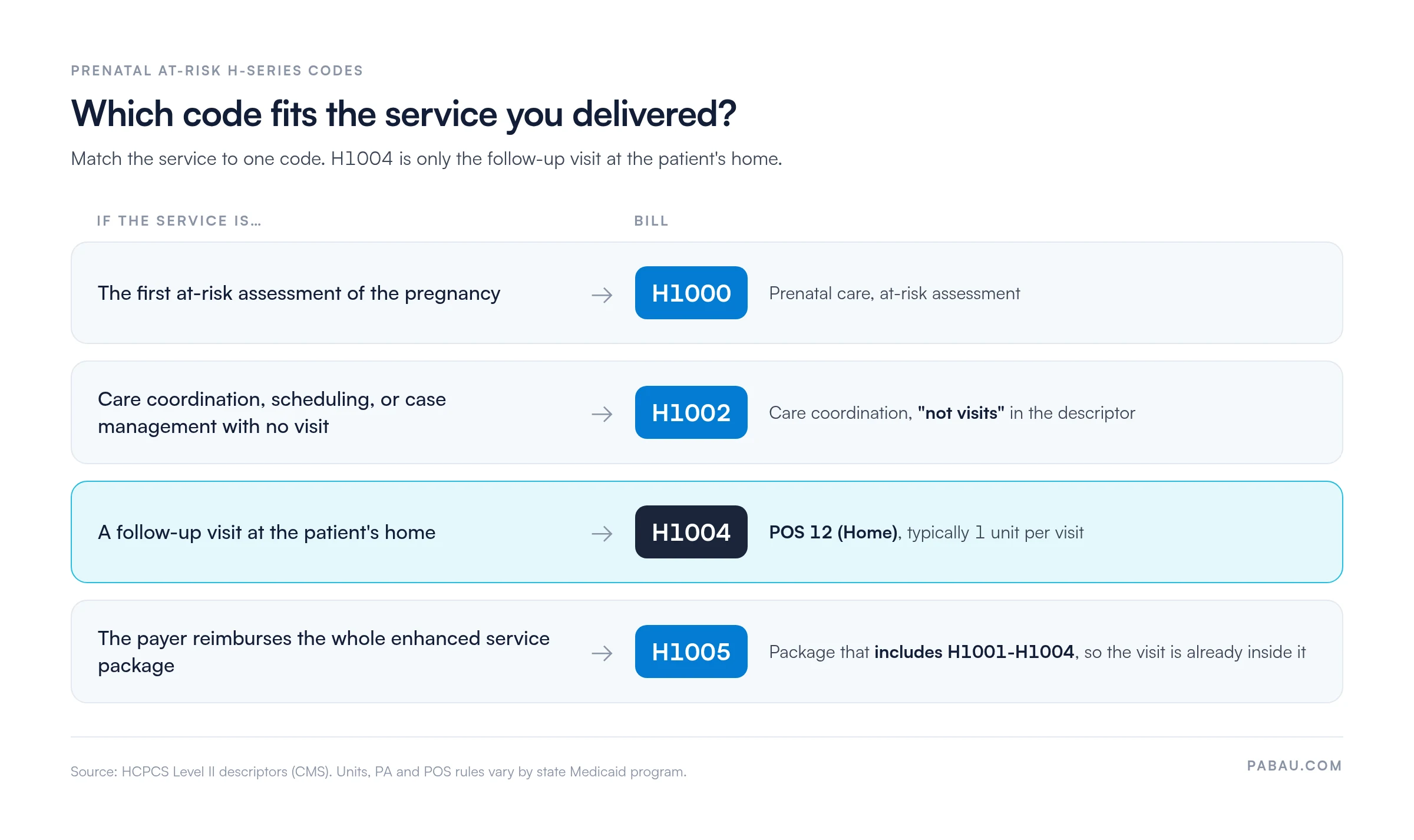
Every H1004 claim requires an ICD-10-CM diagnosis code that establishes medical necessity for the at-risk designation. State Medicaid programs accept diagnosis codes that document high-risk pregnancy conditions, social determinants of health, or behavioral health factors. The table below lists commonly accepted codes. Covered diagnoses vary, so always verify them with your state Medicaid plan.
Social determinant codes (Z59 series) are increasingly accepted by Medicaid plans as sufficient to justify the at-risk designation. Some managed Medicaid organizations require a co-occurring clinical diagnosis alongside the social determinant code. Verify your plan’s policy before relying solely on a Z code to establish necessity for HCPCS Code H1004.
H1004 is a Medicaid code. Medicare does not cover H-series services, and commercial payers rarely include H1004 in their fee schedules without a specific state contract. OB/GYN practices should configure their billing systems to route H1004 claims only to Medicaid and managed Medicaid plans.
Eligibility requirements typically include:
Prior authorization (PA) for H1004 is not universally required, but many state Medicaid programs and MCOs mandate it. Wisconsin’s ForwardHealth program, for example, has published unit-based guidance for H-series prenatal codes. States that require PA typically expect the following before authorization is granted:
Always check with your specific state Medicaid agency or the patient’s MCO before the first H1004 visit. PA rules change with annual Medicaid policy updates, and managed care contracts often impose requirements beyond what the state publishes. Verify whether telehealth delivery of what would otherwise be a home visit qualifies under your state’s post-public-health-emergency policy.
Run an eligibility check on every Medicaid patient before billing H1004. Confirm the patient is enrolled in a plan that covers the code, and verify whether the MCO requires PA. Record the authorization number on the claim before submission. A missing authorization number is one of the fastest denial triggers for HCPCS Code H1004 claims.
Solid documentation is the single biggest factor in whether an H1004 claim pays on the first submission. The medical record must support both the at-risk designation and the home visit itself. Billing compliance best practices require that every element below be present before the claim is submitted, not reconstructed after a denial.
Home-visit records add a practical problem. The visit log must be signed in the field, but providers often complete the clinical note after returning to the office. Capture the patient signature during the visit and complete the clinical note within 24 hours.
Getting the technical billing fields right prevents a large share of H1004 denials, including many unrelated to clinical documentation.
Use the AAPC’s HCPCS code lookup to verify the current descriptor and any published national guidance. Then cross-reference it against your state’s Medicaid provider manual for state-specific modifier and unit rules. National code references and state policy frequently diverge on H-series codes.
H1004 claim denials cluster around a predictable set of billing and documentation failures. Knowing the patterns in advance lets billing teams build preventive checks into the submission workflow. Effective denial management workflows treat each of these as a preventable process failure rather than an administrative inevitability.
Most state Medicaid programs allow appeals within 60-180 days of the denial date; check the remittance advice for the exact deadline. A successful appeal for HCPCS Code H1004 typically requires:
Keep a log of all denied H1004 claims, their denial reason codes, and the outcome of each appeal. When the same reason code keeps coming back, trace it to the step that failed, such as a missing screening date or a lapsed credential. Fix that step before the next batch of claims goes out.
Because H1004 is an H-series code administered by state Medicaid agencies, there is no single national fee schedule. Reimbursement rates are set individually by each state Medicaid program and can differ further between fee-for-service Medicaid and managed Medicaid contracts. The CMS Physician Fee Schedule lookup does not include H-series codes; rates must be obtained directly from your state Medicaid portal or your MCO contract.
When researching your state’s rate, check for:
CMS also publishes the annual Alpha-Numeric HCPCS files, which list every Level II code with its descriptor. For billing system integrations, the NLM’s HCPCS Level II API returns current code descriptions programmatically.
An H1004 claim usually fails on a detail nobody checked in time. The authorization number sits in an email, and the signed home visit log is on paper. Nobody checks the at-risk screening date until the remittance comes back.
Pabau, the practice management platform we build, keeps the visit note, the signed visit log, and the authorization details on the patient’s record. Its error-checking claims management lets your team track prior authorization status and flag a claim with missing documentation before it goes to Medicaid.
Claims leave complete the first time, so your billing team spends less time on appeals and more time keeping at-risk patients enrolled in their program. You also get a clear record of which H1004 visits were authorized, billed, and paid.

Pabau’s claims management tools help prenatal billing teams track prior authorization, flag missing documentation, and submit clean Medicaid claims the first time.

Prepare an H1004 claim before the clinician leaves for the home. Confirm the patient’s plan covers the code, check whether it needs prior authorization, and make sure the at-risk screening is signed and dated.
That front-loaded work is the trade-off worth accepting. A few minutes of checks per patient cost far less than an appeal. Appeals run on a 60-180 day window and can still end in a write-off. If your state pays H1005 as a package, settle that with the payer first, because it decides whether H1004 is billed at all.
Book a demo to see how Pabau keeps authorizations, visit logs, and claims for at-risk prenatal patients in one place.

Coding the coordination side? HCPCS code H1002 covers the prenatal care coordination code most often billed alongside H1004.
Starting at the first assessment? HCPCS code H1000 covers the at-risk assessment that qualifies a patient for enhanced prenatal services.
Billing prenatal education too? HCPCS code H1003 covers the at-risk enhanced education service in the same prenatal series.
Struggling with Medicaid claim denials? Denial management in healthcare explains how to audit denial patterns and build preventive workflows into your billing process.
Decoding a remittance advice? Denial codes in medical billing explains the reason codes payers attach to rejected claims.
HCPCS Code H1004 covers a follow-up home visit delivered as part of an at-risk enhanced prenatal care service. It is billed to state Medicaid programs for pregnant patients formally identified as high-risk. The visit must occur at the patient’s residence. Office-based visits and care coordination activities are billed under separate codes.
H1002 covers prenatal care coordination activities such as scheduling, case management, and care planning, and its descriptor explicitly states “not visits.” H1004 covers the follow-up home visit itself. Billing both for the same service date requires clear documentation showing two distinct, separately delivered services, or the claim will be denied for unbundling.
H1004 needs prior authorization only where the state Medicaid program or the patient’s managed care organization requires it. Some states require PA before any H1004 visit; others require it only after a set number of visits per pregnancy. Always verify with the specific payer before the first visit.
Accepted ICD-10-CM codes for H1004 include high-risk pregnancy supervision codes (O09 series) and substance use in pregnancy codes (O99.320). Behavioral health diagnoses such as opioid use disorder (F11.10) and social determinant codes (Z59 series for homelessness or food insecurity) are also accepted. The diagnosis code must match the documented at-risk factor in the clinical record.
Modifier requirements for HCPCS Code H1004 are state-specific. Many state Medicaid programs require a U-series modifier (U1-U9) to identify the enhanced prenatal program or provider type. The GT modifier may be required for telehealth-delivered services in states that allow it for H1004. Check your state’s Medicaid provider bulletin for the current modifier requirement.
No. HCPCS H-series codes are by definition state Medicaid agency codes and are not covered by Medicare. H1004 claims submitted to Medicare will be denied. Only state Medicaid programs and Medicaid managed care organizations recognize and reimburse this code.



