HCPCS Code K0900: Customized DME billing and coding guide
HCPCS Code K0900: Official descriptor and code overview HCPCS Code K0900 is a CM...

Last Updated: Nov 18, 2026
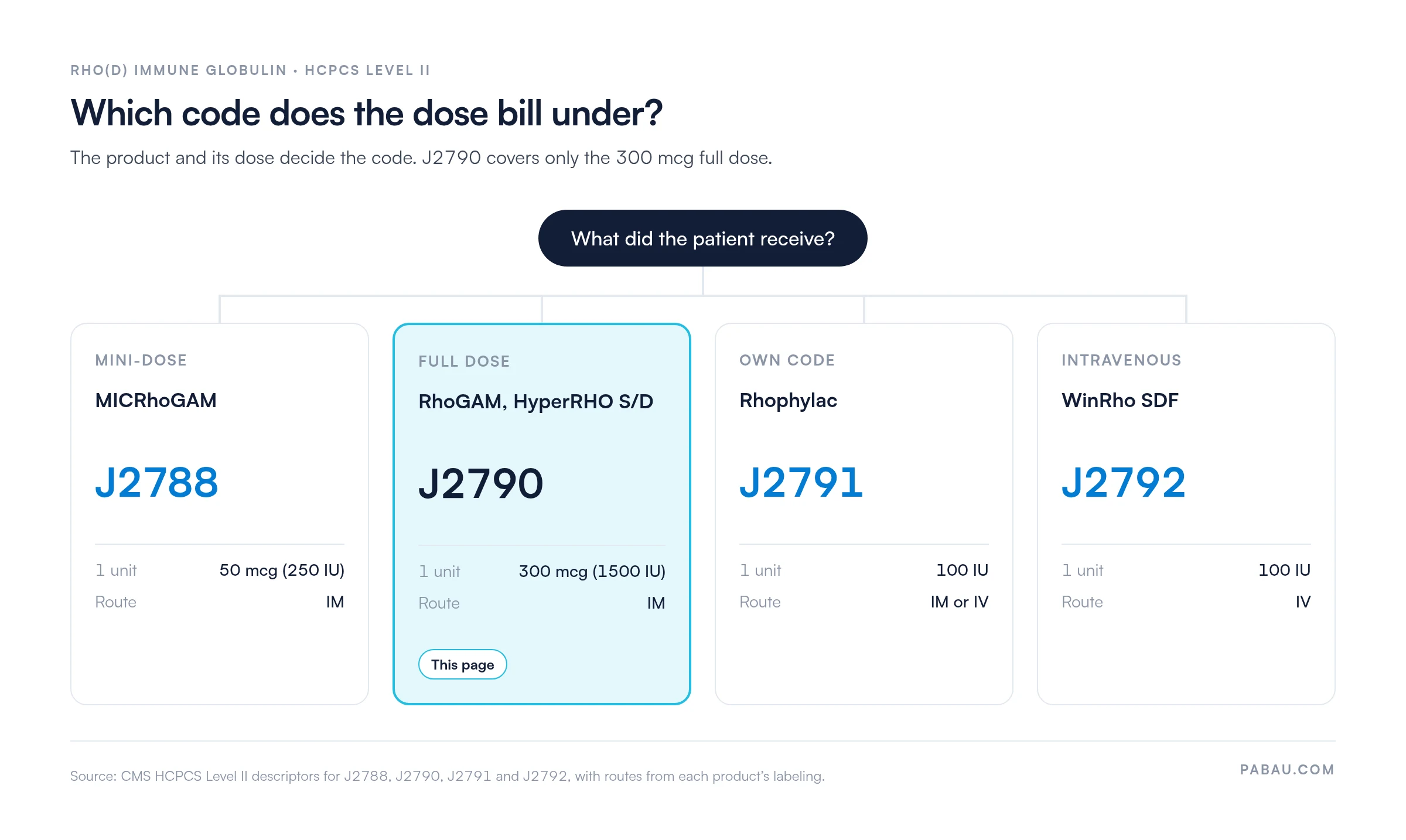
J2790 is the HCPCS Level II code for injection, Rho D immune globulin, human, full dose, 300 micrograms (1500 I.U.). One unit equals one 300 mcg dose, so a practice bills one unit for each full dose of RhoGAM or HyperRHO S/D administered.
The 50 mcg mini-dose has its own code, J2788, and Rhophylac bills under J2791. Intravenous WinRho SDF bills under J2792, and every J2790 claim needs a valid 11-digit NDC.
Let Pabau's smart automation suggest the right codes, reduce claim denials, and keep your practice compliant—effortlessly.
Automate repetitive tasks and focus on what matters most—your patients.
Reduce coding errors and ensure compliance with the latest regulations.
Clean claims, fewer denials, and faster reimbursements.
Powerful insights and reporting to help your practice thrive.
HIPAA compliant SOC 2 certified GDPR-compliant Trusted by 4,000+ clinics worldwide

J2790 bills full-dose Rho(D) immune globulin, with one unit for each 300 mcg dose of products such as RhoGAM and HyperRHO S/D.
The 50 mcg mini-dose bills under J2788, Rhophylac under J2791 and intravenous WinRho SDF under J2792, so the product on the label decides the code.
An 11-digit NDC with qualifier N4, quantity and unit of measure belongs on every Medicare Part B claim. A missing or malformed NDC is the top denial trigger.
Pabau, the practice management platform we build, records the lot and expiry of each dose against the patient and submits 837P claims through Claim.MD.
HCPCS code J2790 is the CMS code for injection, Rho D immune globulin, human, full dose, 300 micrograms (1500 I.U.). It belongs to CMS’s HCPCS Level II system, which identifies the drugs, supplies and services that CPT codes do not cover. One billed unit equals one 300 mcg dose. The full-dose products billed under it, RhoGAM and HyperRHO S/D, are given intramuscularly.
MICRhoGAM, the 50 mcg mini-dose, has its own code, J2788. Billing it as J2790 overstates the dose sixfold, so a documented 50 mcg dose always goes on a J2788 line. Rhophylac has a dedicated code too, J2791, and the rest of the J-code range is indexed in our HCPCS code library.
J2790 is medically necessary when an Rh D-negative patient needs protection against Rh D-positive fetal red blood cells. Without it, the antibodies the patient forms can cause hemolytic disease of the newborn in a later pregnancy.
ACOG’s practice bulletin on Rh D alloimmunization reports that postpartum Rh D immune globulin cut alloimmunization in at-risk pregnancies from about 13–16% to 0.5–1.8%. The indication documented in the chart decides which ICD-10 diagnosis code supports the claim.
FDA-approved IM indications for standard-dose Rho(D) IG include:
Z29.13 (encounter for prophylactic Rho(D) immune globulin) is the supporting ICD-10-CM code most often paired with J2790. Depending on the clinical context, O09.522 (supervision of elderly multigravida, second trimester) may apply too. Code to the most specific level available, because a vague diagnosis code is a common secondary denial trigger.
Always confirm Rh-negative blood type in the chart before billing J2790. Payers audit these claims, and a missing blood type result in the medical record is treated the same as no documented indication. Flag the lab result, the clinical indication, and the NDC in a single pre-billing checklist.
Each 300 mcg dose equals one billable unit on the claim. Take a patient who receives two doses at 28 weeks and one at delivery. The antepartum claim carries 2 units, and the postpartum claim carries 1.
Submitting one unit for a two-dose administration underbills. Submitting two units for a one-dose administration is an overbilling error with audit implications.
CMS requires an 11-digit NDC on every Medicare Part B drug claim, as confirmed in the Medicare Claims Processing Manual, Chapter 17, Section 40. On the 837P transaction, the NDC sits in loop 2410, in the LIN segment. Four pieces of data travel with it:
Submitting a clean claim for J2790 means every field above is populated and consistent with the medical record before the batch is released.
J2790 covers the drug cost only. Giving the IM injection is a separate billable service under CPT 96372. Both codes appear on the same claim for a typical office-based Rho(D) IG administration.
Two situations prevent separate billing of 96372. The first is a dose given during a global obstetric period, where payer policy bundles the administration into the global package. The second is an NCCI bundling edit that blocks 96372 alongside a separately billed E&M on the same date.
CMS publishes those pairs in its quarterly NCCI procedure-to-procedure edit files. When a pair carries an edit, the Column Two code is denied unless an NCCI-associated modifier is reported.
J2790 bills the 300 mcg full dose, while J2792 bills intravenous Rho(D) IG per 100 IU. Billing the wrong one is a route-mismatch denial. Fixing it takes more than a data-entry correction, because the medical record must support whichever route is claimed.
A note on ITP: Some practices attempt to bill J2790 for immune thrombocytopenic purpura treatment. The IM formulations (RhoGAM, HyperRHO S/D) do not carry an FDA indication for ITP.
WinRho SDF, the IV formulation, holds the ITP indication. Bill J2792 for IV Rho(D) IG given for ITP, and confirm the indication is covered under the applicable MAC Local Coverage Determination.
Two more codes complete the set. J2788 covers the 50 mcg mini-dose, and J2791 covers Rhophylac, given IM or IV at 100 IU per unit. The product on the label decides between all four, as the chart below lays out.
Medicare Part B pays J2790 at the Average Sales Price (ASP) plus 6%, under the standard Part B drug payment methodology.
CMS updates ASP every quarter, so pull the allowed amount from the current file, not from a fixed figure. A J2790 rate hardcoded into a fee schedule in Q1 will be out of date by Q4. The current limits are in the CMS Part B drug payment limit files.
Place of service affects the allowed amount. In a physician office (POS 11), the non-facility rate applies, and the practice collects both the drug payment and the administration fee. In a hospital outpatient setting (POS 22), the facility rate applies, and the drug payment may go to the facility, not the billing provider. Confirm the POS on every claim matches the site of service in the encounter note.
Medicaid and commercial payer rates are set independently. Some state Medicaid programs reimburse at a percentage of the Medicaid drug rebate price rather than ASP+6%.
Commercial payers often have contracted rates that differ from Medicare. Contact each payer for their current J2790 fee schedule rather than applying Medicare rates across the board.
Most J2790 denials fall into five categories. Knowing the denial reason code (CARC) narrows the fix immediately. Strong denial management strategies start with tracking CARC codes per J-code rather than lumping all drug denials together.
Medicare Part B generally does not require prior authorization for J2790 when it is given in an obstetric setting with a documented clinical indication. Commercial payers and Medicaid managed care organizations differ, with PA requirements that vary by plan, state, and sometimes formulary tier.
Check the payer’s drug policy before the first administration of each calendar year, particularly after annual formulary resets.
The medical record must support the claim on every point an auditor checks. The chart should contain:
When a commercial payer requires PA, submit clinical notes confirming Rh-negative blood type and the gestational stage or obstetric event.
Add the planned product and NDC, plus any prior Rho(D) IG administrations in the current pregnancy. Superbill documentation that carries the NDC and lot number from the drug record removes most of the manual rework from this step.
Run a quarterly audit of your J2790 claims. Pull the NDC from the last 20 submitted claims and cross-check it against the product lot numbers in the drug dispensing log. A one-character transposition in an NDC is enough to trigger a CO-16 denial. It won’t show up in your chart until the remittance comes back.
The riskiest steps in a J2790 claim are manual ones. Someone copies the NDC and lot from the product, counts the doses, links the diagnosis code to the line, and keys the claim. When the billing team works from a paper drug log, each of those steps is a chance to miskey a digit.
In Pabau, stock carries a batch number and an expiry date, and the lot is recorded against the patient and the appointment. The dose record and its audit trail therefore sit on the patient record, not in a separate log.
Pabau’s claims management software then submits the 837P claim through the Claim.MD clearinghouse. Eligibility checks and ERA remittances come back to the same record.
Prior authorization is tracked on the patient’s case, with the auth code, dates and sessions, and Pabau warns when one is missing. For a commercial payer that requires PA for Rho(D) IG, that warning arrives before the dose is given rather than after the denial.

Pabau records the lot and expiry of each dose against the patient, then submits 837P claims through the Claim.MD clearinghouse. See how it fits your drug billing workflow.

Most J2790 rework starts before the claim is built, when the product on the label and the code on the line don’t match. A 50 mcg dose belongs on J2788, Rhophylac on J2791 and IV WinRho on J2792. The code decision therefore belongs at the point of administration, not in the billing queue.
Record the NDC, the dose count and the Rh-negative lab result on the day of the injection, and the claim needs no reconciliation afterward. Book a demo to see how Pabau keeps dose records and claim submission on the same patient record.

Need a full framework for clean claim submission? Clean claim submission best practices covers every field-level requirement across payer types, from NDC formatting to modifier placement.
Struggling with remittance codes after a J2790 denial? Denial codes in medical billing breaks down CARC and RARC codes so your team can action remittances faster.
Want to understand what ties your drug claims together? Revenue cycle management explained shows how NDC capture, claim submission, and denial resolution fit into one continuous billing loop.
HCPCS code J2790 covers full-dose Rho(D) immune globulin (human), with each billed unit representing a 300 mcg dose. It applies to intramuscular products such as RhoGAM and HyperRHO S/D used for Rh incompatibility prophylaxis in obstetric care. It does not cover intravenous WinRho SDF (J2792), Rhophylac (J2791) or the 50 mcg mini-dose MICRhoGAM (J2788).
Bill one unit per 300 mcg dose administered. A patient who receives two full doses in a single encounter is billed 2 units of J2790. A 50 mcg MICRhoGAM dose never goes on a J2790 line, because it has its own code, J2788.
J2790 is for the intramuscular route and J2792 is for the intravenous route. Using J2790 when the IV formulation (such as WinRho SDF) was administered is a route-mismatch error that generates a CO-4 or CO-11 denial. Always verify the route of administration in the clinical note before selecting the code.
Yes. RhoGAM is an intramuscular Rho(D) immune globulin product and bills under J2790 at the standard 300 mcg unit. Include the RhoGAM NDC (11-digit, N4 qualifier) on the claim alongside the quantity administered and the supporting ICD-10 diagnosis code.
Medicare Part B generally does not require prior authorization for J2790. The claim still needs a documented clinical indication, a valid NDC and a supporting ICD-10 code. Commercial payers and Medicaid managed care plans may impose PA requirements that vary by plan and state. Verify each payer’s drug policy before each calendar year begins.
Use the 11-digit NDC printed on the specific product administered that day, formatted with the N4 qualifier on the 837P claim. An NDC identifies the exact product and package, so never use a generic NDC or a number carried over from a previous administration. The NDC must match the drug dispensing record for the encounter.
Yes, in most physician office settings. CPT 96372 covers the act of administering the IM injection and is billed separately from J2790, which covers the drug cost. Some payers bundle the administration fee into a global obstetric package, and NCCI edits may prevent separate billing of 96372 alongside a same-date E&M service. Check your payer’s specific bundling policy before billing both codes.