

HCPCS code E0198: Water pressure pad billing guide
HCPCS code E0198 is a water pad for a standard mattress HCPCS code E0198 is the ...

Last Updated: Oct 13, 2026
97598 is the CPT add-on code for selective open wound debridement of each additional 20 sq cm, or part thereof, of total wound surface area. The AMA descriptor names high pressure waterjet with/without suction and sharp selective debridement with scissors, scalpel and forceps. It removes fibrin, devitalized epidermis and/or dermis, exudate, debris and biofilm. It also includes topical application(s), wound assessment, use of a whirlpool when performed, and instruction(s) for ongoing care.
It is billed per session and listed separately in addition to 97597, the primary code for the first 20 sq cm or less. Claims that carry 97598 without 97597 are rejected under NCCI and payer add-on code edits.
Let Pabau's smart automation suggest the right codes, reduce claim denials, and keep your practice compliant—effortlessly.
Automate repetitive tasks and focus on what matters most—your patients.
Reduce coding errors and ensure compliance with the latest regulations.
Clean claims, fewer denials, and faster reimbursements.
Powerful insights and reporting to help your practice thrive.
HIPAA compliant SOC 2 certified GDPR-compliant Trusted by 4,000+ clinics worldwide

CPT 97598 is an add-on code for selective debridement of each additional 20 cm², or part of it, beyond the first 20 cm².
It can’t be billed without CPT 97597 as the primary code. Standalone 97598 claims are rejected under standard add-on code edits, and payers apply their own edits.
Overcounting 20 cm² units without documented wound measurements brings audit and recoupment risk, and potential False Claims Act exposure for knowingly overbilled units.
Technique and depth decide the code. Selective debridement bills 97597/97598, non-selective methods bill 97602, and excision into subcutaneous tissue or deeper bills the 1104x series.
Pabau, the practice management platform we build, captures wound care CPT codes and submits claims through its Claim.MD clearinghouse integration.
CPT code 97598 is the add-on code for selective debridement of each additional 20 cm² of open wound surface, or part of it. It applies whenever the total area debrided in a session exceeds the first 20 cm² covered by the primary code, CPT 97597.
The American Medical Association, which maintains the CPT code set, marks 97598 with a plus sign (+97598) to show its add-on status.
The official AMA descriptor for 97598 is a single long sentence. Here it is verbatim, broken at its own punctuation.
Two points matter for correct billing. The phrase “or part thereof” means any wound area above a 20 cm² threshold triggers one more unit, even if only 2 cm² remain. The closing instruction requires a primary procedure code, which is always 97597.
CPT 97597 and CPT 97598 work as a billing pair. CPT 97597 covers the first 20 cm² or less of selective debridement in a session. CPT 97598 adds one unit for every additional 20 cm², or part of one, beyond that threshold. 97597 can be billed alone, but 97598 can’t, because it only stacks on top of the primary code.
Both codes describe selective debridement, which removes devitalized tissue from the epidermis and dermis only. The AMA names high-pressure waterjet, irrigation, and sharp selective debridement with scissors, scalpel and forceps as the techniques. Non-selective methods, such as enzymatic agents and wet-to-moist dressings, bill under CPT 97602 instead.
Unit calculation for CPT 97598 follows a straightforward formula, but errors here are a frequent audit trigger in wound care billing. The steps are:
The ladder below shows where each new unit starts, so you can read the count straight off the measured area.
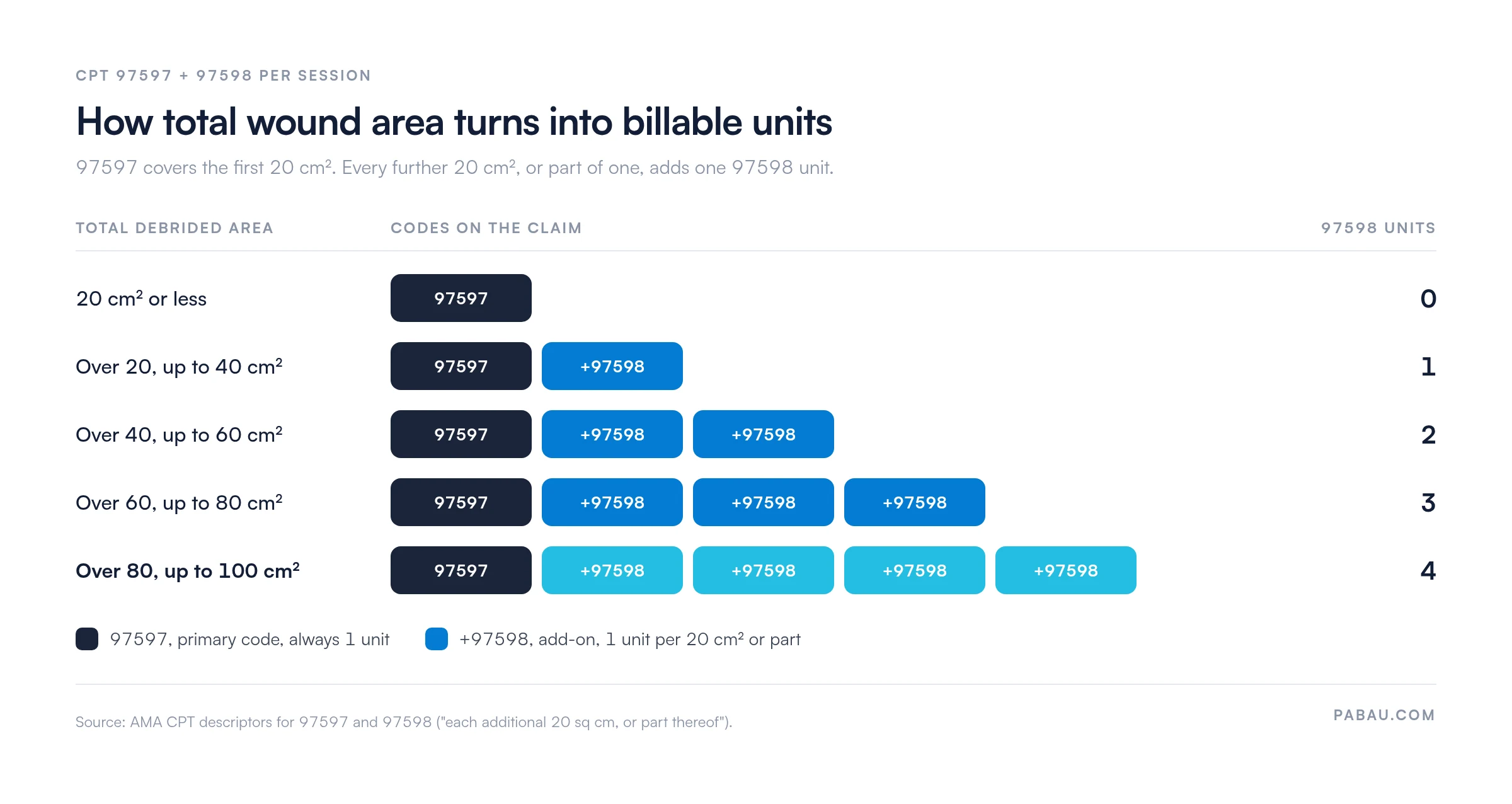
Worked examples:
Every 97598 unit billed must be supported by a documented wound measurement in the medical record. Billing four units without a wound area of at least 81 cm² recorded in the progress note is an overcoding violation. Document the measurement before submitting the claim, not after.
Measure wound area in cm² at each visit using a sterile measuring device and record the length-times-width calculation in the progress note. Some payers audit unit counts by comparing the documented area against the number of 97598 units billed per date of service. A discrepancy of even one unit can trigger a demand for repayment across all claims in the audit window.
The 97597/97598 pair and the 11042 to 11044 series both describe wound debridement, but they apply to different depths of tissue. Choosing the wrong series is a common miscoding error in wound care billing.
The key decision point is tissue depth and technique, not wound size or the instrument in the clinician’s hand.
Billing the 1104x codes for a selective procedure is upcoding, and billing 97597/97598 for an excisional one is downcoding. Both create audit and compliance exposure.
Medicare covers CPT 97598 under Local Coverage Determinations issued by each Medicare Administrative Contractor (MAC). Many MACs reference LCD L33821 (or its successor), which specifies qualifying wound types, visit frequency, and documentation requirements. Because LCD numbers and coverage criteria vary by MAC jurisdiction, verify your specific contractor’s current LCD before billing.
Qualifying wound types commonly covered under Medicare LCDs include:
Commercial payers generally follow Medicare criteria but may impose additional prior authorization requirements or lower frequency limits. Always check the payer-specific policy before the first visit and document medical necessity explicitly in each progress note. Claims that lack a wound-type diagnosis consistent with the payer’s LCD are among the highest-volume denial reasons for 97598.
Medicare pays for CPT 97598 at a lower rate than the primary code 97597 because it covers an incremental area, not a full session. Rates below are national averages from the 2025 Medicare Physician Fee Schedule and vary by geography through Geographic Practice Cost Index (GPCI) adjustments.
Use the CMS Physician Fee Schedule lookup tool for your locality’s current payment amount.
These are approximate national averages. Your payment varies by locality, practice setting, and whether the provider participates in Medicare. For RVU breakdowns and locality adjustments, the FastRVU lookup tool provides current Work, Practice Expense, and Malpractice RVU values for 97598. It also shows the GPCI multipliers for your geographic area.
Every unit of CPT 97598 billed must be supported by a corresponding entry in the medical record. Missing or vague documentation is a leading reason claims pass initial submission but fail on post-payment audit. Each visit note must contain all of the following:
Good medical billing compliance in wound care starts with a progress note written to answer an auditor’s likely questions. Without a recorded measurement, no unit count can be defended, however large the wound was.
Claim denials for CPT 97598 cluster around a small number of predictable errors. Most are preventable with a pre-submission checklist, and each returns a reason code, so knowing the common denial codes speeds up the fix.
For practices with recurring wound care denials, tracking denial reason codes per CPT code exposes systematic errors faster than reviewing claims one by one. Submitting a clean claim the first time avoids the 30- to 60-day resubmission delay that squeezes cash flow in wound care practices.
Modifiers add specificity to 97598 claims and are sometimes required to prevent automatic denial. The table below covers the most frequently used modifiers and when each applies.
The providers eligible to bill CPT 97598 depend on the payer, the billing method, and the clinical setting. Several provider types may bill this code, subject to scope-of-practice rules that vary by state:
Settings where CPT 97598 may be billed include physician offices, hospital outpatient departments, skilled nursing facilities (SNF), and outpatient wound care centers. Incident-to billing rules are complex, and misapplying them is a frequent compliance finding. Always confirm your MAC’s current incident-to policy before billing 97598 under a supervising provider’s NPI.
If your wound care team includes non-physician providers who perform most of the debridement, have a compliance consultant review your incident-to billing structure annually. CMS auditors specifically target wound care practices where the billing provider (physician) rarely appears in the progress notes as the performing provider.
Accurate claim submission for CPT 97598 requires several decisions made before the claim leaves the practice. This step-by-step sequence covers the full process from wound measurement to submission.
The goal is one auditable package: the clinical note, the code selection, and the claim form, all agreeing before submission. Claims tend to break at two points, the diagnosis pairing in step 4 and clearinghouse validation in step 7. Those two steps cause many of the cash-flow delays in outpatient wound care.
Many 97598 denials start before the claim is built. The wound is measured in one place, the code is picked in another, and the unit count is worked out by hand. When the three disagree, the claim fails an edit or an audit.
In Pabau, the measurement, the CPT code pair and the unit count sit in the same patient record as the progress note. Our claims management software builds the claim from that record. It then sends the claim through the Claim.MD clearinghouse integration, which checks code pairs before the payer sees them.
The result is fewer rejected add-on lines and an audit trail showing how each 97598 unit was earned. Your billing team spends its time on new claims instead of rework.

Pabau keeps wound measurements, CPT codes and units in the same patient record, then sends wound care claims through its Claim.MD clearinghouse integration.

Treat the wound measurement as the source document for the claim. If the note records total area, tissue depth and technique, the 97597 and 97598 lines follow directly. An auditor can then rebuild the unit count from the chart.
The trade-off worth remembering is depth. Once tissue removal reaches subcutaneous fat, 97598 is the wrong code however large the wound is, and the 1104x series takes over.
Get those two decisions right at the point of care and the rest of the claim is arithmetic. Book a demo to see how Pabau carries wound measurements from the progress note into a clean 97597 and 97598 claim.

Need a clearinghouse for wound care claims? Medical claims clearinghouse guide explains how clearinghouses validate CPT code pairs and route claims to payers.
Getting repeated denials on wound care billing? Denial codes in medical billing covers the most common CARC denial reasons and how to appeal them efficiently.
Want to verify eligibility before each wound care visit? Insurance eligibility verification walks through the steps to confirm coverage and LCD-qualifying diagnosis codes before the patient arrives.
Is the debridement going deeper than the dermis? CPT code 11043 covers excisional debridement of muscle and/or fascia and how its units are counted.
Switching the wound to negative pressure therapy? CPT code 97605 explains billing for the next active wound care service in the same code family.
CPT code 97598 is the add-on code for selective debridement of each additional 20 cm², or part thereof, of open wound surface. The first 20 cm² is billed under CPT 97597. It covers high-pressure waterjet, irrigation, and sharp selective debridement with scissors, scalpel and forceps. The tissue removed is devitalized epidermis and/or dermis, fibrin, exudate, debris or biofilm.
No. CPT 97598 is an add-on code, marked with a plus sign (+97598) in the AMA codebook, and NCCI edits tie it to CPT 97597. A claim that submits 97598 without 97597 as the primary code is rejected under standard add-on code edits, and payers apply their own edits too.
There is no universal cap in the CPT codebook, but most Medicare LCDs and commercial payers impose per-visit or per-period frequency limits. Each unit must be supported by a documented wound area increment of 20 cm² beyond the primary 97597 coverage. Always verify your MAC’s or payer’s maximum units policy before billing multiple units.
CPT 97598 covers selective debridement of devitalized epidermis and/or dermis, while CPT 11042 covers excisional debridement of subcutaneous tissue. The deciding factor is tissue depth, not the instrument. Sharp selective debridement with a scalpel still maps to 97597/97598 when it stays above the subcutaneous layer. Non-selective methods such as enzymatic agents map to 97602 instead.
Each visit note must document wound dimensions in cm², the calculated surface area, and the specific selective technique used. It also needs a medical necessity statement, the provider’s credentials, and the date of service. The documented cm² must support the number of 97598 units billed. A mismatch between the note and the claim is an audit trigger.
The most frequent denials come from billing 97598 without 97597, overcounted units versus documented wound area, and missing wound measurements. Others include billing 97598 for excisional debridement into subcutaneous tissue or deeper, and exceeding LCD frequency limits. A diagnosis code that doesn’t match the LCD’s covered wound types also triggers denials.



