



CCSD code G5100: Bypass of duodenum billing guide
CCSD code G5100 bills a bypass that leaves the duodenum in place CCSD code G5100...

Last Updated: Oct 16, 2026

CPT code 97605 covers negative pressure wound therapy (NPWT) delivered with a durable medical equipment (DME) pump, on wounds of 50 sq cm or less.
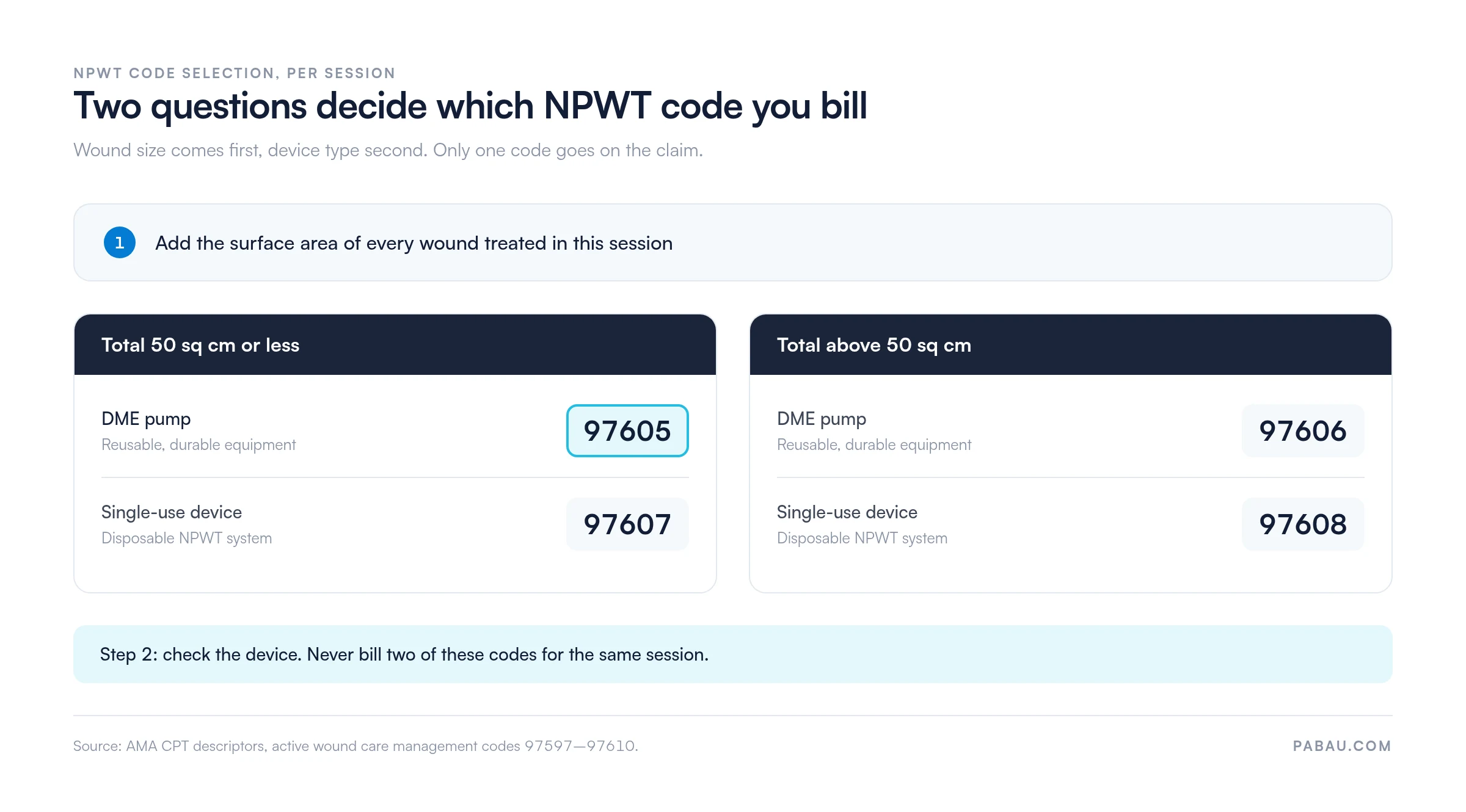
Total wound size picks the code. Bill 97605 at or under 50 sq cm, and CPT 97606 above it.
Medicare pays roughly $42 per session in the office and $21 in a facility, before geographic adjustment.
Coverage needs a qualifying ICD-10 diagnosis and a documented trial of conservative wound care that did not work.
Pabau pre-fills the claim from the wound note, checks the required fields, and files it through Claim.MD.
CPT code 97605 bills negative pressure wound therapy (NPWT) delivered with a durable medical equipment (DME) pump. It applies when the wounds treated in one session total 50 square centimeters or less. Cross that line and the claim belongs to 97606 instead.
That one measurement drives most NPWT denials, so it pays to settle it before the claim is built. Here is the descriptor, Medicare’s rate, the ICD-10 pairings, the session documentation, and the errors that send claims back.
CPT code 97605 pays for a single NPWT session. That session includes applying or changing the dressing, assessing the wound, and teaching the patient how to manage care between visits.
The American Medical Association (AMA) maintains the code inside the active wound care management family, codes 97597 to 97610.
Read the descriptor as four separate requirements. Fail any one of them and the service is not 97605.
Two phrases in that descriptor do the heavy lifting. Durable medical equipment rules out single-use systems, and “per session” means the number of wounds never changes the units you bill.
NPWT applies sub-atmospheric pressure to the wound bed through a sealed dressing connected to a pump.
The suction draws off excess exudate, reduces swelling, and encourages granulation tissue to form. Clinicians reach for it when a chronic wound has stalled under standard moist wound care.
Two questions settle it, and the order matters. Total the surface area of the wounds you treated, then confirm which kind of pump delivered the therapy.
The chart below runs both in sequence.
Each code also maps onto a familiar clinical picture.
Key rule: when you treat several wounds in one session, add their areas together. A combined total of 50 sq cm or less is 97605. A larger total is 97606. Never put both codes on the same session.
Medicare pays about $42 per session in the office and about $21 in a facility. Those are national figures under the CMS Physician Fee Schedule (PFS), before any geographic adjustment.
The math behind those numbers is public. CPT code 97605 carries 1.260 total RVUs in the non-facility setting and 0.630 in the facility setting. Multiply either by the current conversion factor and you land near $42.09 and $21.04.
Your own rate will differ from both figures. The Geographic Practice Cost Index (GPCI) moves every locality up or down, so check the CMS PFS tool for the amount your contractor actually pays.
Run an eligibility check before each session rather than after it. The check confirms active Part B coverage and tells you whether the patient’s MAC wants prior authorization or a KX attestation on the claim.
Check the coverage policy that applies to your claim before you bill. The pump itself sits under the joint DME MAC policy, LCD L33821, Negative Pressure Wound Therapy Pumps. A/B MACs may publish their own wound care policies on top of it, and covered indications, documentation and modifier rules all shift by jurisdiction. Billing against the wrong policy is a reliable way to attract an audit.
Medicare needs a covered ICD-10 diagnosis on the claim to establish medical necessity. The diagnosis has to describe a wound type the applicable policy covers, at the level of detail that policy asks for.
Vague codes are a routine denial cause. A general skin ulcer code with no laterality or depth invites a records request instead of a payment. The CMS ICD-10-CM code files publish the full valid set each year.
Pick the most specific code the documentation supports. For a diabetic wound, that means the diabetes type, the site, and the ulcer depth. For a pressure injury, it means the location and the confirmed stage.
Document every element of the descriptor, plus the clinical picture that justifies NPWT. Miss one and the claim can fail a clean-claim edit before a reviewer ever opens the chart.
Store wound photographs, measurement records, and session notes where you can produce them on demand. A retrospective audit asks for the whole episode, and paper charts rarely hold the detail a reviewer wants.
Modifiers tell the payer something the code alone cannot. The wrong one, or a missing one, stalls the payment. Rules shift by contractor, so check your active policy before you submit.
One caution on KX: the modifier attests that every coverage criterion is documented, so add it only when that is true. Applying it out of habit is exactly what a post-payment review looks for.
Coverage policy decides which wounds qualify for NPWT. Bill 97605 for an indication the policy excludes and the claim is denied, however complete the note is.
Typically covered wound types:
Commonly non-covered scenarios:
Most 97605 denials trace back to a short list of preventable errors. Reading your remittance against the common denial codes shows which of them is costing you money before the pattern spreads.
Debridement is the usual flashpoint. Where a distinct debridement is documented, CPT 11042 can sit on the same claim with modifier 59. Same wound, same session and no modifier means a bundling denial. Selective debridement is sized in its own units. The first 20 sq cm bills as 97597, and each additional 20 sq cm adds 97598.
Build the superbill before the patient leaves the room. Capture wound size, device type, ICD-10 code and any modifier while the session is fresh. Practices that reconstruct billing data from a progress note two days later are the ones that lose measurements. A missing measurement is the hardest denial to appeal.
Wound care billing usually breaks at the handoff. The measurement lives in the clinical note and the code lives in the billing system. Somebody has to carry one across to the other without dropping a detail.
Practice management software like Pabau closes that handoff. Its simpler claims management tools build the claim from the record you already wrote. The CPT code attached to the service lands on the charge line, and the ICD-10 slots are seeded from the client’s recorded problem list.
Before a claim can go out, Pabau checks that the required fields are complete. A missing membership or authorization number gets caught at the desk, not at the payer. Built-in CPT and ICD-10 lookup libraries sit behind a search icon, so the coder is not switching to a separate reference to confirm a code.
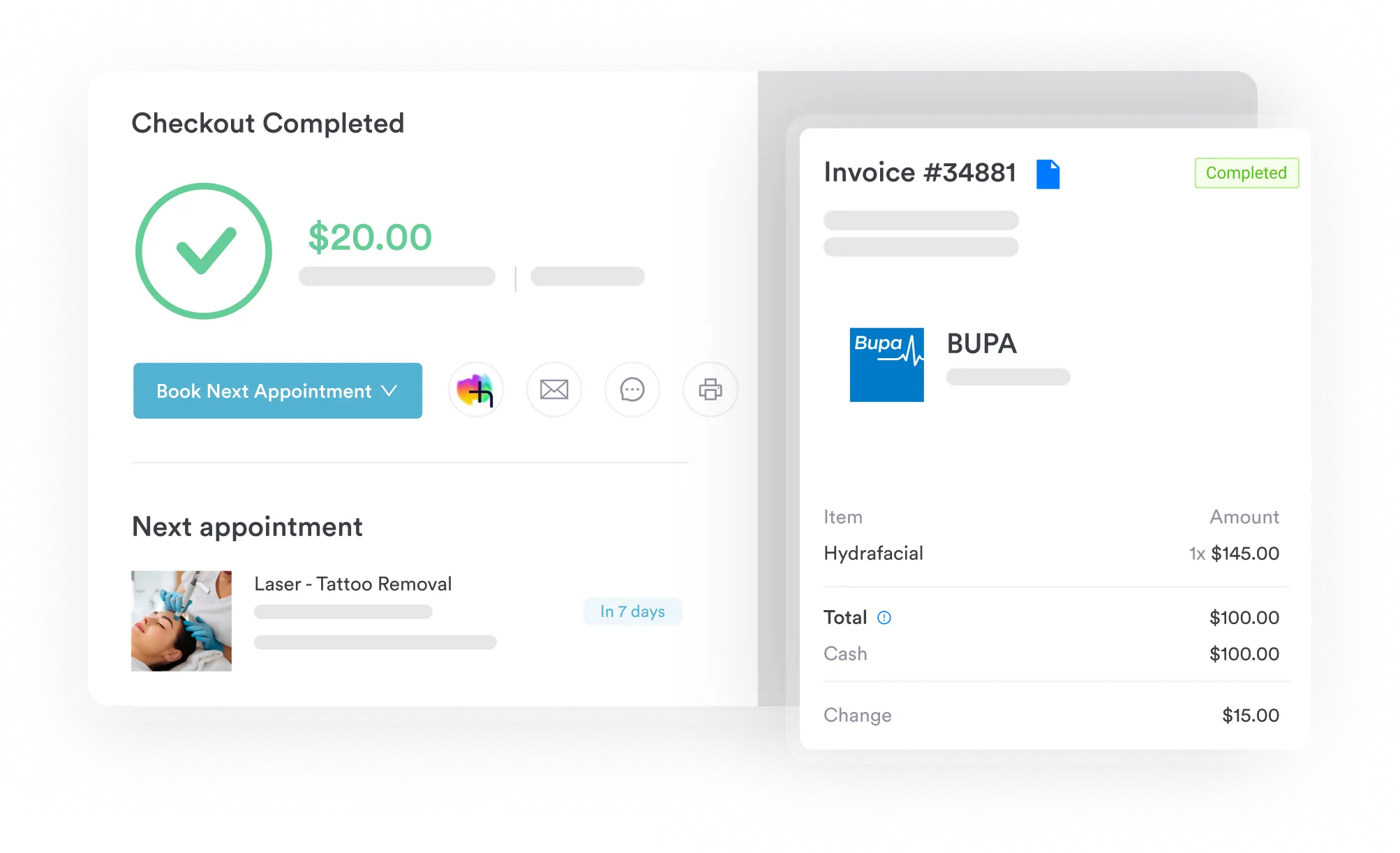
For US practices, Pabau files through the Claim.MD clearinghouse, which reaches thousands of US payers including Medicare. Eligibility checks run before the session starts. After adjudication, electronic remittance advice posts back automatically, so a denial surfaces the same day the payer responds.
For a wound care practice, that means fewer round trips. The session note, the claim, and the payer’s answer live in one system, so the billing team is not chasing detail across three screens.

Pabau builds each claim from the wound note you already wrote, checks the required fields, and files it through Claim.MD with remittance posted back automatically. See how it fits a wound care workflow.

CPT code 97605 is a simple code with an unforgiving claim. The area calculation, the device type, the diagnosis, and the conservative care trial all have to agree with each other and with the note.
Which means the work sits upstream of billing. Practices that measure and document at the bedside, in a form the claim can use, rarely see these denials. Practices that rebuild the session from memory see them every month.
If NPWT denials are eating into your margin, the fix is usually a workflow change rather than a coding one. Book a demo to see how Pabau carries a wound note through to a paid 97605 claim.

Billing the debridement that came first? CPT code 97597 billing guide covers active wound care management and the selective debridement that often precedes NPWT.
Sending claims through a clearinghouse? Claim.MD clearinghouse guide explains how 837P submissions reach Medicare and commercial payers.
Reading a rejection report? 837 file billing guide breaks down the EDI 837P format and the transaction-level errors it flags.
Denials piling up across codes? Denial management in healthcare sets out a process for working, appealing and preventing them.
Checking coverage before the visit? Insurance eligibility verification shows what to confirm at intake so a session is never billed into a lapse.
Yes. CPT code 97605 pays only for the clinician’s session work. The pump itself is durable medical equipment, so the supplier bills it as a rental under HCPCS code E2402. Dressing sets fall under A6550 and the collection canister under A7000.
Yes. CPT code 97605 is a sometimes therapy code. When a physical or occupational therapist performs the session, Medicare treats it as a therapy service. The claim then needs an outpatient therapy plan of care and the matching therapy modifier, GP, GO or GN.
The DME MAC policy caps pump rental at four months of therapy for the most recent wound. Time on NPWT before discharge from an inpatient stay counts toward that limit. Past four months on the same wound, the KX modifier no longer belongs on the rental claim.
No. The descriptor bundles topical application, wound assessment and patient instruction into one per-session payment. A dressing change without a negative pressure device is not NPWT, so 97605 does not apply. Bill the code that describes the work you actually did.



