



CCSD code G5100: Bypass of duodenum billing guide
CCSD code G5100 bills a bypass that leaves the duodenum in place CCSD code G5100...

Last Updated: Oct 16, 2026
CPT code 97602 covers non-selective wound debridement performed without anesthesia, billed once per session. The methods it covers are wet-to-moist dressings, enzymatic agents, abrasion, and larval therapy.
One rule shapes how the rest of it works. Medicare assigns 97602 status indicator B, so a physician or non-physician practitioner is never paid separately for the session. Separate payment arises only on the outpatient therapy side, and the claim then needs a therapy modifier.
That matters to anyone forecasting revenue or working a denial queue, because a line billed in hope of payment comes back denied. This guide covers the descriptor, the bundling rule, supporting ICD-10 codes, modifiers, and the documentation that holds up under review.

CPT code 97602 covers non-selective wound debridement without anesthesia, billed once per session regardless of wound count.
Medicare assigns CPT 97602 status indicator B, so physician-billed and NPP-billed sessions are bundled into payment for other services.
Separate payment arises only where the session is a therapy service, and the claim then needs a GP, GO, or GN modifier.
Documentation must include wound location, size, depth, tissue type, and the clinical rationale for the method chosen.
Practice management software like Pabau connects the wound care note to the claim, with documentation templates, code lookup, and electronic submission.
The descriptor from the American Medical Association (AMA) reads “removal of devitalized tissue from wound(s), non-selective debridement, without anesthesia.” A parenthetical then names the methods, namely wet-to-moist dressings, enzymatic, abrasion, and larval therapy.
The descriptor closes with “including topical application(s), wound assessment, and instruction(s) for ongoing care, per session.”
The code sits in the Physical Medicine and Rehabilitation section of the CPT code set, under the Active Wound Care Management subsection.
Three features fix its scope. Debridement must be non-selective, so the method does not distinguish viable tissue from dead tissue. Anesthesia cannot be involved. Wound assessment and patient education belong to the session itself, not to a second code.
Use 97602 when a wound needs active management and the method applied does not discriminate between tissue types.
The clinical picture should not call for selective debridement or surgical intervention. Medicare coverage runs through local coverage determinations (LCDs), which set the medical necessity criteria.
Common covered wound types and clinical situations include:
LCD policies vary by Medicare Administrative Contractor (MAC) jurisdiction. Read the LCD for your state before the first session rather than after the first denial. Then document why this wound, at this visit, needed a non-selective method.
The most consequential decision in wound care coding is 97602 versus 97597. Miscoding between them is an active audit target, because the clinical distinction changes both coverage and payment.
A worked example makes the line clear. A nurse softens a sacral pressure injury with a wet-to-moist dressing and books the patient back in three days. No tissue was cut away, and the dressing does the work over the next few days. That session is 97602.
The following week the physician takes a curette to the same wound and removes slough down to a clean bed. That session is 97597, priced by the square centimeter of wound surface.
The payment consequence follows the coding one. A physician who codes the session as 97602 receives no separate Medicare payment. The same session, correctly coded as 97597, is separately payable. Describe the method precisely in the note. That is a reason for precision, never permission to reach for the higher code.
Every 97602 claim needs a supporting ICD-10-CM diagnosis code that establishes medical necessity. The table below lists the codes wound care practices reach for most often.
ICD-10-CM is updated every October 1, so check validity against the CMS ICD-10 code files before billing.
Pick the code that matches the patient’s confirmed diagnosis, at the highest specificity the record supports. Where a comorbidity drives the wound, such as diabetes behind a foot ulcer, code the underlying condition alongside it.
Codes are added, revised, or retired every October 1. Practices that audit their most-used ICD-10 list once a year catch a retired code before a payer does.
Missing documentation drives more 97602 denials than any coding error does. The Centers for Medicare and Medicaid Services (CMS) and the MAC local coverage determinations set the bar. Eight elements belong in the clinical record for every session billed.
Build these into the note template rather than chasing them afterwards. A wound care note typed into a blank text box tends to drop one of the eight.
Review your wound care notes against the eight-element checklist above before submitting any claim for CPT 97602. Flag any session note that is missing wound dimensions or a debridement method description. Incomplete notes should be corrected before claim submission, not after a denial.
No modifier converts 97602 into a separately payable line for a physician. What modifiers do is route the claim correctly. Which one applies depends on the payer, the service setting, and what else is billed that day.
Check the National Correct Coding Initiative (NCCI) edits for this code before you apply any of them, since the edits are updated quarterly.
Treat the table as a starting point, not a payer instruction. Requirements change annually and vary by payer, so confirm against the policy you are billing under. A quarterly modifier audit catches the drift before it turns into a run of denials.
Medicare pays a physician or non-physician practitioner nothing extra for CPT code 97602. The code carries status indicator B on the Medicare Physician Fee Schedule, which bundles payment into the payment for other services. In the 2026 National Physician Fee Schedule Relative Value File, every RVU field for 97602 reads 0.00.
Those zeros are a deliberate designation rather than missing data, and the neighboring codes show why. Codes 97597 and 97598 sit in the same CMS relative value file with status A and carry nonzero RVUs.
From there, who bills the session decides what happens next, and the routes split five ways.
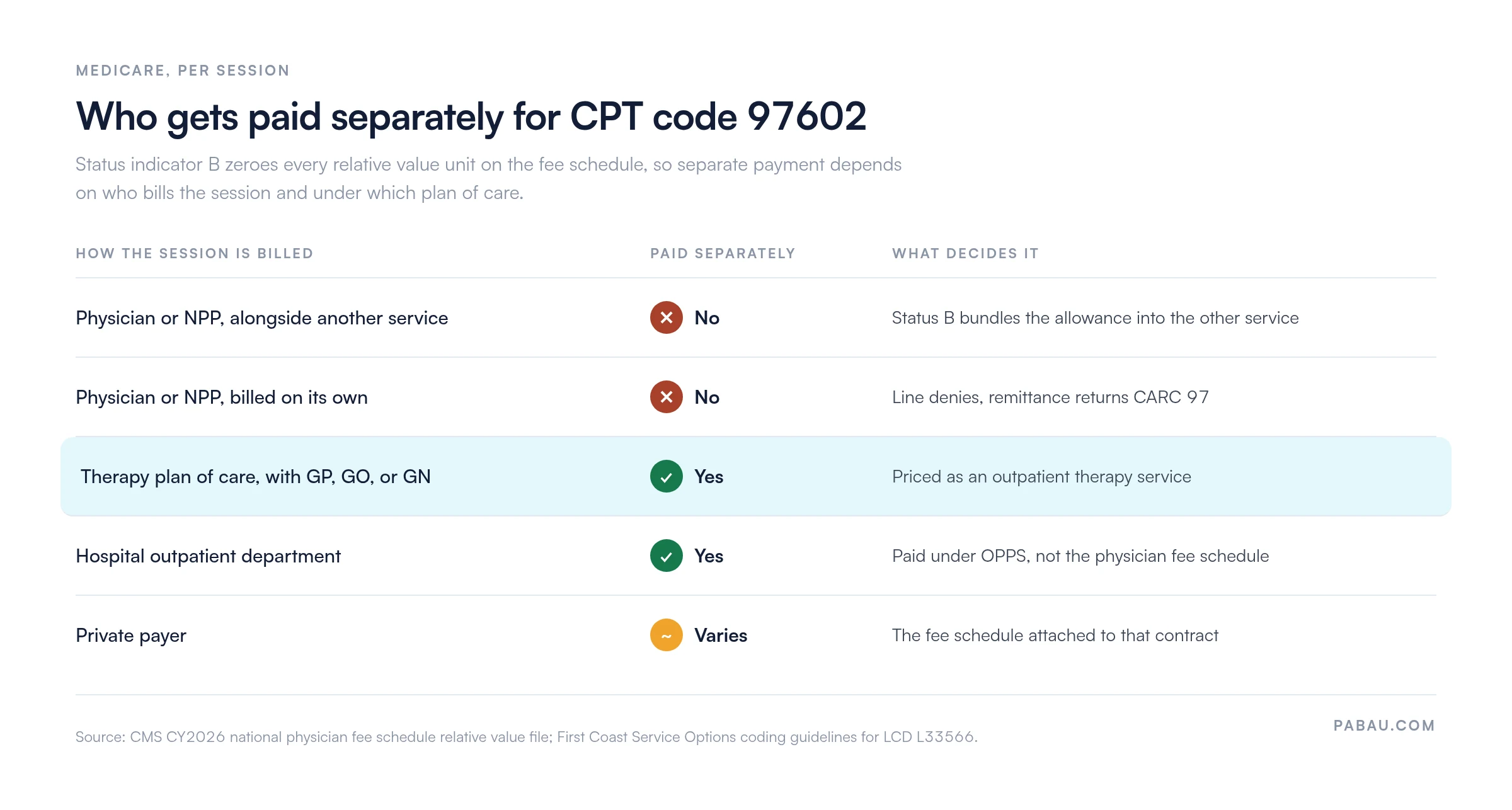
First Coast Service Options states the rule directly in its CMS-hosted coding guidelines for LCD L33566. CPT 97602 “represents services that have a B-status Indicator on the Medicare Fee Schedule for physician’s services. Therefore, these services are bundled into payment for other services.”
The same document confirms that physicians, NPPs, and therapists may all perform the service within their scope of practice. Who is allowed to perform it and who gets paid separately for it are two different questions.
Separate payment arises on the outpatient therapy side. CMS classifies 97602 as a “sometimes therapy” code, so the service counts as a therapy service whenever a therapist performs it. It also counts as therapy when a physician or NPP furnishes it under an outpatient rehabilitation plan of care.
The claim then has to carry the matching therapy modifier. GP covers physical therapy, GO covers occupational therapy, and GN covers speech-language pathology.
The therapy revenue code goes on the claim alongside it. A hospital outpatient department is paid for 97602 under OPPS rather than the Physician Fee Schedule, per CMS transmittal R805CP.
Billing without the therapy modifier, or billing the code alone on a physician claim, produces the same result. The line denies, and the remittance returns claim adjustment reason code 97, “Payment is included in the allowance for another service/procedure.”
Take CPT 97602 out of any revenue forecast built on a per-session rate. It earns its place in the chart as documentation of medically necessary wound care. That record supports the E/M or therapy service Medicare does pay. If your practice management report shows expected revenue against 97602 lines, the report is measuring something Medicare will never pay.
The wound assessment and patient instruction delivered during the session are what support those payable services. When a bundled line does reach a claim, the denial returns on the electronic remittance advice with CARC 97 attached. Billing staff can then read the reason without calling the payer.
Confirm the current designation before you plan around it. The status indicator lives in the CMS Physician Fee Schedule Relative Value Files, published each year and revised quarterly.
Wound care claims attract a disproportionate share of denials, and nine patterns account for most of them. They come from published MAC guidance and from what coders report seeing on remittances.
Sort these before you work them. A CARC 97 on a physician-billed 97602 line is the system behaving as designed, so reworking it wastes the hour. A medical necessity denial on the same claim is a documentation problem you can fix.
Our guide to denial codes in medical billing maps the CARC and RARC codes that turn up on wound care remittances. Working from that list beats guessing at what a three-digit code meant.
Medicare covers CPT code 97602 as a medically necessary service, and the physician claim still draws no separate payment. Coverage comes from the MAC local coverage determination for your jurisdiction, which sets covered indications, required documentation, frequency limits, and provider eligibility.
Covered status does not produce a separate payment on a physician claim, because status B bundling applies regardless. Noridian and other MACs publish these policies openly, so search the CMS Medicare Coverage Database for the LCD that applies to your state.
Medicaid varies widely by state. Some states cover 97602 at parity with Medicare, others restrict coverage to specific wound types or require prior authorization. Contact your state Medicaid program or managed care organization for current rules.
Private payers generally follow Medicare coding logic but set their own fee schedules and prior authorization requirements. Some pay 97602 as a separate line, others mirror Medicare and bundle it. Review each active payer contract for wound care provisions before the first session.
A consistent workflow catches errors before the claim leaves the practice. These six steps reflect standard coding guidance from CMS and the AAPC. Verify each one against your own payer requirements.
A wound care charge template that pre-populates 97602, 97597, 97598, and the supporting ICD-10 codes removes most of the manual entry. Flag 97602 in that template as bundled for physician billing, and the same question stops coming back every quarter.
Build a wound-care-specific superbill or charge capture template that lists CPT 97602, 97597, and 97598 alongside the six most common supporting ICD-10-CM codes. Clinicians then select the correct combination at the point of documentation, reducing downstream coding review time by eliminating free-text entry of codes.
Wound care billing carries a heavier documentation load than most outpatient work. Practices that run it across a separate EHR and a separate billing tool pay for that split twice. The cost shows up in rework, and again in days spent in accounts receivable.
Practice management software like Pabau keeps the whole path in one record. Its claims management software pre-fills the claim from the wound assessment note, so nobody retypes the codes. Required fields are checked for completeness before submission, and a code lookup library saves hunting for the supporting ICD-10 code.
Claims go out electronically through Claim.MD, and remittances come back attached to the claim record with their denial reason codes. Billing staff see what failed without opening a second portal. Bundling denials sort into their own bucket, so the team stops reworking CARC 97 lines that are behaving exactly as Medicare intends.

Pabau’s claims management software carries the wound care note through to the claim, so documentation, submission, and remittance sit in one record. See how it fits your workflow.

Treat CPT code 97602 as a documentation code rather than a revenue line. Medicare bundles it on every physician and NPP claim, so the money follows the E/M or therapy service that the note supports. Practices that accept that stop chasing CARC 97 denials.
Two habits do most of the work. Record the wound’s dimensions, tissue type, and method at the point of care. Then flag 97602 in your charge template as bundled, so nobody bills it expecting a check. To see how one claims workflow carries wound care documentation through to remittance, book a demo.

Working a wound care denial queue? Denial codes in medical billing maps the CARC and RARC codes that turn up on remittances.
Want fewer rejections at the clearinghouse? Clean claim requirements covers the elements every claim must carry to pass a technical edit.
Debriding deeper than skin? CPT code 11043 explains how surgical debridement of muscle and fascia is reported and paid.
Billing the dressings as well as the session? HCPCS code K0745 covers how absorptive wound dressing supply is billed.
Billing wound care alongside other specialties? Best medical billing software for US practices compares the leading platforms by specialty fit and clearinghouse integration.
Yes. The code is active in the CY2026 national physician fee schedule relative value file, still carrying status indicator B with every RVU field at 0.00. Its bundled treatment did not change for 2026.
No. It is reported once per session, whatever the number of wounds treated or minutes spent. Selective debridement is the family that scales, with 97597 and 97598 measured in square centimeters of wound surface.
CPT 11042 is surgical debridement of subcutaneous tissue, reported by wound surface area. It sits in the integumentary surgery section rather than active wound care management. The two should not be reported for the same wound on the same date.
Yes, where the session is billed as a therapy service under a plan of care. Those claims carry GP, GO, or GN, and they apply to the annual outpatient therapy threshold. Add modifier KX above the threshold when the record supports continued care.
The line denies. The remittance returns CARC 97, which reads “Payment is included in the allowance for another service/procedure.” A physician claim gets the same result either way, because status B bundling applies with or without a modifier.



