

HCPCS Code Q4185: Cellesta flowable amnion billing guide
HCPCS Code Q4185: definition and official descriptor HCPCS Code Q4185 is the Lev...

Last Updated: Nov 20, 2026
S5712 is the CCSD code for debridement of wound (and surgical toilet) over 25cm² in area. CCSD (Clinical Coding and Schedule Development) is the procedure schedule used by UK private medical insurers.
The wound area decides the code. A wound of 25cm² or less is coded S5710, and surgical toilet of a deep wound is coded S5730.
Let Pabau's smart automation suggest the right codes, reduce claim denials, and keep your practice compliant—effortlessly.
Automate repetitive tasks and focus on what matters most—your patients.
Reduce coding errors and ensure compliance with the latest regulations.
Clean claims, fewer denials, and faster reimbursements.
Powerful insights and reporting to help your practice thrive.
HIPAA compliant SOC 2 certified GDPR-compliant Trusted by 4,000+ clinics worldwide

CCSD code S5712 covers sharp or surgical debridement with surgical toilet of a wound over 25cm² in area. The measured area must appear in the notes.
A wound of 25cm² or less is coded S5710. Billing S5712 for a smaller wound is upcoding and a common audit query.
AXA Health’s CCSD schedule grades S5712 as Minor, with a £150 procedure fee. Bupa, Aviva and other UK insurers set their own fees and rules.
AXA Health lists 12 codes that cannot be billed with S5712, including S5710, S5730 and the S4182 and S4183 debridement-and-suture codes.
Pabau, a practice management platform, records wound measurements at the point of care and submits CCSD-coded claims to UK insurers through Healthcode.
S5712 is the CCSD code for debridement of wound (and surgical toilet) over 25cm² in area. AXA Health’s published CCSD schedule lists it under that descriptor, next to S5710 for wounds up to 25cm².
CCSD stands for Clinical Coding and Schedule Development. It is the procedure schedule that UK private medical insurers and hospitals use to code treatment, and it is maintained by the CCSD Group.
CCSD does not set fees. Each insurer, including Bupa, AXA Health, Aviva and VitalityHealth, sets its own reimbursement, pre-authorisation and co-billing rules. Claims are usually sent electronically through Healthcode, the UK clearing service for private medical bills.
S5712 sits in Chapter 15 of the schedule (Skin and subcutaneous tissue), in sub-chapter 15.2, Repair. General surgeons, plastic surgeons, dermatologists and wound care specialists bill it most often, for chronic or traumatic wounds. Pabau’s guide to Bupa CCSD codes explains how the schedule is structured and billed.
The 25cm² threshold defines the code on its own. A wound of exactly 25cm² falls under S5710, because S5712 needs the area to exceed it. The measured area therefore decides both the claim and how it fares at audit.
Wound debridement and surgical toilet over 25cm² is an operative procedure, with its own preparation, instruments and aftercare.
A typical procedure covers these steps:
Necrotic and devitalised tissue prevents healing and promotes infection. Removing it surgically and cleaning the wound bed lets healthy granulation tissue form.
Not all debridement is surgical, and code selection depends on method as well as area. S5712 applies to sharp or surgical debridement combined with wound toilet, not to conservative methods. Excising a burn down to viable tissue is a separate procedure, coded by site and area. On the hands or face, up to 9 cm², that code is S5520. On the trunk or limbs, up to 2% of body area, the excision is billed as S5524 burn excision.
When the clinician performs sharp debridement plus wound toilet on a wound over 25cm², S5712 is the correct code. No other debridement method falls under this code, whatever the wound size.
The 25cm² threshold is binary. Above it, S5712 applies. At 25cm² or less, S5710 is the correct code, so the measurement itself carries the claim.
The length x width method is the most widely used approach. Measure the longest axis of the wound (length) and the widest perpendicular axis (width), then multiply. A wound of 5cm x 6cm gives 30cm², which exceeds the threshold and supports S5712. A wound of 4cm x 6cm gives 24cm², so bill S5710 instead.
Pabau’s measurements tracking feature lets clinicians record wound dimensions in the patient record at the time of the procedure.
Other accepted methods include wound tracing on transparent film with planimetry, and digital wound-imaging tools. Whichever method is used, the clinical notes must state:
An undocumented measurement is treated the same as a measurement that did not happen. If an insurer queries the claim and the area is missing from the notes, it will likely decline the claim. That holds even if the clinician recalls a large wound.
Several codes in sub-chapter 15.2 sit close to S5712. Knowing when each applies prevents upcoding, undercoding and duplicate billing queries. The descriptors below follow AXA Health’s published CCSD schedule, and Pabau’s CCSD billing guides cover several of these neighbouring codes on their own pages.
The most common coding error in this family is billing S5712 when the documented area is 25cm² or less. Insurer audits flag this as upcoding. AXA Health grades S5710 and S5712 alike, as Minor with a £150 fee, so the larger code earns no more there.
Check descriptors against the current CCSD schedule and the CCSD Technical Guide, as codes change on the CCSD publication cycle. For a wound closed in the same sitting, see S4183 for trunk and limbs or S4182 for head and neck. A wound covered with a distant pedicle flap is billed under code S1900, which includes closure of the secondary defect. An island skin flap of 9 cm² or more takes the S2000 island flap code.
Taken together, the descriptors give a fixed order of checks. Method comes first, then closure, then depth, and the wound area only decides the last step.
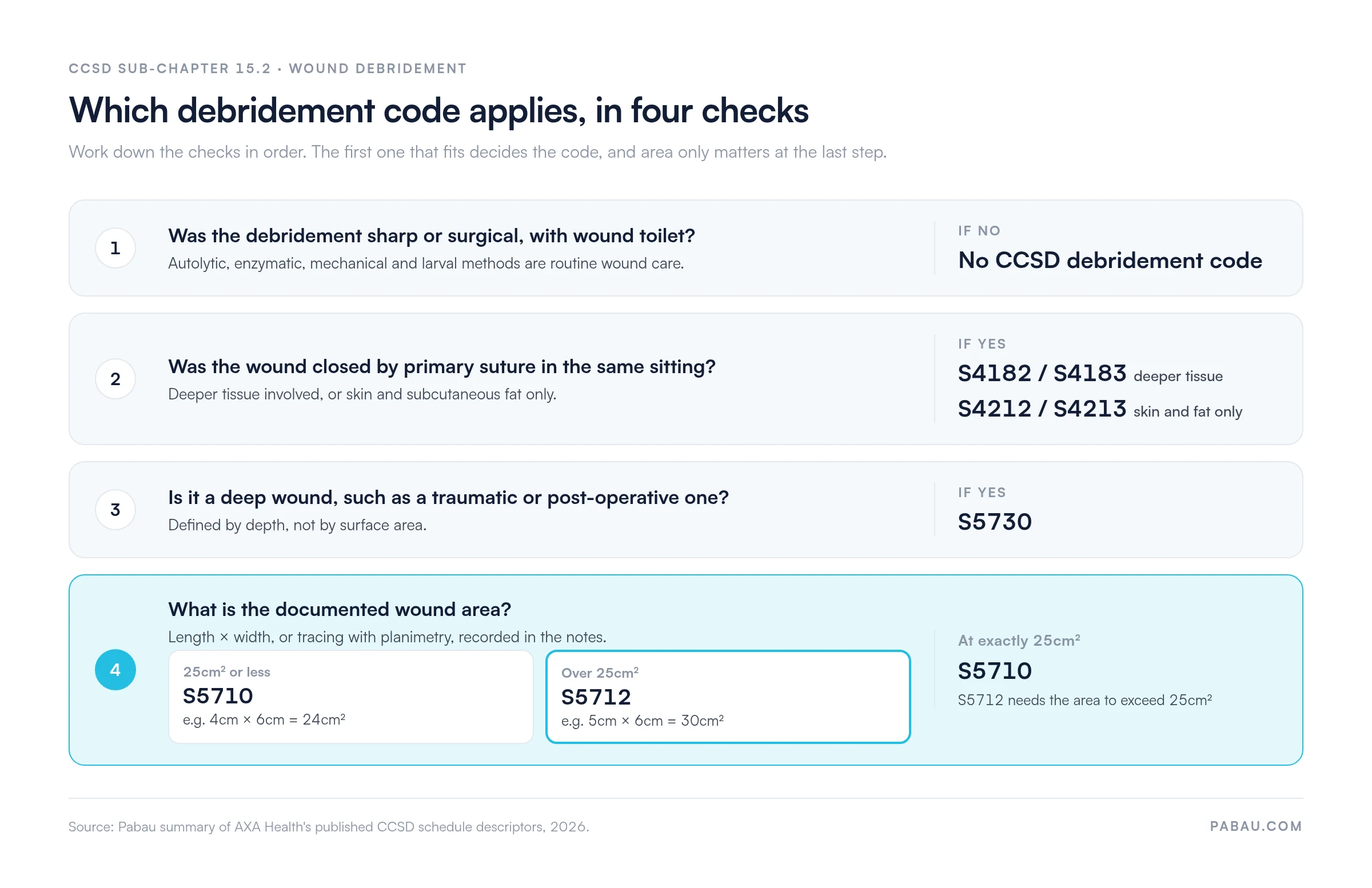
Before billing S5712, run a quick check. Was the debridement sharp or surgical? Was wound toilet performed? Does the recorded wound area exceed 25cm²? All three must be yes. If the documented area is 25cm² or less, bill S5710 instead.
A complete clinical record is what makes an S5712 claim defensible. Insurer auditors read the notes first, and they decline a code the notes do not support, whatever happened in theatre.
Store records in a structured patient record system so every required element is captured during the procedure, not reconstructed afterwards.
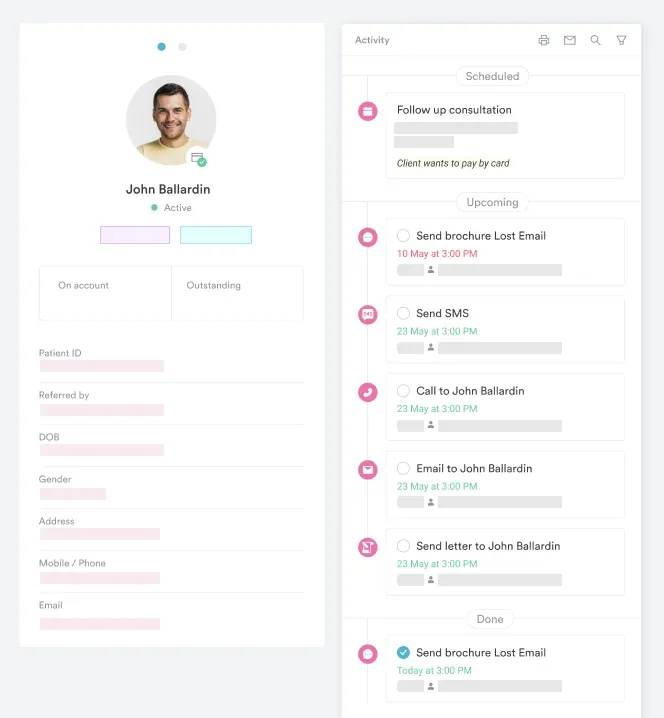
Every S5712 claim should be supported by clinical notes that include:
Use digital clinical forms to standardise wound documentation across your practice. A structured wound assessment form stops mandatory fields being missed and gives every S5712 claim a consistent audit trail.
Most UK private medical insurers expect pre-authorisation before planned treatment. The patient usually contacts the insurer, which issues an authorisation number for the claim. Rules vary by insurer and by policy, so check them before each procedure.
When pre-authorisation is required and not obtained, the insurer may decline the claim, however sound the clinical indication. Record the authorisation number in the notes and the billing file.
Cover is the second check. Many UK policies pay for acute conditions and exclude ongoing care of chronic ones. Repeat debridement of a long-standing ulcer may therefore fall outside the patient’s cover.
Bupa, AXA Health, Aviva, VitalityHealth and WPA each publish their own provider rules. The Bupa code search portal lets providers look up a CCSD code against Bupa’s schedule before treatment.
Where the insurer asks for a diagnosis, the ICD-10 code must match the clinical notes. UK insurers use the WHO ICD-10 classification, not the US ICD-10-CM. Commonly paired codes for wounds needing large-area debridement include:
Prefer a site-specific open wound code over T14.1 when the notes name the body region. An outdated or mismatched code is a common reason for a claim query.
The area threshold makes an S5712 claim easy for an auditor to check. These are the patterns that lead to a query or a declined claim.
Upcoding from S5710 to S5712 carries compliance risk as well as a declined claim. Insurer fraud teams audit coding patterns, and systematic upcoding can lead to recovery of fees already paid.
CCSD has no CPT-style modifiers. What can be billed together is set by the schedule’s unacceptable combinations, and by each insurer’s own rules.
AXA Health’s published schedule lists 12 codes that cannot be billed with S5712:
Other insurers may apply their own lists. Check the current CCSD schedule, which needs a login, and the insurer’s rules before you add a second code. S4720 is the drainage code for a smaller skin lesion or abscess. A large subcutaneous abscess or haematoma has its own drainage code, CCSD code S4740. A haematoma drawn off through a needle and syringe, with no incision, is coded CCSD code S4780 instead.
AXA Health grades S5712 as Minor, with a £150 procedure fee and a £142 fee for general anaesthesia. Bupa, Aviva, VitalityHealth and WPA set their own fees, so confirm the rate with each insurer before you quote the patient.
A consultation may be billed on the same day as S5712 only if a clinically separate consultation took place. The notes must support both. Some insurers ask for evidence that the consultation was more than the pre-procedure assessment.
Some insurers also treat the post-procedure dressing as part of the procedure fee. The WPA medical fees guidance shows the kind of insurer rules that govern these co-billing decisions.
Audit your S5712 claims quarterly. Run a report of every S5712 submission and check that each claim has a wound area in cm² in the notes. Then confirm none carries an unacceptable combination, such as S5710 for the same wound. Catching these patterns internally costs less than answering an insurer audit.
When the wound note and the insurer claim live in separate systems, the measurement an auditor asks for is hard to find. Pabau keeps the notes, the measurement and the claim on one patient record.
An S5712 claim in Pabau’s claims management software runs through these steps:
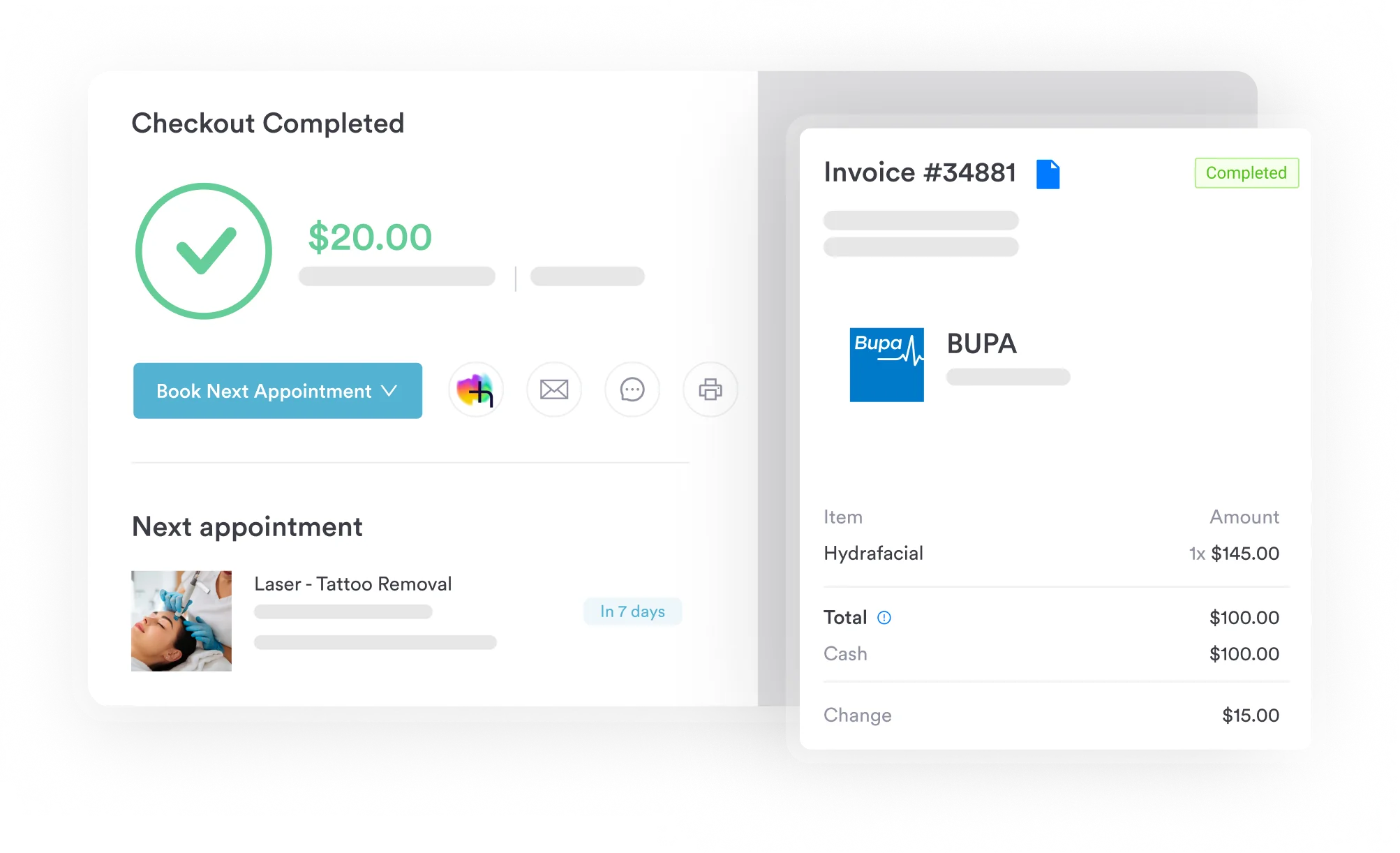
Pabau submits CCSD-coded claims through Healthcode and tracks each one to payment. The clinician still chooses the codes. Pabau links the diagnosis codes the clinician has selected to the claim.
For chronic wound patients seen across several visits, wound measurements tracked over time show healing progress. Each session’s claim then links to its own clinical record.

Pabau helps UK private practices record wound measurements and authorisation numbers at the point of care, then submits CCSD-coded claims to insurers through Healthcode.

S5712 turns on one number and two facts. If the notes show an area over 25cm², sharp debridement and surgical toilet, the code stands. If any one is missing, the claim is open to query.
So measure before you debride, and record the method. Check the policy and the combinations list before you add a second code. For a chronic wound, confirm the policy covers the condition at all.
Book a demo to see how Pabau keeps the measurement, the notes and the Healthcode claim on one record.

Need a broader CCSD billing reference? Pabau’s CCSD codes guide covers the structure of the CCSD schedule, how insurer fee schedules work, and key billing rules across the code family.
Closing the wound in the same sitting? CCSD code S4183 covers debridement and primary suture of a trunk or limb wound with involvement of deeper tissue.
Debriding and closing a head or neck wound? CCSD code S4182 covers debridement and primary suture of a head and neck wound.
CCSD code S5712 covers debridement of a wound and surgical toilet where the wound area exceeds 25cm². It applies when a clinician surgically removes devitalised, necrotic or infected tissue and cleans and irrigates the wound in the same procedure. It does not cover conservative methods such as autolytic or enzymatic debridement, or wounds of 25cm² or less.
S5712 applies when the wound area exceeds 25cm², and S5710 applies to wounds up to 25cm². Both codes cover the same procedure, debridement and surgical toilet, so the area decides which is correct. Billing S5712 when the documented area is 25cm² or less is upcoding and a common audit flag. The two codes cannot be billed together.
Multiply the wound’s longest axis (length) by its widest perpendicular axis (width) in centimetres. The result must exceed 25cm² to support S5712. A wound of 5cm x 6cm gives 30cm², which qualifies. Record the method and the calculated area in the notes at the time of the procedure. Wound tracing with planimetry is an accepted alternative.
UK insurers that use the CCSD schedule can pay for S5712 when the debridement is clinically indicated and the policy covers the condition. CCSD does not set fees, so each insurer sets its own. AXA Health lists a £150 procedure fee. Many policies exclude ongoing care of chronic conditions, and most require pre-authorisation, so check both before treatment.





