HCPCS code G0257: Unscheduled or emergency dialysis billing guide
HCPCS code G0257: Official descriptor and code overview HCPCS code G0257 is defi...

Last Updated: Oct 27, 2026
CPT code 95921 reports cardiovagal testing, the part of an autonomic study that measures how the vagus nerve controls heart rate. To bill it, the report must show at least two of three maneuvers. Those are heart rate response to deep breathing, the Valsalva ratio, and the 30:15 ratio.
That two-test rule decides most claims. A single maneuver is a reduced service billed with modifier 52, while adding adrenergic tilt testing moves the study to 95924. Below, you'll find the 2026 Medicare rate of about $90, the diagnoses payers accept, and what to check before you submit.
Let Pabau's smart automation suggest the right codes, reduce claim denials, and keep your practice compliant—effortlessly.
Automate repetitive tasks and focus on what matters most—your patients.
Reduce coding errors and ensure compliance with the latest regulations.
Clean claims, fewer denials, and faster reimbursements.
Powerful insights and reporting to help your practice thrive.
HIPAA compliant SOC 2 certified GDPR-compliant Trusted by 4,000+ clinics worldwide

CPT code 95921 covers parasympathetic (cardiovagal) autonomic function testing only, not adrenergic or sudomotor testing.
The code requires at least two of three component tests: heart rate response to deep breathing, Valsalva ratio, and 30:15 ratio.
Do not report 95921 with 95922 or 95924 for the same session, because 95924 replaces both when both limbs are tested.
The CY2026 Medicare national payment for 95921 is about $90.18, based on 2.70 total RVUs.
Claims software such as Pabau pre-fills CPT and ICD-10 codes from the patient record and checks required fields, like the authorization number, before sending.
CPT code 95921 reports testing of the parasympathetic, or cardiovagal, limb of the autonomic nervous system. The American Medical Association descriptor reads: “Testing of autonomic nervous system function; cardiovagal innervation (parasympathetic function), including 2 or more of the following:”
At least two of the three listed maneuvers must be performed and documented for the full code. If only one is completed, Medicare billing guidance treats it as a reduced service, so you append modifier 52. Many labs run all three, but the report must show results for at least two.
The code stops at the parasympathetic limb. Adrenergic (sympathetic) testing, sudomotor testing, and combined protocols each have their own code.
With the clinical scope settled, here are the administrative facts a biller checks first. Payment figures come from the CMS Physician Fee Schedule for 2026, before geographic adjustment.
RVUs and the conversion factor change every year with the Medicare fee schedule final rule. The FastRVU lookup tool shows current values, and your locality’s adjustment sets the final amount.
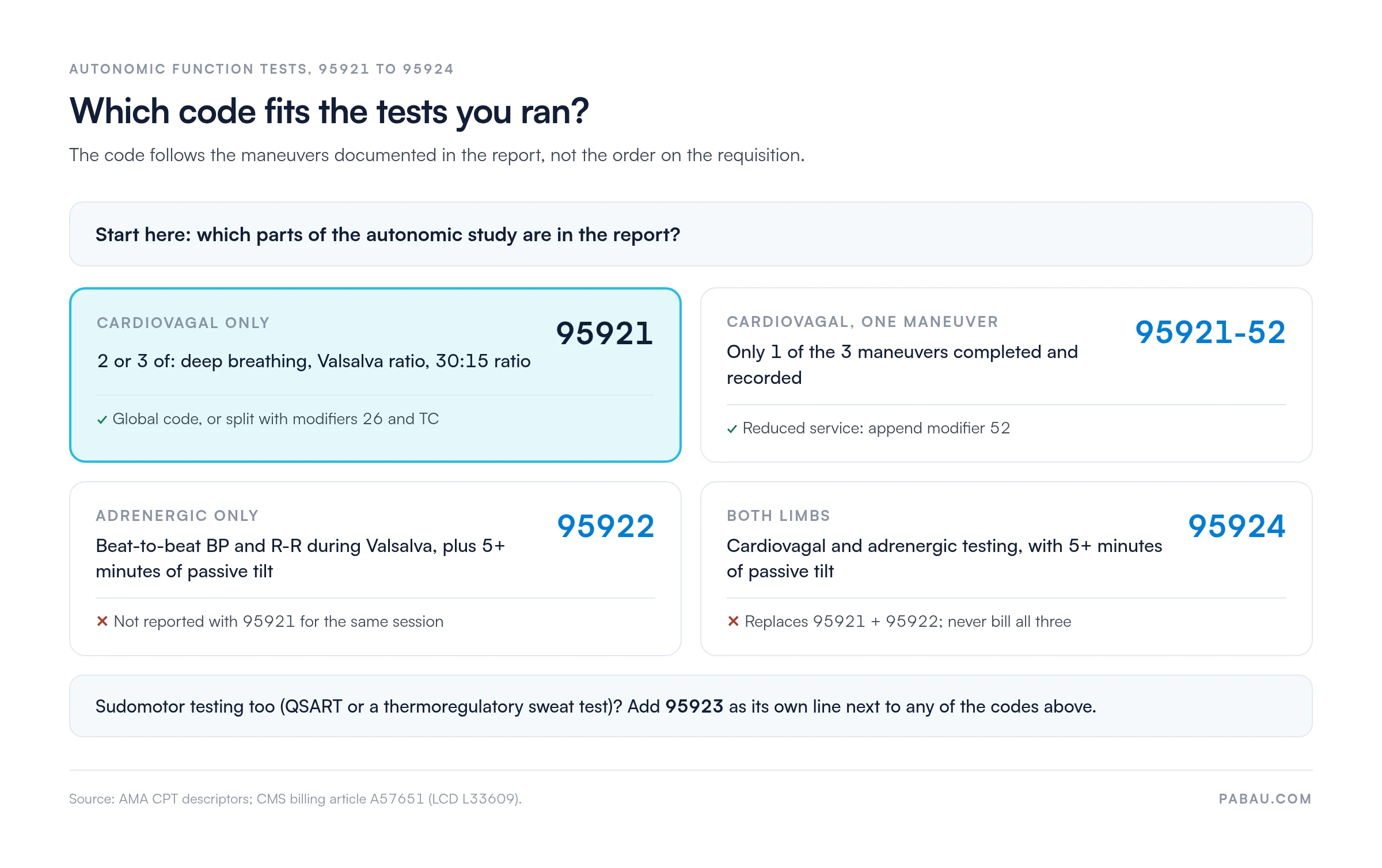
Autonomic testing uses four codes, and each one tracks a different part of the nervous system. Picking the wrong one, or stacking codes that can’t be billed together, is the quickest route to a denial.
So when one session covers both the parasympathetic and adrenergic limbs, bill 95924 alone. Add 95923 only if sudomotor testing was also done and documented. Before billing any pairing, check the current NCCI procedure-to-procedure edits.
In practice, the code choice comes down to which maneuvers made it into the signed report. The chart below walks through each combination.
Once the CPT code is right, the diagnosis has to justify it. Payers check the ICD-10-CM code paired with 95921, and an unaccepted diagnosis is denied however good the report is.
Two rows deserve a second look. POTS has had its own code, G90.A, since October 1, 2022, so it no longer borrows G90.3. Syncope work-ups under R55 need the ordering note to explain why autonomic testing is the next step.
Covered diagnoses vary by Medicare Administrative Contractor (MAC) and change over time. A diagnosis your MAC accepts may still need prior authorization from a commercial payer.
Check the applicable MAC billing article before you bill 95921 with a POTS or syncope diagnosis. Some covered-diagnosis lists include R55 but not G90.A, so confirm the code is listed. Record how long the symptoms have lasted in the ordering note, since payers often ask.
Medicare coverage for 95921 comes from Local Coverage Determinations (LCDs) issued by each MAC.
One example is LCD L33609, Autonomic Function Tests, with its billing article A57651, in the CMS Medicare Coverage Database. Before the visit, run insurance eligibility verification to confirm active coverage and which policy the plan follows.
Most coverage policies look for three things. They want a documented indication, a minimum symptom history, and an ordering clinician who has evaluated the patient.
Coverage tells you whether the test can be paid. Prior authorization (PA) decides whether this particular order will be. Rules vary by payer and plan, so work through these steps for each order.
Auditors reviewing 95921 want to see the descriptor met on paper. In other words, the report has to prove which maneuvers ran and what they showed.
Split billing adds one more requirement. When separate entities bill the technical and professional components, each needs its own records. A modifier 26 claim without a standalone interpretation note is a common audit finding.
Modifiers tell the payer who did what, and how much of the test was completed. These are the ones that apply to 95921.
When one provider performs and interprets 95921 in the office, no modifier is needed, so bill the global code. Place-of-service code 11 (office) covers most outpatient autonomic testing. POS 22 (on-campus outpatient hospital) applies when the test runs in a hospital-based lab.
You can bill 95921 on the same date as an evaluation and management (E/M) visit. The E/M must address a separately identifiable problem, beyond interpreting the test. Document that separate decision-making in the E/M note, and append modifier 25 to the E/M code, not to 95921.
For 2026, 95921 carries 2.70 total RVUs, which works out to about $90.18 nationally. The breakdown below comes from the CMS 2026 national relative value file. Your locality’s geographic practice cost indices (GPCIs) then move the final payment up or down.
The payment uses the 2026 conversion factor of $33.4009, which applies to clinicians who are not qualifying APM participants. Values reset each January, so confirm them before quoting expected reimbursement.
Even a well-run study can come back denied. Most rejections trace to a short list of causes, mapped below to the claim adjustment reason codes (CARCs) you will see on the remittance.
Fixing these before submission costs far less than working them afterward. Getting a clean claim out the first time means checking codes, PA status, and modifiers at charge entry. For the codes you can’t prevent, our guide to medical billing denial codes maps each CARC to an appeal step.
Autonomic testing claims fail on details: a missing PA number, an unlisted diagnosis, or a code typed in twice. Most practices still catch these by hand, line by line, after the study.
Pabau, the practice management platform we build, moves those checks earlier. Its claims management software pre-fills the CPT code and ICD-10 diagnoses from the patient record.
Built-in CPT and ICD-10 lookup libraries help coders confirm each code. Before a claim can be sent, Pabau checks that required fields, such as the authorization code, are filled in.
For US practices, Pabau submits claims through the Claim.MD clearinghouse. Real-time eligibility checks happen before the visit, and electronic remittance advice (ERA) posts back automatically.
As a result, your team spends less time re-keying and more time fixing the few claims that need a person.

Pabau pre-fills CPT and ICD-10 codes from the patient record and checks required fields, like authorization numbers, before a claim is sent. US claims go through Claim.MD, with eligibility checks and ERA posting built in.

CPT code 95921 is simple to define and easy to get wrong. The test itself is rarely the problem. Instead, claims fail when the report, the diagnosis, and the code stop agreeing.
So build the habit into intake rather than appeals. Confirm PA and the covered diagnosis before the patient arrives, and code from the signed report, not the order. A practice that does this turns 95921 into a routine, predictable claim.
Want fewer of those checks done by hand? Book a demo to see how Pabau pre-fills and checks your autonomic testing claims before they reach the payer.

Need to understand clearinghouse submission for neurology claims? Medical claims clearinghouse guide covers how electronic claim transmission works end-to-end.
Want to reduce claim rejections before they reach the payer? How to submit a clean claim explains front-end validation and common CMS-1500 errors.
Billing a tilt table study as well? CPT code 93660 covers cardiovascular function testing with a tilt table.
Worried about audit exposure on diagnostic testing? Medical billing compliance explains the rules auditors check and how to stay inside them.
Looking for a structured approach to denial follow-up? Denial management in healthcare sets out a process for tracking, appealing and preventing denials.
The CY2026 Medicare national payment for CPT 95921 is about $90.18. That comes from 2.70 total RVUs multiplied by the $33.4009 conversion factor. Facility and non-facility rates are the same, and your locality adjusts the final amount.
Not quite. The deep breathing test inside 95921 measures heart rate variation, but the code needs at least two of its three named maneuvers. A standalone heart rate variability readout from an ECG or a wearable doesn’t meet the descriptor.
Labs usually ask patients to skip caffeine and nicotine beforehand. Some medicines that affect heart rate or blood pressure may be paused, but only on the ordering clinician’s advice. Send written instructions at booking, so the study doesn’t need repeating.
Parasympathetic testing (95921) looks at how the vagus nerve slows and speeds the heart. Sympathetic adrenergic testing (95922) looks at blood pressure control during Valsalva and passive tilt. Testing both in one session is billed as 95924.
Neurology orders most autonomic studies, often to work up neuropathy, fainting, or POTS. Cardiology and endocrinology refer patients too, for example people with diabetes and suspected autonomic neuropathy.