HCPCS code S0139: Billing guide for Medicaid and commercial payers
HCPCS code S0139: Official descriptor and quick-reference details HCPCS code S01...

Last Updated: Nov 13, 2026
95924 is the CPT code for combined parasympathetic and sympathetic adrenergic function testing, with at least 5 minutes of passive tilt. It covers the cardiovagal limb billed alone under 95921 and the adrenergic limb billed alone under 95922, tested together in one session.
When both limbs are tested, 95924 replaces 95921 and 95922 rather than sitting on top of them. Sudomotor testing is not part of the code: QSART and other sweat tests are billed separately with 95923, which can go on the same claim. Below, you'll find the 2026 Medicare rate of about $155, the diagnoses payers accept, and the documentation an audit looks for.
Let Pabau's smart automation suggest the right codes, reduce claim denials, and keep your practice compliant—effortlessly.
Automate repetitive tasks and focus on what matters most—your patients.
Reduce coding errors and ensure compliance with the latest regulations.
Clean claims, fewer denials, and faster reimbursements.
Powerful insights and reporting to help your practice thrive.
HIPAA compliant SOC 2 certified GDPR-compliant Trusted by 4,000+ clinics worldwide

CPT Code 95924 reports combined parasympathetic (cardiovagal) and sympathetic adrenergic testing, with at least 5 minutes of passive tilt, in one session.
It replaces 95921 plus 95922 and is never billed with either. Sudomotor testing is not part of 95924, so 95923 can go on the same claim.
The 2026 Medicare national payment is about $154.65, from 4.63 total RVUs, before geographic adjustment.
Coverage follows MAC policy such as LCDs L35124 and L36236. Diabetic autonomic neuropathy (E11.43, E10.43) and autonomic disorders (G90.x) are common pairings.
Pabau’s claims management software pre-fills CPT and ICD-10 codes and submits claims through the Claim.MD clearinghouse for neurology practices.
CPT Code 95924 reports combined parasympathetic and sympathetic adrenergic autonomic testing, done in one session with at least 5 minutes of passive tilt.
The official descriptor reads: “Testing of autonomic nervous system function; combined parasympathetic and sympathetic adrenergic function testing with at least 5 minutes of passive tilt.” As CMS billing article A54954 puts it, the code represents those two limbs tested together.
In practice, 95924 bundles two codes that can each be billed alone. The cardiovagal limb is 95921, and the adrenergic limb is 95922. When the same session covers both, 95924 replaces the pair, and CMS says not to report it with either one.
Sudomotor testing sits outside the code. QSART and other sweat tests are billed with 95923, which may appear on the same claim as 95924. So a full autonomic profile with sweat testing is two codes, not one.
Each limb has its own named maneuvers, and the report has to show them. The table maps the standard tests to the code that pays for them.
The tilt is the threshold to watch. If the tilt ran for less than 5 minutes, neither 95922 nor 95924 is met, and only the cardiovagal work can be billed.
With the clinical scope settled, these are the administrative facts a biller checks first. Payment figures come from the CMS Physician Fee Schedule for 2026, before geographic adjustment.
Autonomic testing uses four codes, and each one tracks a different part of the nervous system. Picking the wrong one, or stacking codes that can’t be billed together, is the quickest route to a denial.
So the rule is short, and the chart below follows it from the signed report to the code. Cardiovagal plus adrenergic testing is 95924 alone. Add 95923 only when sudomotor testing was also done and documented, and check the current NCCI procedure-to-procedure edits before billing any pairing.
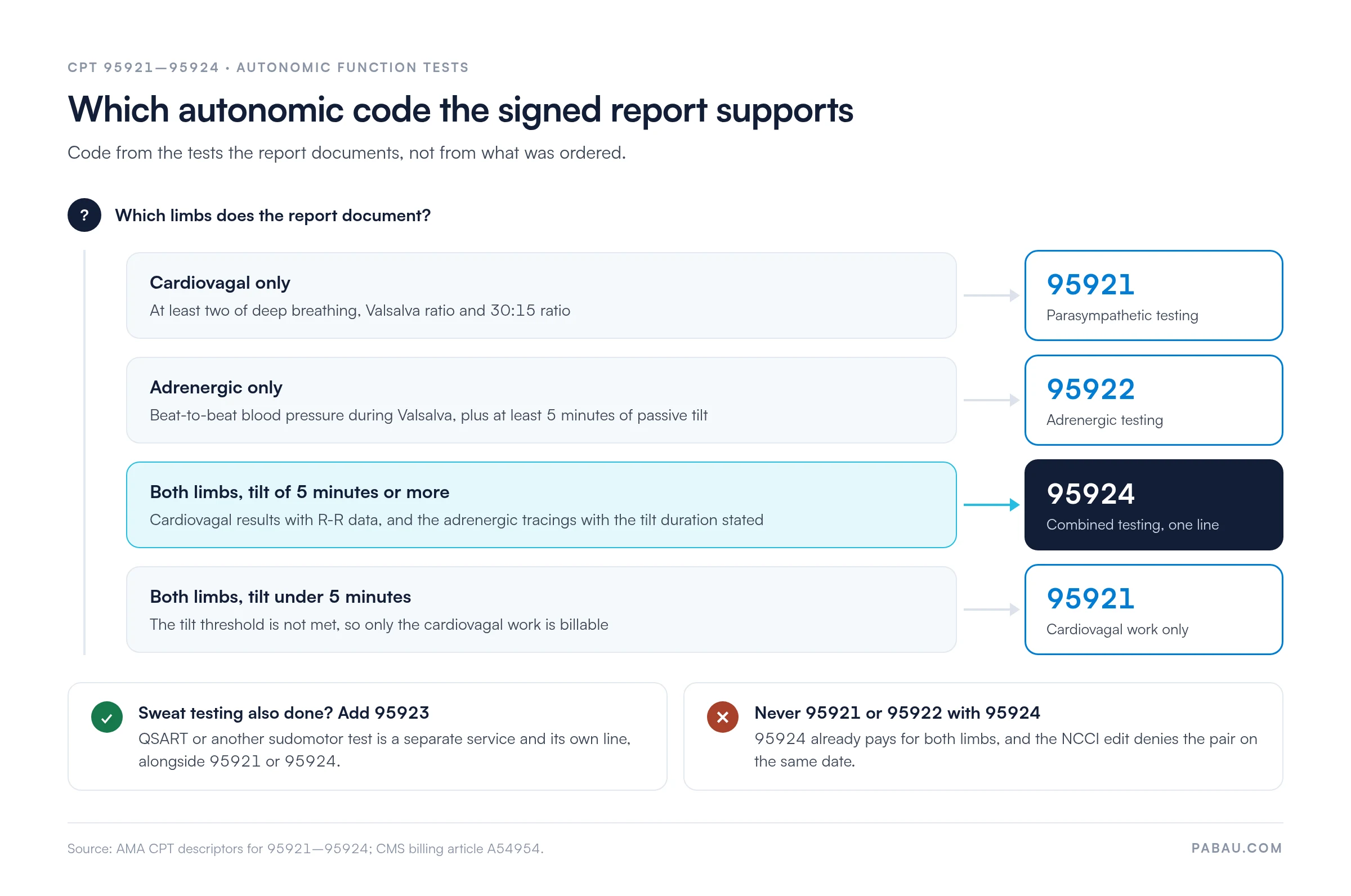
The highest-risk confusion pair is 95922 vs 95924, because both descriptors require at least 5 minutes of passive tilt. A report that shows a tilt and blood pressure tracings can look like either code at a glance.
The difference is the cardiovagal work. 95924 needs the parasympathetic maneuvers as well, so the report must show the deep breathing response and the Valsalva heart rate data. If those results are missing, the study is 95922, and billing 95924 is upcoding.
The opposite mistake costs money. A lab that runs both limbs but bills 95921 and 95922 separately hits the NCCI edit, and the pair is denied. When both limbs are documented, 95924 is the only correct code.
Before billing CPT Code 95924, check the report for both limbs. Look for cardiovagal results with R-R interval data, then beat-to-beat blood pressure tracings from Valsalva and a tilt of at least 5 minutes. If the cardiovagal results are missing, bill 95922 instead. If sweat testing was done, add 95923 as a separate line.
Medicare and most commercial payers require documented medical necessity before they pay for CPT Code 95924. The indications recognized under LCD L35124 and similar MAC policies center on conditions where autonomic dysfunction is a known complication or the main diagnostic question.
Commercial payer criteria are often more restrictive than Medicare LCD criteria. Don’t assume a Medicare-covered indication is covered by a commercial plan. Check each payer’s policy before you schedule the study.
The CMS ICD-10 code set supplies the diagnosis codes that payers check against the indications in their LCDs. Pairing 95924 with a diagnosis that isn’t on the covered list leads to a denial, however strong the clinical record is.
For unexplained syncope, R55 is the usual pairing once the cardiac and neurological workup has come back negative. ICD-10-CM codes update each October.
Verify the codes above against the current-year code set before submission, because an expired code fails the claim regardless of the clinical case. A CPT-to-ICD crosswalk tool helps confirm payer-accepted pairings for 95924 in your MAC jurisdiction.
Medicare coverage for CPT Code 95924 comes from Local Coverage Determinations issued by each Medicare Administrative Contractor (MAC). LCD L35124 and LCD L36236 are both in effect. L35124’s billing article is A57551, and L36236’s is A57024. Other MACs publish parallel policies with their own articles, such as A54954 and A57651.
Because LCDs are jurisdiction-specific, confirm which policy your MAC applies in the CMS Medicare Coverage Database. The billing articles carry the coding rules this guide relies on, including the instruction not to report 95924 with 95921 or 95922.
Each MAC receives claims for its own jurisdiction, so a claim sent to the wrong contractor is rejected before anyone reads the report. A medical claims clearinghouse routes each 837P transaction to the right MAC automatically.
Traditional Medicare does not require prior authorization for CPT Code 95924 when the claim meets LCD criteria. Medicare Advantage plans work differently. Many require prior authorization, and their criteria can be stricter than the LCD.
Commercial payer rules vary by payer and plan year. Check the current requirement before scheduling, through the payer portal or provider services. Thorough insurance eligibility verification at booking shows whether authorization is needed and what the payer wants to see.
A prior authorization request usually needs four things. Include the referring diagnosis with its ICD-10 code and clinical notes on symptoms and prior workup. Add the ordering physician’s statement of medical necessity and the planned tests. Many payers also want proof that simpler steps, such as a cardiac evaluation, came first.
A claim for CPT Code 95924 is only as strong as the record behind it. The chart must show that both the cardiovagal and adrenergic limbs were tested, the results were recorded, and a qualified physician interpreted them.
If sudomotor testing ran in the same session, document it in its own section of the report so the separate 95923 line is supported. Confirm what makes a clean claim for autonomic testing before your first submission.
Modifiers tell the payer who did what. These are the ones that come up with 95924.
When one provider performs and interprets the study in the office, bill the global code with no modifier. Place-of-service code 11 covers most office-based testing, while POS 22 applies to an on-campus hospital outpatient lab.
For 2026, 95924 carries 4.63 total RVUs, which works out to about $154.65 nationally. Your locality’s geographic practice cost indices (GPCIs) then move the final payment up or down.
The payment uses the 2026 conversion factor of $33.4009. Because the facility and non-facility totals match, the setting does not change the national rate. Values reset each January 1, so confirm them in the CMS Physician Fee Schedule lookup before quoting expected payment.
Denials for CPT Code 95924 cluster around five patterns, and each has its own fix. Review the medical billing denial codes to read the CARC on the remittance before you write an appeal.
Keep a denial log with the CARC, denial date, and fix for each 95924 claim. When the same CARC repeats across dates of service, the fix belongs upstream in the workflow.
CPT Code 95924 is not reported with 95921 or 95922 on the same date. CMS billing article A54954 states it plainly, in line with CPT direction, and NCCI edits enforce it. 95924 already pays for the cardiovagal and adrenergic limbs those two codes describe.
95923 is different. Sudomotor testing is a separate service, and nothing in the CMS guidance stops it from being billed with 95924. Aetna’s policy CPB 0485 says the same: code 95924 does not include sudomotor testing.
Billers often ask whether modifier 59 or XU can unbundle the 95921 or 95922 edit. In a routine autonomic study, it cannot. The modifier needs a distinct session, site, or condition, and testing both limbs together is none of those.
Run a monthly charge audit on 95924 claims. Search for any date of service where 95924 appears with 95921 or 95922 for the same patient, and fix each match before submission. Don’t flag 95923 on the same claim: it is billed separately and is not part of the edit.
Autonomic testing claims fail on details: a component code typed next to 95924, a diagnosis off the covered list, or a missing authorization number. When those checks happen by hand after the study, each miss means a resubmission and another wait.
Pabau, the practice management platform we build, moves those checks earlier. Its claims software for coders pre-fills the CPT code and ICD-10 diagnoses from the patient record. Built-in CPT and ICD-10 libraries help coders pick 95924, or 95923 alongside it, at the point of service.
For US practices, Pabau submits claims through the Claim.MD clearinghouse. Eligibility checks run before the visit, and remittances post back to the patient record. Your team spends less time re-keying and more time on the few claims that need a person.

Pabau’s claims management tools support CPT code libraries, 837P submission via Claim.MD, and denial tracking. Your neurology practice spends less time chasing rejections and more time on patient care.

CPT Code 95924 is a two-limb code, and most errors come from treating it as more or less than that. It pays for cardiovagal and adrenergic testing together, with at least 5 minutes of tilt. It does not pay for sweat testing, which stays on its own 95923 line.
So code from the signed report, not the order. Check that both limbs are documented, drop any 95921 or 95922 line, and keep 95923 where sudomotor testing ran. Book a demo to see how Pabau pre-fills and checks autonomic testing claims before they reach the payer.

Routing claims to the right MAC? Medical claims clearinghouse guide explains how clearinghouse routing reduces MAC-specific submission errors for specialty practices.
Building a denial management process? Revenue cycle management overview covers the end-to-end workflow from eligibility check through final payment posting.
CPT Code 95924 covers combined parasympathetic and sympathetic adrenergic testing with at least 5 minutes of passive tilt. That means cardiovagal maneuvers, such as deep breathing and the Valsalva ratio, plus beat-to-beat blood pressure during Valsalva and tilt. It does not include sudomotor testing, which is billed with 95923.
CPT 95921 covers cardiovagal (parasympathetic) testing only. CPT 95924 adds adrenergic testing with at least 5 minutes of passive tilt, so it replaces 95921 and 95922 when both limbs are tested. Use 95921 when only the cardiovagal maneuvers were performed.
Yes, Medicare covers CPT Code 95924 when medical necessity criteria are met under your MAC’s policy, such as LCD L35124 or L36236. The claim needs a covered diagnosis, documentation of both limbs, and a signed physician interpretation. Check your MAC’s LCD in the CMS Medicare Coverage Database before submitting.
Not with 95921 or 95922. CMS billing article A54954 says 95924 should not be reported with either, because it already includes both limbs. 95923 is different: sudomotor testing is a separate service and may be billed on the same date as 95924.
Common pairings include E11.43 and E10.43 (diabetic autonomic neuropathy), G90.09 (idiopathic peripheral autonomic neuropathy), G90.3 (multiple system atrophy), G90.A (POTS), and R55 (syncope). Verify the current-year covered code list for your MAC before submitting.
Traditional Medicare does not require prior authorization for 95924 when LCD criteria are met. Many Medicare Advantage plans and commercial payers do, with requirements that vary by plan year. Check through the payer’s provider portal when you schedule the study.