HCPCS code G0257: Unscheduled or emergency dialysis billing guide
HCPCS code G0257: Official descriptor and code overview HCPCS code G0257 is defi...

Last Updated: Oct 27, 2026
93660 is the CPT code for tilt table evaluation of cardiovascular function. Its descriptor reads "Evaluation of cardiovascular function with tilt table evaluation, with continuous ECG monitoring and intermittent blood pressure monitoring, with or without pharmacological intervention."
It covers the passive tilt phase, any drug-provoked phase, and the physician's written interpretation as one service. Medicare pays $168.34 nationally in 2026 for the global service in an office, with a zero-day global period. In a hospital, the physician bills only the professional component with modifier 26.
Let Pabau's smart automation suggest the right codes, reduce claim denials, and keep your practice compliant—effortlessly.
Automate repetitive tasks and focus on what matters most—your patients.
Reduce coding errors and ensure compliance with the latest regulations.
Clean claims, fewer denials, and faster reimbursements.
Powerful insights and reporting to help your practice thrive.
HIPAA compliant SOC 2 certified GDPR-compliant Trusted by 4,000+ clinics worldwide

CPT Code 93660 describes tilt table evaluation of cardiovascular function, distinct from cardiovagal autonomic testing under CPT 95921.
Medicare’s 2026 national non-facility payment for 93660 is $168.34 (5.04 total RVUs), and in a hospital the physician bills modifier 26 for $89.85.
Modifier 26 covers the physician’s interpretation in a hospital-based setting, and modifier TC covers the technical component when it is billed separately.
Pabau, the practice management platform we build, checks each claim for required details such as authorization codes before it is submitted.
CPT Code 93660 is the code for tilt table evaluation of cardiovascular function. Its descriptor reads “Evaluation of cardiovascular function with tilt table evaluation, with continuous ECG monitoring and intermittent blood pressure monitoring, with or without pharmacological intervention.”
The American Medical Association places this code in the cardiovascular procedures range (92920-93799). It does not sit in the autonomic nervous system testing range (95920-95943), and payers hold claims to that distinction.
The procedure itself has two phases. The passive phase tilts the patient to 60-80 degrees for 20-45 minutes while heart rate, blood pressure, and symptoms are monitored continuously. If the passive phase is non-diagnostic, the physician may administer isoproterenol (or sublingual nitroglycerin) to provoke a vasovagal response. Both phases fall within a single 93660 code, as does the interpreting physician’s written summary.
Because CPT Code 93660 includes monitoring and interpretation, a same-day E/M visit needs documented medical decision-making that is distinct from the test itself. That visit is billed with modifier 25, the standard bundling rule in medical billing workflows for diagnostic procedures.
CPT Code 93660 is medically necessary when a patient presents with unexplained syncope, presyncope, or orthostatic intolerance that a less invasive workup has not explained. CMS LCD L36236 governs Medicare coverage determinations for autonomic function testing, and most commercial payers mirror its criteria for 93660.
Cardiology and neurology practices, as well as autonomic and functional medicine practices, commonly bill 93660 for the following supported indications:
Payers will deny 93660 when it is ordered solely for dizziness without a documented syncopal event, for anxiety-related lightheadedness, or without the prerequisite non-diagnostic workup. The record must show that a less invasive evaluation was attempted and did not explain the symptoms. When that workup escalates to a comprehensive electrophysiologic study with induction of arrhythmia, the practice bills 93620 rather than 93660.
Medicare reimbursement for CPT Code 93660 depends on where the procedure is performed. The non-facility rate (physician office) includes practice expense RVUs for staff, equipment, and supplies.
In a hospital, the global code is not payable under the fee schedule. The physician bills the professional component, and the hospital is paid for its technical share separately.
These are national amounts from the CMS relative value file, October 2026 release, at the non-QP conversion factor of $33.4009. Your MAC locality adjusts them, so check the final figure in the CMS Physician Fee Schedule Look-Up Tool. Commercial contracts are negotiated separately.
The split below shows how the $168.34 global fee divides, and which share the physician keeps when the test moves into a hospital.
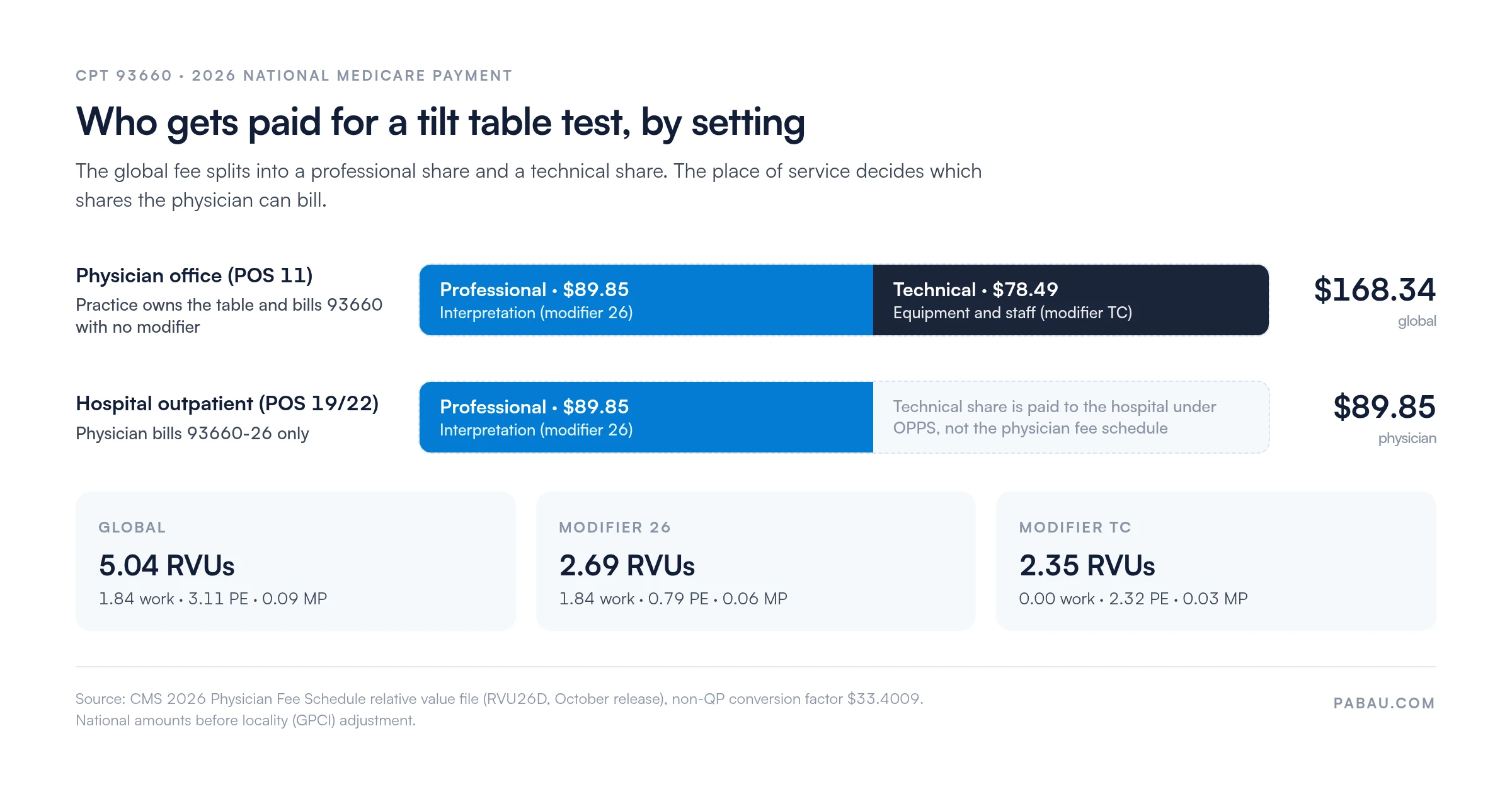
CPT Code 93660 has a PC/TC indicator of 1, meaning the professional and technical components can be split and billed separately. Four modifiers apply most often to 93660 claims.
When a hospital-employed cardiologist interprets the tilt table results, the physician bills 93660-26 and the hospital bills its technical share on a UB-04 institutional claim. When the same cardiologist owns the equipment in a private office, no modifier is needed and the full non-facility rate applies. Adding modifier 26 in that office setting is a common error that cuts the payment to $89.85.
Check the PC/TC indicator for CPT 93660 in each quarterly CMS relative value file before you set up billing templates. A wrong modifier costs the practice the difference between the global rate and the split component rate.
An unsupported ICD-10 pairing is the most common reason CPT Code 93660 claims are denied. Payers cross-reference the billed diagnosis code against their covered-indication list, which typically mirrors CMS LCD L36236. The following codes are broadly accepted across Medicare and major commercial plans.
R55 carries most 93660 claims, because a documented syncopal episode is the core indication. For POTS, code G90.A rather than the G90.8 catch-all for other autonomic disorders.
R10, R42 (dizziness), and anxiety-related codes (F41.x) are not accepted indications for CPT Code 93660. A claim billed with these codes will be denied for medical necessity regardless of the documented clinical rationale. Always code the underlying confirmed or suspected diagnosis, not the patient’s chief complaint.
CPT 93660 and CPT 95921 both involve autonomic nervous system assessment, but they describe different tests with different clinical questions. Billing the wrong code is a frequent error in practices that perform both. The CMS billing article A57024 sets out how the autonomic codes 95921-95924 divide.
Bill CPT 93660 when the clinical question is whether the patient will faint in response to orthostatic stress. Bill CPT 95921 when the question is whether the parasympathetic nervous system is functionally intact, typically in a diabetic neuropathy or Parkinson’s disease workup.
Some autonomic centers order both tests in sequence on the same visit, and both codes may then be billed with the correct modifier.
Most major commercial payers and some Medicare Advantage plans require prior authorization for CPT Code 93660. Confirming PA status before scheduling is the single highest-impact step a billing team can take to prevent denials.
Proactive insurance eligibility verification at scheduling, not at billing, catches PA requirements before the procedure occurs.
A PA request for CPT Code 93660 must include four items. Incomplete submissions are a leading cause of retroactive denials.
Post-payment audits of CPT Code 93660 claims check the procedure note against a set list of elements. A note that omits even one of them can trigger a recoupment request.
Good medical billing compliance on tilt table claims means the procedure note captures each of the following elements:
CPT 93660 denials come from a narrow set of preventable causes, and most trace back to steps taken before the claim is submitted.
Tracking 93660 denial patterns by payer is the core of denial management for diagnostic codes. Reviewing remittance denial codes systematically recovers revenue faster than case-by-case appeals.
The place of service code submitted with CPT Code 93660 decides whether the physician bills the global code or only the professional component. At the 2026 national rate, that is a difference of $78.49 per claim.
A cardiologist moving from a hospital-based practice (POS 22) to an independent office (POS 11) gains the technical share on every 93660 claim. That gain is offset by the capital cost of a tilt table. The break-even point depends on procedure volume, but it typically favors the office setting at more than 3-4 procedures per week.
Always verify POS accuracy before submission. A POS 11 claim for a procedure performed at POS 22 is a false statement and a compliance risk.
Audit the POS codes on your 93660 remittances quarterly. Practices that credentialed at a hospital location first and later opened an office can submit the wrong POS for years before anyone notices. At $78.49 per claim, a year of errors adds up quickly.
CPT Code 93660 carries a CMS global period of 000, a zero-day global. The payment covers the test and related work on the day it is performed, with no follow-up days attached.
Same-day E/M billing is not unrestricted. A same-day visit is paid only when it is significant and separately identifiable from the test, documented as such, and billed with modifier 25.
The zero-day global does not stop repeat testing on later dates. Three other restrictions do:
When repeat testing is indicated, the PA request and procedure note must state what has changed clinically since the first test. “Follow-up tilt table test” as the sole justification is insufficient.
Many 93660 denials start before the claim leaves the practice. The prior authorization was never obtained, eligibility was not rechecked, or the procedure note skipped the tilt angle.
Pabau keeps those steps in one system. Its claims management software runs validation checks every time you send a claim, so required details such as authorization codes are in place. In the US, Pabau connects to Claim.MD for electronic submission to thousands of payers, real-time eligibility checks, and ERA posting.
Treatment note templates can prompt for each element in the documentation checklist above, from inclination angle to provocation dose. The interpreting physician signs a complete note before the claim is raised, rather than writing an addendum after a denial.

Pabau checks each claim for required details like authorization codes before it goes out, and connects to Claim.MD for eligibility checks and electronic submission. See how it fits cardiology and autonomic testing workflows.

Tilt table claims pay or fail on decisions made before the test starts. Confirm prior authorization, code the confirmed diagnosis rather than the complaint, and match the modifier to whoever owns the table.
The setting decision deserves the most thought. An office-based practice collects the full $168.34 national rate but carries the equipment cost. A hospital-based cardiologist bills $89.85 for the interpretation and leaves the technical side with the facility.
If your team bills 93660 regularly, build those checks into the workflow rather than into the appeal. Book a demo to see how Pabau keeps authorization, documentation, and claim status for every tilt table test in one place.

Need to understand how claims reach payers? Medical claims clearinghouse explains how 837P files are routed and validated before reaching Medicare and commercial payers.
Working through a high denial rate on diagnostic codes? Revenue cycle management overview covers the end-to-end billing process from eligibility check through payment posting.
Building a superbill for a diagnostic test? Superbill documentation guide explains what a superbill contains and how practices use it to support claims.
CPT Code 93660 covers tilt table evaluation of cardiovascular function. Its descriptor reads “Evaluation of cardiovascular function with tilt table evaluation, with continuous ECG monitoring and intermittent blood pressure monitoring, with or without pharmacological intervention.” That includes the passive orthostatic phase, any isoproterenol or nitroglycerin provocation, and the interpreting physician’s written findings. A same-day E/M visit is not included unless it is separately documented, medically distinct, and billed with modifier 25.
The 2026 national non-facility Medicare payment for CPT 93660 is $168.34, based on 5.04 total RVUs. In a hospital, the physician bills 93660-26 for $89.85. The technical component pays $78.49 when billed separately with modifier TC outside a facility. Exact amounts vary by MAC locality, so check the CMS Physician Fee Schedule Look-Up Tool.
Modifier 26 applies when the physician interprets in a hospital-based setting and the facility bills the technical component separately. Modifier TC applies to a separately billed technical component. Modifier 59 overrides NCCI bundling when 93660 is performed alongside a separately distinct service. Modifier 52 applies when the test is terminated early or reduced in scope.
CPT 93660 covers tilt table testing focused on cardiovascular and vasovagal syncope evaluation. CPT 95921 covers cardiovagal innervation testing using deep breathing, Valsalva maneuver, and heart rate response to standing. The two codes can be billed on the same day if both tests serve distinctly documented clinical purposes. Modifier 59 on 95921 may be required to avoid NCCI bundling issues.
Yes. Medicare covers CPT 93660 for POTS when the claim carries ICD-10 G90.A (postural orthostatic tachycardia syndrome), the specific POTS code since October 1, 2022. The record must show a sustained heart rate increase of 30+ bpm on standing and name POTS as the suspected or confirmed diagnosis. Coverage is subject to LCD L36236 criteria, so verify with your MAC.
CPT Code 93660 has a CMS global period of 000, a zero-day global. Related work on the day of the test is bundled into the payment. A same-day E/M visit is payable only when it is significant, separately identifiable, and billed with modifier 25. Repeat testing on later dates is governed by payer frequency policies and medical necessity documentation.